

An accelerated death benefit lets you collect part or all of your life insurance payout while you are still alive, if you are diagnosed with a qualifying illness. The insurer deducts what it pays you from the death benefit your beneficiary eventually receives. Most often the trigger is a terminal illness. Some policies also cover chronic or critical illness. Below you’ll find who qualifies, how much you can expect, what happens to taxes and public benefits, and how to file a claim.
TL;DR
- An accelerated death benefit (ADB), also called a living benefit or terminal illness rider, pays you part of your death benefit early when you meet the policy’s illness definition.
- Payouts commonly range from 25% to 95% of the death benefit, and the exact figure depends on the insurer, the policy and your state.
- Whatever you take reduces what your beneficiaries receive, and fees or interest may apply.
- The payment is generally tax-free for terminal or chronic illness, but it can affect Medicaid and Supplemental Security Income, so talk to a tax advisor first.
- Check your policy for this feature before you need it. We can help you review it.
Table of Contents
- What an accelerated death benefit is
- Who qualifies
- How much you can receive
- What happens to the rest of your policy
- Taxes and public benefits
- Accelerated death benefit rider vs. other living benefits
- How to claim
- Our perspective
- Make sure your coverage works while you are living
- FAQ
- Sources
What an accelerated death benefit is
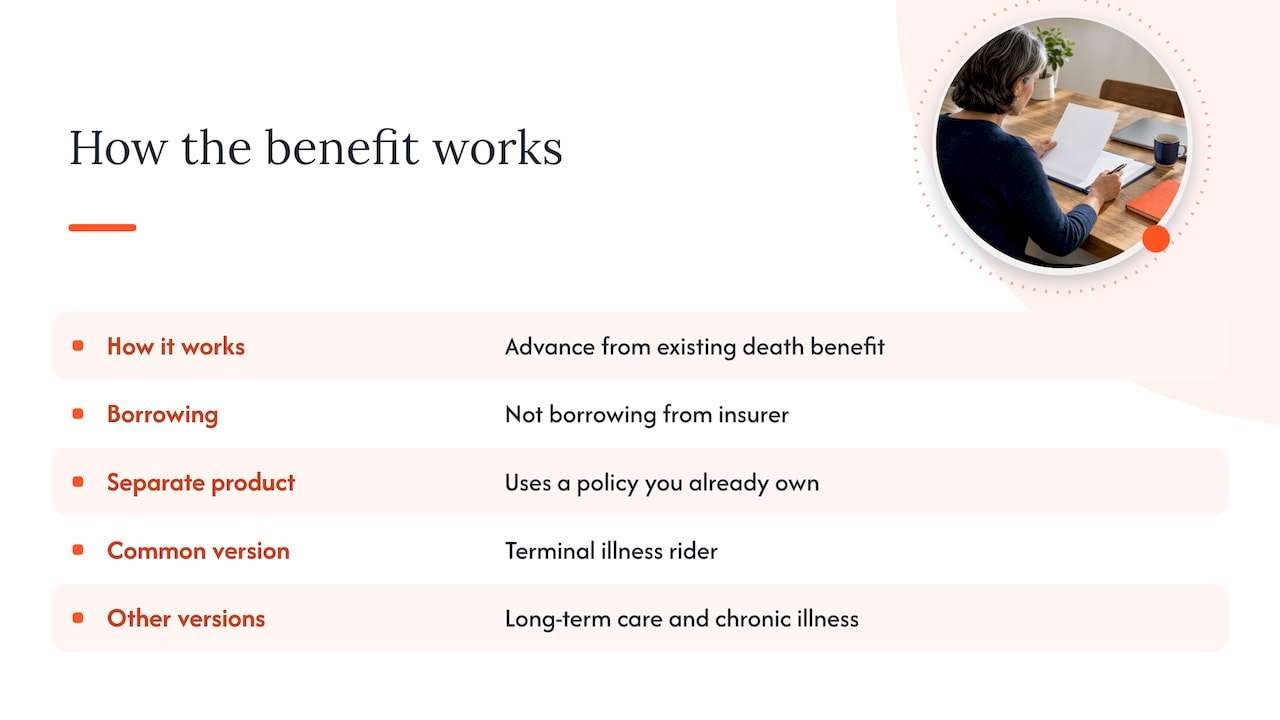
Think of it as an advance on your own life insurance. You are not borrowing from the insurer and you are not buying a separate product. You are asking for money from the death benefit you already own, earlier than usual.
The feature goes by several names: accelerated death benefit rider, accelerated benefit option, terminal illness rider, living benefits. They overlap, but they are not identical. A terminal illness rider is the most common version. The Wall Street Journal quotes an industry researcher at Limra saying most companies offer this rider for terminal illness. Long-term care and chronic illness versions exist too, but they usually don’t treat terminal illness as a qualifying condition.
If you searched for “life insurance living benefits,” this is what the term refers to: ways to use your policy’s value while you are alive, rather than only after you die.
Who qualifies
Qualification depends on your policy’s wording, but federal tax law and state insurance rules set the outer boundaries.
For tax purposes, the IRS defines the terms this way in its Form 1099-LTC instructions:
- Terminally ill: an illness or condition reasonably expected to result in death within 24 months.
- Chronically ill: certified at least annually as unable to perform at least two daily living activities for at least 90 days, or needing substantial supervision because of severe cognitive impairment.
Your policy may be stricter than the tax definition. One insurer’s rider documentation describes a life expectancy of six months or less, another uses 12 months or less. The 24-month figure is the federal tax ceiling, not what every contract uses, so read your own certificate.
Qualifying events regulators recognize
The NAIC’s Accelerated Benefits Model Regulation lists the kinds of events states have used as a template:
- A medical condition that drastically limits life span, for example 24 months or less.
- A condition requiring extraordinary medical intervention, such as a major organ transplant or continuous artificial life support.
- A condition requiring continuous confinement in an eligible institution for the rest of your life.
- A condition that would drastically limit life span without extensive treatment, including coronary artery disease, stroke, end stage renal failure or AIDS.
State regulators confirm the breadth of availability. The Alabama Department of Insurance notes that all 50 states and the District of Columbia have approved some form of accelerated benefits. The Texas Department of Insurance says you need a terminal illness, specified disease or long-term care illness to qualify. New York’s regulator says the same idea applies when the insured is terminally or chronically ill.
How much you can receive
There is no single answer, but there are useful ranges.
| Source | Typical range or example |
|---|---|
| Alabama Department of Insurance | 25% to 100% of the death benefit, varying by policy |
| NerdWallet | 25% to 95%, set by insurer, face amount and state |
| Wall Street Journal | 50% to 100% for terminal illness riders, sometimes capped at a dollar amount such as $250,000, $500,000 or $1 million |
A few contract details explain why the numbers differ:
- Dollar caps. One rider documentation filed with the SEC defines its pool as the lesser of 75% of the death benefit and $1,000,000, less amounts already accelerated under a terminal illness rider.
- Minimums. One insurer’s rider sets a floor of $10,000 and a ceiling of $250,000 or 50% of the specified amount.
- Discounting. When the rider carries no added premium, the insurer reduces the early payment to account for interest lost. In one published fact sheet, the net benefit is generally 90% to 95% of the death benefit.
- Fees. Administrative charges typically run $100 to $300, and an interest charge may apply based on life expectancy and interest rates.
- Outstanding loans. The Illinois Department of Insurance explains that the payment is a percentage of face value minus any outstanding policy loans.
A simple worked example
Suppose you own a $300,000 policy whose terminal illness rider allows up to 75% and charges a $250 processing fee. You could request up to $225,000. If you take all of it, your beneficiaries would be left with about $75,000 at most, adjusted for any discount or interest the contract applies. The numbers are illustrative only, so your own policy will state its own percentages and charges.

Lump sum or installments
The NAIC model regulation requires that a lump sum be among the payment options, that the benefit not be offered as a life-contingent annuity, and that no restrictions be placed on how you use the money. Some policies let you choose monthly installments instead. Choosing installments matters for taxes, covered below.
What happens to the rest of your policy
Taking an advance changes the policy, and the changes are worth understanding before you file.
- Beneficiary payout shrinks. The amount paid is deducted from the death benefit. If you use up the whole death benefit, nothing is left for the beneficiary.
- Other values drop too. Rider terms filed with the SEC state that the specified amount, cash value, indebtedness, required premium and other policy charges are reduced when a benefit is paid.
- You get a statement. Under the model regulation, the insurer must send you and any irrevocable beneficiary a statement showing how the payment affects the policy, then issue an amended schedule page with the new face amount. A Nationwide executive quoted by the Journal says states require a claim disclosure form showing every policy value before and after the claim.
Because of this, many people take only the portion they need, such as the cost of care or housing changes, and leave the rest in place for family.
Taxes and public benefits
Federal income tax
In most cases the payment is not taxed. The IRS treats amounts paid under a life insurance contract for a terminally or chronically ill insured as accelerated death benefits. One insurer’s fact sheet says such benefits are generally excludable from federal income tax as long as the insured meets the tax definition of terminally or chronically ill.
There are exceptions. Installment payouts might accrue interest, which can be taxed as income. Rider language filed with the SEC also notes circumstances where the payment may be included in gross income. State rules require your insurer to give you a disclosure that benefits may be taxable and that you should seek help from a personal tax advisor. Take that seriously: speak with a tax professional before you claim.
Medicaid and SSI
This is the part people miss. The payment can count as income or a resource. Regulators and consumer sources agree that it may affect Medicaid eligibility, and Supplemental Security Income as well. The Alabama regulator adds that federal officials have said policyholders cannot be forced to claim accelerated benefits before qualifying for Medicaid. If you or a spouse rely on, or may soon need, Medicaid-funded care, ask a benefits counselor or elder law attorney how a lump sum would be treated in your state before you request it.
Accelerated death benefit rider vs. other living benefits
Not every living benefit works the same way, and the differences affect cost.
- Terminal illness rider. Often included automatically. The Journal reports that these riders might be in your policy at no extra cost until you use them, or you might add them for a fee.
- Chronic illness or long-term care rider. Tends to be optional, added at purchase for an extra premium. Qualification centers on activities of daily living or cognitive impairment.
- Critical illness triggers. Some insurers extend access to conditions such as heart attack, stroke, cancer or organ failure.
If long-term care is your main worry, our guide on Medicare and long-term care planning shows where Medicare stops and where other coverage steps in. For a cancer diagnosis specifically, see cancer insurance versus critical illness insurance, since those policies pay cash directly and do not touch your death benefit.
How to claim
- Read your policy and riders. Look for the words accelerated benefit, terminal illness, chronic illness or living benefits. Note the percentage, caps, fees and qualifying definitions.
- Call the insurer and request claim forms. The insurer should provide the disclosure statement required in your state.
- Gather medical proof. Expect to provide diagnosis and prognosis reports from a licensed physician.
- Review the before-and-after values. Check what remains for your beneficiaries and how any cash value changes.
- Decide the amount and payment method. Where the policy permits, choose between a lump sum and installments. Lump sums are usually how approved benefits are paid.
- Check taxes and benefits. Confirm with a tax advisor and, if relevant, a Medicaid or SSI caseworker.
Our perspective
Most people find out what their life insurance can do at the worst possible moment. They are in a hospital waiting room, reading a policy for the first time.
We think the better time to ask is now. When we sit down with a client, we look at the whole picture: the life policy, Medicare coverage, and any supplemental plans such as hospital indemnity or cancer coverage. Each one answers a different question. Medicare pays for covered care. Supplemental plans can pay cash for specific events. A living benefit rider turns part of your life insurance into money you can use.
Our agents are trained to explain these choices plainly and without pressure, at no extra cost to you. If your rider limits are low, or your policy has none, that is worth knowing years in advance, while you still have options for choosing coverage that fits your family.
Zach
Make sure your coverage works while you are living
Safeguard Benefit Services is a Charlotte, North Carolina agency that helps seniors and people nearing 65 sort out Medicare and the coverage around it, including life insurance, cancer insurance and hospital indemnity plans. We offer personalized consultations and a free Medicare roadmap, and we support annual plan reviews.

If you want a second set of eyes on how your life insurance, Medicare and supplemental coverage fit together, talk with our team. If you are looking at life insurance without a medical exam, read how guaranteed issue life insurance works first. Living benefits and payout terms differ by policy, so confirm them before you buy. For a cash benefit tied to hospital stays, see our hospital indemnity insurance page.
FAQ
Is an accelerated death benefit taxable?
Usually not, when the insured meets the IRS definition of terminally or chronically ill. The IRS defines those terms and insurers generally structure payments to qualify for tax-free treatment. Installment interest and some other situations can create taxable income, so confirm with a tax advisor.
Does it cost extra to have the rider?
It depends on the policy. The Journal reports that the most common accelerated benefit riders usually carry no extra premium, but you pay when you use them through a reduced death benefit, possible processing fees and interest. Chronic illness riders are more often optional and carry a premium.
Can I get 100% of my death benefit?
Sometimes, but it is not typical. Ranges quoted by regulators and consumer sources run from 25% to 100%, and many contracts cap payouts at a dollar amount or a percentage. Your policy documents give the exact limit.
Will it affect my Medicaid eligibility?
It can. Once you receive the money, it may be treated as income and affect Medicaid or SSI eligibility. Talk to a benefits counselor or elder law attorney in your state before claiming.
Sources
- ALDOI: Questions and Answers on Accelerated Benefits
- IRS: Instructions for Form 1099-LTC
- Texas Department of Insurance: Life insurance guide
- New York DFS: Life Insurance Information for Consumers
- NAIC: Accelerated Benefits Model Regulation
- Illinois Department of Insurance: Viatical Settlements, Accelerated Death Benefits
- Wall Street Journal: What Are Living Benefits?
- NerdWallet: How Does an Accelerated Death Benefit Work?
- SEC filing: Accelerated DB for Chronic Illness Rider
- SEC filing: Accelerated Death Benefit for Terminal Illness
- Insurer rider fact sheet: BenefitAccess Rider
- Insurer rider features: Survivorship Plus Select IUL
- Insurer guide: Accelerated Death Benefit Rider
- Insurer guide: What Is an Accelerated Death Benefit Rider?
Recommended
Request a No Obligation Phone Call








Get Connected