

Medicare covers ambulance transportation when it’s medically necessary, meaning any other way of getting you to care would put your health at risk. Under Original Medicare’s ambulance benefit, Part B typically pays 80% of the Medicare-approved amount once you’ve met your Part B deductible, leaving you responsible for the remaining 20%. Coverage is limited to transport to the nearest appropriate facility, and air ambulance rides face tighter rules than ground transport.
TL;DR:
- Medicare covers ambulance transport only when your condition makes other transportation methods unsafe, and air ambulance rides require tighter documentation and justification.
- You are responsible for 20% of the Medicare-approved amount, in addition to your Part B deductible, which can result in high out-of-pocket costs for a single ride.
- Proper documentation, including physician orders and contemporaneous records showing your condition at pickup, is crucial to avoid claim denials or payment disputes.
- Repetitive non-emergency trips demand prior authorization, and missing or expired certifications are common reasons claims get denied.
- Check coverage details beforehand by contacting Medicare and your provider, and keep thorough records to support your claim or appeal any denials.
Table of Contents
- Ambulance Medicare Coverage: What Part B Actually Pays For
- What You’ll Actually Pay for an Ambulance Ride
- Emergency Versus Scheduled Rides: Why the Distinction Changes Everything
- Records to Keep and How to Appeal a Denied Claim
- How to Check Your Coverage Before You Need an Ambulance
- What Fifteen Years of Medicare Questions Taught Me About Ambulance Claims
- Let Safeguard Benefit Services Untangle Your Ambulance Coverage Questions
- Where to Verify These Ambulance Coverage Rules Yourself
- Sources
- FAQ
Ambulance Medicare Coverage: What Part B Actually Pays For
Medicare Part B pays for ground ambulance transport when your condition requires it and using a car, taxi, or wheelchair van would endanger your health. That’s the whole test. It doesn’t matter whether you own a car or have someone available to drive you. What matters is whether your medical condition, at the moment of pickup, made an ambulance necessary.
Covered destinations include hospitals, critical access hospitals (CAHs), rural emergency hospitals, and skilled nursing facilities. The trip has to go to the nearest facility capable of treating your condition. If you ask to be taken somewhere farther away, perhaps a hospital where your regular doctor practices, Medicare will only pay what it would have cost to reach the nearest appropriate facility. You cover the difference.
Air ambulance coverage kicks in when ground transport can’t reach you quickly enough or physically can’t get to you, such as a remote accident scene, and your condition requires immediate treatment unavailable through ground transport.
A few situations that trip people up:
- ESRD dialysis trips: These are treated as scheduled, repetitive transports and need separate documentation, not a one-time medical necessity note.
- Facility-to-facility transfers: Coverage depends on whether the receiving facility offers a level of care the sending facility can’t provide.
- Multiple-patient transports: The Medicare Benefit Policy Manual sets specific payment adjustments when more than one patient rides in the same vehicle.
- Treated but not transported: If paramedics evaluate you on scene and you’re not taken anywhere, there’s no transport claim for Medicare to cover.
What You’ll Actually Pay for an Ambulance Ride
Once your ambulance trip qualifies as medically necessary, you owe your Part B deductible (if you haven’t met it yet for the year) plus 20% of the Medicare-approved amount. Medicare covers the other 80%.
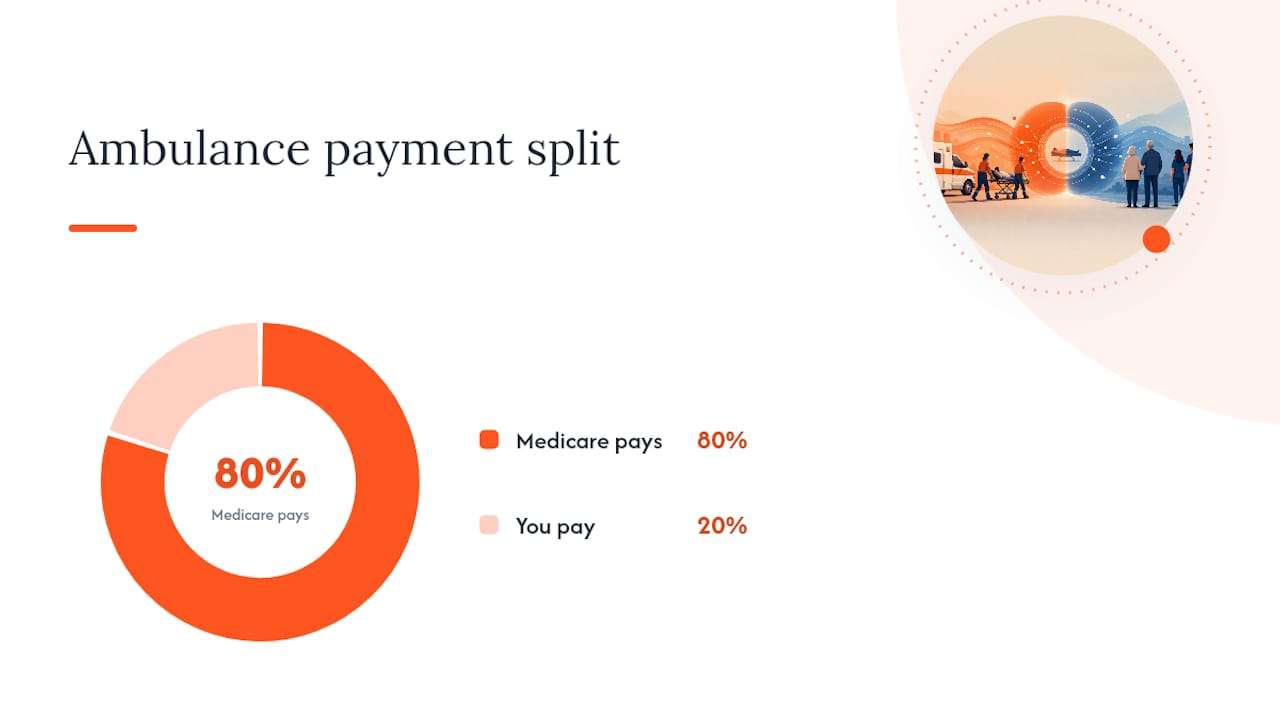
Statistic Callout: The 80/20 Split
Medicare pays 80% of the approved amount for a covered ambulance trip after the Part B deductible; you pay the remaining 20% as coinsurance, according to Medicare.gov. That coinsurance can add up fast. A single ground ambulance ride commonly runs into four figures before insurance, so even 20% of the approved amount can be a real out-of-pocket hit.
A few billing wrinkles matter here:
- Providers who accept Medicare assignment can’t bill you more than the Medicare-approved amount, aside from your deductible and coinsurance.
- Critical access hospitals sometimes have different payment arrangements that change how the ambulance claim gets processed.
- The No Surprises Act protects you from most balance bills for out-of-network air ambulance rides, but ground ambulance services generally fall outside that federal protection. Some states fill that gap with their own rules, so check your state’s balance billing law if a ground ambulance bill looks off.
Your Medicare Summary Notice will show exactly what Medicare approved, what it paid, and what you owe. That’s the document to check first whenever an ambulance bill doesn’t match what you expected.
Emergency Versus Scheduled Rides: Why the Distinction Changes Everything
Medicare treats emergency and non-emergency ambulance transport as two different animals, and the paperwork requirements reflect that.
- Emergency transport applies when you have a sudden medical crisis, you’re in serious danger, and no other transportation method could safely get you to care in time. No advance paperwork is needed. The ambulance crew’s documentation of your condition at pickup carries the weight.
- Non-emergency transport requires a physician’s written order confirming medical necessity, particularly for scheduled or repetitive trips like regular dialysis runs.
- Repetitive scheduled non-emergency ambulance transport (RSNAT) triggers a prior authorization requirement. Once you’ve had three round trips within 10 days, or need at least one round trip weekly for three weeks, Medicare requires prior authorization before it will pay for further trips.
- Air ambulance approval for non-emergency situations is rare and demands detailed documentation showing why ground transport wasn’t a safe or timely option.
Under 42 CFR 410.40, a physician certification statement (PCS) supporting repetitive non-emergency transport can’t be dated more than 60 days before the service. An expired or missing PCS is one of the most common, and most avoidable, reasons these claims get denied.
Pro Tip: Ambulance suppliers usually submit the RSNAT prior authorization request, but you or your physician can also request it directly. Getting that approval before the fourth trip protects you from a stack of denied claims later.
Records to Keep and How to Appeal a Denied Claim
Medical necessity has to be documented, not just asserted. Keep copies of physician orders, the PCS if one was issued, medical records from the day of transport, and the ambulance crew’s run sheet describing your condition.
If Medicare or the ambulance company doesn’t think a service will be covered, you may be asked to sign an Advance Beneficiary Notice of Noncoverage (ABN). Signing it means you agree to pay if Medicare denies the claim. Don’t sign one you don’t understand. Ask the provider to explain exactly why they expect a denial.
If a claim is denied, your MSN outlines the specific appeal steps and deadline. Generally you have 120 days from the date on the MSN to file. A few things help:
- Request medical records from the transport date before you appeal.
- Include a letter from your physician explaining why other transport wasn’t safe.
- File using the instructions on the MSN or CMS Form 20027 if directed.
Your State Health Insurance Assistance Program (SHIP) offers free, unbiased appeal help, and free consultation services can help you understand how a denial affects your specific plan.
How to Check Your Coverage Before You Need an Ambulance
You don’t have to wait for a bill to figure out where you stand. A little groundwork beforehand saves a lot of frustration later.
- Call 1-800-MEDICARE or review the official ambulance coverage page for the current rules and any policy updates.
- Ask any ambulance company you regularly use whether they bill Medicare directly and accept assignment. Not every provider does, and that changes what you’re on the hook for.
- If you’re scheduling non-emergency transport, ask your doctor for a physician certification statement well before the trip. Remember, it’s only valid within 60 days of service.
- For repetitive trips, ask whether the ambulance supplier has requested RSNAT prior authorization, and follow up if they haven’t after your third round trip.
- Talk to SHIP or Safeguard Benefit Services about how your specific plan, Medigap versus Medicare Advantage, handles ambulance cost-sharing differently.
What Fifteen Years of Medicare Questions Taught Me About Ambulance Claims
Most guidance on ambulance coverage treats it like a simple math problem: 80/20, deductible, done. It isn’t. The real fight almost always happens over documentation, not the coverage rule itself. A denial rarely means “Medicare doesn’t cover ambulances.” It usually means the paperwork didn’t prove what actually happened at pickup.
The most overlooked detail? A physician’s order helps, but it isn’t proof on its own. Contemporaneous documentation showing your condition at the moment of transport is what actually decides these claims. If you remember one thing from this article, make it that: document the moment, not just the diagnosis. Then check your MSN the second it arrives, not weeks later when the appeal window has shrunk.
— Zach
Let Safeguard Benefit Services Untangle Your Ambulance Coverage Questions
If you’ve been hit with an unexpected ambulance bill, or you’re trying to figure out how a Medicare Advantage plan versus a Medigap policy would treat future transport costs differently, that’s exactly the kind of question Safeguard Benefit Services answers every day for clients across the Charlotte area.

Unlike a call center reading from a script, Safeguard Benefit Services sits down with you, reviews your specific health needs, and explains in plain terms how Medicare Advantage plans or a Medigap policy would actually change your out-of-pocket exposure the next time you need transport. That matters most if you use ambulances frequently, you’ve already had a claim denied, or your Medicare Summary Notice left you more confused than informed. Reach out for a free consultation and Medicare roadmap, and get answers specific to your situation instead of generic rules that may not apply to your plan.
Where to Verify These Ambulance Coverage Rules Yourself
For the primary documents behind everything covered here, go straight to the source:
- Medicare
- Medicare Coverage of Ambulance Services, Publication 11021 (PDF)
- CMS Medicare Learning Network ambulance compliance guidance
- Medicare Benefit Policy Manual, BP102 chapter 10
For questions specific to your claim, call 1-800-MEDICARE or contact your local SHIP office.
Sources
FAQ
Does Medicare pay anything toward ambulance service?
Yes. Medicare Part B pays 80% of the Medicare-approved amount for medically necessary ambulance transport once you’ve met your Part B deductible, and you pay the remaining 20%.
Why would Medicare deny an ambulance claim?
The most common reasons are insufficient documentation of medical necessity, transport to a facility that wasn’t the nearest appropriate option, missing prior authorization for repetitive scheduled trips, or a scenario where you were treated on scene but not actually transported.
What counts as medical necessity for ambulance transport?
Medical necessity means your condition at the time of pickup made any other form of transportation dangerous to your health. Not owning a car or lacking a ride doesn’t meet that standard on its own.
What are some things Medicare doesn’t cover for ambulance rides?
Medicare generally won’t cover transport to a facility farther than the nearest appropriate one if that’s your personal preference, non-emergency trips without proper physician documentation, repetitive trips without approved prior authorization, and rides where no transport actually took place.
Does Medicare cover urgent care the same way it covers ambulance transport?
No. Medicare Part B covers urgent care visits similarly to other outpatient doctor visits, with a separate coinsurance structure, while ambulance coverage depends specifically on medical necessity for transport rather than the type of facility you’re visiting.
Recommended
Request a No Obligation Phone Call








Get Connected