

Enroll in Medicare when you first become eligible, or keep solid proof of qualifying employer or other creditable coverage. That single habit prevents nearly every late-enrollment penalty. If you already missed a deadline, the fix is the same every time: enroll at your next opportunity, gather your coverage paperwork, and file for reconsideration right away if you believe a penalty was charged in error.
TL;DR:
- Part B premiums rise 10% for each full year of delay and generally stay higher while you have coverage; retiree and COBRA plans do not qualify.
- A gap of 63 consecutive days without creditable drug coverage can trigger a Part D penalty of 1% per full uncovered month.
- The Part B enrollment period lasts eight months from whichever comes first, job termination or coverage loss; Form CMS-L564 or pay stubs can prove eligibility.
- If you dispute a penalty, request reconsideration within 60 days, submit coverage records, and keep paying the full premium during review.
- The Medigap window for guaranteed issue starts when Part B begins at or after age 65; state protections may extend it.
Table of Contents
- What to do today to avoid or limit penalties
- Part A penalty: who pays, the 10% rule, and exceptions tied to employment
- Part B penalty: the 10%/year rule, SEP timing, and GEP fallback
- Part D penalty: the 63-day rule, how the penalty is calculated, and proof you must keep
- Special Enrollment Periods, employer verification forms, and acceptable evidence
- How to dispute a penalty: reconsideration steps and why you must keep paying premiums
- Why delaying Part B can cost you Medigap guaranteed-issue rights
- Consequences of paying Medicare penalties over time
- How to verify and document prior creditable coverage to avoid penalties
- Detailed step-by-step process to enroll or demonstrate coverage timely
- Common mistakes that trigger penalties and how to prevent them
- State-specific rules or nuances impacting Medicare penalty avoidance
- How penalties affect Medicare Advantage Plan choices and costs
- What I’ve learned helping people navigate these deadlines
- Get help avoiding Medicare penalties before deadlines pass
- FAQ
- Sources
What to do today to avoid or limit penalties
Start with your own coverage status before worrying about forms or deadlines. If you’re still working, call your HR department or plan administrator and get written confirmation that your coverage counts as creditable for Medicare purposes.
- Confirm in writing whether your current health and drug coverage is creditable.
- If you’re within three months of turning 65, enroll during your Initial Enrollment Period unless you have qualifying employer coverage.
- If you lose employer coverage, file for a Special Enrollment Period right away and collect your employer verification (Form CMS-L564) or backup proof like pay stubs or plan letters.
- If you receive a penalty notice you disagree with, submit a reconsideration request within 60 days and keep paying your premiums while it’s reviewed.
- Call 1-800-MEDICARE or your state’s SHIP office for free, unbiased enrollment help.
Pro Tip: Request your creditable coverage letter the same week you get a benefits enrollment packet at work. Waiting until you actually need it often means tracking down an HR contact who has since changed jobs.
Part A penalty: who pays, the 10% rule, and exceptions tied to employment
Most people get Part A premium-free because they or a spouse paid Medicare taxes for at least 10 years of work. If you don’t have enough work credits, you can buy Part A, and delaying that purchase without other qualifying coverage can trigger a penalty.
- The Part A late-enrollment penalty raises your premium by 10%, and you pay that higher rate for twice the number of years you delayed, according to Medicare’s official guidance.
- Working past 65 with qualifying employer group coverage is a common, legitimate reason to delay Part A without penalty.
- Verify your premium-free status with Social Security before assuming you need to buy in.
- If your status is unclear, ask your employer’s benefits office for written confirmation of your group plan’s size and coverage terms.
Part B penalty: the 10%/year rule, SEP timing, and GEP fallback
The Part B penalty is one of the costliest mistakes people make with Medicare, mainly because it usually lasts as long as you carry Part B. For each full 12-month period you were eligible but didn’t enroll, your premium goes up by 10%, and that increase generally sticks around for the life of your coverage.
- Employer group coverage based on current, active employment (not retiree or COBRA coverage) can qualify you for a Special Enrollment Period instead of a penalty.
- You’ll typically need written proof from your employer showing the coverage dates and that it was active employment, not retiree benefits.
- If you miss both your Initial Enrollment Period and any SEP, you can only enroll during the General Enrollment Period, January 1 through March 31, with coverage starting July 1.
- Missing your window also delays other decisions, including Medigap timing, discussed further below.
Pro Tip: Ask your HR department directly whether your group health plan counts as “current employment” coverage under Medicare’s rules. Retiree plans and COBRA almost never qualify, even though they look similar from the outside.
Part D penalty: the 63-day rule, how the penalty is calculated, and proof you must keep
Part D works differently from Parts A and B because it’s based on a continuous coverage gap rather than a single enrollment window. Creditable prescription drug coverage includes employer or union plans, VA benefits, TRICARE, and Indian Health Service coverage, among others.
- Going 63 or more consecutive days without creditable drug coverage after your Initial Enrollment Period ends can trigger a penalty, per CMS guidance on Part D penalties.
- The penalty equals 1% of the national base beneficiary premium multiplied by the number of full months you went without coverage, and it applies even if you later choose a $0-premium plan.
- Beneficiaries who qualify for Extra Help, the low-income subsidy program, do not pay the Part D penalty while they remain eligible.
- When a plan flags a coverage gap, it sends a form asking about your prior coverage; returning it promptly with proof is often what gets a penalty waived before it’s even assessed.
Keep every creditable coverage notice your employer or plan sends you. Our detailed breakdown of the Part D penalty walks through real examples of how the math works month by month.
Special Enrollment Periods, employer verification forms, and acceptable evidence
The most common SEP that prevents a penalty applies when you lose coverage tied to active employment. That SEP generally gives you an 8-month window to enroll in Part B after the employer coverage ends or employment stops, whichever comes first.
- Request Form CMS-L564 from your employer to verify your group coverage dates.
- If your employer won’t complete the form, gather dated pay stubs, W-2s, or plan enrollment letters as alternative proof.
- Submit Form CMS-40B along with your evidence to enroll in Part B outside the standard windows.
- Contact Social Security, 1-800-MEDICARE, or your state’s SHIP program if you need help filing or tracking your paperwork.
COBRA and retiree coverage are frequent trip-ups here. According to Social Security’s guidance, these plans generally don’t count as coverage based on current employment for SEP purposes, so relying on COBRA after a job ends can leave you exposed to a penalty later.
How to dispute a penalty: reconsideration steps and why you must keep paying premiums
If you get a penalty notice you believe is wrong, you have the right to ask for a formal review. You generally must file your reconsideration request within 60 days of the notice date.
- Submit written proof of creditable coverage, including employer letters, plan benefit statements, and specific coverage dates.
- Keep paying your full premium, including the disputed penalty amount, while CMS reviews your case.
- Expect a written decision after review; outcomes can include the penalty being removed, reduced, or upheld, with refunds issued if it’s adjusted in your favor.
A single uncovered month can translate into a permanent 1% bump on your Part D premium base, according to CMS’s penalty calculation guidance, which is why documentation matters more than arguing your case after the fact.
Why delaying Part B can cost you Medigap guaranteed-issue rights
Signing up for Part B late doesn’t just risk a premium penalty. It can also close your window for guaranteed Medigap coverage, which typically opens for six months starting the day your Part B begins at or after age 65.
- Guaranteed-issue rights mean insurers must sell you a Medigap policy regardless of health history, according to Medicare’s Medigap publication.
- Miss that window, and insurers in most states can use medical underwriting, charge more, or deny coverage outright.
- If Medigap matters to you, enroll in Part B during your Initial Enrollment Period, or check with your state SHIP office about any state-specific protections before delaying.
Consequences of paying Medicare penalties over time
A Medicare penalty isn’t a one-time fee. It attaches to your monthly premium and typically stays there for as long as you keep that coverage, which for most people means decades.
Consider how this compounds. A Part B penalty based on two years of delayed enrollment adds a permanent 20% to your monthly premium, and because Part B premiums themselves rise with inflation most years, that 20% applies to a growing number every year you’re enrolled. A Part D penalty works similarly: it’s calculated once using the national base beneficiary premium at the time of your penalty, then recalculated annually as that base premium changes, so the dollar amount creeps upward even though the percentage stays fixed.
Over a retirement that could span 20 or more years, these penalties add up to a cost that dwarfs whatever premium you might have saved by delaying enrollment in the first place. There’s no cap and no expiration date on a Part B penalty as long as you carry the coverage, and the same is true for Part D.
This is why documentation matters more than memory. People who assume they’ll remember their coverage dates or that their old employer will vouch for them years later often find that HR contacts have moved on, records have been purged, or plan letters were never saved. Treat your creditable coverage proof the same way you’d treat a tax document: file it, back it up, and keep it somewhere you can find it years from now.
How to verify and document prior creditable coverage to avoid penalties
The burden of proof falls on you, not on Medicare or your old employer, so verification should happen before you need it rather than after a penalty notice arrives.
Start by requesting a written statement from any employer, union, or government program that provided your health or drug coverage before you enrolled in Medicare. This letter should state the coverage dates and confirm that the plan met Medicare’s creditable coverage standards. For drug coverage specifically, your plan’s annual notice of creditable coverage, usually sent every fall, is a document worth keeping permanently rather than discarding after that plan year ends.
If you can’t get a formal letter, build a paper trail from what you already have: pay stubs showing health insurance deductions, W-2 forms noting employer-sponsored coverage, COBRA election notices, or enrollment confirmations from your plan. Each of these can serve as backup evidence if your creditable coverage is ever questioned.
Store digital copies in a dedicated folder and keep paper originals in a labeled file. When you do enroll in Medicare, whether through your Initial Enrollment Period, a Special Enrollment Period, or the General Enrollment Period, bring this documentation with you or have it ready to upload if you’re applying through Social Security’s online system. Proactive documentation is almost always faster and less stressful than reconstructing your coverage history after the fact during an appeal.
Detailed step-by-step process to enroll or demonstrate coverage timely
The right process depends on your situation, but the sequence of steps is consistent across most cases.
First, figure out your eligibility date. Most people become eligible the month they turn 65, and your Initial Enrollment Period spans the three months before, the month of, and the three months after your birthday month. Second, decide whether you’re enrolling now or delaying because of creditable coverage. If you’re delaying, request written proof of that coverage immediately rather than waiting.
Third, if you’re enrolling now, apply through Social Security either online, by phone, or in person, and request Parts A and B together unless you have a specific reason to delay one. Fourth, if you’re enrolling based on a Special Enrollment Period after losing employer coverage, submit Form CMS-L564 along with Form CMS-40B, and include your evidence of prior coverage dates.
Fifth, once enrolled, decide on your drug coverage and supplemental insurance timing. If you want Medigap, apply during your six-month guaranteed-issue window that starts with Part B. If you need drug coverage, enroll in a Part D plan or confirm your existing coverage remains creditable.
Finally, calendar your deadlines. Our Medicare enrollment timeline lays out IEP, SEP, and GEP windows visually, which makes it easier to see exactly how many days you have left before a decision becomes irreversible.
Common mistakes that trigger penalties and how to prevent them
Most penalties trace back to a handful of repeated mistakes, not unusual or complicated situations.
The most common is assuming that any employer coverage automatically delays Medicare without a penalty. Retiree coverage and COBRA plans typically don’t qualify, and people who rely on them past 65 often discover the problem only when a penalty notice arrives. A second frequent mistake is missing the 63-day window for Part D: people assume that as long as they eventually sign up, timing doesn’t matter, when in fact a gap of just over two months can trigger a lifetime penalty.
A third mistake is failing to request or save documentation when coverage was clearly creditable. Without a written letter or acceptable backup evidence, you have no way to prove your case if Medicare’s systems show a gap. A fourth is delaying Part B to avoid the premium, without realizing it also delays or forfeits guaranteed-issue Medigap rights.
Finally, some people simply don’t realize GLP-1 medications and other high-cost prescriptions purchased through workplace plans or HSAs can affect how they think about drug coverage timing. If you’re managing ongoing prescription costs, understanding how HSA-eligible expenses interact with your Medicare enrollment timing is worth a few minutes before you finalize your Part D decision.
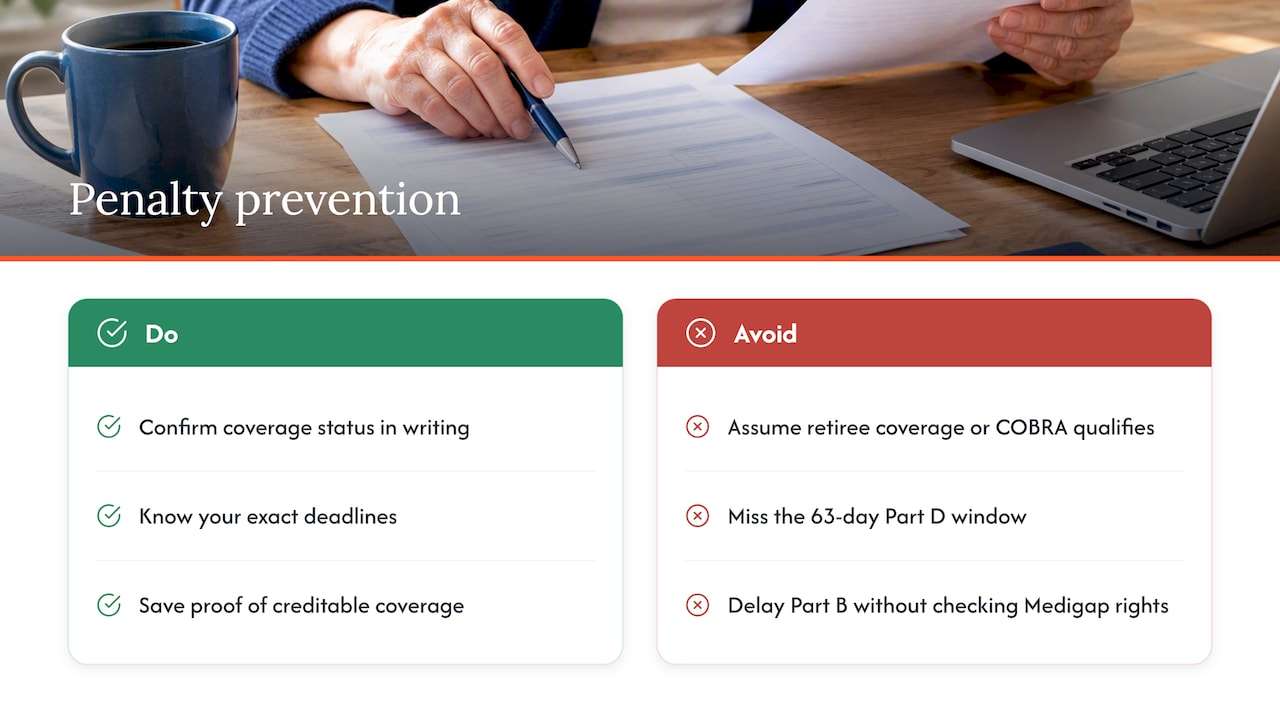
Preventing all of these comes down to the same habit: confirm your coverage status in writing, know your exact deadlines, and never assume silence from an old employer means you’re covered.
State-specific rules or nuances impacting Medicare penalty avoidance
Federal rules set the baseline for Medicare penalties, and those rules apply the same way in every state. Where states differ is in Medigap protections, which can affect how costly a Part B delay turns out to be.
Some states offer broader guaranteed-issue protections for Medigap than federal law requires, including extended enrollment windows or protections for people under 65 who qualify for Medicare due to disability. Other states stick closely to the federal minimum, meaning a missed Part B enrollment window has sharper consequences for Medigap access.
Because these protections vary, check with your state’s SHIP office before assuming your situation matches a national example. SHIP counselors are trained specifically on your state’s Medigap rules and can tell you whether local protections soften the impact of a late Part B enrollment. Contact information for every state’s SHIP office is available through Medicare’s main site, and the service is free.
This state-level variation doesn’t change anything about Part A, Part B, or Part D penalty calculations, which are federal and apply uniformly nationwide. It only affects your backup options if you do end up delaying Part B past your Initial Enrollment Period.
How penalties affect Medicare Advantage Plan choices and costs
A Part B penalty follows you into Medicare Advantage, not just Original Medicare, because Medicare Advantage plans require you to keep Part B as a condition of enrollment. That means a Part B penalty continues layering onto your costs even if you choose a Medicare Advantage plan instead of Original Medicare plus Medigap.
Many Medicare Advantage plans bundle drug coverage, so a Part D penalty carries over into that bundled premium as well. If you delayed drug coverage without a qualifying exception, switching to a Medicare Advantage plan with built-in Part D coverage doesn’t erase the penalty. It’s calculated separately and added to whatever premium the plan charges.
This matters most for people comparing Medicare Advantage against Medigap, since a Part B penalty affects the cost comparison either way. A plan that looked affordable before a penalty was assessed may look very different once that 10% per year is factored in permanently. Reviewing your penalty status before shopping plans, rather than after, gives you a clearer picture of your real annual costs.
What I’ve learned helping people navigate these deadlines
The biggest misconception about Medicare enrollment isn’t about which form to file. It’s the assumption that delaying is harmless as long as you eventually sign up. People picture the penalty as a minor inconvenience, not a cost that compounds for the rest of their life once it’s assessed.
What actually separates people who avoid penalties from those who don’t usually isn’t complicated: it’s whether they kept paperwork. Coverage that was genuinely creditable gets penalized anyway when nobody can produce proof of it. That’s a documentation failure, not a coverage failure, and it’s entirely preventable.
Safeguard Benefit Services is a Medicare insurance agency based in Charlotte, North Carolina, built around helping people avoid exactly this outcome by walking through Medicare Advantage Plans, Supplements, Prescription Drug Plans, and supplemental Dental, Vision, and Hearing Plans. We focus specifically on closing the gaps that lead to enrollment penalties and coverage delays, built on a training program designed to give every agent the same depth of knowledge about these rules. Every client also gets access to a free Medicare roadmap that lays out their specific options before a deadline becomes a problem.
— Zach
Get help avoiding Medicare penalties before deadlines pass
We walk clients through their enrollment timeline, help gather the employer verification forms a Special Enrollment Period requires, and assist with reconsideration paperwork if a penalty notice shows up unexpectedly, all without an extra fee for that guidance.

Our free Medicare roadmap clarifies which enrollment window applies to your situation and what documentation to pull together before you call Social Security.
| What we help with | What it solves |
|---|---|
| Free Medicare roadmap consultation | Clarifies your enrollment window and deadlines |
| SEP paperwork assistance | Helps document employer coverage correctly |
| Penalty reconsideration support | Organizes evidence for a CMS appeal |
| Plan comparison guidance | Shows how a penalty affects Medicare Advantage or Medigap costs |
Pro Tip: Book your consultation before your enrollment window opens, not after, so we have time to verify your coverage documentation while there’s still room to act.
Getting this right the first time costs nothing extra and saves you from a premium increase that follows you for life.
Our local Medicare Advantage plans in Charlotte page is a good starting point if you’re weighing your options, or you can go straight to our main site to request your free roadmap and schedule a personalized consultation today.
This article is general information, not a substitute for advice from a qualified financial advisor. Consult a qualified financial professional about your own circumstances before acting on anything here.
FAQ
How can I avoid paying a Medicare Part B penalty?
Enroll in Part B during your Initial Enrollment Period, or make sure any employer coverage you’re relying on is based on current, active employment rather than retiree or COBRA benefits. If you lose that employer coverage, file for a Special Enrollment Period within the required window and bring documentation of your coverage dates.
What is the big mistake people make with Medicare?
The most common mistake is assuming that any coverage, including COBRA or retiree plans, automatically protects against a penalty the way active employer coverage does. According to Social Security guidance, COBRA and retiree coverage generally don’t qualify for a Special Enrollment Period, which catches many people off guard.
Why am I forced to pay for Medicare?
Medicare isn’t mandatory, but most people enroll because Part A is premium-free after 10 years of work credits and delaying Part B or Part D without qualifying coverage leads to lifetime penalties under Medicare’s enrollment rules. Enrolling on time, or documenting creditable coverage if you delay, is what keeps your costs predictable.
What is the maximum income to avoid Medicare penalty?
Late-enrollment penalties for Parts A, B, and D aren’t based on income. However, beneficiaries who qualify for Extra Help, the low-income prescription assistance program, don’t pay the Part D late enrollment penalty while they remain eligible.
What should I do if I think I was charged a penalty in error?
File a reconsideration request within 60 days of your penalty notice and include written proof of any creditable coverage you had, according to CMS appeals guidance. Keep paying your premium and the disputed penalty during the review to avoid losing your coverage.
Sources
- Avoid late enrollment penalties | Medicare
- Information partners can use on: The Part D late enrollment Penalty. (CMS PDF)
Recommended
Request a No Obligation Phone Call








Get Connected