

You can cancel a Medicare Advantage plan during the Annual Enrollment Period (October 15 to December 7) or the Medicare Advantage Open Enrollment Period (January 1 to March 31), and outside of those windows only with a qualifying Special Enrollment Period. Enrolling in a new plan usually cancels the old one automatically. Once you leave, you typically revert to Original Medicare and have to arrange Part D drug coverage and, in some cases, a Medigap policy on your own.
TL;DR:
- Disenrolling during the Annual Enrollment Period or Medicare Advantage Open Enrollment Period requires timely requests, with the effective date usually set for January 1 or the first of the following month.
- Calling 1-800-MEDICARE or submitting a written request are key methods for disenrollment, with confirmation and proper documentation essential to ensure success.
- After disenrolling, you automatically revert to Original Medicare but must separately enroll in Part D and consider Medigap options, as those do not carry over automatically.
- Timing is critical for avoiding coverage gaps or penalties, so it’s crucial to coordinate Part D enrollment and Medigap application before the effective date.
- Special Enrollment Periods due to life events like moving or losing coverage provide additional opportunities to disenroll outside standard windows, but require proper documentation and prompt action.
Table of Contents
- Which enrollment periods let you cancel or disenroll
- How to submit a valid disenrollment request
- What happens after you disenroll from Medicare Advantage
- Special Enrollment Periods: life events that let you leave early
- Confirming your disenrollment actually went through
- How we help with Medicare Advantage disenrollment timing
- What the disenrollment process actually gets wrong
- Get help timing your Medicare Advantage disenrollment
- FAQ
- Sources
Which enrollment periods let you cancel or disenroll
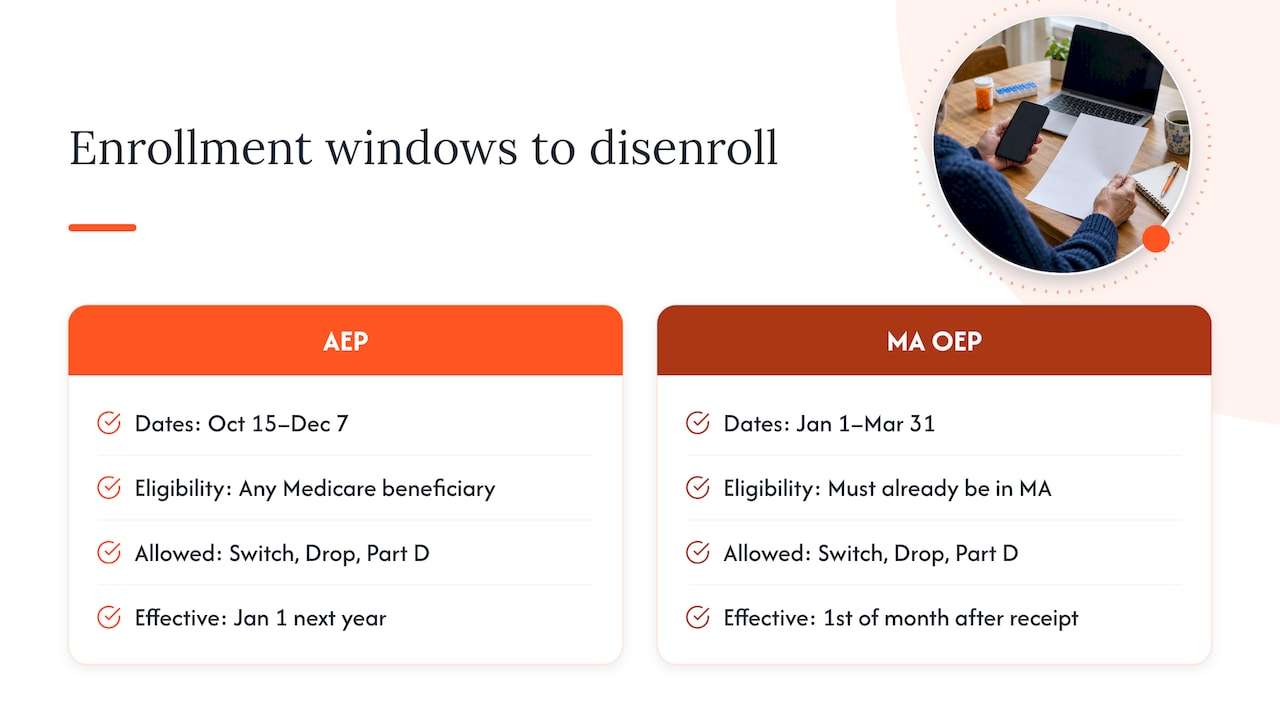
Medicare runs on a calendar, and the window you use determines both whether your request is valid and when your new coverage starts. The Annual Enrollment Period, which runs every year from October 15 through December 7, is the broadest opportunity. During AEP you can drop a Medicare Advantage plan and return to Original Medicare, switch to a different Medicare Advantage plan, or join a standalone Part D plan. Any change made during AEP takes effect on January 1 of the following year, regardless of the exact date you submitted it within the window.
The Medicare Advantage Open Enrollment Period runs January 1 through March 31 each year and works differently. It is only open to people already enrolled in a Medicare Advantage plan, and it allows exactly one change: you can switch to another Medicare Advantage plan or drop Advantage coverage entirely and return to Original Medicare, with the option to add a standalone Part D plan. Because it is limited to a single change, treat the decision as final for the year rather than a trial you can reverse in February if you change your mind again in March. Coverage changes made during MA OEP become effective the first of the month after your plan receives the request, not the date you mail it or even the date you call.
A few other situations create their own windows. If you joined Medicare Advantage during your initial enrollment period around turning 65, you get a trial right lasting about a year to drop the plan and return to Original Medicare, and in some cases a guaranteed right to buy a Medigap policy, a protection described on Medicare.gov’s enrollment periods guide. Plans that lose their Medicare contract or exit a service area trigger their own disenrollment and Special Enrollment Period, and CMS has historically allowed certain exceptions tied to plan star ratings, though these apply narrowly and change from year to year.
The distinction between when you submit a request and when your plan actually receives it matters more than most people expect. A letter postmarked December 5 but received December 9 may still process correctly within AEP, but a request mailed near the edge of the Medicare Advantage Open Enrollment Period can slip into the following month if it arrives late, pushing your effective date out and potentially leaving you enrolled in a plan you intended to leave for an extra few weeks. Whenever timing is tight, call rather than mail, and get a confirmation number on the spot.
How to submit a valid disenrollment request
There are three ways to leave a Medicare Advantage plan, and picking the right one depends on how much time you have and whether you already know your next plan.
- Enroll in a new plan. If you sign up for a different Medicare Advantage plan or a standalone Part D plan during a valid enrollment period, that enrollment automatically disenrolls you from your current plan. You generally do not need to separately contact your old insurer once you have enrolled elsewhere.
- Call 1-800-MEDICARE. Dial 1-800-633-4227 (TTY 1-877-486-2048) and tell the representative you want to disenroll from your Medicare Advantage plan and return to Original Medicare, as outlined in SSA’s disenrollment guidance. Have your Medicare number ready, confirm the representative’s name or ID, and ask for a confirmation number along with your exact effective date before you hang up.
- Submit a written request to your plan. Some plans accept a signed letter or form by mail or fax. A valid request needs your full name, Medicare number, plan name and member ID, the date, a clear statement that you want to disenroll, and your signature.
When you call, a short script helps keep the conversation on track: state your name and Medicare number, say you want to disenroll from your current Medicare Advantage plan effective as soon as the rules allow, and ask the representative to read back the effective date and provide a reference number. Write that number down immediately, along with the date and time of the call and the representative’s name.
If you are submitting a written request instead, build a short checklist before you send it: confirm your plan’s correct mailing address or fax number from your member materials, include every required field listed above, sign and date the letter, keep a photocopy for your own records, and send it by certified mail with a return receipt so you have proof of the date it arrived. Receipt date, not postmark date, is what determines your effective date under SSA’s procedural rules, so certified mail protects you if there is ever a dispute.
Pro Tip: If you plan to return to Original Medicare, enroll in a standalone Part D plan the same day you disenroll from your Advantage plan to avoid a gap in drug coverage that could trigger a penalty later.
Our Medicare Part D Prescription Drug Plans guide walks through how standalone drug plans work if you are weighing that step.
What happens after you disenroll from Medicare Advantage
Once your disenrollment takes effect, you are automatically back on Original Medicare, meaning Part A (hospital insurance) and Part B (medical insurance) through the federal government rather than a private plan. Nothing about that transition is automatic for drug coverage or supplemental coverage, so those two pieces need separate attention.
- Part D drug coverage does not carry over. If you do not enroll in a standalone Part D plan around the time you leave Medicare Advantage, you risk a gap in creditable drug coverage.
- Medigap eligibility is not guaranteed in every state once you are past your initial enrollment window, though certain qualifying situations, like the trial right described above, create guaranteed-issue protections.
- Out-of-pocket exposure tends to rise without a Medigap policy, since Original Medicare alone leaves you responsible for the Part A and Part B cost-sharing that a supplement would otherwise cover.
The financial risk tied to drug coverage gaps is specific and measurable. A Part D late-enrollment penalty is added to your monthly premium for as long as you have Part D coverage, calculated based on how many months you went without creditable drug coverage, according to Medicare.gov’s penalty guidance. You can estimate what a gap might cost you with our Part D Late Enrollment Penalty Calculator before you finalize your disenrollment timing.
Medigap guaranteed-issue rights deserve a close look before you assume you can simply buy a supplement after leaving Medicare Advantage. Outside of specific triggers like the 12-month trial right, insurers in many states can medically underwrite Medigap applications, meaning a pre-existing condition could result in a higher premium or a denial. A handful of states have their own rules extending guaranteed issue further than federal law requires, so checking your state’s specific protections before you drop Advantage coverage is worth the extra step. Our comparison of Medicare Advantage versus Medigap plans breaks down how the two paths differ in practice, and the Medicare Advantage vs. Medigap guide for 2026 offers additional state-level context if you want a second source while deciding.
Think through the sequence before you act: disenroll, then immediately confirm your Part D enrollment, then assess whether you qualify for guaranteed-issue Medigap or need to apply through standard underwriting. Doing these out of order is the most common way people end up with an unplanned coverage gap.

Special Enrollment Periods: life events that let you leave early
Outside of AEP and the Medicare Advantage Open Enrollment Period, you generally need a Special Enrollment Period tied to a specific life event to disenroll. Medicare.gov’s Special Enrollment Periods page lists the qualifying circumstances, and the most common ones include:
- Moving out of your plan’s service area, which typically gives you a window around the move to switch plans or return to Original Medicare.
- Losing employer or union coverage, which opens a Special Enrollment Period similar to the one new Medicare enrollees get.
- Your plan terminating its Medicare contract or leaving your area, which triggers CMS-initiated disenrollment and a chance to pick new coverage.
- Gaining or losing Medicaid or Extra Help, which can open an SEP tied to the change in your eligibility status.
Each SEP comes with its own timeframe. A move typically gives you a window measured in months around the date you relocated, while a plan error or CMS-documented mistake might give you a shorter window measured in weeks from when you were notified. Because the clock starts from the triggering event rather than from when you decide to act, confirm your specific deadline with your plan or 1-800-MEDICARE as soon as the event happens rather than waiting.
Documentation matters here more than in a routine AEP or MA OEP switch, since you are asking for an exception to the normal calendar. A utility bill or lease showing your new address supports a move-based SEP, a letter from your former employer confirming the coverage end date supports a job-loss SEP, and a plan’s own termination notice supports a contract-related SEP. Keep copies of everything you submit. Our Special Enrollment Period guide and our mid-year plan change walkthrough go into more detail on gathering the right paperwork for each scenario.
Confirming your disenrollment actually went through
Medicare Advantage organizations are required to send you a written acknowledgement of a valid disenrollment request and to submit that disenrollment to CMS, with specific transaction timelines and response codes governing how quickly that has to happen, according to CMS’s enrollment and disenrollment guidance. In practice, that means you should receive something in writing confirming your request and your effective date, not just a verbal assurance.
Hold onto every piece of paper this process generates: the written acknowledgement from your plan, any confirmation number from a phone call, and your certified mail receipt if you submitted a written request. If your plan has not confirmed your disenrollment within a reasonable time, call 1-800-MEDICARE to check CMS’s records directly rather than assuming the request is still processing.
If someone else is handling this on your behalf, such as an adult child or caregiver, they generally need to be a documented authorized representative, which usually requires a signed form on file with your plan or Social Security before they can request changes for you.
How we help with Medicare Advantage disenrollment timing
Timing a disenrollment correctly, and lining up Part D or Medigap coverage behind it, is exactly the kind of decision that personalized consultations can help with. Such consultations often include reviewing which enrollment window applies to your situation, confirming whether a Special Enrollment Period fits your circumstances, and gathering the documentation a plan or CMS might ask for.
We also recommend annual plan reviews so a decision made correctly one year does not quietly become outdated the next as plan benefits and costs shift. When clients are moving from Medicare Advantage back to Original Medicare, guidance on sequencing Part D enrollment and checking Medigap guaranteed-issue eligibility can help avoid gaps in drug coverage and surprise underwriting denials. A Medicare roadmap lays out these steps in the order that protects you financially, and comprehensive agent training encourages walking through the full picture rather than pushing a single product, so guidance reflects actual options under CMS rules, not just the plan that pays the highest commission.
What the disenrollment process actually gets wrong
Most guidance on canceling Medicare Advantage focuses entirely on the mechanics, which window, which phone number, which form, and treats the disenrollment itself as the finish line. It isn’t. The real risk sits in the days after you disenroll, when Part D and Medigap decisions either get made promptly or get forgotten entirely because the hard part felt like it was over.
The conventional advice undersells how unforgiving Medigap underwriting can be outside a guaranteed-issue window, and it rarely emphasizes that a single missed Part D enrollment can mean a penalty that follows you for as long as you have drug coverage. If you take one thing from this guide, prioritize sequencing over speed: know your effective date, then line up Part D before that date arrives, then check your Medigap eligibility before you assume you can shop for a supplement later. Acting fast on the cancellation while leaving the replacement coverage for later is the most common and most expensive mistake people make here.
— Zach
Get help timing your Medicare Advantage disenrollment
Canceling a Medicare Advantage plan correctly takes more than one phone call. It takes the right window, the right paperwork, and a plan for Part D and Medigap that does not leave you exposed in between.

Free consultations can help walk through your specific timeline, confirm which enrollment period applies to you, and review your Part D and Medigap options before you make a move. Here is what such a consultation typically covers:
- A review of your current enrollment window and confirmation of your exact effective date
- A comparison of standalone Part D options so you avoid a coverage gap
- A check of your Medigap guaranteed-issue eligibility based on your situation and state
- Confirmation steps to make sure your disenrollment is properly recorded with CMS
Visit our Medicare services page to schedule a consultation or request your free Medicare roadmap.
This article is general information, not a substitute for advice from a qualified financial advisor. Consult a qualified financial professional about your own circumstances before acting on anything here.
FAQ
How do I get out of my Medicare Advantage plan?
You can disenroll by enrolling in a new Medicare Advantage or Part D plan during a valid enrollment period, which automatically cancels your old plan, or by calling 1-800-MEDICARE (1-800-633-4227) directly. You can also submit a signed written request to your current plan, though your effective date depends on when the plan receives it rather than when you send it.
Is it better to have Original Medicare or a Medicare Advantage plan?
Neither option is universally better. Original Medicare paired with a Medigap policy tends to offer more predictable out-of-pocket costs and fewer network restrictions, while Medicare Advantage often includes extra benefits at a lower monthly premium but with provider networks and cost-sharing that vary by plan, so the right choice depends on your health needs, budget, and preferred providers.
Is there a penalty for canceling Medicare Part B?
Canceling Part B itself can trigger a separate late-enrollment penalty if you later want to re-enroll without other qualifying coverage, which is a different issue from disenrolling from a Medicare Advantage plan. Dropping Medicare Advantage and returning to Original Medicare does not cancel your Part B, it simply changes how your Part A and Part B benefits are delivered.
Why do people say to stay away from Medicare Advantage plans?
Common concerns center on provider networks narrowing your choice of doctors and hospitals compared with Original Medicare, along with the fact that leaving a Medicare Advantage plan later and buying a Medigap policy is not always guaranteed, since underwriting can apply outside specific protected windows. These concerns are legitimate for some people but do not apply to everyone, since many Medicare Advantage enrollees are satisfied with their network and extra benefits.
Sources
- SSA POMS: Disenrollment From A Medicare Advantage or 1876 Cost Plan
- CMS — CY 2027 Medicare Advantage appendices & exhibits
Recommended
Request a No Obligation Phone Call








Get Connected