

Yes, Medicare Part B covers medically necessary cataract surgery, and after the Part B deductible, you typically pay 20% of the Medicare-approved amount. Coverage includes conventional intraocular lens implantation and one pair of standard glasses or contacts afterward. Premium lens upgrades are elective and billed separately, so ask your surgeon for a written cost estimate before you schedule anything.
TL;DR:
- Medicare covers standard cataract removal with a monofocal intraocular lens and includes one pair of glasses or contacts after surgery, but upgrades like presbyopia-correcting lenses are out-of-pocket expenses.
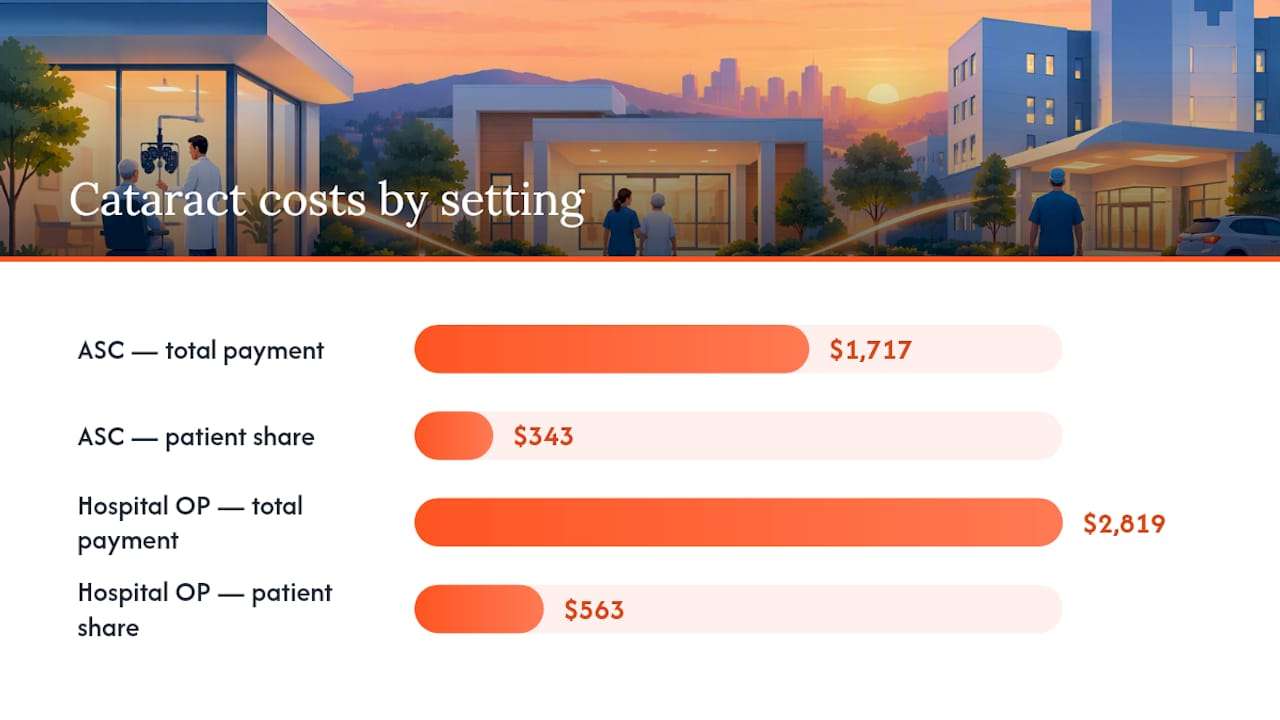
- In 2026, the patient’s out-of-pocket cost in an ambulatory surgical center is around $343 after meeting the $283 deductible, while hospital outpatient costs average about $563.
- Medicare Advantage plans may require prior authorization and limit providers, potentially increasing out-of-pocket costs if procedures are out-of-network or improperly authorized.
- Clarifying whether your surgeon and facility accept Medicare assignment and obtaining written estimates beforehand can prevent unexpected charges.
- Supplementary Medigap policies can cover the remaining 20% coinsurance, but costs vary depending on your coverage and whether you choose elective upgrades.
Table of Contents
- What Does Medicare Part B Pay for During Cataract Surgery?
- How Much Cataract Surgery Costs Under Medicare in 2026
- What Medicare Does Not Cover for Cataract Surgery
- How Medical Necessity Gets Documented for Your Claim
- Where You Have Surgery Changes What You’re Billed
- How Medicare Advantage and Medigap Change Your Costs
- Your Pre-Surgery Checklist to Avoid Surprise Bills
- What I See Trip Up Clients Most Often
- Get Clarity on Your Coverage Before You Schedule
- Sources
- FAQ
What Does Medicare Part B Pay for During Cataract Surgery?
Medicare Part B treats cataract removal as a medically necessary procedure once your vision loss interferes with daily life and glasses can no longer fix it. Coverage applies to the surgery itself, the surgeon’s fee, facility charges, anesthesia, and a conventional monofocal intraocular lens (IOL) that replaces your clouded natural lens.
What’s included under Original Medicare:
- Surgeon and facility fees for the cataract removal procedure
- A standard monofocal IOL, the type that corrects vision at one distance
- One pair of eyeglasses or contact lenses after each cataract surgery with an IOL
- Pre-op evaluation and post-op follow-up visits tied to the surgery
The CMS ruling on presbyopia-correcting IOLs draws a clear line here: Medicare pays for the conventional IOL and the associated surgical service, but any refractive benefit beyond that, such as reduced dependence on reading glasses, falls outside the covered benefit. Facility charges and physician charges are billed under separate claims, which is why your Medicare Summary Notice may show two line items for what feels like one visit — understanding these distinctions can help with diabetic device insurance approval and similar coverage complexities.
How Much Cataract Surgery Costs Under Medicare in 2026
Before Medicare pays anything, you’re responsible for the annual Part B deductible of $283 in 2026, on top of the standard Part B premium of $202.90 a month. Once you’ve met the deductible, you generally owe 20% coinsurance on the Medicare-approved amount for both the facility and physician portions of the bill.
Setting expectations with real numbers: for CPT code 66984, the standard cataract removal with IOL insertion, Medicare’s procedure price lookup shows national average total payments and patient shares that vary by setting, with ambulatory surgical centers generally less costly than hospital outpatient departments.
- ASC setting: roughly $1,717 total, about $343 out-of-pocket after the deductible
- Hospital outpatient setting: roughly $2,819 total, about $563 out-of-pocket after the deductible
- Physician fees are often billed on a separate claim and can vary by region and provider
Those figures are national averages, not a quote for your case. Ask your facility for a location-specific estimate before surgery day.
What Medicare Does Not Cover for Cataract Surgery
Medicare’s cataract benefit stops at the conventional lens and the medically necessary parts of the procedure. Anything considered an elective upgrade becomes your responsibility, in full, for the difference above the standard rate.
- Premium IOLs, including presbyopia-correcting and toric lenses, since the extra refractive benefit is not a covered service
- Additional fitting or measurement fees tied specifically to premium lens selection
- Eyewear beyond the one covered pair per surgery, including designer frames or extra pairs
- Laser-assisted techniques or add-ons your surgeon frames as elective rather than medically required
Pro Tip: Ask your surgeon’s office for the price difference between the standard IOL and any premium lens in writing before you consent to the upgrade, so there’s no surprise on the bill.
How Medical Necessity Gets Documented for Your Claim
Medicare doesn’t approve cataract surgery based on a vision chart number alone. Local Coverage Determinations set the real bar: your cataract has to be causing symptomatic, functional impairment that glasses can’t correct, and your surgeon has to rule out other explanations for the vision loss.
A Snellen acuity test showing 20/50 vision, by itself, usually isn’t enough to justify surgery in a Medicare audit. What actually supports the claim is documentation of how the cataract affects your life.
- Ask your eye doctor to note specific complaints, such as glare at night, difficulty reading, or trouble driving
- Request that your chart reflect any glasses or contact lens trials that failed to resolve the problem
- Confirm other causes of blurred vision, like macular degeneration, have been ruled out
- Keep copies of exam notes and referral letters in case your claim is questioned later
If a claim is denied, you have the right to appeal through Medicare’s standard redetermination process, starting with a written request to your Medicare Administrative Contractor.
Where You Have Surgery Changes What You’re Billed
Cataract surgery happens in one of three settings, and the setting shapes both your bill and how charges are bundled. Ambulatory surgical centers tend to bundle facility and device costs into a lower overall rate than hospital outpatient departments, which often carry higher facility fees for the same procedure.
- Ambulatory surgical center (ASC): typically the lowest-cost setting, with facility and supply costs often bundled
- Hospital outpatient department (HOPD): usually higher facility charges for the identical surgical work
- Office-based procedures: less common for cataract extraction, reserved for specific cases
Common CPT codes to recognize on your statement include 66984 (routine cataract removal with IOL insertion), 66982 (complex cataract surgery requiring extra devices or techniques), and 66989 (cataract removal with insertion of a complex IOL). Ask your surgeon’s office and the facility for separate written estimates covering both the professional fee and the facility fee before you commit to a date.
How Medicare Advantage and Medigap Change Your Costs
If you have a Medicare Advantage plan, it must cover everything Original Medicare covers, including medically necessary cataract surgery, but the plan can require prior authorization and limit you to in-network surgeons and facilities. Skipping that step or going out-of-network can mean a denied claim or a much larger bill.
Medigap policies work differently. They’re designed to pick up the 20% coinsurance that Original Medicare leaves on the table, which is often the single biggest lever for lowering your out-of-pocket exposure for a procedure like this one.
- Confirm whether your Medicare Advantage plan requires prior authorization for cataract surgery
- Verify your surgeon and facility are in-network before scheduling
- Ask whether your Medigap plan covers the full 20% coinsurance or only a portion
Pro Tip: Call your plan’s member services line and ask specifically about cataract surgery prior authorization requirements, not just general coverage, since the rules can differ by procedure.
Your Pre-Surgery Checklist to Avoid Surprise Bills
A short set of questions before your surgery date can save you from an unexpected bill weeks later.
- Confirm your surgeon and facility accept Medicare assignment, meaning they’ll accept the Medicare-approved amount as full payment
- Get a written estimate that separates the facility fee, physician fee, and any elective lens upgrade cost
- Ask directly whether the IOL being recommended is the standard covered lens or a premium option
- If you have Medicare Advantage, confirm prior authorization has been submitted and approved before the surgery date
- If you have Medigap, verify with your carrier how much of the 20% coinsurance the policy covers
- Keep your written estimates, exam notes, and any authorization letters together in one folder in case a claim needs review
What I See Trip Up Clients Most Often
The surprises I hear about most aren’t the surgery itself. They’re the separate physician bill nobody warned a client about, the premium lens upgrade presented as standard, or a Medicare Advantage prior authorization that got denied because the paperwork was incomplete. Every one of those is preventable with the right questions asked early.
Some Medicare insurance agencies build free Medicare roadmaps for situations like this, with agents trained to explain cost scenarios before they become a bill in your mailbox.
— Zach
Get Clarity on Your Coverage Before You Schedule
Knowing that Medicare Part B covers your cataract surgery is only half the picture.

Some Medicare insurance agencies offer personalized Medicare plan reviews, Medigap comparisons, and Medicare Advantage guidance built around real procedures like this one, not generic brochures.
- A Medicare roadmap that helps map your current coverage against upcoming procedures
- Medigap and Medicare Advantage comparisons focused on coinsurance exposure
- Local consultations with agents knowledgeable on Medicare rules and enrollment timing
If you want a clear picture of what cataract surgery would actually cost under your current plan, or whether switching coverage during your next enrollment window could lower that number, start a consultation with Safeguard Benefit Services today.
This article is general information, not a substitute for advice from a qualified doctor. Consult a qualified healthcare professional about your own circumstances before acting on anything here.
Sources
FAQ
Does Medicare Pay for 100% of Cataract Surgery?
No. Medicare Part B covers medically necessary cataract surgery, but you first meet the Part B deductible and then typically pay 20% coinsurance on the Medicare-approved amount. A Medigap policy can cover some or all of that remaining 20%.
How Much Does Medicare Pay for Cataract Surgery in 2026?
For CPT code 66984, Medicare’s procedure price lookup shows a national average total payment of $1,717 in an ambulatory surgical center and $2,819 in a hospital outpatient department. Your actual patient share depends on whether you’ve met your deductible and whether you have supplemental coverage.
What Is the Typical Out-of-Pocket Cost for Cataract Surgery With Insurance?
After the 2026 Part B deductible of $283 is met, the patient share for CPT 66984 runs about $343 in an ambulatory surgical center and about $563 in a hospital outpatient department, based on national average payments. Medigap coverage or a Medicare Advantage plan’s cost-sharing structure can lower that figure further.
What Type of Cataract Surgery Is Not Covered by Medicare?
Medicare does not cover the added refractive benefit of premium lenses, including presbyopia-correcting and toric IOLs, since the CMS ruling on these lenses treats that upgrade as elective. You’re responsible for the difference in cost between the standard covered lens and any premium option you choose.
Recommended
Request a No Obligation Phone Call








Get Connected