

Medicare Part B covers screening colonoscopies at no cost when your doctor bills it as a screening and accepts Medicare assignment. Two things change that: if the doctor finds and removes a polyp, coinsurance usually kicks in, and how often Medicare pays again depends entirely on your risk level, with intervals determined by Medicare guidelines.
TL;DR:
- Removing a polyp during a screening colonoscopy shifts it from a preventive service to a therapeutic procedure, typically resulting in about 15% coinsurance.
- Medicare covers screening colonoscopies at no cost only if the procedure is coded as screening, no tissue is removed, and the provider accepts Medicare assignment within the appropriate interval.
- Frequency of coverage varies: once every 10 years for average risk individuals and more often, about every 2 years, for those at high risk.
- Billing codes and modifiers, such as the -KX modifier, determine whether a procedure is billed as screening or diagnostic, affecting your out-of-pocket costs.
- Checking with your plan and provider beforehand can help ensure the correct billing code is used and prevent unexpected charges after the procedure.
Table of Contents
- What Does Medicare Part B Cover for Colonoscopy Screenings?
- Why Does Removing a Polyp Change Your Bill?
- How Often Will Medicare Pay for a Screening Colonoscopy?
- How Do Billing Codes Decide What You Owe?
- Does Your Plan Type Change What You Pay?
- What Should You Do Before Scheduling a Colonoscopy?
- Why the “Free Colonoscopy” Framing Misses the Point
- Get Help Confirming Your Coverage Before You’re On the Table
- Where to Verify These Rules Yourself
- Sources
- FAQ
What Does Medicare Part B Cover for Colonoscopy Screenings?
Part B treats colonoscopy as a preventive benefit, not a diagnostic test, which is the whole reason it can cost $0. That distinction only holds if the paperwork lines up correctly behind the scenes.
Under Medicare’s screening colonoscopy rules, you owe nothing for the procedure, the anesthesia, or the pathology if it’s coded as a screening and your provider accepts assignment. Assignment means the doctor and the facility agree to Medicare’s approved amount as full payment, no balance billing on top.
Medicare also treats a follow-on colonoscopy as a screening, not a diagnostic procedure, when it happens after a positive result on a Medicare-covered stool-based or blood-based test. That’s a meaningful protection: without it, plenty of beneficiaries would get hit with diagnostic cost-sharing simply because their non-invasive screening test flagged something.
A few conditions determine whether you land in the $0 category:
- The provider and facility both accept Medicare assignment.
- The claim is coded as a screening colonoscopy, not diagnostic.
- No polyp or tissue is removed during the exam.
- You fall within Medicare’s covered screening interval for your risk category.
Miss any one of those, and the bill changes shape. This is why understanding what Medicare covers for preventive services and annual screenings matters before you ever sit down with a scheduler.
Why Does Removing a Polyp Change Your Bill?
Here’s the scenario nobody explains clearly enough: you go in for a routine screening, the doctor finds a polyp, removes it right there during the same procedure, and suddenly your “free” colonoscopy has a coinsurance bill attached.
That’s not a billing error. It’s how Medicare’s rules work. The moment a polyp gets removed, the procedure shifts from purely preventive to screening-to-therapeutic, and cost-sharing rules apply to that therapeutic portion.
Here’s the number that surprises most people: according to Medicare’s own guidance, when a polyp is removed during what started as a screening colonoscopy, you typically owe about 15% coinsurance on the provider’s charge, and often a facility coinsurance too, in an outpatient hospital setting. The Part B deductible is waived for this surgical portion in many screening-to-therapeutic cases, but the coinsurance itself is not.
Three cost scenarios in practice:
- Screening, nothing removed: $0 if the provider accepts assignment.
- Screening that becomes therapeutic (polyp removed): coinsurance applies, roughly 15% of the Medicare-approved provider charge, plus possible facility coinsurance.
- Diagnostic colonoscopy ordered because of symptoms: standard Part B cost-sharing applies, meaning your deductible plus 20% coinsurance, unless a supplement or Medicare Advantage plan absorbs it.
Prices also vary by where you have the procedure done. Medicare’s price lookup tool notes that national average figures for screening colonoscopy exclude physician fees entirely and shift by region, so what you see listed nationally is a floor, not a quote.
How Often Will Medicare Pay for a Screening Colonoscopy?
Frequency depends entirely on your personal risk classification, and Medicare is specific about the intervals.
- Average risk: Medicare covers a screening colonoscopy roughly once every 10 years.
- High risk (family history of colorectal cancer or polyps, inflammatory bowel disease, or certain other risk factors): coverage may be available more frequently, about every 2 years.
- After a flexible sigmoidoscopy: follow-up screening colonoscopies occur at intervals longer than 2 years depending on clinical context.
- After a positive stool-based or blood-based test: the follow-on colonoscopy counts as a screening, not a new diagnostic event, regardless of when your last screening colonoscopy happened.
That last rule is worth underlining, because CMS coverage guidance expanded this “complete colorectal cancer screening” pathway to include follow-on colonoscopies after positive blood-based biomarker tests. The American Cancer Society recommends average-risk adults start screening at age 45, and Medicare’s coverage intervals align with that broader clinical guidance on prevention through early polyp detection.
How Do Billing Codes Decide What You Owe?
Every colonoscopy gets a CPT or HCPCS code attached, and that code, plus any modifier tacked onto it, is what actually determines your bill. Not the conversation you had with your doctor beforehand. Not your intent when you scheduled it. The code.
Here’s what the three designations mean in practice:
- Screening: ordered on a routine schedule with no symptoms present, billed under preventive codes, and eligible for $0 cost-sharing if nothing is removed.
- Diagnostic: ordered because of symptoms like bleeding, pain, or abnormal test results, and subject to standard Part B deductible and 20% coinsurance.
- Therapeutic (screening converted mid-procedure): starts as a screening code but shifts when tissue is removed, triggering coinsurance on that portion specifically.
When a follow-on colonoscopy happens after a positive covered non-invasive test, the practitioner is supposed to apply a -KX modifier, which signals to Medicare that this procedure qualifies as complete colorectal cancer screening rather than a fresh diagnostic event. If that modifier gets left off a claim, you could get billed as if it were diagnostic, even though the rules protect you.
Pro Tip: Before you show up for the procedure, ask the scheduling office directly which CPT code and modifier they intend to bill. If your Explanation of Benefits later shows a diagnostic code when you expected a screening code, call the billing office and ask for a claim review before you pay anything.
Does Your Plan Type Change What You Pay?
Original Medicare with a Medigap policy and Medicare Advantage handle colonoscopy cost-sharing very differently, even though both must cover the same underlying benefit.
- Medicare Advantage plans must cover everything Original Medicare covers, but many require prior authorization or restrict you to in-network facilities and gastroenterologists. Skip that step, and you could face higher costs or a denied claim even for a routine screening.
- Medigap (Medicare Supplement) plans often pick up the Part B coinsurance that Original Medicare leaves on the table. That means a polypectomy that would otherwise cost you 15% coinsurance might end up costing $0 if your supplement covers Part B cost-sharing in full.
- Plan rules aren’t universal. Always check your Summary of Benefits or call your plan directly before scheduling, since Medicare Advantage versus Medigap coverage details genuinely vary plan to plan.
What Should You Do Before Scheduling a Colonoscopy?
A short call before your appointment can save you a confusing bill later. Run through this list:
- Confirm the provider and the facility both accept Medicare assignment, not just one or the other.
- Ask whether the visit will be billed as screening, and which CPT/HCPCS code and modifiers apply.
- Ask how anesthesia is billed. Anesthesia is generally covered under Part B for colonoscopy, but the anesthesiologist or CRNA often bills separately, which can mean a separate cost-sharing line if it’s not bundled with the facility charge.
- If you have Medicare Advantage or a Medigap policy, call your plan to confirm how it handles a polypectomy or diagnostic scenario specifically.
- Only sign an Advance Beneficiary Notice (ABN) if staff tell you upfront the procedure likely won’t be covered.
Pro Tip: Keep a copy of your pre-procedure conversation, even a simple email confirming the screening code was quoted. If a surprise diagnostic bill shows up afterward, that record makes it far easier to request a claim correction.
Why the “Free Colonoscopy” Framing Misses the Point
The $0 screening benefit is real, and it’s genuinely one of the better preventive deals in Medicare. But treating it as a blanket guarantee sets people up for a nasty surprise when a polyp turns up mid-procedure and the bill lands weeks later.
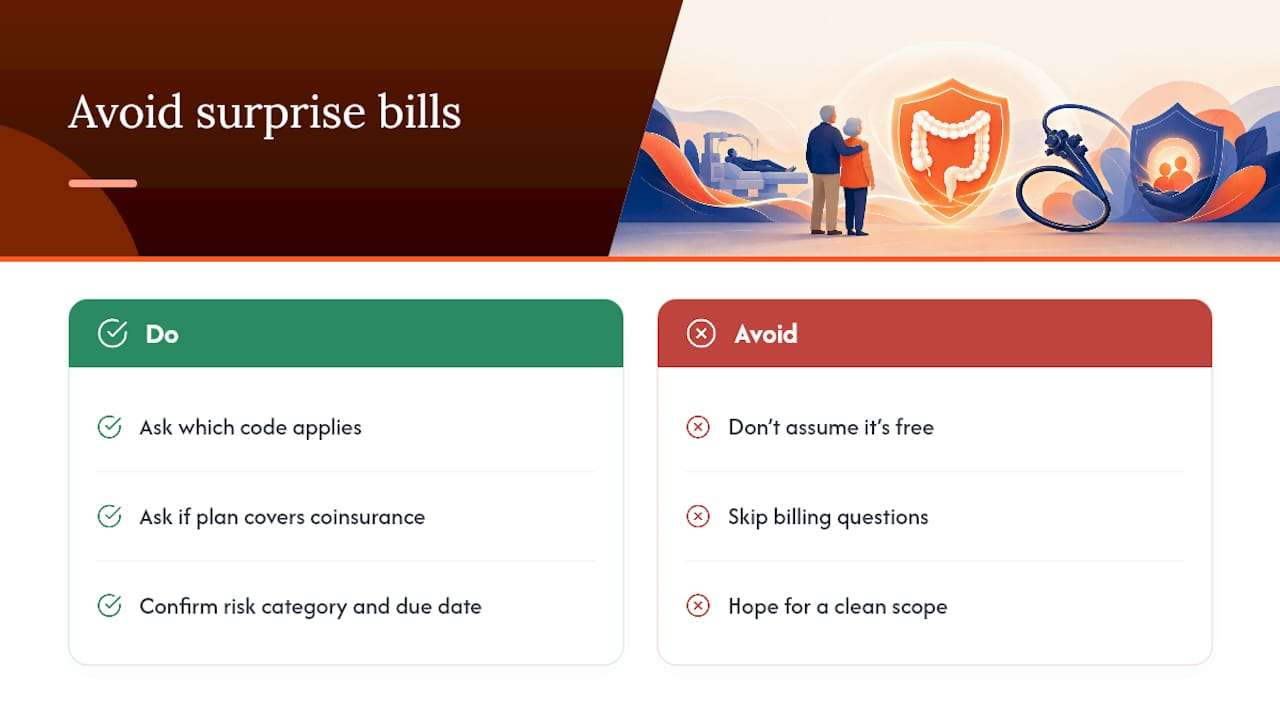
What actually protects you isn’t hoping for a clean scope. It’s knowing ahead of time which code applies to your situation, whether your plan fills the coinsurance gap, and what your risk category means for how soon you’re due again. Beneficiaries who ask two or three specific questions before the appointment almost always avoid the confusion that shows up after it.
That’s the gap this agency tries to close: understanding your plan well enough, before the procedure, that nothing about the bill afterward comes as news. A free Medicare roadmap consultation exists for exactly this kind of question.
— Zach
Get Help Confirming Your Coverage Before You’re On the Table
Reading the rules is one thing. Knowing exactly what your specific Medicare Advantage plan or Medigap policy will do with a polypectomy bill is another, and that’s where a licensed agent earns their keep.

This agency works with Medicare beneficiaries to review plan benefits line by line, confirm whether your Medigap coverage will absorb Part B coinsurance if a polyp gets removed, and check whether your preferred gastroenterologist sits inside your Medicare Advantage network before you ever schedule the procedure. If you’re comparing options, a breakdown of Medicare Advantage plans walks through how prior authorization and network rules could affect a colonoscopy referral. Consider a free Medicare roadmap consultation to get your coverage confirmed before the procedure.
Where to Verify These Rules Yourself
Check Medicare’s colonoscopy coverage page and the CMS Medicare Coverage Database for current billing and modifier guidance, plus the American Cancer Society’s screening guidelines for clinical context on why intervals exist. For background on how blood-based screening tests factor into follow-on colonoscopy coverage, this screening guide offers useful patient-facing context.
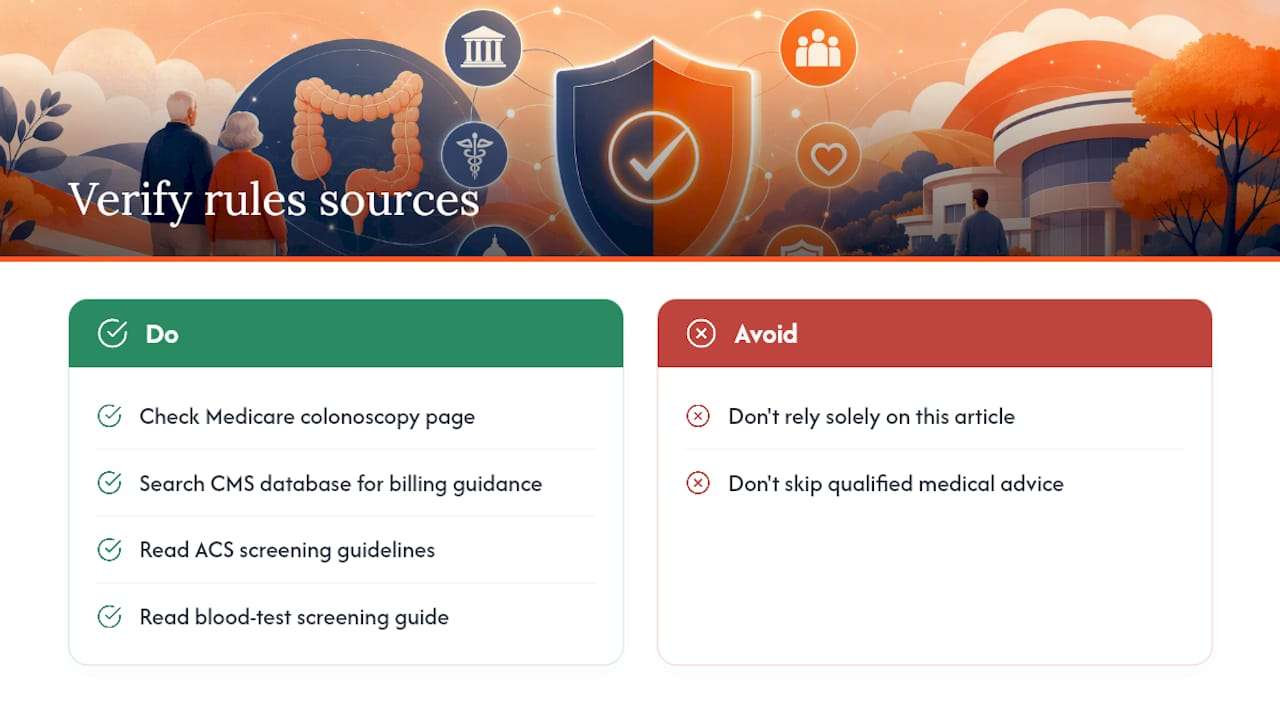
This article is general information, not a substitute for advice from a qualified doctor. Consult a qualified healthcare professional about your own circumstances before acting on anything here.
Sources
FAQ
Does Medicare Pay 100% for a Colonoscopy?
If a polyp is removed, coinsurance typically applies to the therapeutic portion of the procedure.
Will Medicare Cover Colonoscopy in 2026?
Yes. Screening colonoscopy remains a covered Part B preventive benefit in 2026, with coverage frequency still set at 120 months for average risk and 24 months for high risk.
Does Medicare Cover Colonoscopy After Age 75?
Medicare doesn’t set an upper age limit on screening colonoscopy coverage. Eligibility is based on your risk category and screening interval, not your age alone.
How Much Does a Colonoscopy Cost With Medicare Insurance?
A pure screening colonoscopy costs $0 if your provider accepts Medicare assignment.
Recommended
Request a No Obligation Phone Call








Get Connected