

You can delay Part B without a penalty only if you have group health coverage based on current employment, and you enroll while covered or within 8 months after that employment or coverage ends. COBRA, retiree plans, VA benefits, and individual Marketplace plans do not qualify. If you miss the window, you wait for the General Enrollment Period and may pay a permanent penalty.
TL;DR:
- Each full year without Part B adds 10% of the standard premium, usually for as long as coverage continues; the 2026 standard premium is $202.90.
- Submit the Part B application and employment verification form; pay stubs, wage statements, or an insurance card can help if human resources is unresponsive.
- At employers with fewer than 20 workers, ask benefits staff whether you must take Part B while working; TRICARE and CHAMPVA have separate rules.
- During the first full month after coverage ends, you can request a later Part B start date; otherwise, coverage begins the month after enrollment.
Table of Contents
- What the Part B Special Enrollment Period covers and the 8-month rule
- How the Part B late-enrollment penalty works
- How to enroll later without penalty: forms, documentation, and timing
- Common real-world scenarios and how they affect your ability to delay Part B
- Actionable checklist and timeline to avoid gaps and penalties
- Why verifying your coverage type matters more than anything else
- How we help you finish SEP enrollment and avoid penalties
- FAQ
- Sources
What the Part B Special Enrollment Period covers and the 8-month rule
The Special Enrollment Period (SEP) is your protected window to sign up for Part B after your Initial Enrollment Period without a late penalty. It applies when you are covered by a group health plan through current employment: your own job, your spouse’s, or, if you are disabled, a family member’s. The rule is simple but strict. You can enroll anytime while that coverage lasts, or during the 8 months after either the employment or the coverage ends, whichever comes first. COBRA does not extend that clock.
These coverages do not count as current-employment coverage:
- COBRA continuation coverage
- Retiree health plans
- Individual or Marketplace plans
- VA benefits and most other non-employer coverage
People often assume these plans protect them because they feel like job-based insurance. They don’t, and months can pile up toward a penalty while you believe you are covered.
Pro Tip: Ask your benefits administrator in writing whether your plan is group coverage based on current employment, and whether you must take Part B while still working. This matters most if your employer has fewer than 20 employees.
How the Part B late-enrollment penalty works
The penalty adds 10% of the standard Part B premium for each full 12-month period you were eligible but not enrolled. It is usually permanent, charged for as long as you have Part B. Medicare.gov explains the rule, and the premium it applies to is the standard amount, not your income-adjusted one.
The 2026 standard Part B premium is $202.90 per month. Using it, here is what delay costs:
- 12 full months missed: the penalty adds 10% of the standard Part B premium
- 24 full months missed: the penalty adds 20% of the standard Part B premium
Income-related adjustments exist, but these examples use the standard base. If you want to run your own numbers, our Part B penalty calculator helps estimate the penalty.
How to enroll later without penalty: forms, documentation, and timing
Enrolling after a delay takes paperwork, and the order matters.
- Decide when you want Part B to start. If you sign up during the SEP while still covered or within the first full month after employer coverage ends, you can request a later Part B start date. Otherwise, coverage generally starts the month after you sign up.
- Complete form CMS-40B, the application for Part B.
- Have your employer complete CMS-L564, the Request for Employment Information.
- If HR is slow or unresponsive, gather alternate evidence: pay stubs showing premium deductions, W-2s, or an insurance ID card with effective dates.
- Submit everything to Social Security. You can apply online, by fax, or by mail, and incomplete documentation can delay or reject your application.
Pro Tip: Start collecting pay stubs and your insurance card the day you decide to enroll, so you never depend on HR’s schedule.
Common real-world scenarios and how they affect your ability to delay Part B
Your situation decides whether delaying is safe. Here is how the common ones play out:
- Working past 65 on an employer plan: Delaying is generally fine while you stay on a qualifying group plan. Confirm with your benefits administrator, especially at employers with fewer than 20 employees.
- COBRA or retiree coverage: Neither preserves SEP eligibility. Losing job-based coverage starts your 8 months whether or not you elect COBRA.
- Marketplace or individual plans: These do not count as employer group coverage, and Marketplace assistance doesn’t create an SEP. Delaying on one risks penalties and a coverage gap.
- TRICARE, CHAMPVA, and disability-based rules: These follow their own coordination rules, and Part B may still be required to keep full benefits. Check with the plan administrator before you decide to delay.
Actionable checklist and timeline to avoid gaps and penalties
Work through these in order:
- Confirm with your benefits administrator that your plan is employer group coverage and whether you must enroll in Part B while employed.
- Note the final month of employer coverage and choose your desired Part B start date. Check the effective-date rules and submit CMS-40B in time to coordinate your Part B start with the end of employer coverage.
- Gather pay stubs, a W-2, and your insurance card, and complete CMS-L564. If your employer doesn’t fill in its section, submit the alternate evidence.
- Submit online or through your local Social Security office, follow up, and keep copies of everything. Free help is available from Social Security, Medicare, and your state’s SHIP counselors.
Pro Tip: Put the last day of employer coverage and the end of your 8-month window on your calendar today, with reminders well before each.
Why verifying your coverage type matters more than anything else
The costliest mistake I see is assuming COBRA or a Marketplace plan keeps your Special Enrollment Period alive. It feels logical, since you are paying for health insurance, but Medicare’s rule is about current employment, not about having coverage. Ask HR to confirm your plan type before you make any decision, and send your forms early. Small fixes, like submitting alternate proof instead of waiting on HR, often prevent a permanent surcharge. Getting a second set of eyes helps too.
— Zach
How we help you finish SEP enrollment and avoid penalties

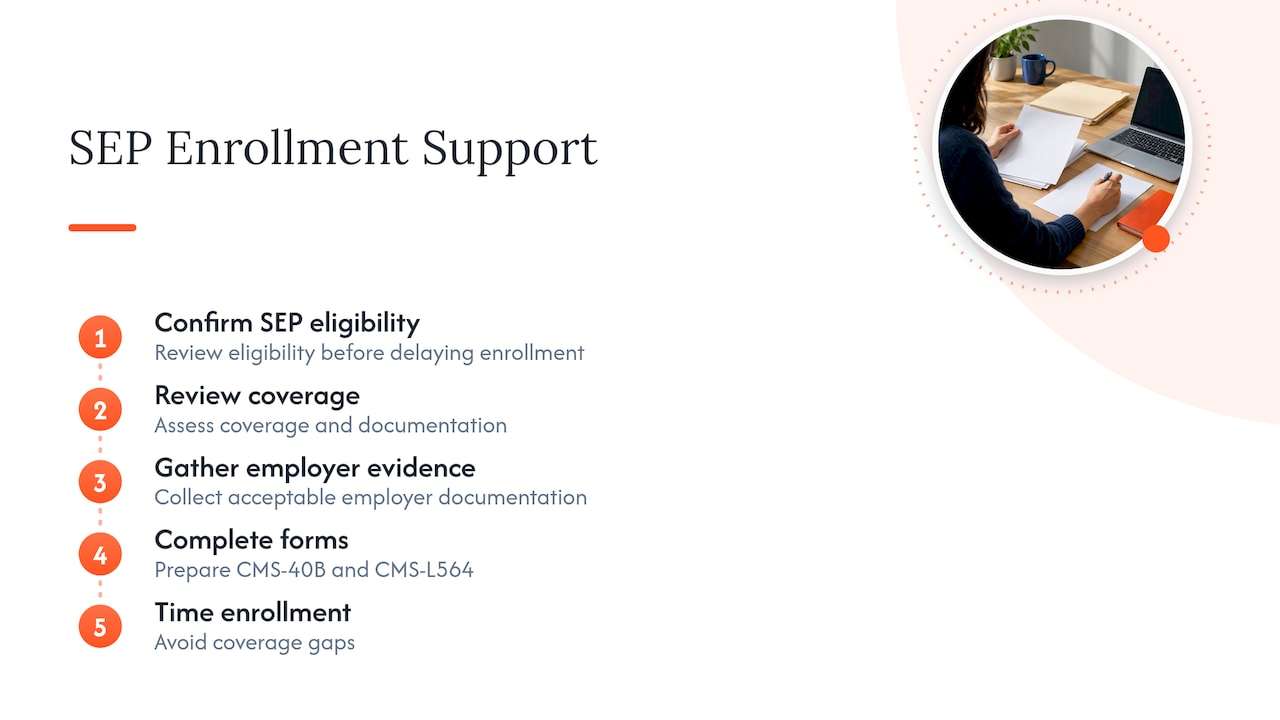
We help people in and around Charlotte confirm they qualify for the Special Enrollment Period before they delay anything. In a consultation, we walk through your coverage, review your documentation, and give you a Medicare roadmap that lays out your options. We help you gather acceptable employer evidence, complete CMS-40B and CMS-L564 correctly, and time your enrollment so you avoid coverage gaps. Our guidance comes at no extra cost to you, and we stay with you through annual plan reviews. To get started, schedule a consultation with our team or call us for personal help.
This article is general information, not a substitute for advice from a qualified doctor. Consult a qualified healthcare professional about your own circumstances before acting on anything here.
FAQ
What happens if I delay Medicare Part B?
If you have qualifying employer coverage, nothing bad happens, because the Special Enrollment Period protects you. Without it, you wait for the General Enrollment Period (January 1 to March 31) and may owe a permanent premium surcharge. Coverage then starts the month after you sign up.
How do I defer Medicare Part B without penalty?
Stay on a group health plan based on current employment, then enroll while covered or within 8 months after that coverage or employment ends. Submit CMS-40B with CMS-L564 or alternate evidence. Social Security describes the process on its SEP page.
Why would anyone decline Medicare Part B?
People with strong employer coverage often delay Part B because they would otherwise pay its premium on top of a plan that already covers them. That choice is only safe while the employer plan qualifies. Check your plan type with HR before deciding.
What is the penalty for late enrollment in Medicare Part B in 2026?
The penalty is 10% of the standard premium for each full 12-month period you could have enrolled but didn’t. With the 2026 standard premium of $202.90, that is an additional 10% of the standard premium per month for each full 12-month period you were eligible but not enrolled, and it usually lasts as long as you have Part B.
Sources
Recommended
Request a No Obligation Phone Call








Get Connected