

Original Medicare does not pay for routine dental care, so after 65 you need a separate source of coverage: a Medicare Advantage plan with dental benefits, a standalone dental plan, or retiree coverage from a former employer. The right choice depends on the dental work you expect, your dentist and your budget. We help people in Charlotte and across North Carolina match those three things to a real plan, and our dental insurance page is a good place to start.
TL;DR
- Original Medicare generally does not cover cleanings, fillings, extractions, dentures or implants. It pays only for dental work tied to certain covered medical treatment.
- Nearly all Medicare Advantage plans include some dental benefit, but scope ranges from cleanings only to fillings, crowns and dentures, usually under a yearly dollar cap.
- A standalone dental plan can sit alongside Medicare when your plan has no dental benefit or too little of it.
- Before you enroll, check the annual maximum, waiting periods, the share you pay on crowns and dentures, and whether your dentist is in network.
- The yearly window to change plans is October 15 to December 7, so compare options before then.
Table of Contents
- What Original Medicare covers for your teeth
- Why it matters: dental costs fall on you
- Your main options for dental coverage after 65
- How to compare plans for crowns, implants and dentures
- When to enroll or switch
- Where we come in
- Our perspective
- FAQ
- Sources
What Original Medicare covers for your teeth
Original Medicare means Part A (hospital) and Part B (medical). Medicare.gov says that in most cases it does not cover dental services such as routine cleanings, fillings, tooth extractions, dentures or implants. Medicare’s own list of what Original Medicare leaves out says the same.
The exceptions are narrow. Medicare may pay for dental work when it is a necessary part of a covered medical treatment, for example:
- an oral exam and dental treatment before a heart valve replacement, or before a bone marrow, organ or kidney transplant;
- a tooth extraction to treat a mouth infection before chemotherapy;
- treatment of dental complications during head and neck cancer treatment;
- exams and infection treatment before and during dialysis for end-stage renal disease.
Even then, coverage stops at the medical need. The National Council on Aging notes that Medicare will not cover implants or dentures even when it pays for preparatory work, and it does not cover follow-up dental care after the main condition is treated. In practice, Medicare may pay to pull a tooth before radiation therapy, but not to replace it.
What the covered cases cost you
When Medicare does pay, normal cost sharing applies. For 2026, Medicare.gov lists a $1,736 Part A deductible for a hospital stay, then $0 a day for days 1 to 60 and $434 a day for days 61 to 90. For dental services covered under Part B, you pay 20% of the Medicare-approved amount after the Part B deductible, plus any facility copayment in an outpatient setting. These figures are reset each year, so confirm them on the Medicare.gov dental page.
Recent rule changes are small
Medicare has widened the exceptions slightly. KFF reports that rules for 2024 added dental exams and treatment tied to head and neck cancer therapy, and the 2025 rule added dental infection treatment tied to dialysis. KFF’s analysts expect the changes to help only a small number of beneficiaries. For routine care, you still need your own coverage.
Why it matters: dental costs fall on you
KFF reports that in 2018, 47% of Medicare beneficiaries had no dental visit in the year, and cost was a major barrier. Among those who did go, the average out-of-pocket spending was $874. KFF also notes that skipped dental care can worsen chronic conditions such as diabetes and cardiovascular disease (KFF, Coverage of Dental Services in Traditional Medicare). Those numbers are from 2018, so today’s bills for crowns, implants or dentures can be higher. The point stands: a single major procedure can cost more than a year of premiums on a good plan.
Your main options for dental coverage after 65
There are four common routes. The first two are where most of our clients land.
1. A Medicare Advantage plan with dental benefits
Medicare Advantage (Part C) is an alternative way to get Medicare through a private plan. It bundles Part A and Part B, usually adds drug coverage, and often adds extras like dental, vision and hearing. KFF’s 2026 plan review found that 98% of individual Medicare Advantage plans offer some dental benefit.
“Some dental benefit” covers a lot of ground. Benefits may include only cleanings and preventive care, or more comprehensive coverage, and they are often subject to an annual dollar cap. Plans can also change their annual maximums and cost sharing from one year to the next.
Milliman’s analysis of 2025 plans adds detail that matters when you compare:
- Enrollment in plans covering only diagnostic and preventive dental rose from 4% in 2024 to 9% in 2025.
- Among enrollees with mandatory comprehensive dental coverage, over 70% have one shared limit for preventive and comprehensive services. A cleaning in March leaves less for a crown in October.
- Some plans are trimming unlimited maximums, folding dental into combined benefit packages and tightening frequency limits.
The lesson is to read the dental section of each plan rather than assume “includes dental” means crowns and dentures. Our guide on how to verify Medicare Advantage dental benefits in three steps walks through it.
2. A standalone dental plan
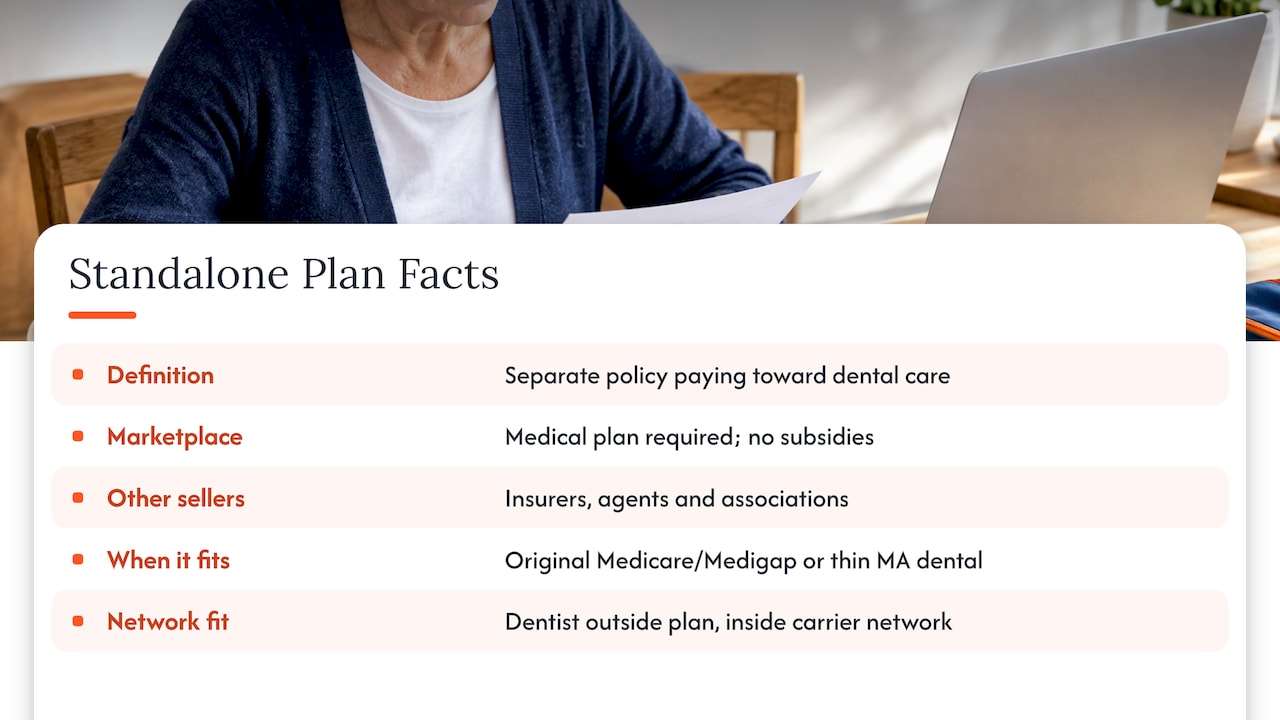
A standalone dental plan is a separate policy that pays toward your dental care whatever medical coverage you have. The American Dental Association’s consumer site lists the Health Insurance Marketplace and Medicare Advantage as places people 65 and older find coverage. FAIR Health adds that stand-alone dental bought through the federal marketplace requires also buying a medical plan, with no subsidies (FAIR Health, Dental Coverage for Retirees). Individual plans are also sold through insurers, agents and associations.
This route suits you if you have Original Medicare with a Medigap policy, since Medigap does not include routine dental, or if your Medicare Advantage plan’s dental benefit is thin. It also fits if your dentist is not in the plan’s network but is in a dental carrier’s. We compare the two paths in Medicare dental, vision and hearing benefits: Medicare Advantage vs. standalone.
3. Retiree coverage from a former employer or union
Some retirees keep dental through a former employer or a federal retiree program. Rules differ by plan. Some limit when you can enroll or re-enroll, and some permit changes only after qualifying life events, so ask the plan administrator about those rules before you drop anything. Medicare.gov also explains that with both Medicare and retiree coverage, Medicare generally pays first, and you may need both Part A and Part B to get the full retiree benefit. If you are still working past 65, our pages on the 20-employee rule and how Medicare works with employer insurance in Charlotte cover the timing.
4. Dental discount plans
A discount plan is not insurance. You pay a yearly membership fee and get reduced rates from participating dentists. The ADA notes that these plans have no deductibles or annual limits, but the discounts vary by plan terms. They can help with a known, one-time need, but they do not reimburse you the way insurance does.
How to compare plans for crowns, implants and dentures
The cleaning-and-exam coverage looks similar across plans. The differences show up on major work. Use this checklist on every plan you consider.
| What to check | Why it matters |
|---|---|
| Annual maximum | Many plans cap yearly benefits. A cap lower than one crown plus a denture means you pay the rest. |
| Shared or separate limit | If preventive and major care share one cap, early-year visits shrink what is left for big work. |
| Coinsurance by category | Preventive care is often paid at a higher share than crowns, dentures or implants. |
| Waiting periods | Some plans delay major services for months after you enroll. |
| Implant coverage | Many plans exclude implants or cover only part of the cost. Ask for it in writing. |
| Frequency limits | A plan may allow one denture or crown on the same tooth only every few years. |
| Network | Check your own dentist, not just the carrier’s list of dentists in the area. |
| Premium and medical costs | For a Medicare Advantage plan, weigh dental against the plan’s premium, out-of-pocket maximum and doctors. |
Two habits save money. First, get a treatment plan and cost estimate from your dentist before you shop, so you compare plans against real procedures. Second, look up typical local prices with FAIR Health’s Dental Cost Lookup to see whether a plan’s cost sharing makes sense.
A simple worked example
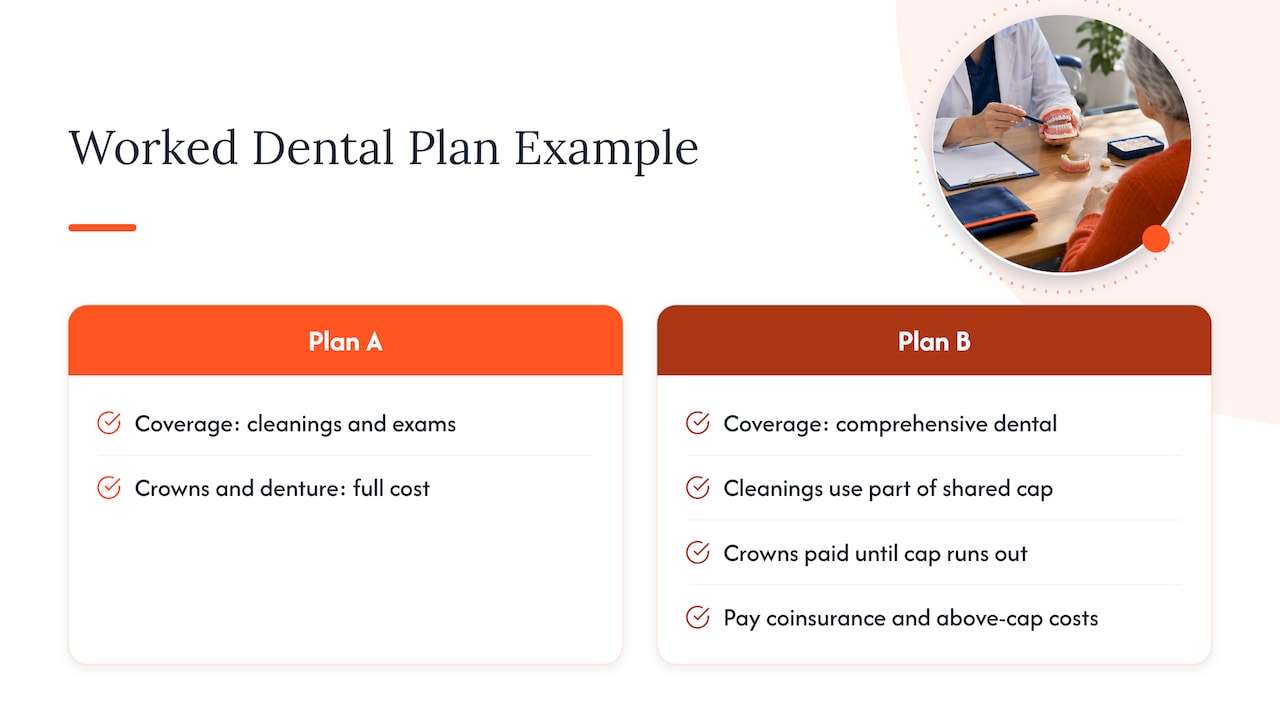
Suppose your dentist recommends two crowns and a partial denture. Plan A is a Medicare Advantage plan with a preventive-only dental benefit. It pays for cleanings and exams, so you pay the full cost of the crowns and denture. Plan B has a comprehensive dental benefit with a shared annual cap. Your two cleanings use part of the cap, and the plan pays a share of the crowns until the cap runs out. You pay the coinsurance and anything above the cap. Plan B can still come out well ahead of Plan A. But you only know that by running your own treatment plan through each plan’s numbers, which is the work we do with clients.
When to enroll or switch
Timing affects both your dental coverage and your penalties.
- When you first turn 65. Medicare’s fact sheet on enrollment says you can join a Medicare Advantage plan or a drug plan during a 7-month period that includes the 3 months before the month your Part A or Part B starts.
- Every fall. Each year, the Open Enrollment Period runs October 15 to December 7, when you can join, switch or drop a Medicare Advantage plan for the following year. Plans change dental caps and cost sharing from year to year, so a fall review is worth it even if you are happy with your plan.
- Early in the year. The Medicare Advantage Open Enrollment Period, January 1 to March 31, lets people already in a Medicare Advantage plan switch to another one or return to Original Medicare. Check Medicare.gov for the current rules.
- Medigap. If you do not buy a Medigap policy within 6 months of first getting Parts A and B, you may not be able to buy one later or may pay more.
Adding or switching a dental plan can be done separately from your medical coverage. Do not let a missed Medicare deadline pass while you focus on teeth. Late enrollment penalties on Part B and Part D can last for as long as you have the coverage.
Where we come in
We are a Medicare insurance agency in Charlotte, North Carolina, and dental, vision and hearing plans are part of what we offer, alongside Medicare Advantage, Medicare Supplement and Part D drug plans. Our agents go through a comprehensive training program, and our guidance comes at no extra cost to you. A consultation covers your eligibility, your dentist and the dental work you expect, and we offer a free Medicare roadmap that lays out your options. You can see the full range on our main page.

If you already have a Medigap policy or a Medicare Advantage plan, we also do annual plan reviews, so you can see whether your dental benefit still fits before the fall window opens. For more on how the pieces fit, see our guide to Medicare dental, vision and hearing coverage options.
Our perspective
Most people come to us after a surprise. A dentist says a tooth needs a crown or a denture, and the person learns Medicare will not pay. We would rather you learn that before the bill arrives.
Our view is that dental coverage should be chosen with the rest of your Medicare, not on its own. A Medicare Advantage plan with a strong dental benefit can be an efficient answer, and a standalone plan can complete a Medigap setup. Either works best when it is matched to your dentist, your likely treatments and your budget, and when you review it every year, because benefits and caps change.
That is why we train our agents to explain the options plainly and to build long-term relationships rather than one-time sales. Our free Medicare roadmap and our annual reviews are part of that. If you are 65 or close to it, we are glad to help you make the choice with all of the information in front of you.
Zach
FAQ
Does Medicare cover dentures or implants?
No. Original Medicare does not cover dentures or implants, even when it pays for related preparatory work before a covered procedure. Some Medicare Advantage and standalone dental plans cover part of the cost of dentures, and some cover implants, but scope and annual caps vary a great deal by plan.
Do all Medicare Advantage plans include dental?
Nearly all do. KFF found that 98% of individual Medicare Advantage plans offered some dental benefit in 2026. The benefit may be only cleanings and exams or may include fillings, crowns and dentures, and most have an annual dollar limit. Read the plan’s dental section before you enroll.
Can I have both Medicare Advantage and a standalone dental plan?
Yes. Some people pair a Medicare Advantage plan with a standalone dental plan when the plan’s own dental benefit is limited or their dentist is not in its network. Compare what the second plan adds against its premium, and check how the two plans would work together on a claim.
Is dental insurance worth it after 65?
It depends on the work you expect. If you only need cleanings and exams, a basic benefit may be enough. If your dentist has recommended crowns, bridges or dentures, a plan with a solid annual maximum and fair coinsurance can lower your costs. Take your dentist’s treatment plan and compare it with each plan’s numbers.
What if I cannot afford dental care and have low income?
Medicaid dental benefits for adults are a state option rather than a federal requirement, and many states limit them, according to KFF’s Medicaid dental analysis. Community health centers are also a major source of dental care for low-income patients. Contact your state Medicaid office to see what North Carolina offers.
Sources
- Dental service coverage, Medicare.gov
- What’s not covered by Original Medicare, Medicare.gov
- Does Medicare Cover Dental, Vision, and Hearing Care?, National Council on Aging
- Coverage of Dental Services in Traditional Medicare, KFF
- Medicare Advantage 2026 Spotlight, KFF
- Dental coverage in Medicare Advantage plans, Milliman
- Types of Dental Plans, MouthHealthy (American Dental Association)
- Dental Coverage for Retirees, FAIR Health
- Retiree insurance and Medicare, Medicare.gov
- Understanding Medicare Advantage and Medicare Drug Plan Enrollment Periods, Medicare.gov
- Access to Dental Care in Medicaid, KFF
Recommended
Request a No Obligation Phone Call








Get Connected