

Yes. Certain Medigap plans pay part of your emergency medical bills abroad, but the benefit is narrow: 80% of billed charges after a deductible, with a lifetime cap, and only for care that starts within the first 60 days of a trip. Original Medicare, on its own, almost never pays for care outside the United States.
TL;DR:
- Medigap foreign travel emergency benefits cover up to 80% of billed charges after a $250 deductible, with a $50,000 lifetime cap on all trips combined.
- Coverage applies only if emergency care starts within 60 days of leaving the U.S., and the lifetime cap is not reset by extended stays abroad.
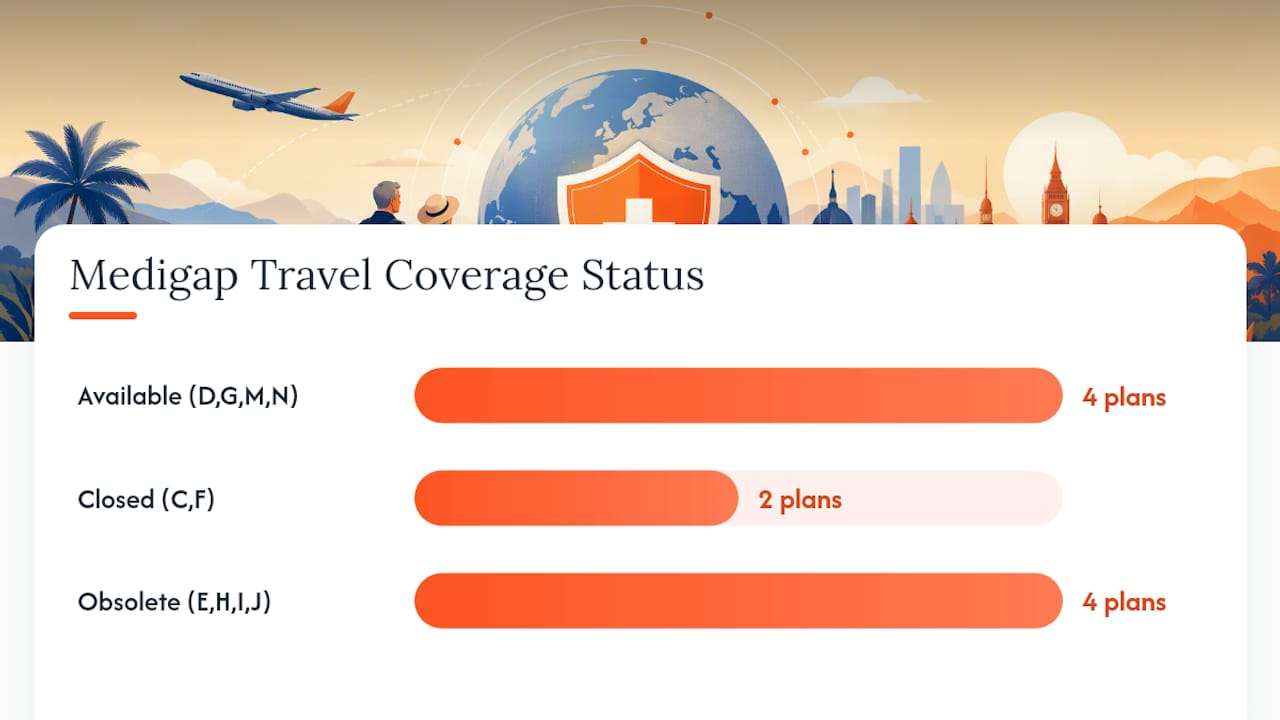
- Plans C and F are closed to new enrollees, while Plans D, G, M, and N remain available and commonly include foreign travel benefits.
- Medicare generally does not pay for overseas care outside three narrow, rare exceptions, making Medigap coverage essential for most travelers.
- For longer or remote trips, standalone travel medical insurance and evacuation coverage are recommended to supplement the limited Medigap benefits.
Table of Contents
- Which Medigap Plans Cover Foreign Travel Emergency Medical Care
- How the $250 Deductible, 80% Coinsurance, and $50,000 Cap Actually Work
- Does Original Medicare Ever Pay for Care Outside the U.S.?
- What to Do If You Need Emergency Care Abroad
- What If Medigap Doesn’t Cover Enough of Your Trip?
- Questions to Ask Before You Travel
- How Safeguard Benefit Services Helps You Prepare for Travel
- Get a Plan Review Before Your Next Trip
- Sources
Which Medigap Plans Cover Foreign Travel Emergency Medical Care
Not every Medigap plan includes this benefit, and not every plan letter is still on the market for new buyers. If you’re shopping for a supplement policy specifically because you travel, the plan letter you pick affects your available benefits as well as the price.
Standardized Medigap plans that include foreign travel emergency coverage are C, D, F, G, M, and N, along with some older plans E, H, I, and J. That’s a wide list, but two of those letters come with an asterisk.
- Plans C and F are closed to most new Medicare enrollees, available only to those eligible before a cutoff date.
- Plans E, H, I, and J are no longer sold and remain active only for existing holders.
- Plans D, G, M, and N remain available to new buyers and are commonly quoted for the travel benefit.
Every Medigap plan is federally standardized, meaning Plan G in North Carolina covers the same benefits as Plan G in Ohio. What changes state to state is pricing and which insurance carriers sell each letter, not the coverage itself. That standardization is also why the foreign travel emergency benefit reads almost identically across every plan that offers it.
One more thing worth stating plainly: Medigap doesn’t replace Medicare. It supplements it. You still need Part A and Part B in force, and Medigap only pays after Original Medicare has done its part, or in the case of foreign travel, where Original Medicare typically does nothing at all. For a fuller breakdown of how these standardized plans work, our guide to Medicare Supplement plans walks through each letter in detail.
Availability also depends on timing. If you first became eligible for Medicare after the cutoff for Plans C and F, those doors are closed no matter how much you’d like the coverage. That’s a real planning wrinkle for people approaching 65 who assume every letter is available to everyone.
How the $250 Deductible, 80% Coinsurance, and $50,000 Cap Actually Work
The mechanics are consistent across every plan that offers this benefit, and they’re worth memorizing before you book a flight. Medicare.gov’s own publication on coverage outside the United States lays out the formula: you pay a $250 deductible per year, and after that, your Medigap plan pays 80% of the billed charges for medically necessary emergency care. You’re on the hook for the remaining 20%, plus anything above the lifetime cap.
The numbers that matter most:
- an annual deductible before the benefit kicks in
- a coinsurance percentage paid by your Medigap plan on covered emergency charges
- a lifetime maximum aggregated across all trips
- Coverage applies only to care that begins during the first portion of a trip
That lifetime cap is the detail people miss. It isn’t $50,000 per year or per trip. It’s $50,000 total for the rest of your life on that policy. Once it’s used up, that specific protection is gone, even if you switch plans later.
The 60-day rule trips people up too. The clock starts the day you leave the U.S. If you fall ill on day 45 of a six-week cruise, you’re covered. If you’re living abroad for five months and get sick on day 90, you’re not. And that 60-day window resets only when you return to the U.S. and depart again. A long-term stay doesn’t refresh the clock just because months have passed.
“Medically necessary emergency care” generally means sudden illness or injury requiring immediate treatment, not elective procedures, routine checkups, or care for a condition you knew about before you left. A broken hip on a hiking trail in Portugal qualifies. A scheduled follow-up with a specialist while visiting family in Italy does not.
Pro Tip: Keep a running mental tally of how much of your $50,000 lifetime cap you’ve used. If you travel frequently and have already filed one or two large claims, that number can shrink faster than you’d expect, and it’s easy to lose track of it between trips.
Does Original Medicare Ever Pay for Care Outside the U.S.?
Rarely, and the exceptions are specific enough that most travelers will never hit them. Medicare.gov outlines three narrow scenarios where Original Medicare might apply:
- You’re traveling through Canada by the most direct route between Alaska and another U.S. state when a medical emergency happens.
- You live in the U.S. and a foreign hospital is closer to your home than the nearest U.S. hospital, regardless of whether an emergency is involved.
- You’re on a ship within six hours of a U.S. port when the emergency occurs.
In those situations, Part A can cover inpatient hospital care and Part B can cover doctor services and ambulance transport tied to that covered stay. Everything else, including outpatient visits unrelated to those exceptions, generally falls outside Medicare’s reach.
Here’s the practical problem: foreign hospitals almost never bill Medicare directly. You’ll likely need to pay the bill yourself and submit an itemized claim afterward, hoping it fits one of those three boxes. Most beneficiaries who get sick abroad never come close to qualifying, which is exactly why the Medigap foreign travel benefit exists in the first place.
What to Do If You Need Emergency Care Abroad
A medical emergency in a foreign country is disorienting enough without also worrying about paperwork. Having a mental checklist before you leave makes the difference between a smooth reimbursement and a denied claim.
- Get treatment first. Don’t delay care to think about billing. Contact local emergency services or your hotel or ship staff, who usually know the fastest route to reliable care.
- Write down provider details immediately. Hospital name, doctor’s name, treatment dates, and diagnosis, ideally before you leave the facility while details are fresh.
- Collect an itemized bill, not a summary receipt. You need a breakdown of each service and charge, not just a total.
- Get everything translated if it isn’t in English. Some insurers require an official translation before they’ll process a claim.
- Pay in local currency when possible and keep proof of payment (credit card receipt, bank statement, or cash receipt) alongside the itemized bill.
- Contact your Medigap insurer’s claims department as soon as you’re able, either from abroad or once you’re home. Ask what claim form they need and where to send it.
- Call 1-800-MEDICARE if you believe one of the rare Original Medicare exceptions might apply, since those claims route differently than a standard Medigap foreign travel claim.
- Keep copies of everything you submit. Foreign claims sometimes take longer to process, and having backups saves you from starting over if something gets lost in the mail.
Pro Tip: Photograph every document the moment you receive it, right there in the hospital or pharmacy. Paper receipts abroad fade, get lost, or get written in a script your insurer’s claims processor can’t read without a translation you may not have time to arrange later.
What If Medigap Doesn’t Cover Enough of Your Trip?
The $50,000 lifetime cap sounds generous until you consider what a multi-day hospitalization or an air ambulance evacuation actually costs overseas. That’s where standalone coverage fills real gaps.
Travel medical insurance is a separate policy, purchased for a specific trip, that pays for emergency medical expenses abroad. Some policies pay as primary coverage, settling claims directly, while others act as secondary coverage and require you to file with Medicare or your Medigap insurer first. Squaremouth’s breakdown of emergency medical benefits notes that primary policies tend to reimburse faster since there’s no waiting on a first insurer’s decision.
Emergency medical evacuation is usually sold as a separate add-on, and for good reason: evacuation from a remote region or a small island hospital to a facility equipped to treat you can run into six figures. Medigap’s foreign travel benefit does not include evacuation costs.
Medicare Advantage complicates the picture further. Some Medicare Advantage plans offer limited international benefits, but that coverage varies enormously by plan and carrier, unlike the standardized Medigap benefit. If you’re enrolled in Medicare Advantage and planning international travel, you cannot assume the same 80/20 formula applies. Our comparison of Medicare Advantage versus Medigap covers how the two paths diverge on this exact issue.
A reasonable rule of thumb: if you’re taking a trip longer than a couple of weeks, heading somewhere with limited hospital infrastructure, or simply want a buffer above $50,000, a standalone travel medical policy with evacuation coverage is worth the cost.
Questions to Ask Before You Travel
Confirming your coverage takes fifteen minutes and can save you thousands. Before booking anything, call your insurer or agent and ask directly:
- “Does my specific plan include foreign travel emergency care, and is it still in the plan I hold?”
- “What’s my deductible and coinsurance percentage for care outside the U.S.?”
- “How much of my $50,000 lifetime cap have I already used?”
- “What’s the exact process for filing a claim for care received abroad?”
- “Are there exclusions for pre-existing conditions on this specific benefit?”
- “Do you require translated documents or a particular claim form?”
Ask for the claims mailing address, a sample claim form, and a direct phone line in writing before you leave. An email confirmation from your carrier is worth far more than a verbal answer if a dispute comes up later.
Pro Tip: If your agent can’t answer the lifetime cap question on the spot, ask them to pull your claims history before you travel. It’s a five-minute lookup that tells you exactly how much protection you have left.
How Safeguard Benefit Services Helps You Prepare for Travel
I’ve reviewed enough Medigap policies to know most beneficiaries don’t find out their travel coverage has a gap until they’re standing in a foreign hospital hallway. Agents review your specific plan letter, check whether the foreign travel benefit applies, and flag how much of that $50,000 lifetime cap you have left.
The recommendations that come out of those reviews are usually the same three: confirm your plan letter actually includes the benefit, add a standalone travel medical policy if you’re going somewhere remote or staying longer than a couple of weeks, and consider an evacuation add-on if your itinerary includes limited hospital access. If you want a plan-specific answer instead of a general one, request a free Medicare roadmap and the policy can be reviewed before your next trip.
— Zach
Get a Plan Review Before Your Next Trip
Your actual Medigap policy can be reviewed against your travel plans, not a generic checklist, so you know your $50,000 lifetime cap and remaining coverage before you book anything.

Many beneficiaries aren’t sure whether they have a plan letter that includes the foreign travel benefit, let alone how much of the lifetime cap they’ve used. A quick policy review can answer both questions and indicate whether pairing a Medigap plan with a standalone travel medical policy for trips abroad might be beneficial. If you’re comparing whether Medigap or Medicare Advantage fits your travel habits better, our Medicare Supplement plan guide breaks down every plan letter side by side. Ready to check your specific coverage before your next trip? Schedule a free Medicare roadmap consultation and get a straight answer on what your plan actually covers overseas.
Sources
For the most current figures and rules, go straight to the source rather than relying on secondhand summaries. Medicare.gov’s coverage outside the United States publication is the definitive reference for deductibles, coinsurance, and the lifetime cap. The Medicare.gov travel coverage page covers the rare Original Medicare exceptions, and CMS transmittals detail how foreign claims get processed on the billing side. AARP’s consumer guide is a solid plain-language supplement to those official documents.
- Medicare coverage outside the United States (PDF)
Recommended
Request a No Obligation Phone Call








Get Connected