

Medicare covers home health care when a doctor certifies you’re homebound and need intermittent skilled nursing or therapy, and covered services typically cost $0. Skilled nursing, physical and occupational therapy, speech therapy, medical social services, and home health aide support (when paired with skilled care) all qualify. Durable medical equipment ordered alongside your care falls under Part B, so you’ll owe the deductible plus 20% coinsurance. Verify your specific case at Medicare.gov or by calling 1-800-MEDICARE.
TL;DR:
- Medicare covers home health care only if a doctor certifies you are homebound and need intermittent skilled nursing or therapy, not custodial care.
- Covered services are limited to skilled nursing, therapy, medical social services, and home health aide support when paired with skilled care, billed on a 30-day cycle.
- Eligibility requires a signed care plan, face-to-face encounter within the required window, homebound status, and need for skilled, not custodial, care; missing any condition results in denial.
- Medicare does not pay for 24-hour care, meal delivery, general homemaker services, or personal care unless combined with skilled services, and claims can be denied if the plan of care is incomplete.
- Out-of-pocket costs are generally zero for services, but durable medical equipment ordered during care is billed separately with deductible and coinsurance under Part B.
Table of Contents
- What Home Health Services Does Medicare Cover?
- Who Qualifies for Home Health Coverage Under Medicare?
- What Medicare Won’t Pay For (and Why Claims Get Denied)
- How Much Does Home Health Care Cost Under Medicare?
- How Long Will Medicare Pay for Home Health Care?
- Choosing a Home Health Agency and Knowing Your Rights
- What to Do If Home Health Coverage Is Denied or Ends Early
- How Medicare Works Alongside Other Coverage for Home Health
- Documentation That Supports a Medicare Home Health Claim
- Starting Home Health Care: The Referral and Assessment Process
- Where the Conventional Advice on Home Health Coverage Falls Short
- How Safeguard Benefit Services Helps You Sort Out Coverage
- Official Resources to Verify Your Coverage
- Sources
- FAQ
What Home Health Services Does Medicare Cover?
Medicare home health coverage runs through a Medicare-certified home health agency, and it only pays for skilled, medically necessary care ordered by your doctor. This isn’t a broad personal-care benefit. It’s a targeted clinical service built around your plan of care.
Covered services include:
- Skilled nursing care on an intermittent basis (wound care, injections, monitoring a new medication, catheter management)
- Physical therapy to rebuild strength or mobility after an injury, surgery, or illness
- Occupational therapy to relearn daily tasks like dressing or bathing safely
- Speech-language pathology for swallowing or communication issues
- Medical social services to help with the emotional and social factors tied to your illness
- Home health aide services, but only if you’re also getting skilled nursing or therapy at the same time
- Medical supplies used during a covered visit, and durable medical equipment ordered as part of your care
Payment to the agency runs on a 30-day cycle under the Home Health Prospective Payment System, commonly abbreviated HH PPS. Medicare pays the agency a set rate for each 30-day period rather than billing visit by visit, and that period renews automatically for as long as you continue to qualify. There’s no cap on how many 30-day periods you can have. What matters is whether your doctor and agency can keep demonstrating the care is still reasonable and necessary.
Who Qualifies for Home Health Coverage Under Medicare?
Four conditions have to line up before Medicare pays a dime, and missing even one is the most common reason claims get denied.
- A doctor or allowed provider must order your care and sign off on a plan of care, then recertify it periodically as your needs evolve.
- A face-to-face encounter with that doctor or an allowed provider (nurse practitioner, physician assistant, or clinical nurse specialist) must happen within a set window around the start of care, confirming the visit and the need for skilled services.
- You must be homebound. That means leaving home takes considerable effort, requires help from another person or a device like a walker or wheelchair, or is medically inadvisable. Someone recovering from hip surgery who can only leave for medical appointments, using a walker and a family member’s help, fits this definition. Occasional trips to church, a family gathering, or a haircut don’t disqualify you.
- You must need intermittent skilled care, not custodial help. A patient needing twice-weekly wound care and physical therapy after a fall qualifies. Someone who just needs help bathing and preparing meals, with no clinical component, does not.
Medicare.gov lays out these requirements in detail, including how homebound status and skilled-need thresholds are assessed by your certifying provider.
What Medicare Won’t Pay For (and Why Claims Get Denied)
Medicare draws a hard line between skilled medical care and long-term personal assistance, and that line trips up more families than any other part of this benefit.
Services Medicare does not cover include:
- 24-hour-a-day care at home
- Meal delivery
- Homemaker services like general cleaning or laundry unrelated to your care plan
- Personal care (bathing, dressing, toileting) when it’s the only service needed, with no skilled nursing or therapy involved
- Custodial care provided mainly to help with daily activities rather than treat a condition
Denials usually come from one of two places: the service requested was never written into the plan of care, or the ongoing need looks custodial rather than skilled. An insight worth remembering here is that families frequently mistake custodial personal care for a covered skilled service, and that confusion is exactly what triggers surprise bills.
When an agency believes Medicare probably won’t pay for a service, it’s required to give you an Advance Beneficiary Notice (ABN) before providing it. Signing an ABN means you’re agreeing to pay out of pocket if Medicare denies the claim.
Pro Tip: Ask your agency to show you the actual plan of care and confirm every service you’re receiving is listed on it. Anything delivered outside that document is the easiest thing for Medicare to reject.
How Much Does Home Health Care Cost Under Medicare?
Covered home health services cost you nothing out of pocket, as long as you meet all eligibility rules. There’s no deductible and no coinsurance for the skilled nursing, therapy, aide services, or social work visits themselves.
Beneficiaries pay $0 for covered home health services, but durable medical equipment ordered as part of that care is billed separately under Part B. That means you’ll pay the Part B deductible plus 20% coinsurance on items like hospital beds, walkers, or oxygen equipment.
That split confuses a lot of families. The nursing visit is free. The wheelchair the nurse recommends is not, and it shows up on a separate Part B claim. If you want a fuller breakdown of how the Part B deductible interacts with other out-of-pocket costs across Medicare, our Medicare costs guide walks through the numbers for the current year.
Before care starts, ask the agency directly which items will bill under Part A home health and which will bill separately under Part B. If a bill ever looks off, call the agency first, then 1-800-MEDICARE if you can’t get a straight answer.
How Long Will Medicare Pay for Home Health Care?
There’s no fixed cutoff. Medicare can keep paying for home health visits indefinitely, as long as your doctor continues to certify that care is reasonable and necessary and you still meet the homebound and skilled-need criteria.
The catch is the “part-time or intermittent” standard that governs frequency. In practice, that generally means a limited number of hours per day (combined nursing and aide time) and a capped number of hours per week, occasionally extended for a limited period if your doctor documents the need. It’s not built for someone who needs round-the-clock supervision.
Payment itself runs in 30-day HH PPS cycles. Each period gets recertified, and a new 30-day period opens automatically if your care continues. Some beneficiaries stay on service for a single 30-day period after a surgery; others cycle through several consecutive periods for a chronic condition that keeps generating skilled needs.
Choosing a Home Health Agency and Knowing Your Rights
You have the right to choose which Medicare-certified home health agency treats you under Original Medicare. Medicare Advantage enrollees often face a narrower network and may need prior authorization, so it pays to check your plan’s rules before assuming coverage will look identical to Original Medicare.
Before care starts:
- Confirm the agency is Medicare-certified and accepts Medicare’s approved payment amount.
- Check the agency’s quality ratings on Medicare Care Compare.
- Ask to review the plan of care and confirm every service you expect is listed.
- If you’re on a Medicare Advantage plan, call the plan directly to confirm network status and any prior-authorization steps required for home health, since rules can differ from Original Medicare.
Pro Tip: If you’re comparing a Medicare Advantage plan against Original Medicare with a Medigap policy, look closely at how each handles home health referrals. Our Medicare Advantage vs. Medicare Supplement guide breaks down how network rules affect access to care like this.
What to Do If Home Health Coverage Is Denied or Ends Early
Two notices govern this process. An ABN warns you before a service starts that Medicare likely won’t pay. A Notice of Medicare Non-Coverage (NOMNC) tells you at least two days before your care ends that services are stopping.
If you disagree with an early end to care, you can:
- Request a fast appeal through your state’s Beneficiary and Family Centered Care Quality Improvement Organization (BFCC-QIO), which typically issues a decision within a day or two of your request.
- Ask the agency to document, in writing, why it believes the service no longer qualifies.
- Call 1-800-MEDICARE for a case review, or contact your State Health Insurance Assistance Program (SHIP) for free, unbiased counseling.
How Medicare Works Alongside Other Coverage for Home Health
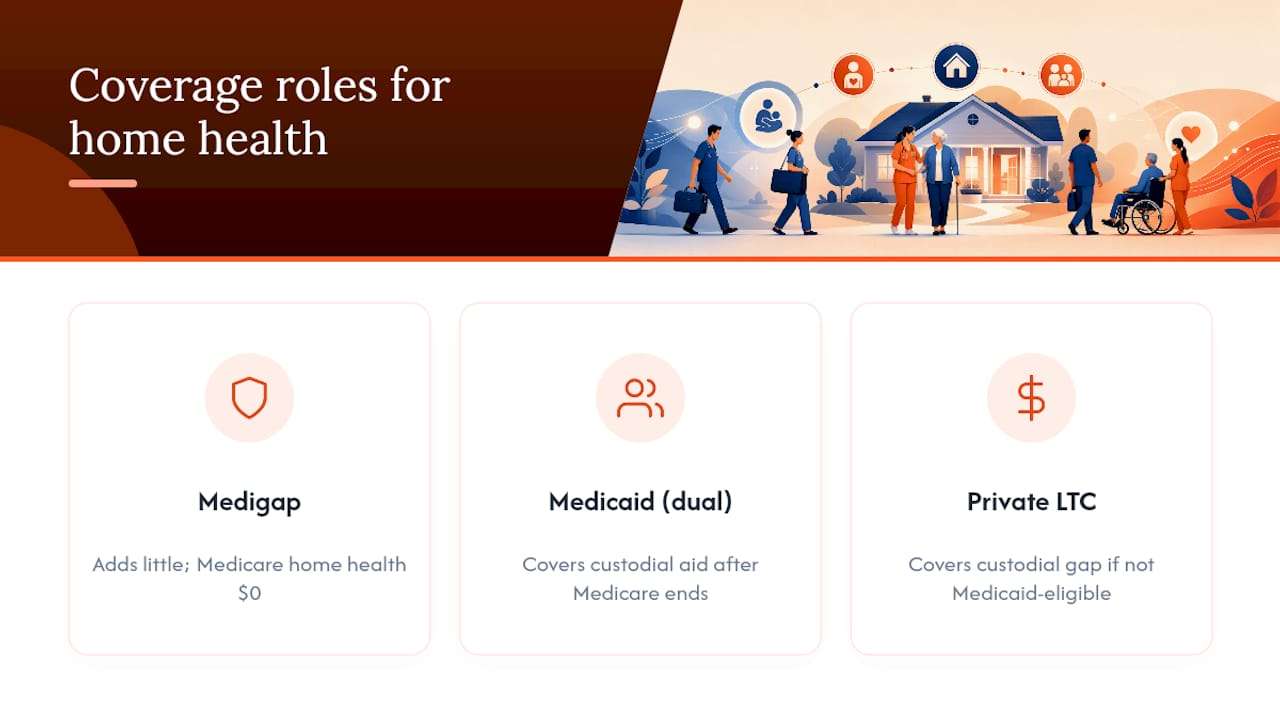
Original Medicare pays the home health claim first, but what happens next depends on what other coverage you’re carrying. A Medigap (Medicare Supplement) policy generally doesn’t add much value here, since covered home health services already cost $0 under Part A and B.
Dual-eligible beneficiaries, people enrolled in both Medicare and Medicaid, get a different safety net. Medicaid can cover home health aide hours or personal care services that Medicare excludes, like ongoing custodial help with bathing or meal prep, once Medicare’s skilled-care benefit ends or was never applicable. This is often where the real gap sits: Medicare handles the medical piece, Medicaid (where eligible) handles the custodial piece, and neither one covers everything on its own.
Private long-term care insurance can also fill that custodial gap for beneficiaries who don’t qualify for Medicaid. If you’re weighing supplemental coverage, it helps to map out what Medicare will and won’t pay for before you buy a policy meant to cover the rest. Our guide on combining Medicare with age-in-place home care covers how these pieces typically fit together for seniors staying at home long term.
Documentation That Supports a Medicare Home Health Claim
Claims get approved or denied on paperwork as much as on medical need. The agency and your doctor’s office carry most of that burden, but knowing what should exist helps you catch gaps before they become denials.
Expect these records to exist somewhere in your file:
- The signed plan of care, listing every service, frequency, and duration of treatment ordered by your doctor.
- Face-to-face encounter documentation, showing the date and clinical findings that justified certifying you as homebound and in need of skilled care.
- Periodic recertification notes every 60 days (aligned with certification periods) confirming continued need.
- Visit notes from nurses and therapists documenting what was done, how you responded, and progress toward stated goals.
- Physician orders for any changes to frequency, new services, or discharge.
If you’re a caregiver managing this for a parent or spouse, ask the agency’s intake coordinator for a copy of the plan of care and keep it somewhere accessible. When a claim is questioned later, having your own copy speeds up the appeal significantly.
Starting Home Health Care: The Referral and Assessment Process
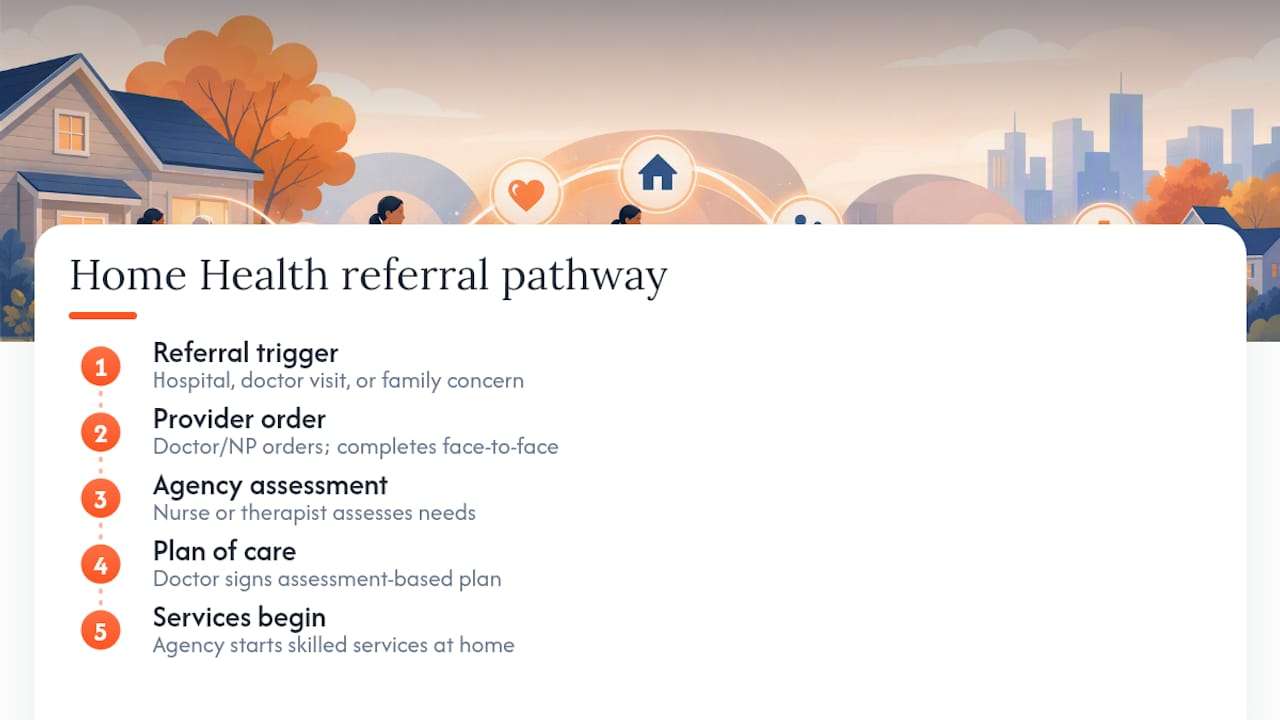
Home health almost always starts with a hospital discharge, a doctor’s office visit, or a call from a concerned family member prompting an evaluation. The mechanics are straightforward once you know the sequence.
Your doctor (or an allowed provider like a nurse practitioner) has to order home health services and complete the face-to-face encounter, either in person or through an already-scheduled telehealth visit. From there, the doctor refers you to a Medicare-certified agency of your choosing. That agency sends a nurse or therapist to your home for an initial assessment, which measures your functional status, safety risks, medication needs, and the specific skilled services required.
That assessment becomes the backbone of the plan of care, which your doctor signs before services officially begin. If you’re being discharged from a hospital or skilled nursing facility, the discharge planner typically coordinates the referral directly with an agency, so ask specifically whether home health has been ordered before you leave. If you’re initiating care from home rather than a hospital stay, start with a call to your primary care provider’s office and ask them to evaluate you for a home health referral.
Where the Conventional Advice on Home Health Coverage Falls Short
Most guidance on this topic treats Medicare’s home health benefit like a simple yes-or-no question: are you homebound, yes or no, do you get coverage. That framing undersells how much this benefit depends on documentation quality and ongoing recertification, not just the initial qualifying event.
The bigger blind spot is Medicare Advantage. Millions of beneficiaries assume their MA plan mirrors Original Medicare’s home health rules exactly, and that’s often not true. Network restrictions and prior-authorization requirements can delay or limit access in ways Original Medicare simply doesn’t impose. If you’re on an MA plan, verifying home health rules before you need the service, not after a hospital discharge, is the single most useful thing you can do.
The other overlooked piece is the plan of care itself. Families obsess over the initial eligibility determination and then stop paying attention, but recertification every 60 days is where coverage quietly lapses if nobody’s tracking it. Ask your agency proactively about recertification timing rather than waiting for a notice that services are ending.
— Zach
How Safeguard Benefit Services Helps You Sort Out Coverage
Home health rules are consistent on paper but messy in practice, especially once Medicare Advantage networks and prior authorizations enter the picture. Our licensed agents provide guidance through a Medicare roadmap that clarifies how specific plans handle home health referrals, network restrictions, and enrollment timing.

If you’re comparing Medicare Advantage against a Medigap policy before you need home health services, that’s the ideal time to talk to a knowledgeable resource. Ongoing support and plan reviews can help you avoid surprises due to network changes mid-treatment. Visit Safeguard Benefit Services to schedule a personalized consultation, or explore our Medicare Advantage plan breakdown to see how coverage compares before you enroll or switch.
Official Resources to Verify Your Coverage
- Medicare
- Medicare & You handbook
- Medicare Care Compare for agency quality ratings
- 1-800-MEDICARE or your local SHIP office for free, direct counseling
This article is general information, not a substitute for advice from a qualified doctor. Consult a qualified healthcare professional about your own circumstances before acting on anything here.
Sources
FAQ
How Much Will Medicare Pay for Home Health Care Per Month?
Medicare pays a home health agency a set rate for each 30-day period rather than a fixed monthly dollar amount, and covered services cost you $0 out of pocket when you meet eligibility rules. Any durable medical equipment ordered alongside your care bills separately under Part B, with the usual deductible and 20% coinsurance.
How Long Will Medicare Pay for Home Health Care?
There’s no maximum number of visits or fixed end date. Coverage continues through repeating 30-day payment periods as long as your doctor recertifies that skilled, intermittent care is still reasonable and necessary.
Does Medicare Pay for Home Health Care for Seniors?
Yes, Medicare covers home health care for seniors of any age who meet the eligibility requirements: homebound status, a doctor’s certification, a face-to-face encounter, and a need for intermittent skilled nursing or therapy. Age alone doesn’t determine eligibility; the clinical criteria do.
How Much Will Medicare Pay a Family Caregiver?
Original Medicare does not pay family members directly for providing custodial care or general caregiving support. It only pays Medicare-certified home health agencies for skilled services ordered by a doctor, so a family caregiver providing unpaid personal care isn’t compensated through this benefit, though some Medicaid programs offer separate caregiver payment options for eligible beneficiaries.
Does Safeguard Benefit Services Help With Home Health Coverage Questions?
Yes. Safeguard Benefit Services offers free, personalized consultations to help beneficiaries understand how their specific Medicare Advantage or Original Medicare plus Medigap coverage handles home health referrals, network rules, and enrollment timing. Current details on services and consultations are available on the Safeguard Benefit Services website.
Recommended
Request a No Obligation Phone Call








Get Connected