

Enroll in any part of Medicare, whether Part A or Part B, and you must stop HSA contributions the month that coverage begins. You can still spend existing HSA dollars tax-free on qualified medical expenses and many Medicare premiums. The tricky part is timing: retroactive Part A coverage and Social Security enrollment can quietly disqualify earlier months, which can result in excess contributions without people realizing.
TL;DR:
- Enrollment in Medicare Part A, Part B, or Advantage plans automatically disqualifies HSA contributions from the month of enrollment onwards, not just from age 65.
- Retroactive Part A coverage can reach back several months, potentially making previous HSA contributions excess and subject to penalties.
- You can still use existing HSA funds tax-free for qualified expenses and Medicare premiums, except for Medigap premiums, which are ineligible.
- When one spouse enrolls in Medicare, the other spouse can still contribute to an HSA if they remain covered by a qualifying HDHP, up to the family limit.
- Stopping contributions requires careful timing, ideally at least one month before actual Medicare coverage begins, and recording all transition documentation to prevent penalties.
Table of Contents
- Why Medicare Enrollment, Not Age 65, Ends HSA Contributions
- How Retroactive Part A and Social Security Enrollment Change Your Timeline
- What You Can Still Buy With HSA Money After Medicare Starts
- How Spousal Coverage and Family Limits Shift When One Spouse Enrolls
- Common HSA and Medicare Mistakes That Trigger Penalties
- Your Month-by-Month HSA and Medicare Checklist
- Why Timing Discipline Beats Panic Every Time
- Get Local Help Timing Your Medicare Enrollment
- Where to Verify These Rules Yourself
- Sources
- FAQ
Why Medicare Enrollment, Not Age 65, Ends HSA Contributions
Turning 65 does not, by itself, end your HSA eligibility. Enrollment does. The Internal Revenue Service treats these as separate events, and mixing them up is the single most common HSA and Medicare mistake people make.
Under Publication 969, you’re HSA-eligible only if you’re covered by a qualifying high-deductible health plan and have no other disqualifying coverage, including Medicare. Fidelity notes that eligibility ends the first month you’re actually enrolled in Medicare, not the month you become eligible for it. You can turn 65, qualify for Medicare, and keep contributing for years if you simply don’t sign up, usually because you’re still working and covered by an employer plan.
Here’s the split that trips people up: the IRS governs HSA tax rules, while the Department of Health and Human Services and the Centers for Medicare & Medicaid Services run Medicare enrollment. Two different federal systems, two different sets of paperwork, and that’s exactly why people get conflicting guidance from well-meaning friends, HR departments, and even some financial advisors.
What actually disqualifies you:
- Enrolling in Medicare Part A (even if you’re not paying a premium)
- Enrolling in Medicare Part B
- Enrolling in a Medicare Advantage plan
- Being automatically enrolled in Part A through Social Security retirement benefits
Medicare eligibility alone, without enrollment, changes nothing about your HSA.
How Retroactive Part A and Social Security Enrollment Change Your Timeline
This is where the real damage happens. Medicare Part A coverage may be retroactive for several months, but never earlier than the month you first became eligible, according to Medicare. If you enroll in Part A in September but turn 65 in March, Medicare can reach back and cover you starting in March. Any HSA contributions you made for those retroactive months become excess contributions, even though you had no idea at the time.
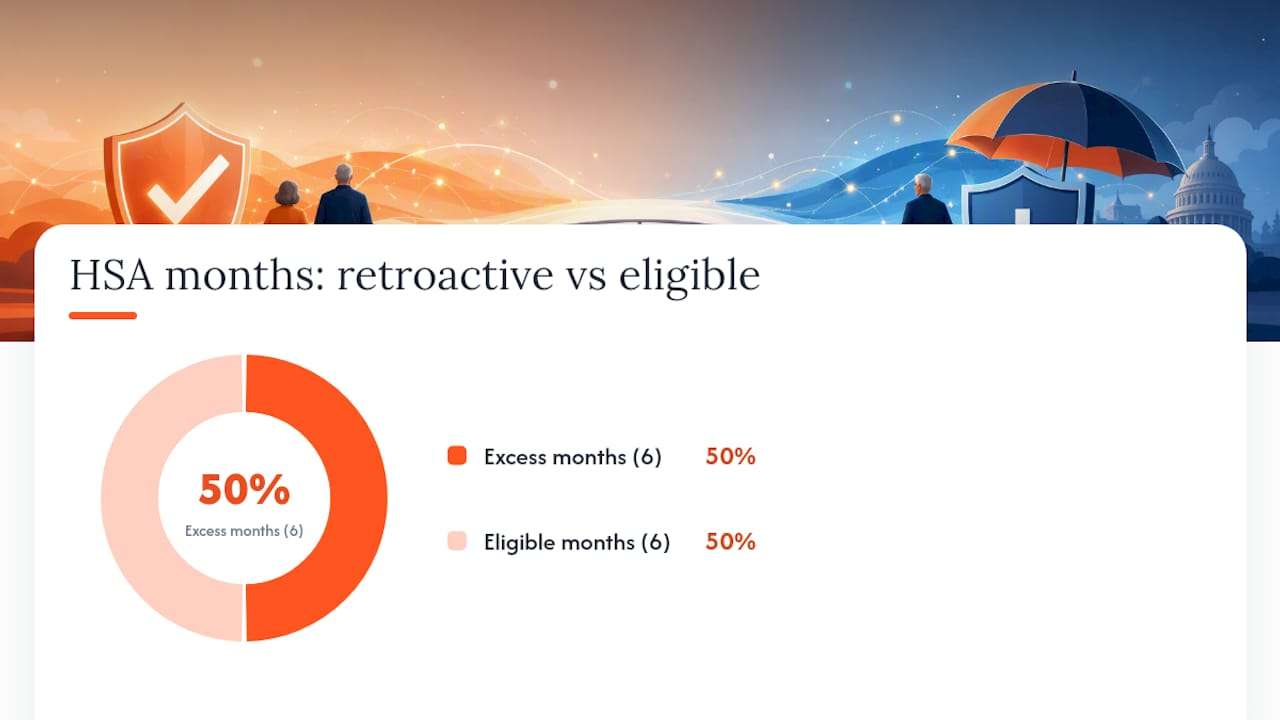
Filing for Social Security retirement benefits makes this worse because it usually triggers automatic Part A enrollment, and Medicare.gov’s guidance on working past 65 confirms that enrollment carries the same six-month lookback. Someone who claims Social Security at 66 might discover, months later, that their HSA contributions for the prior half-year were never actually valid.
A practical sequence to follow:
- Identify your exact Medicare eligibility month (the month you turn 65 or complete 24 months of disability benefits).
- Stop payroll HSA deductions at least one full month before your planned enrollment date, not the enrollment date itself.
- If you’re filing for Social Security within six months of turning 65, assume Part A will be backdated to your eligibility month and plan contributions accordingly.
- Recalculate your annual contribution the moment you know your actual enrollment date, using eligible months only.
- Keep every HSA custodian statement and payroll record from that transition year. You’ll need them if the numbers ever need correcting.
What You Can Still Buy With HSA Money After Medicare Starts
Losing contribution eligibility doesn’t touch the money already sitting in your account. Existing HSA balances remain yours, and every dollar spent on a qualified expense still comes out tax-free, no matter how long ago you funded the account.
Medicare premiums you can pay with HSA funds:
- Part B premiums
- Part D prescription drug plan premiums
- Medicare Advantage (Part C) premiums
- Part A premiums, but only in the less common case where you’re paying for Part A rather than receiving it premium-free
One exception catches almost everyone off guard: Medigap (Medicare Supplement) premiums are not an HSA-eligible expense under IRS Publication 969. If you pair Original Medicare with a Medicare Supplement plan, that premium comes out of pocket, not your HSA.
Beyond premiums, Publication 502 style qualified expenses still apply: deductibles, coinsurance, copayments, dental and vision care, hearing aids, insulin, and many over-the-counter items with a prescription. You can pay a provider directly from the HSA if your custodian supports it, or pay out of pocket and reimburse yourself later, even years later, as long as the expense happened after you opened the account. Save every receipt either way.
How Spousal Coverage and Family Limits Shift When One Spouse Enrolls
Family HDHP coverage sets the family contribution limit, and that limit doesn’t vanish just because one spouse enrolls in Medicare. It shifts to the spouse who’s still eligible.
Once one spouse starts Medicare, that spouse can no longer contribute to an HSA in their own name. But if the other spouse remains covered by a qualifying HDHP and hasn’t enrolled in Medicare, that spouse can still contribute, generally up to the full family limit, and can put those contributions into an HSA in their own name even if the account was originally opened by the Medicare-enrolled spouse.
- The Medicare-enrolled spouse stops all new contributions immediately.
- The still-eligible spouse can open or fund their own HSA and claim the family limit.
- Contributions for a partial eligibility year get prorated by month, and Optum’s guidance confirms you have until the tax filing deadline to make those prorated contributions or pull back anything excess.
Example: a spouse eligible for seven months of the year can generally contribute 7/12 of the family limit, calculated for the specific tax year.
Common HSA and Medicare Mistakes That Trigger Penalties
Two mistakes account for most of the tax headaches: contributing after Medicare enrollment starts, and spending HSA funds on nonqualified expenses before age 65.
Excess contributions face a 6% excise tax for each year they remain in the account uncorrected.
Fixing it:
- Contact your HSA custodian and request a corrective distribution of the excess contribution amount before your tax filing deadline, including extensions.
- Withdraw any earnings that excess amount generated. Those earnings count as taxable income for the year withdrawn.
- Notify your payroll department immediately so future contributions stop at the source.
- File the correction using the documentation your custodian provides. The SSA’s own guidance confirms HSA distributions get reported on Form 1099-SA, so accuracy matters at filing time.
Pro Tip: Request a written eligibility timeline from your HSA custodian the moment you apply for Medicare or Social Security. Having that paper trail on file saves hours if the IRS ever questions a contribution year.
Your Month-by-Month HSA and Medicare Checklist
Three months before enrollment, confirm your exact eligibility date with Medicare.gov and notify payroll of your planned stop date. Three months after, verify your enrollment effective date wasn’t backdated further than expected.
- Contact your HSA custodian before enrolling to confirm your last eligible contribution month.
- Call Social Security directly if you’re filing for retirement benefits near age 65, since that filing affects your Part A start date.
- Loop in payroll the same week you apply for Medicare, not after your first premium bill arrives.
| Timeframe | Action | Contact |
|---|---|---|
| 3 months before | Confirm eligibility month, plan contribution stop | Medicare.gov, HSA custodian |
| 1 month before | Stop payroll HSA deductions | Employer payroll |
| At enrollment | Verify effective date and retroactivity | Social Security Administration |
| 3 months after | Reconcile contributions, correct any excess | HSA custodian, tax preparer |
Safeguard Benefit Services offers a free Medicare roadmap that walks Charlotte-area clients through this exact enrollment timeline so nothing slips through during the transition.
Why Timing Discipline Beats Panic Every Time
People treat the HSA and Medicare overlap like a crisis, and I get why. Nobody wants a surprise excise tax notice in April. But the actual risk here isn’t the rules themselves. It’s the six-month retroactivity window quietly doing damage while you assume everything’s fine.
The HSA money you’ve already built up doesn’t lose value just because Medicare started. It keeps working as one of the more tax-efficient ways to cover retirement health costs, from Part B premiums to hearing aids. What changes is simply your ability to add more.
If your situation involves employer coverage past 65, a working spouse, or a Social Security claim you’re timing carefully, don’t guess. A Medicare agent can walk through the specific dates that apply to your coverage, because generic advice and your actual enrollment paperwork don’t always agree.
— Zach
Get Local Help Timing Your Medicare Enrollment
Safeguard Benefit Services gives Charlotte-area residents something most national call centers can’t: a local agent who walks through your exact HSA contribution deadline, your Part A retroactivity risk, and your Medicare Advantage or Medicare Supplement options in one sitting, at no cost to you.

The free Medicare roadmap lays out a specific enrollment window, flags whether Social Security filing will backdate Part A, and helps avoid excess contribution issues. Agents undergo comprehensive training to provide unbiased guidance rather than steering clients toward a single carrier. If you’re within six months of turning 65 or already drawing Social Security, request your free roadmap and schedule a consultation before your next HSA contribution posts. Getting the date right once beats correcting it later.
Where to Verify These Rules Yourself
Confirm HSA and Medicare details directly with IRS Publication 969, Medicare.gov’s enrollment timing pages, and your HSA custodian’s own statements. Keep every enrollment letter and contribution record from your transition year.
This article is general information, not a substitute for advice from a qualified financial advisor. Consult a qualified financial professional about your own circumstances before acting on anything here.
Sources
- HSAs and Medicare — Fidelity
- Publication 969 (Health Savings Accounts and Other Tax-Favored Health Plans) — IRS
- Medicare
- SSA POMS: HSAs and MSAs guidance — Social Security Administration
FAQ
What Happens If You Have an HSA and Medicare?
You can keep your HSA and spend existing funds tax-free on qualified expenses and most Medicare premiums, but you can no longer add new contributions once Medicare coverage begins. The account itself stays open indefinitely; only the contribution privilege ends.
Do You Have to Stop HSA Contributions Six Months Before Medicare?
Not exactly six months before, but you do need to stop the month your Medicare coverage actually starts, and retroactive Part A can reach back up to six months once you enroll. Many advisors suggest stopping contributions roughly six months before applying if you’re also planning to file for Social Security, since that filing often triggers the retroactive lookback.
Can You Contribute to an HSA After 65 if You Are Not on Medicare?
Yes. If you delay Medicare enrollment, typically because you’re still working and covered by an employer’s qualifying high-deductible health plan, you remain HSA-eligible past 65 and can keep contributing at the full limit.
Can I Pay My Wife’s Medicare Premiums With My HSA?
Yes, HSA funds can cover a spouse’s Medicare Part B, Part D, or Medicare Advantage premiums tax-free, even if the spouse isn’t the account holder. The one exception is Medigap premiums, which are not an HSA-eligible expense for either spouse.
Is Medicare Part A Retroactive Coverage Automatic?
Yes, for most people who enroll after their initial eligibility month, Part A coverage can be backdated up to six months, though never before the month you first became eligible. This retroactivity is what most often causes accidental excess HSA contributions.
Recommended
Request a No Obligation Phone Call








Get Connected