

Yes, you can buy life insurance after 65. There is no universal age cutoff in the U.S., but the choices narrow as you get older: term policies get shorter and then disappear, while whole life and no-exam policies stay available much longer. The right move depends on one question first: does anyone still depend on your income or need your help paying a bill when you die?
This guide covers the policy types open to retirees, how health and age shape approval and price, how to decide whether you need coverage at all, and where life insurance fits next to your Medicare decisions.
TL;DR
- There is no federal age limit for buying life insurance. Most term insurers stop accepting applicants around age 75 to 80, while whole life and final expense policies are often available into the mid-80s.
- After 65, the main choices are term, whole life, simplified issue, and guaranteed issue. Term is usually cheapest but needs a health review. Guaranteed issue accepts nearly everyone but pays out less in the first years.
- Your health, age, tobacco use, and coverage amount drive the premium. Buying sooner almost always costs less than waiting.
- Many retirees need less coverage than they think. Count debts, final expenses, and anyone who depends on you before you pick an amount.
- Medicare does not replace life insurance, and life insurance does not replace Medicare. Plan both together.
Table of Contents
- Can you still get life insurance after 65?
- The main types of life insurance for retirees
- What life insurance costs after 65
- How health and age affect approval
- Do you actually need life insurance in retirement?
- Life insurance and Medicare: two different jobs
- Perspective: what we tell people at 65
- Get help comparing your options
- Mistakes to avoid when buying after 65
- FAQ
- Sources
Can you still get life insurance after 65?
Yes. CBS News reports that there is no universal age cutoff in the U.S. Most term life insurers stop offering coverage at 75 or 80. Whole life is often available to 85, sometimes 90. Guaranteed issue and final expense policies can typically be bought up to 80 or 85, and a few insurers go to 90 or 95.
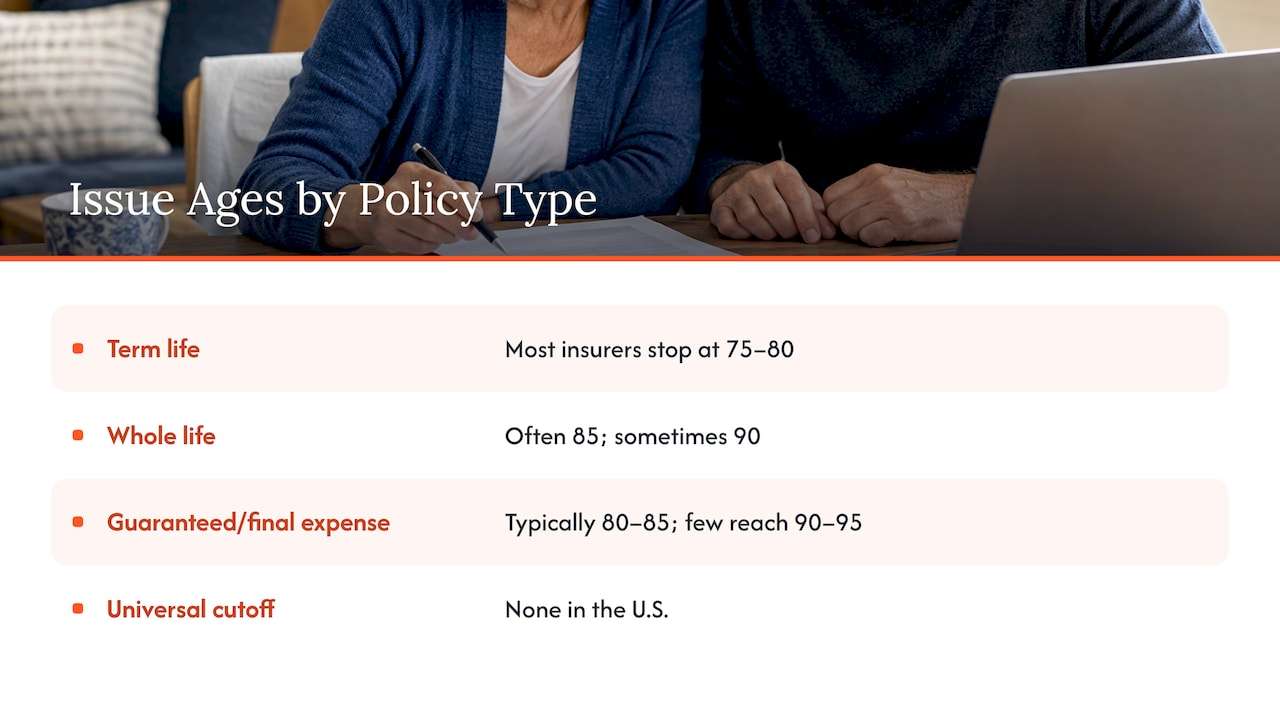
So at 65, you have the full menu. At 72, you still have options, but fewer. At 82, you are mostly looking at permanent policies with smaller benefits.
MoneyGeek’s review of senior term coverage points the same way. Applicants in their early 60s qualify for longer terms, while those over 70 are generally limited to 10- and 15-year policies.
One note on wording. Some readers search for a “65 life insurance policy.” That is not a standard product category. It usually describes ordinary term, whole life, or no-exam coverage bought at 65. Ask any agent what type of policy is actually on the quote, how long it lasts, and when the benefit is paid in full.
The main types of life insurance for retirees
Each type solves a different problem. Here is how they compare.
| Type | Health review | Typical use | Watch for |
|---|---|---|---|
| Term life | Usually a health exam | Cover a debt or income need for 10 to 15 years | Ends when the term ends; harder to find after 75 |
| Whole life | Varies by policy | Permanent coverage, estate planning, inheritance | Higher premiums than term |
| Simplified issue | Health questions, no exam | Moderate coverage for people with manageable conditions | Lower coverage limits |
| Guaranteed issue | None | Final expenses when health makes other policies hard to get | Waiting period before full benefit |
Term life
Term life covers you for a set number of years and pays out only if you die within them. NerdWallet notes that term is a low-cost option for seniors in good health who will take a medical exam. People in their 60s and 70s can typically get a 10- or 20-year term, but over 80 it becomes hard to find.
Term fits a specific, time-limited need: a mortgage balance, a spouse who still relies on your pension, or a loan a co-signer would inherit.
Whole life
Whole life lasts as long as you pay the premiums and builds cash value. It costs more than term for the same death benefit. That is the tradeoff, and the reason it suits people who want a guaranteed payout for a legacy, an estate plan, or a burial fund that never expires. If you are weighing the two, our guide on term versus whole life for U.S. budgets walks through the price gap.
Simplified issue and guaranteed issue
Simplified issue skips the exam but asks health questions. Guaranteed issue asks none. NerdWallet explains that guaranteed issue typically carries a two-year waiting period. If death is not accidental during that time, beneficiaries may not receive the full benefit. Simplified issue rarely offers coverage above $100,000.
The usual pattern is that a manageable condition, such as controlled diabetes or high blood pressure, can still fit simplified issue. A more serious recent diagnosis often points to guaranteed issue. Our page on guaranteed issue life insurance explains how it works and who it fits.
What life insurance costs after 65
Exact quotes depend on your health, your state, and the insurer, so no article can give you your premium. What holds across the market is the shape of the curve: price climbs with age, and it climbs faster after 70.
CBS News gives a sense of scale. A healthy 60-year-old might pay under $100 a month for modest term coverage. An 80-year-old might pay several hundred dollars a month for a much smaller benefit.
These factors move your premium the most:
- Age. Each year you wait raises the price.
- Health. Chronic illnesses and past diagnoses change the rate class you are offered.
- Tobacco. Smokers and vapers pay far more than non-smokers, and some carriers will not offer the best classes at all.
- Coverage amount. A $25,000 final expense policy and a $250,000 term policy are very different purchases.
- Policy type. Term is generally cheaper than whole life, and no-exam policies cost more per dollar of coverage than fully underwritten ones.
One point is easy to miss. Policies that require a medical exam tend to be cheaper, because the insurer can price your actual health instead of assuming the worst. NerdWallet points out that exams are often free, so they can be worth taking even if your health is not perfect.
A practical budget rule
An adequate policy you can keep paying beats a large one you let lapse. A common guideline is to keep premiums to a small share of your monthly income, since a lapsed policy pays nothing. Fixed-income retirees should check the premium against their budget in a bad month, not an average one.
How health and age affect approval
After 65, underwriting looks more closely at how you are doing day to day. Depending on the insurer and the policy, that can include blood pressure, cholesterol, weight, tobacco use, prescription history, and how independently you live.
The approach changes with age. Fast “accelerated” underwriting that skips the exam typically stops around 60 to 65, according to Rates Chaser’s overview of term for seniors over 70. Past 70, most carriers want a full paramedical exam with a blood draw.
If you want to understand your own numbers before you apply, a baseline check is a sensible start. Some people use biological age testing alongside their doctor’s bloodwork to see where they stand on fitness and wellness markers before an insurer asks about them.
A few steps improve your odds:
- Gather your medication list and the dates of any diagnoses or surgeries.
- Bring recent blood pressure and cholesterol readings if you have them.
- Be accurate on the application. A misstatement can lead to a denied claim later.
- Apply for the type that fits your health. A declined application can follow you to the next one, so ask an agent which product to try first.
If you also manage a health condition while choosing a Medicare plan, our guide on choosing a Medicare plan with pre-existing conditions covers that side.
Do you actually need life insurance in retirement?
Not everyone does. NerdWallet’s guidance is to check first. If you have no debt and have savings set aside for final expenses, you might not need a policy.
Coverage can make sense when:
- You have debt that someone else would have to repay.
- A spouse or other dependent relies on your income or pension.
- You want to pay for funeral and final costs without touching family savings.
- You have a larger estate and want money available for taxes.
- You want to leave an inheritance or a charitable gift.
Size the policy in three layers
A simple way to pick an amount is to build it up in tiers:
- Final expenses only. Funeral, last medical bills, and estate costs.
- Final expenses plus debt. Add any mortgage balance, credit cards, and personal loans.
- Legacy. Add an amount for family support or inheritance, balanced against what you can comfortably pay each month.
A retired couple with a paid-off home, healthy savings, and no dependents may land at layer one. A widow with a mortgage and an adult child who co-signed it is probably at layer two. Write the numbers down before you request quotes, so the quote answers a real need.
Life insurance and Medicare: two different jobs
Medicare pays for medical care. It does not pay a death benefit to your family. That is why retirees often end up with a Medicare plan, a Part D drug plan, possibly a Medigap plan, and a separate life insurance policy. Each does a different job, and one does not stand in for another.
It helps to think about timing too. If you are still working and approaching 65, start with how Medicare eligibility works in Charlotte, NC, then handle life insurance in the same planning window. If you have employer coverage past 65, the 20-employee rule affects which plan pays first. Group life insurance through a job often shrinks or ends at retirement, so check what you actually keep.
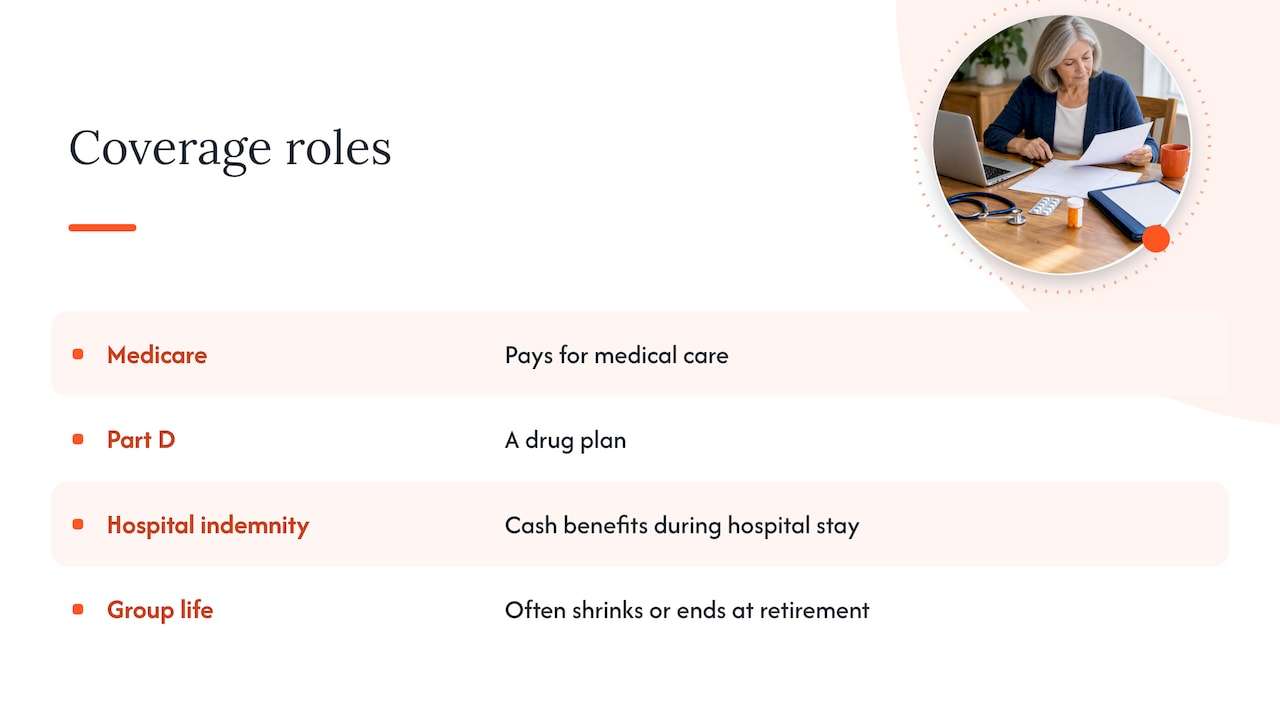
Another type of coverage worth knowing is hospital indemnity insurance, which pays cash benefits during a hospital stay. It is not life insurance, but it is often considered in the same conversation about protecting savings.
Perspective: what we tell people at 65
Most of the people who call us about life insurance after 65 are not looking for the biggest policy. They want to know their family will not be stuck with a funeral bill or a loan.
Our agents go through a training program built around education first, so we start with what you need and what you can comfortably pay. We do not start with a product. Then we match you to the type of policy that fits your health: term, whole life, simplified issue, or guaranteed issue.
Our advice is to look sooner rather than later. Age and health only move one way, and every year of waiting narrows your choices. If your health already limits you, a guaranteed issue policy is a legitimate way to cover final expenses, and we will explain the waiting period plainly so nothing surprises your family.
There is no extra cost to you for our guidance. We also review things yearly, because a plan that fit at 65 may need adjusting at 72.
Zach
Get help comparing your options
Safeguard Benefit Services is a Medicare insurance agency in Charlotte, North Carolina. Besides Medicare Advantage, Medicare Supplement, and Part D drug plans, we help clients with life insurance, cancer insurance, and hospital indemnity plans. We offer personalized consultations and a free Medicare roadmap, so you can see your life insurance choices next to your health coverage in one conversation.

If you are ready to compare options, contact our Charlotte team and tell us your age, your health situation, and the amount you have in mind.
Mistakes to avoid when buying after 65
- Waiting for a “better time.” Premiums rise with each birthday and a new diagnosis can limit your options.
- Buying more than you can pay for. A lapsed policy pays nothing, so pick a premium that holds up in a tight month.
- Skipping the waiting-period details. On guaranteed issue, ask exactly what your beneficiaries receive if death occurs in the first two years.
- Ignoring the term end date. A 10-year term bought at 70 ends at 80, exactly when replacing it becomes hard. Match the term to the need.
- Forgetting to name and update beneficiaries. Review them after any marriage, death, or divorce.
- Treating Medicare as a substitute. Medicare covers medical bills, not a family’s financial needs after your death.
FAQ
Is it too late to buy life insurance at 70?
No. Most term insurers accept applicants at 70, usually with 10- or 15-year terms, and whole life and guaranteed issue policies are available well beyond that. Expect higher premiums than at 60, and expect a fuller health review.
Can a 72-year-old get term life insurance?
Yes, but with a shorter list of insurers and shorter terms, typically 10 years and sometimes 15. Past 70, most carriers also want a full paramedical exam. An independent agent can check which companies will take your age and health.
What is the easiest life insurance to get after 65?
Guaranteed issue is the easiest, since it asks no health questions and needs no exam. The tradeoff is a smaller benefit, higher cost per dollar of coverage, and a waiting period of about two years before the full benefit is paid for non-accidental death.
Do retirees need life insurance?
Only if someone would face a financial gap when you die, such as a debt, a dependent spouse, or final costs your savings cannot absorb. If you have no debts and enough saved, you may not need a policy. Review the question every year or so as your situation changes.
Sources
- At what age can you no longer buy life insurance? CBS News
- A Guide to Buying Life Insurance for Seniors, NerdWallet
- Best Term Life Insurance for Seniors, MoneyGeek
- Term Life Insurance for Seniors Over 70, Rates Chaser
- DNA Testing for SystemAge by Generation Lab
Recommended
Request a No Obligation Phone Call








Get Connected