
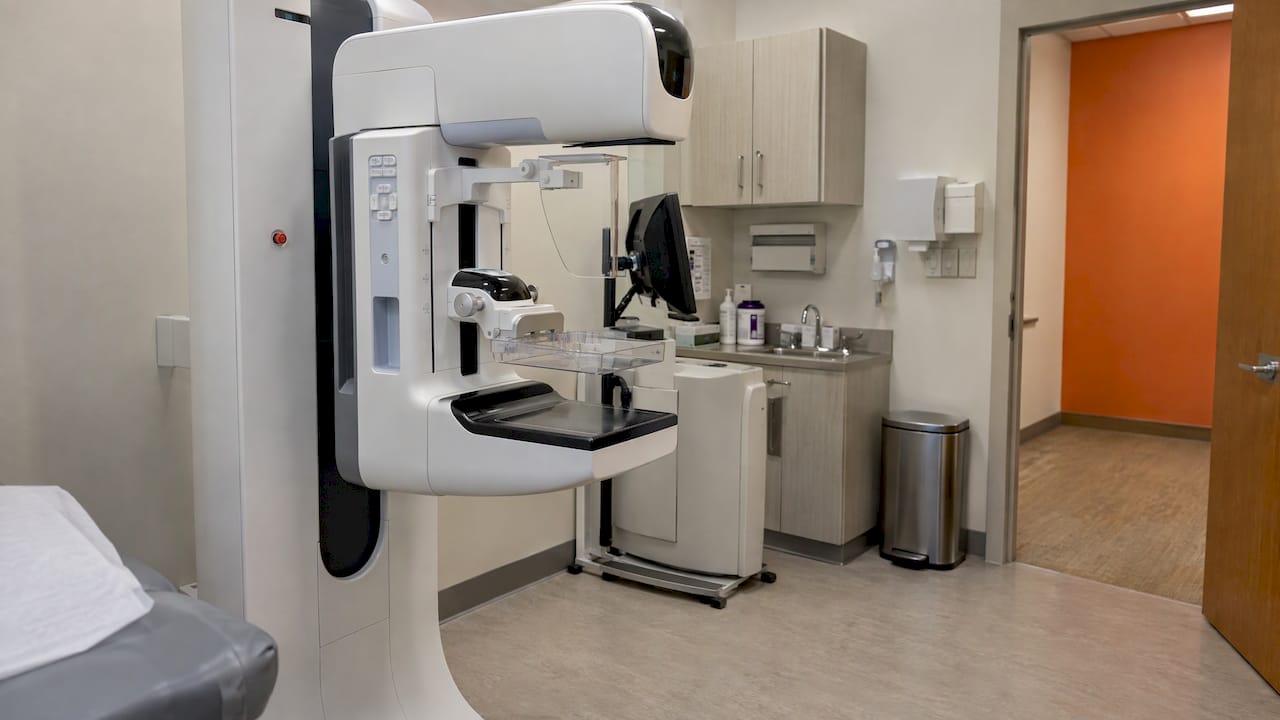
Yes, Medicare covers mammograms. Part B covers baseline, screening and diagnostic mammograms when you meet the conditions for each. A screening mammogram costs you nothing when the provider accepts assignment. A diagnostic mammogram usually carries a 20% share. Which kind you get, and where you get it, decides your bill, and that is the part worth understanding before you book. If you want help matching your coverage to your screening schedule, our Charlotte agents walk through it with you.
TL;DR
- Part B covers three kinds of mammograms: a one-time baseline (ages 35 to 39), a yearly screening (age 40 and up) and diagnostic mammograms when a doctor finds them medically necessary.
- Baseline and screening mammograms cost $0 when the provider accepts assignment, meaning the provider agrees to Medicare’s approved payment.
- Diagnostic mammograms generally cost 20% of the Medicare-approved amount after the Part B deductible, which is $283 in 2026.
- Medicare Advantage plans must cover what Original Medicare covers, but network rules and costs can differ.
- A Medigap plan can pick up the 20% on diagnostic exams, so your supplement choice affects this bill.
Table of Contents
- The three kinds of mammograms Medicare covers
- Does Medicare cover 100% of a mammogram?
- Will Medicare pay for mammograms in 2026?
- Original Medicare vs. Medicare Advantage for mammograms
- How to schedule a covered mammogram without a surprise bill
- Who this matters most for
- Where a supplement or extra coverage fits
- Get your Medicare coverage lined up with your screenings
- FAQ
- Sources
The three kinds of mammograms Medicare covers
Medicare draws a line that your doctor’s office may not explain: the same machine and the same images can be billed as screening or diagnostic. The label changes what you owe.
| Type | Who it’s for | How often | What you pay (Original Medicare) |
|---|---|---|---|
| Baseline | Women ages 35 to 39 | One in your lifetime | $0 if the provider accepts assignment |
| Screening | Women age 40 and older, no symptoms needed | Every 12 months | $0 if the provider accepts assignment |
| Diagnostic | Anyone with symptoms or a relevant history, when a doctor orders it | As often as medically necessary | 20% of the Medicare-approved amount after the Part B deductible |
The frequency and cost rules come from Medicare.gov’s mammogram page. The federal rule behind them, 42 CFR §410.34, says Medicare does not pay for screening mammography under age 35 and allows only one screening exam for a woman over 34 but under 40.
Screening mammograms: the preventive exam
A screening mammogram is a routine X-ray of the breast when you have no signs of a problem. Starting at age 40, you can have one every 12 months. There is no upper age limit in the Medicare coverage rules, so a woman at 68 or 78 is covered the same way as one at 52.
The $0 cost applies when the provider accepts assignment. Most imaging centers and hospital departments that take Medicare do, but the term trips people up, so here is what it means. A provider who accepts assignment agrees to take the Medicare-approved amount as full payment. A provider who does not accept assignment may charge up to the limiting charge on certain Part B services, as the CMS preventive services guide explains. When you call to schedule, ask whether the facility accepts assignment for screening mammography.
Baseline mammograms: one between 35 and 39
If you are between 35 and 39 and on Medicare (usually because of a disability), Part B covers a single baseline exam in your lifetime. It gives a radiologist a reference image for later comparisons. After that, annual screening coverage starts at 40.
Diagnostic mammograms: when something needs a closer look
A diagnostic mammogram is ordered when there is a reason to look more closely. Under the federal rule, it applies to a man or woman with signs or symptoms of breast disease, a personal history of breast cancer, or a personal history of biopsy-proven benign breast disease. The same regulation says Part B pays when a doctor of medicine or osteopathy orders it and an appropriately certified supplier performs it.
CMS’s national coverage determination for mammograms adds that a diagnostic exam can also be covered when a patient has no symptoms but the physician judges it appropriate based on history and other significant factors. Unlike a screening exam, a diagnostic mammogram is not limited to once a year if it is medically necessary.
Does Medicare cover 100% of a mammogram?
For a baseline or screening mammogram, yes, when the provider accepts assignment. For a diagnostic mammogram, no. You generally pay 20% of the Medicare-approved amount after you meet the Part B deductible, and actual costs vary with the provider and setting, per Medicare.gov.
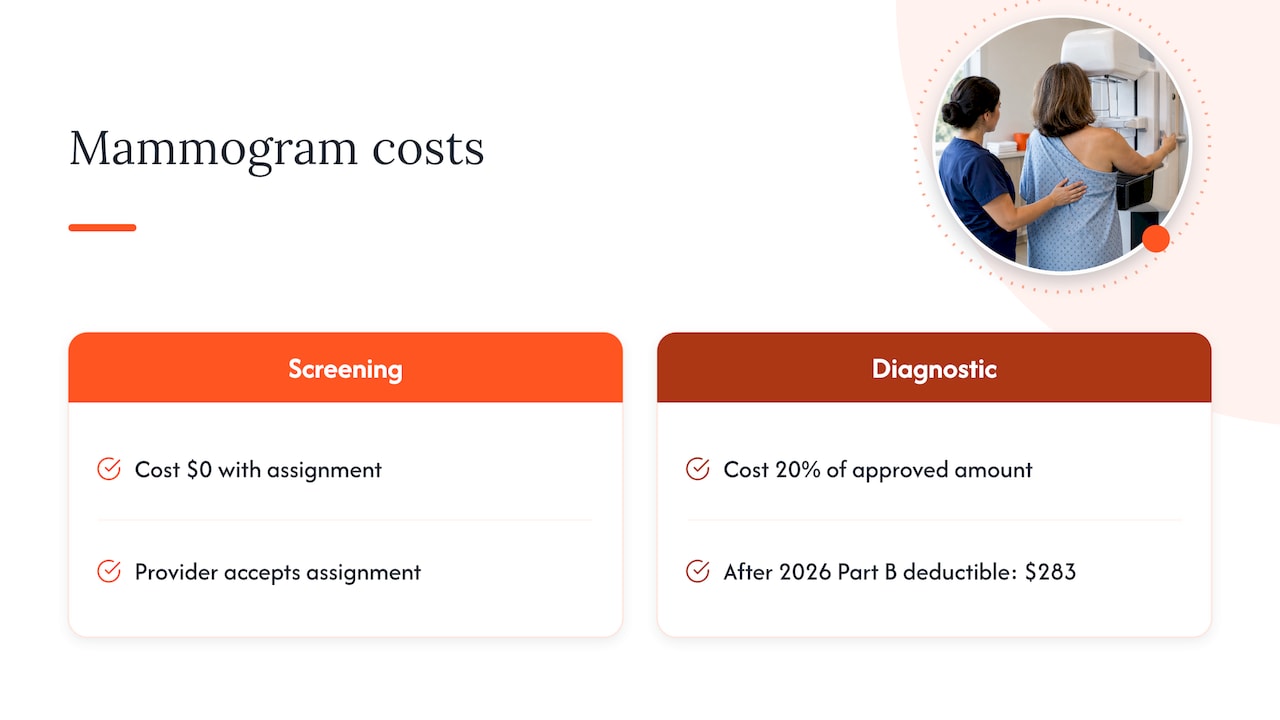
The 2026 Your Medicare Benefits booklet sets the Part B deductible at $283 for 2026. That figure changes each year when CMS publishes new Part B amounts, so check the current year’s number before you plan around it. Our guide to Medicare costs, premiums and deductibles lays out how the yearly amounts fit together, and the Part B premium and deductible explainer for 2027 covers what comes next.
A worked example
Say you are 66 and your annual screening is on the calendar. The radiologist sees something and calls you back for more images the same week. Your original visit is a screening exam at $0. The follow-up is diagnostic. If you have not yet met your Part B deductible that year, you would pay toward it first, then 20% of the approved amount on the remainder. The exact dollars depend on the approved amount at that facility, so ask the billing office for it before the visit.
This is the situation where a supplement earns its keep. A Medigap plan is designed to cover Part B coinsurance, and many plans pay the 20%. That turns a surprise bill into a predictable one.
Will Medicare pay for mammograms in 2026?
Yes. Medicare.gov’s page lists mammograms as a Part B benefit, with the baseline, annual screening and diagnostic rules above, and the 2026 Part B deductible is $283. Screening guidelines from other bodies have shifted, but those are separate from what Medicare pays.
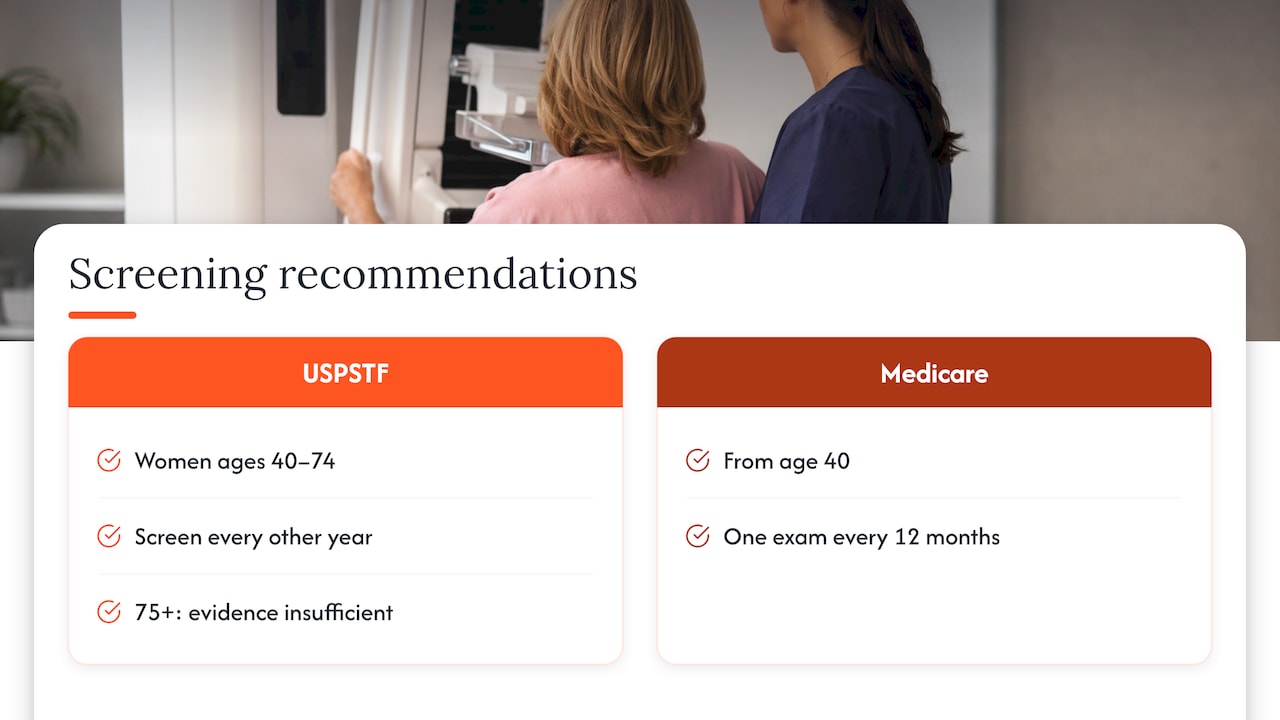
The U.S. Preventive Services Task Force, an independent expert panel, recommended in April 2024 that women ages 40 to 74 get screening mammography every other year. Its recommendation says the evidence is insufficient to judge the balance of benefits and harms for women 75 and older. The task force’s own FAQ states that its recommendation does not itself determine insurance coverage. Medicare’s rule is still one screening exam every 12 months from age 40 on. How often you actually go is a decision to make with your doctor, based on your history and risk.
Original Medicare vs. Medicare Advantage for mammograms
Your plan type changes the logistics more than the benefit.
- Original Medicare (Parts A and B): You can generally use any doctor or hospital that takes Medicare anywhere in the country. There is no annual out-of-pocket limit unless you have supplemental or other coverage.
- Medicare Advantage (Part C): Plans must cover all medically necessary services that Original Medicare covers, but your out-of-pocket costs can differ, and you may have to use network providers for non-emergency care.
In practice, if you have Medicare Advantage, confirm that your imaging center is in your plan’s network before you schedule, and ask how the plan handles a diagnostic follow-up. If you are weighing the two paths, our comparison of Medicare Advantage vs. Medicare Supplement shows how each handles routine preventive care and the costs that follow a callback.
How to schedule a covered mammogram without a surprise bill
- Confirm your eligibility. You need Part B. Check your Medicare card or your online Medicare account, or ask us if you are unsure.
- Pick a facility that accepts Medicare assignment. Ask the scheduler directly. If you have Medicare Advantage, also confirm the facility is in your network.
- Ask whether the exam is billed as screening. If you have no symptoms and no new concern, it should be. If your doctor orders it for a specific problem, it is diagnostic and the 20% applies.
- Tell the staff about any callbacks in advance. A screening that turns into additional imaging in the same visit may be billed partly as diagnostic. Knowing this helps you budget.
- Check the 12-month timing. Screening coverage is every 12 months. A screening that falls too early may not be covered as a screening exam, so ask the facility to verify your last date.
- Review your Medicare Summary Notice or plan statement. Compare the billed amount with what you expected. If a screening was billed as diagnostic by mistake, ask the provider to review the coding.
Mammography is one of several preventive services Part B covers. Our overview of what Medicare covers for preventive services and annual screenings is a useful next stop, and we cover other screenings in colonoscopy coverage and Cologuard coverage. For the bigger picture of Part B, see what Medicare Part B covers.
Who this matters most for
Women turning 65. You are likely already in the annual screening window. Your first Medicare year is a good moment to set your yearly mammogram date and confirm that your coverage choice fits where you get care.
Women who have had breast disease. If you have a personal history of breast cancer or biopsy-proven benign breast disease, your exams may be diagnostic, which means the 20% share applies. Planning for that coinsurance, whether through a supplement or a plan with a defined out-of-pocket limit, is part of choosing coverage.
Anyone worried about a callback. Most callbacks are not cancer, but the follow-up imaging is still a billable service. If you want the whole path covered, including treatment costs if a diagnosis does come, see our guide to cancer treatment coverage under Medicare.
Men. Diagnostic mammography under the federal rule applies to a man or woman with signs or symptoms of breast disease, so a man with a lump can be covered when a doctor orders the exam.
Where a supplement or extra coverage fits
Original Medicare pays well for the exam itself, but the 20% on diagnostic imaging, biopsies and any treatment that follows is open-ended because Original Medicare has no annual out-of-pocket limit. There are two common ways to close that gap: a Medigap plan with Original Medicare, or a Medicare Advantage plan that has its own limit on yearly spending. Our guides to Medigap plans and how Medicare Advantage works explain the trade-offs in plain terms.
Some people also add a hospital indemnity plan or cancer insurance to help with costs that Medicare leaves behind. We offer both.
Our view on mammogram coverage
People tend to think of a mammogram as a yes-or-no coverage question. The better question is what happens after the image. Screening is the easy part: it is covered, it is yearly, and it can cost nothing. The costs show up when a radiologist asks for a second look, because that is when the exam becomes diagnostic and the 20% starts to matter.
That is why we start every Medicare conversation with your actual health routine, not a plan brochure. We ask how often you see specialists, where you get imaging, and whether you want the freedom to see any Medicare provider or are comfortable with a network. Then we match a Medigap, Medicare Advantage or supplemental plan to those answers.
Our agents go through a comprehensive training program so that the guidance you get is personalized and unbiased, and it comes at no extra cost to you. We also review your plan every year, because your health, your doctors and plan details change. A mammogram schedule that works in January should still work in December.
Zach
Get your Medicare coverage lined up with your screenings
Safeguard Benefit Services is a Medicare insurance agency in Charlotte, North Carolina. We help with Medicare Advantage plans, Medicare Supplements, prescription drug plans, dental, vision and hearing plans, cancer insurance, life insurance and hospital indemnity plans. We offer personalized consultations and a free Medicare roadmap that lays out your options and eligibility, and we help you avoid enrollment penalties and coverage gaps.

If you want your yearly screening, a possible diagnostic follow-up and your out-of-pocket exposure to work together, talk with our team about your Medicare options.
FAQ
How often does Medicare cover a mammogram?
A woman age 40 or older can have a screening mammogram every 12 months. A woman between 35 and 39 can have one baseline mammogram in her lifetime. Diagnostic mammograms can be covered more often than once a year when they are medically necessary.
Is a mammogram free with Medicare?
Baseline and screening mammograms cost you nothing when the provider accepts assignment. Diagnostic mammograms generally cost 20% of the Medicare-approved amount after you meet the Part B deductible, which is $283 in 2026.
Does Medicare Advantage cover mammograms?
Yes. Medicare Advantage plans must cover all medically necessary services that Original Medicare covers. Your costs can differ from Original Medicare, and you may need to use in-network providers for non-emergency care, so confirm your imaging center with your plan before you book.
Does Medicare cover mammograms after age 75?
Medicare’s coverage rule for annual screening does not set an upper age limit. The U.S. Preventive Services Task Force says the evidence is insufficient to judge screening for women 75 and older, so the decision about continuing is one to make with your doctor based on your health and history.
What is the difference between a screening and a diagnostic mammogram?
A screening mammogram is a routine exam when you have no symptoms. A diagnostic mammogram is ordered by a doctor when there are signs or symptoms of breast disease, a history of breast cancer or biopsy-proven benign breast disease, or other factors the doctor considers significant. The difference decides what you pay.
Sources
- Medicare.gov: Mammograms
- eCFR: 42 CFR §410.34, Mammography services
- CMS National Coverage Determination 220.4, Mammograms
- Your Guide to Medicare Preventive Services
- Your Medicare Benefits, 2026
- Medicare.gov: Compare Original Medicare and Medicare Advantage
- USPSTF: Breast Cancer Screening recommendation, April 2024
- USPSTF: Breast Cancer Screening FAQ
Recommended
Request a No Obligation Phone Call







Get Connected