

Every Medicare Advantage plan carries an annual medical out-of-pocket maximum, or MOOP, that caps what you pay for covered Part A and Part B services. Federal ceilings exist for 2026, but most plans set their own limit well below that number, and prescription drugs fall under a completely separate cap. Before enrolling, check whether a plan uses an in-network-only MOOP or a combined in- and out-of-network limit, and read the Summary of Benefits closely.
TL;DR:
- Most Medicare Advantage plans set their out-of-pocket maximum well below federal 2026 limits, with the average in-network cap at $5,421 and combined cap at $9,825.
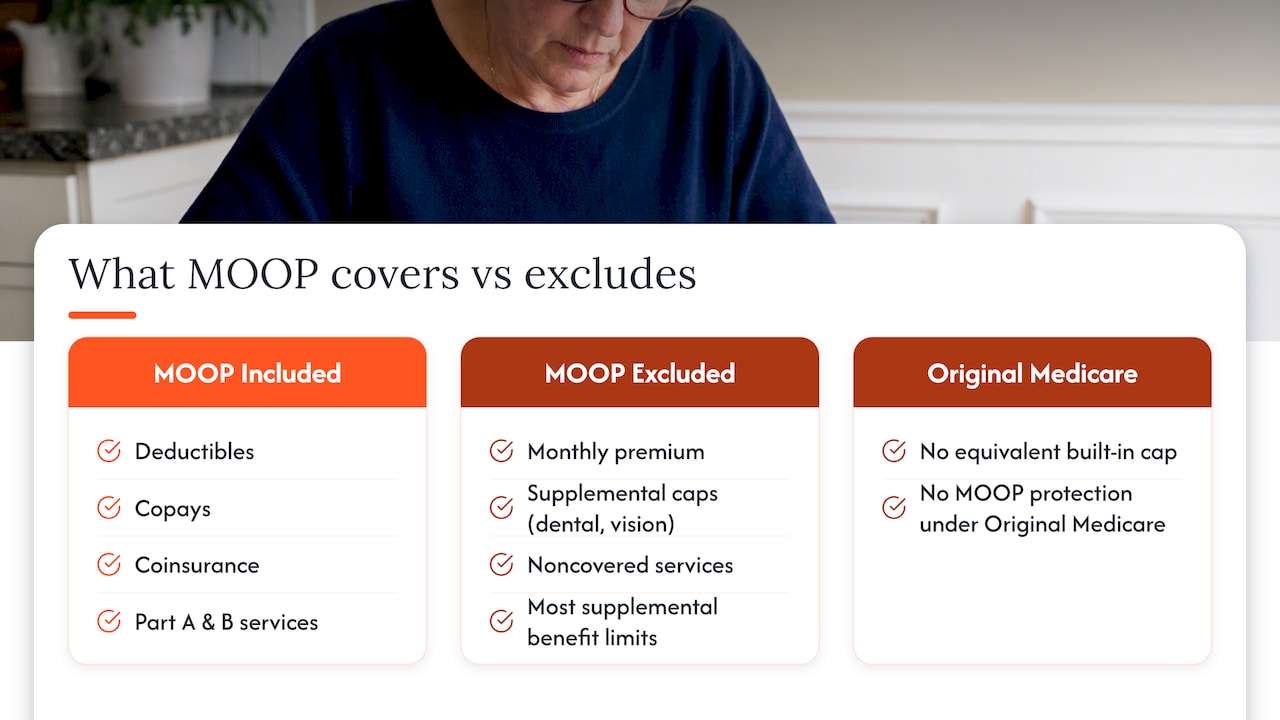
- The MOOP only covers deductibles, copays, and coinsurance for Part A and B services, excluding premiums, Part D drugs, and noncovered expenses.
- In-network MOOP and combined MOOP can differ significantly, especially for PPO plans, affecting your actual financial risk depending on your provider choices.
- Expect higher costs if you frequently see out-of-network providers, and always verify provider participation and prior authorization rules before selecting a plan.
- Separately budgeting for medical MOOP and Part D costs provides a more accurate estimate of your total annual out-of-pocket expenses.
Table of Contents
- What the Medicare Advantage out-of-pocket maximum actually is
- 2026 federal caps and enrollment-weighted averages you should know
- What counts toward the MOOP and what you still must budget for
- How plan type and networks change your real exposure
- Step-by-step: compare plans for MOOP and total expected annual cost
- Part D and prescription spending: why a separate cap matters in 2026
- How a local Medicare agent turns these numbers into a decision
- Get help comparing Medicare Advantage plans in Charlotte
- Sources
- FAQ
What the Medicare Advantage out-of-pocket maximum actually is
The MOOP is a yearly ceiling on what you pay in deductibles, copays, and coinsurance for Medicare Part A and Part B covered services under your Medicare Advantage plan. Once your spending on those services hits the limit, the plan covers 100% of the cost for the rest of the calendar year, according to the Medicare & You handbook. Original Medicare has no equivalent built-in cap, which is one of the main reasons people choose Medicare Advantage in the first place.
The MOOP is narrower than people assume. It does not include your monthly premium, most supplemental benefit limits (like separate dental or vision maximums), or anything you spend on noncovered services. Plans are required to track your covered costs and notify you when you reach the limit, but the protection only applies to Part A and Part B services billed through the plan.
2026 federal caps and enrollment-weighted averages you should know
For 2026, CMS sets maximum allowable MOOP ceilings that Medicare Advantage plans cannot exceed; there is a maximum for in-network-only spending and a higher one for plans using a combined in-network and out-of-network limit. Plans are free to set lower limits, and most do.
The enrollment-weighted average MOOP in 2026 is five thousand four hundred twenty-one dollars for in-network services and nine thousand eight hundred twenty-five dollars for combined in- and out-of-network services, according to KFF’s 2026 analysis. That gap matters: a plan advertising a combined limit near the statutory ceiling can look generous while still exposing you to nearly double the in-network figure if you go outside the network.
A few patterns show up consistently in the data:
- HMO enrollees tend to see lower in-network MOOP averages because HMOs restrict out-of-network access in the first place.
- PPO enrollees often see higher in-network averages paired with a combined cap that covers both in- and out-of-network care.
- The statutory ceiling is a legal maximum, not a typical experience. KFF notes that enrollment-weighted averages are a far better guide to what you are likely to actually pay.
What counts toward the MOOP and what you still must budget for
Your MOOP tracks specific types of spending, and knowing the boundaries keeps your annual budget realistic. Plan documents list the detail, but the categories are consistent across most Medicare Advantage plans:
- Deductibles, copays, and coinsurance for Part A services like hospital stays and skilled nursing care.
- Deductibles, copays, and coinsurance for Part B services like doctor visits, outpatient care, and durable medical equipment.
- Cost sharing for services the plan covers, even when billed by an out-of-network provider under a combined limit.
What does not count is just as important. Your monthly premium never applies toward the MOOP, and neither does spending on Part D prescription drugs, which run under their own separate cap, confirmed by CMS guidance on 2026 Medicare Advantage programs. Noncovered services, such as most cosmetic procedures, also fall outside the limit entirely. If you qualify for Extra Help, a state pharmaceutical assistance program, or you carry employer or retiree coverage alongside Medicare, your real exposure can be considerably lower than the plan’s stated MOOP suggests, since those programs absorb costs before you ever reach the cap.
How plan type and networks change your real exposure
The MOOP number on a brochure only tells part of the story. HMO plans generally require you to stay in-network except for emergencies, so their in-network MOOP is close to your actual worst-case cost. PPO plans often advertise a lower in-network figure alongside a much higher combined limit, meaning your real risk depends heavily on how often you see providers outside the network.
- Always check both the in-network MOOP and the combined MOOP, since Summary of Benefits documents list them separately.
- Confirm that prior authorization rules will not delay or deny coverage for treatments you expect to need.
- Verify that your current providers participate in the network before assuming a low MOOP applies to your situation.
Medicare.gov’s guidance on provider networks warns that a low headline MOOP can be misleading if your preferred doctors or hospitals sit outside the plan’s network, since you would then face combined-limit costs instead of the lower in-network figure.
Pro Tip: If you travel frequently or split time between two states, a PPO’s combined MOOP often matters more than its in-network number.
Step-by-step: compare plans for MOOP and total expected annual cost
Comparing Medicare Advantage plans properly takes more than glancing at a premium. Work through the numbers in order:
- Run Plan Compare on Medicare.gov for your ZIP code and build a short list of candidate plans.
- Open each plan’s Summary of Benefits and Evidence of Coverage, and note the in-network MOOP, the combined MOOP if one exists, and exactly what payments count toward each.
- Confirm your doctors, hospitals, and pharmacies participate in the network, and check prior authorization rules for any recurring treatments you rely on.
- Add your expected Part D drug spending and your monthly premiums to the MOOP figure to estimate your real annual outlay. Our guide to Medicare premiums and deductibles walks through how these pieces fit together.
- If predictable cost sharing matters more to you than network flexibility, compare the plan against Medigap coverage before deciding.
Pro Tip: Write down your last twelve months of actual doctor visits and prescriptions before comparing plans. Most people underestimate how often they used specialists.
Part D and prescription spending: why a separate cap matters in 2026
Prescription drug costs run on their own schedule, separate from the medical MOOP entirely. In 2026, the maximum Part D deductible is $615 and the out-of-pocket cap for covered drugs is $2,100, after which you pay nothing more for covered medications for the rest of the year, according to Medicare’s Part D cost breakdown.
- The Medicare Prescription Payment Plan lets you spread your Part D out-of-pocket costs into monthly installments across the year, though it does not lower the total amount you owe.
- Extra Help and state pharmaceutical assistance programs can reduce your Part D liability well below the standard cap if you qualify.
- Budgeting for medical MOOP and Part D as two separate numbers, rather than one combined figure, gives a more accurate picture of your total annual exposure.
How a local Medicare agent turns these numbers into a decision
Reading a Summary of Benefits is one thing. Knowing which combination of MOOP, network, and drug coverage actually fits your health history is another. A personalized plan review often surfaces costs a brochure does not, like a specialist who is technically in-network but requires a referral that adds delay.
Signs that a Medigap policy might serve you better than Medicare Advantage include frequent travel, a preference for predictable cost sharing over a hard annual cap, or a chronic condition that involves specialists outside your area. Some agencies review these trade-offs with clients annually, not just at initial enrollment, so coverage keeps pace with changing health needs.
— Zach
Get help comparing Medicare Advantage plans in Charlotte
Understanding your MOOP options is only useful if you can turn it into a plan that fits your actual health needs and budget. Certain Medicare agencies offer complimentary Medicare roadmaps and personal consultations to walk through in-network and combined MOOP figures, drug coverage, and network details side by side, at no cost to clients.

If you are nearing 65 or reviewing your coverage for 2026, visit Safeguard Benefit Services to schedule a consultation and get a clear comparison of the Medicare Advantage plans available where you live.
This article is general information, not a substitute for advice from a qualified financial advisor. Consult a qualified financial professional about your own circumstances before acting on anything here.
Sources
- Medicare Advantage, Medicare prescription drug programs expected to remain stable for 2026
- Medicare Advantage out-of-pocket limits: variation and trends (KFF)
- Medicare & You handbook
FAQ
What is the maximum out-of-pocket for Medicare Advantage in 2026?
Federal ceilings set the legal maximum a plan can charge, but most beneficiaries pay far less. The enrollment-weighted average is $5,421 for in-network services and $9,825 for combined in-network and out-of-network services in 2026, and many individual plans set limits below both figures.
Why do people say to stay away from Medicare Advantage plans?
Common concerns center on network restrictions and prior authorization requirements, since a low MOOP does not help if your preferred providers are out of network or a needed treatment requires approval first, as Medicare.gov’s network guidance explains. These trade-offs are real, but they vary by plan and region, so comparing network and MOOP details together matters more than relying on general reputation.
What is the income limit to avoid higher Medicare premiums?
Income-related monthly adjustment amounts affect Part B and Part D premiums based on your modified adjusted gross income from two years prior, and the thresholds change annually. Check the current figures directly with Medicare or the Social Security Administration, since they are not part of the Medicare Advantage MOOP discussed here.
What are the top three Medicare Advantage plans?
There is no single best plan nationwide, since availability, networks, and MOOP limits vary by county and change each year. The better approach is comparing the plans available in your ZIP code through Medicare’s Plan Compare tool, or working with a licensed agent who can walk through Medicare Advantage options in your area.
Recommended
Request a No Obligation Phone Call








Get Connected