

Yes, your Medicare Advantage plan almost certainly requires prior authorization for at least some services, and you’re not imagining that it’s slowing things down. Before you schedule anything non-emergency, pull out your Evidence of Coverage and call member services to confirm whether the service needs pre-approval. Standard decisions are supposed to come within 7 calendar days, expedited ones within 72 hours, and every denial has to include a reason plus instructions for appealing it.
TL;DR:
- Most Medicare Advantage plans require prior authorization for common services such as inpatient stays, certain drugs, and advanced imaging, with requirements varying by plan and changing annually.
- Call your plan’s member services before scheduling non-urgent care to confirm if prior approval is necessary and obtain submission details from your provider.
- Decision timelines are generally seven days for standard requests and 72 hours if delaying could harm your health, with plans required to provide specific denial reasons.
- In case of denial, file a reconsideration within the deadline and gather comprehensive documentation, including diagnosis codes and supporting test results, to strengthen your case.
- CMS rules starting in 2026 will improve transparency and speed of decisions, but ongoing mismatches between plans and your needs may indicate a different plan could serve you better.
Table of Contents
- What Prior Authorization Means in Medicare Advantage
- How the Authorization Process Actually Works
- Services That Commonly Require Prior Approval
- Decision Timelines: What’s Standard and What’s Expedited
- If Your Request Gets Denied: The Appeals Path
- Building a Request That’s Hard to Deny
- What the 2026-2027 CMS Rules Change for You
- How Safeguard Benefit Services Fits Into This
- Get Local Help Before Prior Authorization Becomes a Problem
- Why Prior Authorization Frustrates People More Than It Should
- Sources
- FAQ
What Prior Authorization Means in Medicare Advantage
Prior authorization is your plan’s advance approval process. Before it pays for certain care, the plan reviews the request and decides whether the service meets its medical necessity rules. Every Medicare Advantage plan has to spell out which services require this approval in its Evidence of Coverage, and that document is the first place to check, not the plan’s marketing brochure.
Original Medicare uses prior authorization sparingly, mostly for a short list of DME items and a handful of outpatient procedures. Medicare Advantage plans lean on it far more heavily as a utilization management tool, and the rules differ from carrier to carrier and even from plan to plan within the same carrier.
- One plan might require PA for a knee MRI while a competing plan in the same county doesn’t
- Some plans require PA on nearly every specialist referral; others only flag high-cost procedures
- Requirements can change at the start of a new plan year, so last year’s approved list isn’t this year’s
How the Authorization Process Actually Works
The sequence is fairly consistent across plans, even when the paperwork looks different.
- Before scheduling anything non-urgent, call your plan’s member services line and ask directly whether the specific service, drug, or equipment needs prior approval.
- Your provider’s office typically submits the request, not you. Ask them for the submission date and a reference or authorization number, and write both down.
- The plan issues a decision notice. If approved, confirm the approval covers the exact provider, facility, and code that will actually be billed. If denied, the notice must state why and explain how to appeal.
- Follow up in writing if anything in the notice seems off. Verbal confirmations get lost. Paper trails don’t.
Pro Tip: Treat the authorization number the same way you’d treat a confirmation number for a flight. If a claim gets denied later for a coding mismatch, that number and the date it was issued are often the fastest way to prove the service was actually approved in advance.
Services That Commonly Require Prior Approval
Certain categories show up on nearly every plan’s prior authorization list, year after year.
- Inpatient hospital admissions and skilled nursing facility stays
- Durable medical equipment, including wheelchairs, oxygen equipment, and certain orthotic devices
- Select Part B drugs administered in a clinical setting, including many chemotherapy infusions
- Advanced imaging such as MRIs, CT scans, and PET scans
- Home health services and many specialty procedures, including certain surgeries
Emergency services are the one clear exception. Federal rules bar plans from requiring prior authorization before treating a genuine emergency, so if you’re in an ambulance or an ER, that’s not the moment to worry about paperwork.
Decision Timelines: What’s Standard and What’s Expedited
Plans generally have 7 calendar days to decide a standard prior authorization request, and 72 hours when a delay could jeopardize your health, according to CMS guidance summarized by the Georgetown Center on Health Insurance Reforms.
To get the faster 72-hour review, your provider generally needs to state, in the request itself, that waiting the standard timeframe could seriously harm your health. Some Part B drug requests move on separate, often faster tracks because delaying a cancer treatment or infusion carries different risks than delaying an elective imaging scan. CMS’s Interoperability and Prior Authorization final rule locks these timeframes in, requires plans to give specific denial reasons instead of boilerplate language, and pushes public reporting of PA approval and denial data. The rule also phases in electronic Prior Authorization APIs through 2027, which should eventually cut down on the fax-and-phone-tag routine that drives most of the frustration.
If Your Request Gets Denied: The Appeals Path
A denial is a starting point, not a final answer. HHS OIG’s review of Medicare Advantage denials found that an estimated 13% of denials in its sample actually met Medicare’s own coverage rules, meaning the care should have been approved in the first place.
- File a Level 1 reconsideration with your plan using the instructions in your denial notice. This is your first formal appeal, and the notice will list the deadline.
- Ask for an expedited appeal if waiting for a standard decision would risk your health. Your doctor’s written statement supporting urgency carries real weight here.
- If the plan upholds the denial, your case moves automatically to an independent review entity outside the plan, and further levels exist beyond that if needed.
Medicare walks through each level in detail, including the specific deadlines tied to standard versus expedited requests.
Building a Request That’s Hard to Deny
The single biggest driver of delays isn’t plan malice. It’s incomplete paperwork.
- Diagnosis codes and a clear treatment history that matches the request
- Relevant test results, imaging, or lab work supporting medical necessity
- A clinician’s written statement explaining why this specific treatment, and not a cheaper alternative, is necessary
- Correct procedure and billing codes that match what will actually be submitted on the claim
Keep every submission confirmation, authorization number, and decision letter in one folder, physical or digital. Documentation practices used in other clinical contexts, like the coverage-focused records podiatrists compile for foot surgery insurance decisions, illustrate how much a well-organized clinical file speeds up a determination. The same logic applies to DME suppliers documenting devices like sleep apnea dental appliances for insurance coverage.
Pro Tip: If the plan says information is missing, get that specific list in writing and resubmit fast. A quick, complete resubmission usually resolves things faster than an appeal, and it avoids the appeal clock altogether.
What the 2026-2027 CMS Rules Change for You
The CMS Interoperability and Prior Authorization rule isn’t just paperwork reform. It changes what plans owe you in practice.
- Faster, enforceable response windows instead of vague “we’ll get back to you”
- Specific, written denial reasons tied to actual coverage criteria, not generic form letters
- Public reporting of each plan’s prior authorization approval and denial metrics starting in 2026 reporting cycles
- A phased rollout of electronic Prior Authorization APIs through 2027, aimed at replacing fax-based submissions
Nearly all Medicare Advantage enrollees, about 99% according to KFF’s analysis, are already in plans that require prior authorization for at least some services, and insurers processed close to 53 million such requests in 2024 alone. Electronic authorization should eventually cut down on lost faxes and duplicate submissions, but plan-specific clinical criteria aren’t going away. Your Evidence of Coverage still matters just as much in 2027 as it does today.
How Safeguard Benefit Services Fits Into This
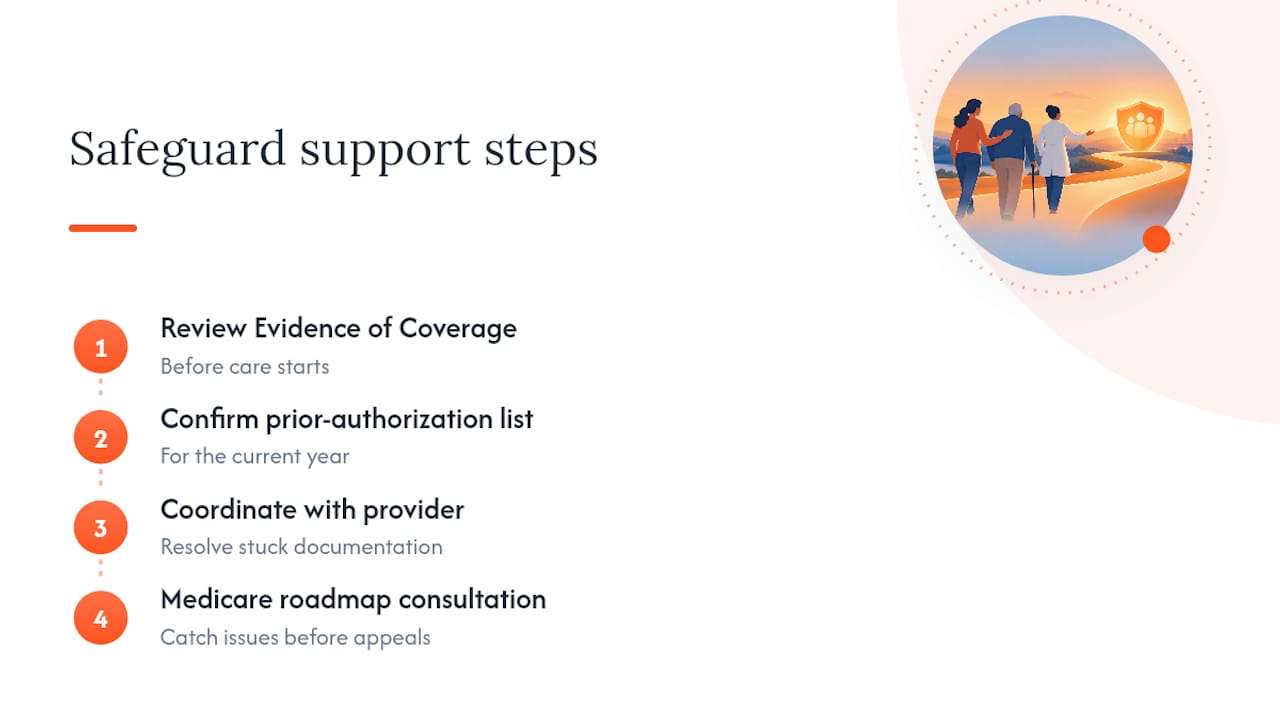
Most of the prior authorization headaches we see come down to one thing: nobody checked the Evidence of Coverage before care started. Working with an agent often starts with reviewing the Evidence of Coverage and confirming what’s on the prior authorization list for the current year We also coordinate with your provider’s office when documentation gets stuck. A Medicare roadmap consultation can help catch these issues before they become an appeal rather than afterward.
Get Local Help Before Prior Authorization Becomes a Problem
You have other ways to sort through this on your own, including calling your plan directly or working through Medicare.gov’s appeals materials line by line. Working with a local agent who reviews your Evidence of Coverage and prior authorization list before a problem starts can be helpful.

Agents can often confirm what documentation your provider needs before a procedure gets scheduled, and if a denial does happen, help you understand the reconsideration process step by step. These services typically do not cost extra to the client since agents are compensated by the carriers. If you’re comparing Medicare Advantage plans or wondering whether a Medicare Supplement would sidestep prior authorization altogether, that’s exactly the kind of question worth a real conversation. Visit Safeguard Benefit Services to schedule a free consultation and get your Medicare roadmap started.
Why Prior Authorization Frustrates People More Than It Should
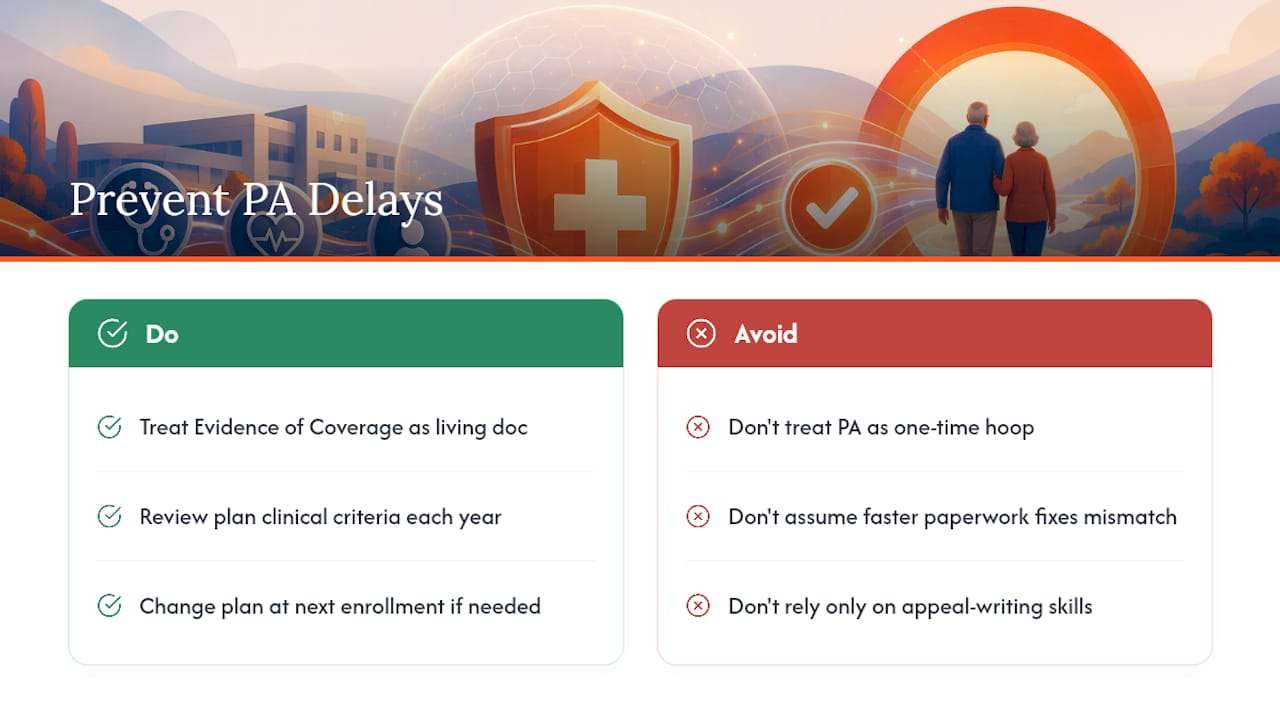
Here’s what conventional advice gets backwards: it treats prior authorization as a hoop to jump through once and forget. It’s not. It’s a recurring negotiation between what your doctor recommends and what your plan’s utilization criteria will pay for, and that negotiation resets every plan year. The beneficiaries who avoid delays aren’t the ones with the least complicated conditions. They’re the ones who treat their Evidence of Coverage like a living document instead of paperwork they signed once in October.
The 2026 and 2027 CMS timelines will help, genuinely. Faster decisions and clearer denial reasons close a real gap in accountability. But faster paperwork doesn’t fix a mismatched plan. If you’re constantly fighting prior authorization for the same category of care, imaging, a specific drug, a recurring procedure, that’s usually a signal your plan’s clinical criteria don’t match your actual health needs, not a signal that you need better appeal-writing skills. Sometimes the fix isn’t a better appeal. It’s a different plan during the next enrollment window.
— Zach
This article is general information, not a substitute for advice from a qualified doctor. Consult a qualified healthcare professional about your own circumstances before acting on anything here.
Sources
- Medicare Advantage insurers made nearly 53 million prior-authorization determinations in 2024 (KFF)
- Prior authorization fact sheet (Georgetown Center)
- CMS finalizes rule to expand access to health information and improve the prior authorization process (CMS)
- Some Medicare Advantage organization denials of prior-authorization requests raise concerns (HHS OIG)
- Medicare
FAQ
Does Medicare Advantage Require Prior Authorization?
Yes, nearly all Medicare Advantage plans require prior authorization for at least some services, though the exact list varies by plan. KFF found that about 99% of MA enrollees are in plans with some prior authorization requirement.
Will Medicare Require Prior Authorization in 2026?
Original Medicare traditionally uses prior authorization sparingly, but Medicare Advantage plans have long required it broadly and will continue to in 2026. What’s changing in 2026 is the transparency around it: CMS’s rule requires faster decisions and public reporting of plan-level PA metrics.
What New Items Are Being Added to Prior Authorization Lists for 2026?
CMS has been phasing in required prior authorization for specific durable medical equipment items on its DMEPOS Master List, with specific HCPCS codes added on a rolling schedule. Check your plan’s current Evidence of Coverage for the exact list that applies to you, since Medicare Advantage plans set their own PA lists separately from this federal DME schedule.
Where Do I Submit a Prior Authorization Request for Medicare?
Your provider’s office typically submits the request directly to your Medicare Advantage plan, not to Medicare itself. Confirm the submission date and get a reference number from your provider’s office, and if you want help confirming your plan’s specific submission process, Safeguard Benefit Services can walk through it with you.
What Happens if My Prior Authorization Is Denied?
You can file a Level 1 reconsideration with your plan, using the deadline and instructions listed in your denial notice. If the plan upholds the denial, your case automatically moves to an independent review outside the plan, as outlined in Medicare.gov’s appeals guidance.
Recommended
Request a No Obligation Phone Call








Get Connected