

Medicare Advantage star ratings are CMS’s 1 to 5 scale for grading plan quality, updated every year and published on Medicare.gov before Fall Open Enrollment. They’re a legitimate shortcut for narrowing down options, but they should never be the whole decision. A 5 star plan that doesn’t include your cardiologist or cover your insulin isn’t a 5 star plan for you.
TL;DR:
- High star ratings often depend on regional availability, and most plans with five stars are limited to certain states or contracts, not nationwide.
- Overall star ratings can mask weak spots in specific domains like customer service or chronic condition management, which may be critical for your needs.
- CMS updates star ratings annually based on more outcome-focused measures, with 45 total metrics in 2026, including new ones like kidney health evaluations for diabetics.
- Verifying network coverage and formulary compatibility should take priority over star ratings, which only serve as a starting filter in plan comparison.
- Enrolling through the Fall Open Enrollment window or using a licensed agent can help ensure you consider all factors and avoid costly coverage gaps.
Table of Contents
- How CMS calculates Medicare Advantage star ratings
- Where can you find your plan’s official star rating?
- Using star ratings to compare Medicare Advantage plans
- Why star ratings don’t tell the whole story
- When it’s time to call someone who does this for a living
- A three-step routine that actually works
- Get a Free Medicare Roadmap From Safeguard Benefit Services
- Where to verify the numbers yourself
- Sources
- FAQ
How CMS calculates Medicare Advantage star ratings
The overall score isn’t a single survey result. CMS pulls together dozens of individual measures across several domains and rolls them into one number, with more weight going to the categories that affect health outcomes.
The main domains for Medicare Advantage plans include:
- Staying healthy: screenings, tests, and vaccines
- Managing chronic conditions: how well the plan supports diabetes, heart disease, and other ongoing care
- Member experience: how enrollees rate their own care and plan
- Complaints and appeals: how often members file grievances or leave the plan
- Customer service: call center responsiveness and accuracy
Each individual measure earns its own 1 to 5 score, and those scores get averaged, with heavier weighting applied to outcome and improvement measures than to simple process checks. Overall and summary ratings can land on a half star, since CMS builds that flexibility into the technical notes governing the calculation.
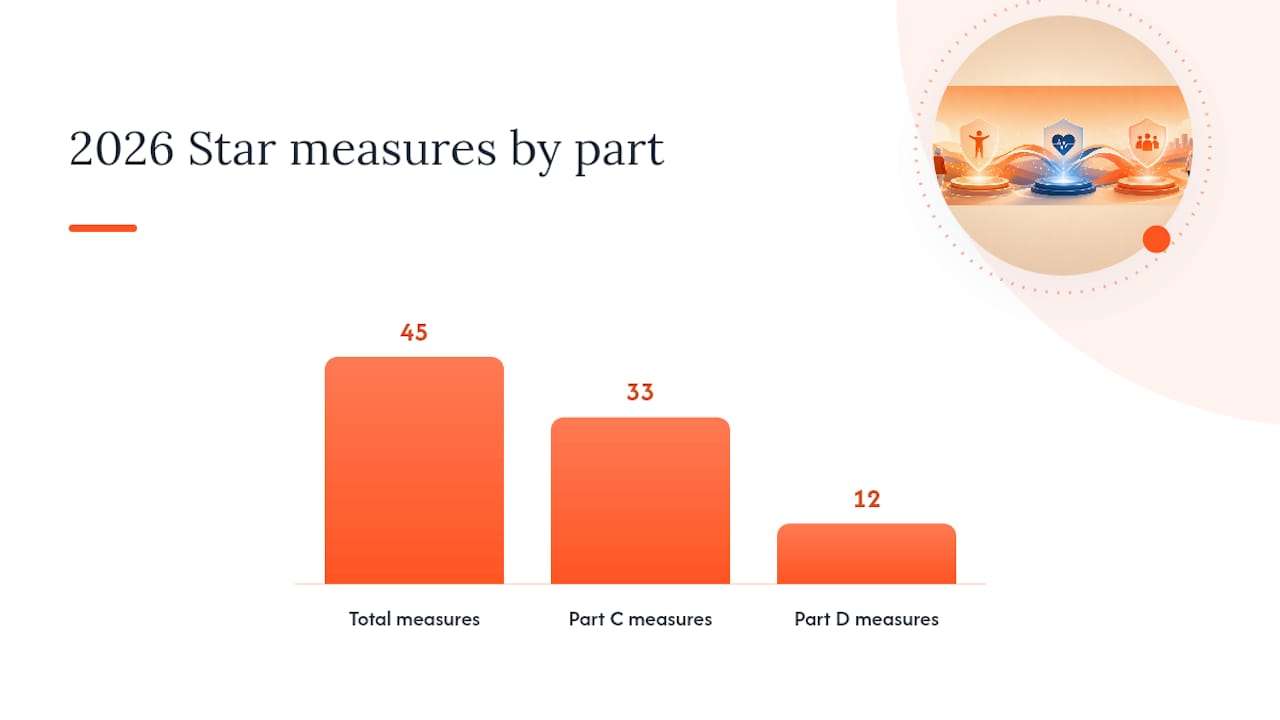
The 2026 Medicare Star Ratings expanded to 45 total measures, 33 for Part C and 12 for Part D, and added new ones such as a Kidney Health Evaluation measure for members with diabetes. Plans that invest in chronic disease management and readmission reduction tend to move the needle more than plans that just clean up their paperwork, since CMS now rewards outcomes over process reporting.
Where can you find your plan’s official star rating?
The only place to get a live, accurate number is the Medicare Plan Finder at Medicare.gov. CMS refreshes these ratings annually and posts them ahead of the Fall Open Enrollment window, which runs October 15 through December 7.
Here’s how to pull it up yourself:
- Go to Medicare.gov and open the Plan Finder tool.
- Enter your ZIP code and basic details like current coverage and medications.
- Browse the plan list, where the overall star rating appears next to each plan name.
- Click into a specific plan to see the Part C and Part D summary stars separately, along with domain level breakdowns.
The average beneficiary can choose from roughly 42 Medicare Advantage plans in their area, so the overall star badge is really just a starting filter, not a verdict.
Pro Tip: Don’t stop at the overall star number. Click through to the domain breakdown, because a plan can carry a strong overall score while quietly scoring low on customer service or chronic care management, the exact areas that matter most if you’re managing several conditions.
Using star ratings to compare Medicare Advantage plans
Ratings matter most when you use them in the right order. Checking stars before checking your doctors is how people end up locked into a plan that doesn’t actually serve them.
Work through comparisons in this sequence:
- Confirm your doctors, specialists, and preferred hospital are in-network before anything else.
- Check the drug formulary for your exact medications, including tier placement and any prior authorization rules.
- Add up expected total costs, not just the premium: deductibles, copays, and out-of-pocket maximums.
- Only then compare star ratings, and look at domain scores that match your priorities, like customer service if you call your plan often, or chronic condition management if you’re tracking diabetes or heart disease.
- Note whether the plan is stable year to year or has swung in rating, since a jump can signal a temporary boost tied to a single strong measure rather than a broad improvement.
This isn’t a random order. Advisors who work with Medicare shoppers daily generally check network match first, formulary second, and star ratings third, because that sequence is what actually prevents someone from landing in a plan that later denies a claim or leaves a prescription uncovered.
Pro Tip: If a 5 star plan shows up in your ZIP code, you get a one-time Special Enrollment Period to switch into it outside the normal window. It’s worth checking Plan Finder even outside Fall Open Enrollment if your current plan is underperforming.
Why star ratings don’t tell the whole story
Five star plans are rare, and rarity is the whole point of the warning. A high score only helps you if that plan actually operates in your ZIP code and includes your providers, and 5-star availability is often concentrated in a handful of states or specific contracts rather than spread evenly across the country.
A few other blind spots worth knowing before you commit:
- Overall stars can mask weak individual domains. A 4-star plan might still score poorly on the exact measure you care about most, like managing chronic conditions.
- Ratings shift year to year. CMS recalculates cut points annually, and plan crosswalks and appeals can alter a specific contract’s rating even after it’s published in October.
- Enrollment-weighted averages look better than the raw plan count suggests. Roughly 40% of MA-PD contracts hit 4 stars or higher, but weighted by actual enrollment, about 64% of enrollees sit in a 4+ star contract, which tells you more about where people already are than where you should go.
- A strong star rating says nothing about whether your specific drug is covered or your specialist is in-network. That still requires a separate check every time.
Chasing the headline number without checking network and formulary details is the single most common mistake shoppers make during Open Enrollment.
When it’s time to call someone who does this for a living
Plan Finder is a genuinely useful tool, but it wasn’t built to catch every edge case; it’s important to verify your residential rehab coverage when exploring specialty services. If you’re managing multiple specialists, recovering from a recent hospital stay, dealing with a complicated drug formulary, or trying to appeal a coverage denial, a licensed agent can catch details the online tool won’t flag on its own.
There are specialized Medicare insurance agencies that walk clients through exactly these situations. A typical consultation includes:
- A full Plan Finder walkthrough matched to your ZIP code and current providers
- A formulary and pharmacy check against your actual prescriptions, not just a general drug list
- Guidance on enrollment timing so you avoid late penalties or coverage gaps
- A review of Special Enrollment Period options if a higher-rated plan becomes available
Some agencies address common pain points such as enrollment penalties and coverage delays, and they may emphasize trust and education through agent training programs, so the guidance you get isn’t a rushed sales pitch. It’s a second set of eyes on a decision that affects your care for a full year.
A three-step routine that actually works
Here’s the short version I give people who feel stuck staring at a list of plans: verify your doctors first, check your drugs second, and only then compare domain-level star strengths against what you personally need most, whether that’s customer service or chronic care support. If any of it feels unclear, call someone before you enroll, not after.
Keep an eye on the 5-star Special Enrollment Period too. It’s a narrow opportunity, but it’s real, and reviewing your plan annually rather than letting it auto-renew is the habit that saves people money and headaches over time. Read our breakdown on how star ratings shape your plan selection for a deeper look at the tradeoffs.
— Zach
Get a Free Medicare Roadmap From Safeguard Benefit Services
Reading star ratings on your own only gets you halfway there. Some agencies offer a free, personalized Medicare roadmap where a licensed local agent runs your actual doctors and prescriptions against Plan Finder results, not just a generic score.

If you’re in or around Charlotte and want someone to double check a plan before you’re locked in for the year, our personalized consultation walks through network coverage, drug tiers, and enrollment timing so nothing gets missed. If you’re specifically weighing Medicare Advantage against a supplement plan first, our comparison of Medicare Advantage and Medigap is a good place to start before you request your roadmap.
Where to verify the numbers yourself
- 2026 Star Ratings technical notes and fact sheet (CMS)
- Medicare Plan Finder for live plan data
- Wakely’s market summary for broader trend context
Sources
- Medicare Plan Finder
- 2026 Part C & D Star Ratings technical notes (CMS)
- 2026 Medicare Advantage and Part D Star Ratings fact sheet (CMS)
- Wakely summary of 2026 Star Ratings
FAQ
Who has the highest-rated Medicare Advantage plans?
No single insurer holds every 5-star plan, and availability shifts by year and by county. The only reliable way to see who currently holds a 5-star rating in your area is to search by ZIP code on Medicare Plan Finder, since ratings are contract-specific and regional.
What are the star ratings for Medicare Advantage plans?
Star ratings run from 1 to 5, with half-star increments possible on overall and summary scores. About 40% of MA-PD contracts earned 4 stars or higher in 2026, and roughly 64% of enrollees are in one of those higher-rated contracts.
Which Medicare Advantage plans deny the most claims?
CMS’s star ratings don’t publish a specific “claims denied” measure, so this isn’t something you can look up directly through Plan Finder. Checking the complaints and appeals domain score for a specific plan, along with your own network and formulary, is the closest available signal before you enroll.
Where can I find CMS star ratings?
CMS publishes them each year on the Medicare Plan Finder, searchable by ZIP code, with ratings posted before Fall Open Enrollment begins October 15. For the underlying methodology, the CMS technical notes explain exactly how each measure gets converted into the star you see on screen.
Recommended
Request a No Obligation Phone Call








Get Connected