

If you joined a Medicare Advantage plan for the first time within roughly the past year, or you dropped a Medigap policy to try MA, you likely have a federal trial right to switch back to Original Medicare and buy a Medigap policy without medical underwriting. You just have to move within that 12-month window and hit the application deadline window from 60 days before to 63 days after. Miss it, and insurers can start asking health questions again.
TL;DR:
- The Medicare Advantage trial right allows certain beneficiaries to switch back to Original Medicare and buy a Medigap policy without underwriting within 12 months of initially enrolling or dropping Medigap for the first time.
- Eligibility depends on first-time MA enrollment at age 65 or dropping Medigap to try MA, with the 12-month clock starting from the enrollment or dropping date.
- The application window runs from 60 days before to 63 days after MA coverage ends, requiring careful timing to avoid losing guaranteed-issue protections.
- Applying early, ideally around 60 days before MA ends, helps ensure coverage continuity and avoids application delays or missed deadlines.
- Most errors stem from logistical missteps, not eligibility, so working with a knowledgeable agent or SHIP office can minimize costly mistakes.
Table of Contents
- What Is the Medicare Advantage Trial Right?
- Who Actually Qualifies for This Trial Right?
- When Does the Clock Start, and What’s the Application Window?
- How Do You Actually Use the Trial Right?
- What Guaranteed Issue Actually Gets You (and Its Limits)
- What Documents Do You Need, and Who Do You Call?
- How a Licensed Medicare Agent Reduces Your Risk of a Costly Mistake
- Why Most Advice on This Topic Undersells the Deadline Risk
- Get Help Using Your Trial Right Before It Expires
- Sources
- FAQ
What Is the Medicare Advantage Trial Right?
The Medicare Advantage trial right is a federally protected guaranteed-issue period. It lets certain first-year MA enrollees drop their plan and return to Original Medicare, then buy a Medigap policy without an insurer reviewing their health history. Medicare’s own guide to choosing a Medigap policy spells this out directly: if you joined MA when you first became eligible at 65, or dropped Medigap to try MA for the first time, you generally get about a year to change your mind.
This is not a general “try any plan risk free” rule. It applies to a narrow set of situations, and it exists because Medigap underwriting outside these protected windows can be strict, sometimes strict enough to price out someone with a new diagnosis.
CMS reinforces the stakes in its Contract Year 2026 guidance, directing agents and brokers to explain upfront how joining MA can affect future Medigap guaranteed-issue rights. That instruction exists because too many beneficiaries find out about the trial right only after it has expired.
- It is a one-time, narrowly defined guaranteed-issue window, not an open-ended safety net.
- It protects your right to buy a Medigap policy, not necessarily the exact plan you had before.
- It runs on a strict one-year clock tied to your enrollment date, not the calendar year.
Who Actually Qualifies for This Trial Right?
Two scenarios trigger it, and most readers fall into one of them.
The first: you signed up for a Medicare Advantage plan the moment you were first eligible for Part A at 65, and within your first 12 months you decide MA isn’t working. Maybe your preferred cardiologist isn’t in-network, or the referral process is slower than you expected. Either way, Medicare’s enrollment guidance confirms this counts as a qualifying trial.
The second: you had a Medigap policy already, dropped it to try Medicare Advantage for the first time, and want to reverse course within a year.
- New to Medicare at 65 and enrolled in MA right away, now reconsidering within 12 months.
- Held a Medigap policy, switched to MA for the first time, and want to return before the year is up.
- Enrolled through a PACE program in some states, where trial protections can work similarly.
- Live somewhere with expanded state protections, since some states extend guaranteed-issue rights well beyond the federal minimum.
If you have used a Medicare Advantage trial right once already, a second attempt on a different MA plan generally does not carry the same guaranteed-issue protection.
When Does the Clock Start, and What’s the Application Window?
The 12 months start on the date your MA coverage began, or the date you dropped Medigap to join MA, not January 1 and not your birthday. From there, you have a specific application corridor around the day you plan to leave MA.
| Timing element | Rule |
|---|---|
| Trial right duration | 12 months from MA enrollment or from dropping Medigap |
| Earliest you can apply for Medigap | 60 calendar days before MA coverage ends |
| Latest you can apply for Medigap | 63 calendar days after MA coverage ends |
| When Medigap coverage can start | Only after MA coverage actually ends |
That 60 day before to 63 day after window comes straight from Medicare’s official enrollment period publication. Apply too early and there’s nothing to process yet. Apply too late and you can lose guaranteed issue entirely.
State rules can extend this. Medicare.gov notes that states may add protections beyond the federal floor, so it’s worth a call to your State Health Insurance Assistance Program (SHIP) or State Insurance Department before you assume the federal minimum is all you get.
How Do You Actually Use the Trial Right?
Working through this in the right order keeps you from a gap in coverage, which is the single most common mistake people make.
- Confirm your eligibility date. Pin down exactly when your MA coverage started, or when you dropped Medigap, since that date starts your 12-month clock.
- Pull your paperwork. Locate your MA enrollment confirmation and, if relevant, your old Medigap policy number or cancellation notice.
- Contact your MA plan. Initiate disenrollment and get written confirmation of your exact coverage end date.
- Apply for Medigap within the window. Submit as early as 60 days before your MA end date, using that guaranteed-issue right, and request an effective date that lines up with your MA termination.
- Loop in help if anything looks off. A licensed agent or your local SHIP office can catch timing errors before they cost you underwriting protection.
Pro Tip: Apply for your Medigap policy about 60 days before your MA plan ends rather than waiting until the last minute. That gives the insurer room to set a future effective date, so your Medigap coverage kicks in the same day MA coverage stops, with zero gap in between.
What Guaranteed Issue Actually Gets You (and Its Limits)
Guaranteed issue means an insurer has to sell you a Medigap policy and cannot turn you down or charge more because of a preexisting condition, as long as you’re inside the window. That’s the core protection, and it’s a real one. But it comes with boundaries worth understanding before you apply.
- If the exact Medigap policy you had before is still sold by that same insurer in your state, you generally have the right to get it back.
- If that insurer no longer sells your old policy, you can still buy other standardized Medigap plans available in your state under guaranteed issue.
- Anyone new to Medicare on or after January 1, 2020, cannot buy Plan C or Plan F, since those plans cover the Part B deductible and were phased out for new enrollees under federal law.
- Your Medigap coverage cannot begin until your MA coverage actually ends. There’s no overlap, and there’s no way to start it early.
That last point trips people up more than any other. Coordinate your dates carefully, or you could end up with a stretch of weeks where you’re technically covered by neither plan the way you expected.
What Documents Do You Need, and Who Do You Call?
Insurers reviewing a guaranteed-issue application want proof, not just your word. Keep these on hand before you apply:
- Your Medicare Advantage enrollment confirmation letter.
- The MA disenrollment or coverage termination notice with your exact end date.
- Your prior Medigap policy number or cancellation letter, if that’s your qualifying scenario.
- Proof of your first Medicare eligibility date, usually your Medicare card or Social Security award letter.
Where to get help verifying your situation: 1-800-MEDICARE, your State Health Insurance Assistance Program (SHIP), your State Insurance Department, or a licensed Medicare agent familiar with guaranteed-issue timing.
CMS’s own 2026 guidance puts the burden partly on agents, directing them to disclose how an MA enrollment decision affects your future Medigap options before you sign anything. Keep copies of everything you submit. If a carrier disputes your guaranteed-issue claim, your documentation is what settles it.
How a Licensed Medicare Agent Reduces Your Risk of a Costly Mistake
Most trial-right mistakes aren’t about eligibility. They’re about timing, missing documents, or a Medigap application submitted a week too late. Many Medicare insurance agencies train their agents on situations like this: confirming your eligibility date, reviewing what paperwork an insurer will actually require, timing your Medigap application to land inside the 60/63 day window, and coordinating your MA termination date with your new Medigap effective date so there’s no gap.
That kind of case-by-case review is where CMS’s push for proactive agent education actually plays out in practice. If your situation involves a state-specific extension or a dispute with an insurer, escalate to your SHIP office or State Insurance Department. A good agent should tell you when that’s the right move, not just handle everything themselves.
Why Most Advice on This Topic Undersells the Deadline Risk
Most articles on the Medicare Advantage trial right spend all their energy explaining that it exists and barely any time on how easily people blow the deadline. That’s backwards. The eligibility rules are simple enough to grasp in one read. The failure point is almost always logistics: someone waits until their MA coverage has already ended, applies for Medigap on day 70, and loses guaranteed issue by a week.
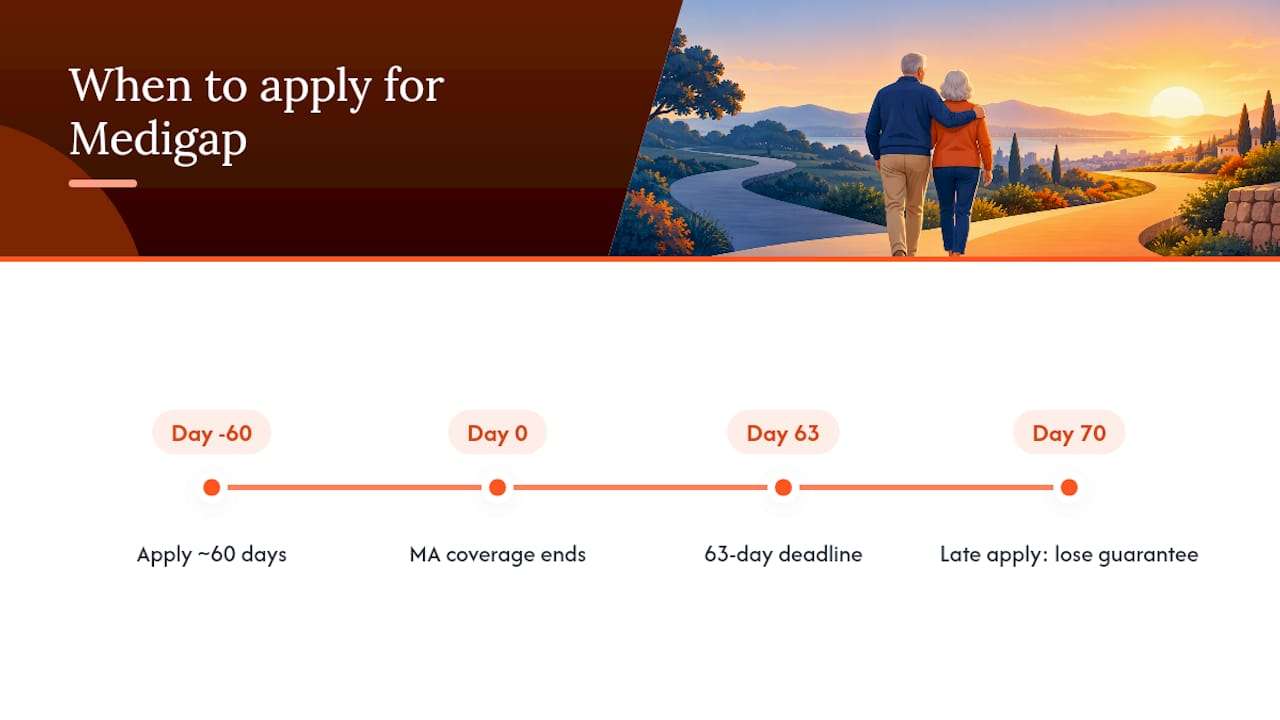
The conventional wisdom treats this like a one-time decision you make and forget. It’s really a coordination problem with two moving parts, your MA termination date and your Medigap application date, that have to line up within a tight window. If I had to give one piece of advice, it would be to apply early, around the 60-day mark, rather than treating the 63-day-after deadline as your target. Aiming for the last possible day leaves zero margin for a slow mail carrier or a missing signature.
The other thing worth saying plainly: this window doesn’t come back around. Use it, or the underwriting protections it offers may disappear for good.
— Zach
Get Help Using Your Trial Right Before It Expires
Some Medicare insurance agencies work directly with Medicare Advantage enrollees who are inside this 12-month window and want to switch back without losing guaranteed-issue protection. Certain agents may be specifically trained on the timing and documentation issues that cause trial-right applications to get denied, and there is often no extra cost for that guidance since agents are typically paid by the carrier, not by the client.

If you’re not sure whether you qualify, or you just need someone to check your dates before you submit anything, request your free Medicare roadmap and get a personalized consultation. Safeguard also helps with Medicare Supplement enrollment, Part D coordination, and hospital indemnity coverage if you want to fill gaps Original Medicare leaves open. Call or book online today, before your 63-day window closes.
This article is general information, not a substitute for advice from a qualified doctor. Consult a qualified healthcare professional about your own circumstances before acting on anything here.
Sources
- Contract Year 2026 policy and technical changes to the Medicare Advantage program and Medicare prescription drug benefit program | CMS
- Guide to choosing a Medigap policy | Medicare (PDF)
FAQ
Can I drop my Medicare Advantage plan and go back to Original Medicare?
Yes. If you’re within your 12-month trial right window, you can disenroll from MA and return to Original Medicare, then buy a Medigap policy without medical underwriting under Medicare’s guaranteed-issue rules. Outside that window, you can still switch, but the Medigap insurer may ask health questions.
What is the new Medicare Advantage rule for 2026?
CMS’s 2026 policy guidance directs agents and brokers to clearly explain how enrolling in Medicare Advantage can affect your future Medigap guaranteed-issue rights before you sign up. It’s meant to stop beneficiaries from discovering the trial right’s limits only after it’s too late to use them.
Why do people say to stay away from Medicare Advantage plans?
Criticism usually centers on narrower provider networks, prior authorization requirements, and the risk of losing easy Medigap access later if you don’t act within your trial right. None of that means MA is wrong for everyone. It means the decision deserves the same scrutiny agents are now required to provide upfront.
What happens if I miss the 12-month trial right deadline?
You lose your guaranteed-issue protection, meaning a Medigap insurer can require medical underwriting, charge more, or deny coverage based on your health history. You can typically still apply for Medigap plans, but without the federal protection this window provides.
Can Safeguard Benefit Services help me switch back to Original Medicare?
Yes. Safeguard Benefit Services helps clients confirm trial-right eligibility, gather the right documentation, and time their Medigap application inside the 60 day before to 63 day after window so there’s no coverage gap.
Recommended
Request a No Obligation Phone Call








Get Connected