

Your Medicare coverage start date depends on which enrollment window you used. Most people who sign up during their Initial Enrollment Period get coverage on the first of a month tied to their birthday, while General Enrollment Period sign-ups start the month after enrollment and Special Enrollment Periods follow their own rules. For your exact Medicare or your Social Security account.
TL;DR:
- Enrolling during the three months before your 65th birthday generally starts your coverage the month you turn 65, while late sign-ups in the birthday month or afterward begin the following month.
- Missing your Initial Enrollment Period can result in enrollment delays until the General Enrollment Period, which runs from January 1 to March 31, but may incur late enrollment penalties.
- Events like losing employer or Medicaid coverage allow for a Special Enrollment Period, typically starting the month after the coverage ends, with documentation crucial for accurate effective dates.
- Changes made during the October 15 to December 7 Annual Enrollment Period take effect January 1, while January 1 to March 31 Medicare Advantage Open Enrollment changes start the first of the next month.
- Confirm your actual Medicare start date by checking your online account, mailed notice, or calling Social Security to avoid billing surprises or coverage gaps.
Table of Contents
- At-a-glance timeline: enrollment windows and common effective dates
- Initial Enrollment Period: how your sign-up month sets your start date
- General Enrollment Period: your backup option if you missed IEP
- Special Enrollment Periods: qualifying events and effective dates
- AEP and MA OEP: when plan changes take effect
- How to confirm your effective date and what to do next
- What most people get wrong about their enrollment timing
- Get help locking in the right effective date
- Sources
- FAQ
At-a-glance timeline: enrollment windows and common effective dates
Before digging into the details, it helps to see how the major enrollment periods line up against each other. Each window has its own timing and its own rule for when coverage actually kicks in.
- Initial Enrollment Period (IEP): a 7-month window around your 65th birthday, with the effective date depending on which month you sign up.
- General Enrollment Period (GEP): runs January 1 through March 31 each year, with coverage starting the month after you enroll.
- Special Enrollment Period (SEP): triggered by events like losing job-based coverage, usually starting the first day of the month after you sign up.
- Annual Enrollment Period (AEP): runs October 15 through December 7, with any changes taking effect January 1.
- Medicare Advantage Open Enrollment Period (MA OEP): runs January 1 through March 31, with changes effective the first of the month after the plan gets your request.
The practical takeaway: if you are approaching 65, enrolling early in your IEP, ideally in the three months before your birthday month, gets your coverage active the month you turn 65. If you are adjusting an existing plan, AEP and MA OEP give you two distinct windows each year for that.
Initial Enrollment Period: how your sign-up month sets your start date
Your IEP is a 7 month window: it opens three months before your 65th birthday month, includes your birthday month, and closes three months after. Where you land inside that window determines your effective date. According to Medicare.gov, signing up in one of the three months before your birthday month means coverage generally begins the first day of your birthday month. Sign up during your birthday month or in the three months after, and coverage instead starts the first day of the month after you enroll.
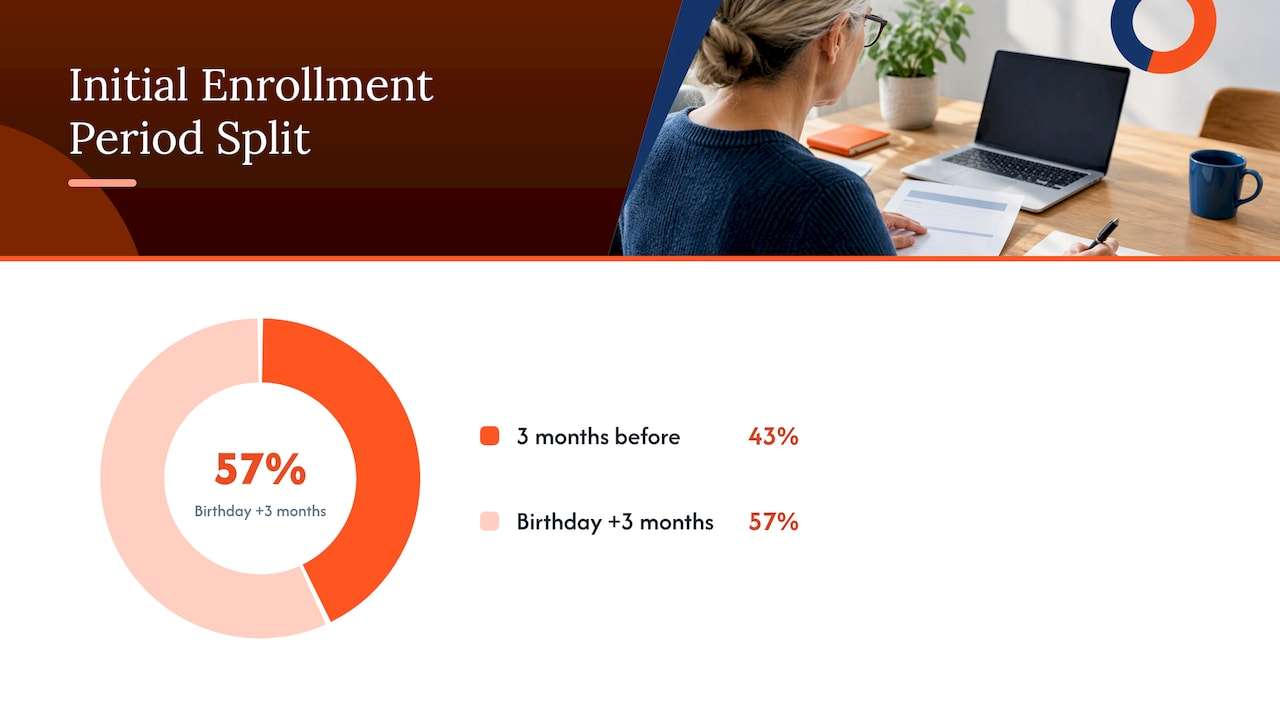
There is one exception worth knowing. People whose birthday falls on the first of the month have their whole window shifted a month earlier, starting four months before and ending two months after that birthday month, according to Medicare.gov.
A few examples make this concrete:
- Birthday is June 15: enroll in March, April, or May, and coverage starts June 1.
- Same birthday, but you enroll in June, July, August, or September: coverage starts the first of the month after you sign up.
- Birthday is June 1: your IEP runs February through July instead of March through September, because of the day-1 exception.
Our Initial Enrollment Period guide walks through more scenarios if your birth month falls near a calendar year change.
General Enrollment Period: your backup option if you missed IEP
If your IEP has already closed and you did not qualify for a Special Enrollment Period, the General Enrollment Period is your next chance. It runs January 1 through March 31 every year, and coverage generally begins the month after you enroll, according to Medicare.gov.
The catch is cost. Missing your IEP without other coverage can trigger a Part B late-enrollment penalty, and that penalty can last for as long as you have Part B. If you find yourself in this position:
- Enroll as soon as the GEP window opens rather than waiting until March 31.
- Ask Social Security to calculate what your penalty will look like before you commit.
- Review our guide on avoiding enrollment penalties for a fuller breakdown, and see this third-party overview of Part B penalties for additional context on estimating costs.
Special Enrollment Periods: qualifying events and effective dates
Most Special Enrollment Periods exist for people who delayed Medicare because they had coverage through a current employer or spouse’s group health plan (GHP). Once that coverage ends, or once you decide to leave it, you typically get up to eight months to enroll without a late penalty, based on Social Security’s POMS guidance.
Common SEP triggers include:
- Losing employer or union group health coverage, including retiree coverage.
- Losing Medicaid eligibility.
- Moving out of your plan’s service area.
- A federally declared disaster that disrupted your enrollment window.
- Employer or plan misrepresentation that caused you to delay enrollment in error.
In most of these cases, coverage starts the first day of the month after you sign up. Some SEP situations, particularly those tied to employer coverage ending, let you request a specific effective month using a CMS-40B attestation, according to SSA POMS examples.
Documentation matters here. Keep your employer coverage termination letter, COBRA paperwork if you had it, and any correspondence from CMS or Social Security. Our enrollment guide for IEP and SEP situations covers what paperwork to gather for each scenario.
Pro Tip: COBRA and retiree coverage do not count as active employer group health coverage for SEP purposes, so relying on either past your IEP can leave you without a valid Special Enrollment Period.
AEP and MA OEP: when plan changes take effect
Two separate windows exist each year for adjusting an existing Medicare Advantage or Part D plan, and they work differently. The Annual Enrollment Period runs October 15 through December 7, and any changes you make take effect January 1 of the following year, according to the Medicare & You 2026 handbook.
The Medicare Advantage Open Enrollment Period runs January 1 through March 31. Changes made during MA OEP generally take effect the first day of the month after your plan receives the request, per CMS enrollment and disenrollment guidance.
- During AEP, you can switch between Medicare Advantage and Original Medicare, change Part D plans, or move to a different Medicare Advantage plan.
- During MA OEP, you can switch Medicare Advantage plans once or drop Medicare Advantage for Original Medicare, but you cannot use it to switch Part D plans if you started the year in Original Medicare.
If you are weighing your options for either window, our comparison of Medicare Advantage and Medigap breaks down what each path means for your coverage.
How to confirm your effective date and what to do next
Do not guess. Confirming your actual effective date takes a few minutes and prevents billing surprises or gaps in coverage.
- Log into your account at Medicare.gov or ssa.gov to see your confirmed start date and card status.
- Check the welcome packet or notice mailed by Social Security or your plan after you enrolled.
- Call Social Security directly if your online account does not show a clear date yet.
- Gather your birthdate, enrollment confirmation number, employer coverage end date, and any CMS or SSA letters before you call, so the representative can verify your case quickly.
- If you are billing a provider around your start date, this Medicare coverage guide for physical therapy explains how effective dates interact with service billing.
If your situation involves an SEP, a missed IEP, or you simply want a second set of eyes before you submit paperwork, Safeguard Benefit Services offers a free Medicare roadmap and can walk through your specific dates with you. Our step-by-step enrollment guide is also a good starting point.
What most people get wrong about their enrollment timing
The most common mistake is waiting. People assume they have plenty of time inside their IEP, then enroll in the last month of the window and end up with a coverage gap they did not expect, or they miss the window entirely and land in GEP with a penalty attached. My recommendation is simple: enroll in the three months before your birthday month whenever possible, and if you are relying on an SEP, gather your documentation the day your coverage ends, not weeks later. Safeguard Benefit Services builds a free Medicare roadmap for exactly this reason, to catch these details before they become expensive.
— Zach
Get help locking in the right effective date
Figuring out your exact enrollment window is only half the job. Picking the right plan once your Medicare Part A and Part B are active is the other half, and that is where a local agent pays off. A local Medicare insurance agency helps clients confirm their enrollment timing, document SEP eligibility correctly, and compare Medicare Advantage, Medicare Supplement, and Part D options side by side at no added cost to you.

- Get a free Medicare roadmap that lays out your enrollment timeline and plan options.
- Have an agent double-check your SEP documentation before you submit it.
- Compare Medicare Advantage, Medigap, and Part D plans available in your area.
If you are ready to talk through your specific dates and options, visit Safeguard Benefit Services to schedule a consultation, or explore our Medicare Advantage plans page to see what is available near you.
This article is general information, not a substitute for advice from a qualified financial advisor. Consult a qualified financial professional about your own circumstances before acting on anything here.
Sources
- When does Medicare coverage start? | Medicare
- CY 2026 Enrollment and Disenrollment Guidance (CMS)
- SSA – POMS: HI 00805.384 – Exceptional Conditions SEP (GHP or Employer Misrepresentation)
FAQ
How do I know my Medicare effective date?
Log into your account at Medicare.gov or ssa.gov, where your confirmed start date appears once your enrollment is processed. You can also check the notice mailed to you by Social Security or call them directly if the online record is not yet updated.
What’s going to happen to Medicare in 2026?
Medicare’s core enrollment structure stays the same in 2026: the Annual Enrollment Period runs October 15 through December 7 with changes effective January 1, and the Medicare Advantage Open Enrollment Period runs January 1 through March 31, according to the Medicare & You 2026 handbook. Specific plan costs and benefits can shift year to year, so it is worth reviewing your options each fall.
If I was born in 1966, when am I eligible for Medicare?
You become eligible for Medicare the month you turn 65. Your Initial Enrollment Period opens three months before your birthday month and closes three months after, unless your birthday falls on the first of the month, which shifts the window one month earlier, according to Medicare.gov.
What is the 2 year rule for Medicare?
People under 65 with certain disabilities generally become eligible for Medicare after receiving Social Security disability benefits for a waiting period. This waiting period does not apply to most people qualifying by age, and specific exceptions exist for conditions like ALS and End-Stage Renal Disease, so check your situation directly with Social Security.
Recommended
Request a No Obligation Phone Call








Get Connected