

Missing your Medicare enrollment window does not just mean a paperwork delay. It can mean a lifetime premium penalty that follows you for as long as you have Medicare coverage. Most people turning 65 in North Carolina assume they will be automatically enrolled or that they have plenty of time to figure it out. Neither assumption is reliably true. Understanding the Medicare eligibility rules now, before your birthday month arrives, is the single most effective thing you can do to protect your coverage and your wallet.
Table of Contents
- Quick Takeaways
- Who Qualifies for Medicare
- The Medicare Age Requirement and What It Means in North Carolina
- Qualifying for Medicare Under 65
- The Three Enrollment Periods Explained
- Late Enrollment Penalties: What They Cost You
- Enrollment Path Comparison
- Common Eligibility Mistakes People Make at 64 and 65
- Frequently Asked Questions
- References
Quick Takeaways
| Key Insight | Explanation |
|---|---|
| The standard Medicare age is 65 | U.S. citizens and qualifying legal residents become eligible for Medicare at age 65, regardless of whether they are still working. |
| Premium-free Part A requires 40 work quarters | If you or your spouse worked and paid Medicare taxes for at least 10 years (40 quarters), you owe no Part A premium. Fewer quarters means a monthly premium. |
| Your Initial Enrollment Period is only 7 months | It opens 3 months before your 65th birthday month and closes 3 months after. Missing it triggers the General Enrollment Period and likely a penalty. |
| Working past 65 on employer coverage is fine, but rules apply | You qualify for an 8-month Special Enrollment Period once that employer coverage ends. COBRA does not count as creditable coverage for this purpose. |
| Part B penalties are permanent | You pay an extra 10% for every full 12-month period you could have enrolled in Part B but did not. That surcharge stays for life. |
| Under-65 eligibility exists for specific conditions | You can qualify before 65 if you have received Social Security Disability Insurance for 24 months, have end-stage renal disease, or have ALS. |
| A licensed Medicare agent costs you nothing | Working with an agency like Safeguard Benefit Services in Charlotte gives you personalized plan guidance at no charge. Agents are compensated by the insurance carriers. |
Who Qualifies for Medicare
Medicare is a federal health insurance program, and the basic eligibility criteria are set at the federal level. That means the rules are the same whether you live in Charlotte, Concord, or anywhere else in North Carolina.
To qualify for Medicare at age 65, you must be a U.S. citizen or a qualifying legal resident who has lived in the United States for at least five continuous years. Citizenship alone is not enough if you have not met the residency requirement.
Premium-free Part A, the hospital insurance portion of Medicare, is available to people who have worked and paid Medicare taxes for at least 40 quarters, which equals roughly 10 years of covered employment. You can also qualify through a spouse’s work history if you are currently married and your spouse is eligible for Social Security benefits, and you have been married for at least one year before applying. If you do not meet the 40-quarter threshold, you can still buy into Part A by paying a monthly premium.
Part B, which covers outpatient and preventive care, is available to anyone who qualifies for Part A. Unlike Part A, Part B always carries a monthly premium.
The question is not just whether you are eligible. The question is whether you are enrolled on time, in the right parts, with the right plan for your specific health and financial situation.
The Medicare Age Requirement and What It Means in North Carolina
The Medicare age requirement is 65 for standard eligibility, and it applies uniformly across all states, including North Carolina. There is no state-specific age variation. What does vary by state is the range of Medicare Supplement and Medicare Advantage plans available, the premiums those plans carry, and the network of providers who accept them.

For North Carolina residents approaching 65, this matters practically. The Charlotte metro area, including communities like Matthews, Monroe, Cornelius, and Kannapolis, has a competitive Medicare insurance market. That means more plan options, but also more confusion about what you are actually buying and what tradeoffs you are making between Original Medicare, Medicare Supplements, and Medicare Advantage plans.
When Your Eligibility Clock Starts
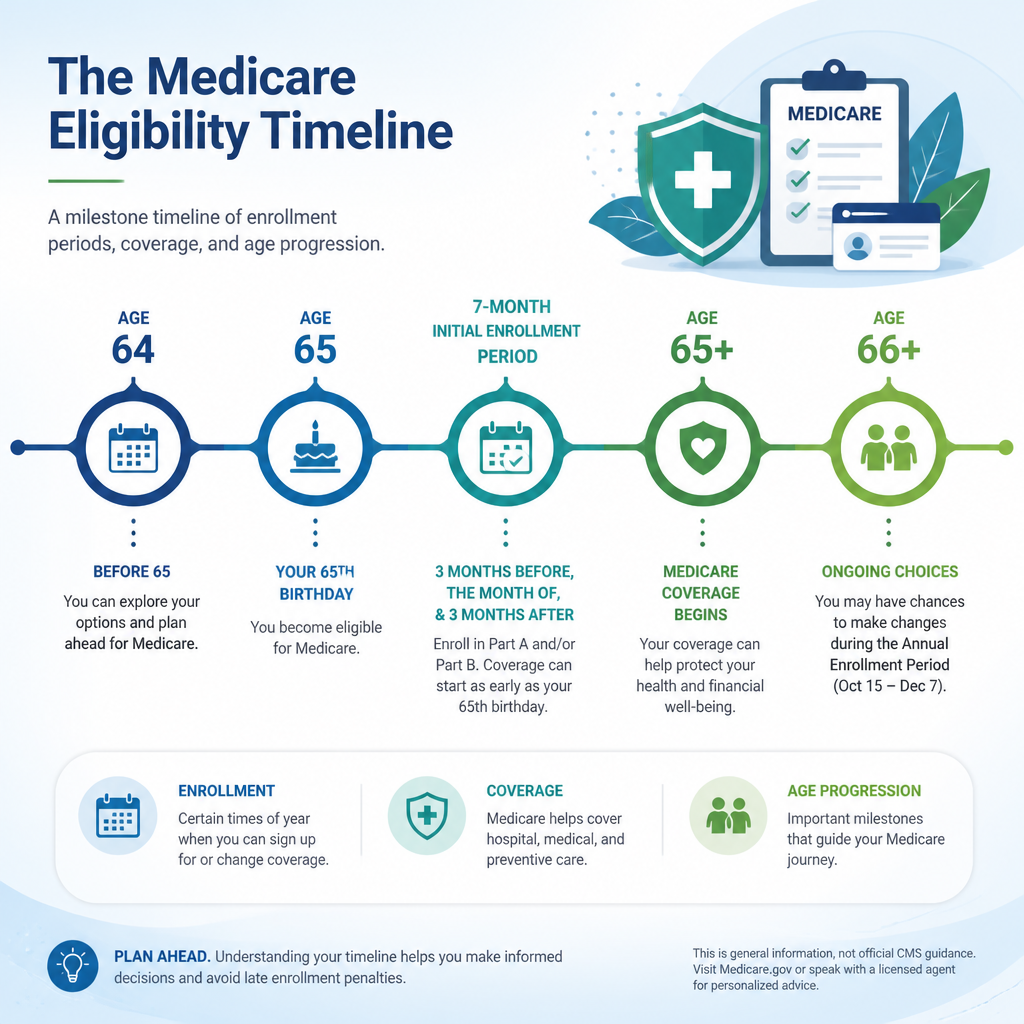
You become eligible for Medicare three months before the month you turn 65. If your birthday is in July, your eligibility window opens in April. This is when you can first enroll, and for most people, enrolling early in that window means your coverage starts on the first day of your birthday month without any gap.
If you enroll in the month you turn 65 or during the three months after, your coverage start date shifts forward. Enrolling late within your own Initial Enrollment Period can cause a one-to-three month coverage delay. That gap matters if you have prescriptions, scheduled procedures, or chronic conditions that require active coverage.
Pro tip: If your birthday falls on the first day of a month, Medicare treats the prior month as your birthday month. Enroll earlier than you think you need to in order to land the coverage start date you actually want.
Qualifying for Medicare Under 65
Most people do not realize that Medicare is not exclusively a senior program. Three distinct situations allow younger individuals to qualify.
Social Security Disability Insurance Recipients
If you have been receiving Social Security Disability Insurance benefits for at least 24 months, you automatically become eligible for Medicare Parts A and B. The 24-month waiting period begins from the date your SSDI benefits start, not from the date of your disability. This is a painful gap for many people and one that a licensed agent can help you plan around with other coverage options.
End-Stage Renal Disease
People with end-stage renal disease who require dialysis or a kidney transplant qualify for Medicare regardless of age. ESRD eligibility has its own enrollment rules and coverage start timelines that differ from standard age-based enrollment. Getting the enrollment timing right with ESRD is especially important because mistakes can delay dialysis coverage.
Amyotrophic Lateral Sclerosis
People diagnosed with ALS, also called Lou Gehrig’s disease, are eligible for Medicare the same month their Social Security disability benefits begin. There is no 24-month waiting period for ALS. This is one area where the rules are more forgiving, and it reflects how rapidly the disease can progress.

The Three Enrollment Periods Explained
Knowing that you are eligible is only half the battle. Knowing when to enroll, and which enrollment period applies to your situation, determines whether you pay a penalty and how quickly your coverage begins.
Initial Enrollment Period
The Initial Enrollment Period is a 7-month window that starts 3 months before your 65th birthday month and ends 3 months after it. This is your primary opportunity to enroll in Medicare Parts A and B without any late penalty. For most people approaching 65 in North Carolina, this is the enrollment period they should be planning around right now.
If you enroll during the first three months of your IEP, your coverage generally begins on the first day of your birthday month. The further into your IEP you wait, the later your coverage start date gets.
Special Enrollment Period
If you are still working at 65 and covered by a group health plan through an employer with 20 or more employees, you can delay Medicare without penalty. Once your employment ends or your employer coverage ends, whichever comes first, you have an 8-month window to enroll in Parts A and B. This is the Special Enrollment Period.
A common and costly mistake here: people who leave their job and go onto COBRA or retiree health coverage assume that coverage counts as creditable employer coverage. It does not trigger the Special Enrollment Period rules in the same way as active employer coverage. If you are planning to retire and bridge to Medicare on COBRA, talk to a licensed agent before you finalize those dates.
Pro tip: When you stop working, contact Social Security before your employer coverage actually ends. That gives you time to sequence the enrollment correctly and avoid a gap in coverage.
General Enrollment Period
If you miss both your Initial Enrollment Period and any applicable Special Enrollment Period, you can sign up during the General Enrollment Period, which runs from January 1 through March 31 each year. Coverage under the GEP begins July 1 of that year. That means you could face several months without Medicare coverage, plus you will almost certainly face a permanent late enrollment penalty on your Part B premium.
Late Enrollment Penalties: What They Cost You
Late enrollment penalties are permanent, proportional, and frequently underestimated by people who are just starting to research Medicare. They are also entirely avoidable with proper timing.
Part B Penalty
For Part B, the penalty is an extra 10% of the standard Part B premium for every full 12-month period you could have been enrolled but were not. If you waited two full years without a qualifying Special Enrollment Period, your premium goes up by 20%, and that surcharge stays in place for the rest of your life. The penalty is recalculated when the base Part B premium changes each year, so it can grow over time.
Part D Penalty
Part D covers prescription drugs, and its late enrollment penalty works differently. The penalty is calculated as 1% of the national base beneficiary premium for each month you went without creditable drug coverage after first becoming eligible. That penalty is added to your Part D premium for as long as you have drug coverage, even if you switch plans. The national base beneficiary premium for Part D changes annually.
The practical lesson is straightforward: if you do not enroll in Part D when you first become eligible, you need a documented reason, specifically creditable drug coverage from another source. If you cannot prove you had that coverage, the penalty applies.
Enrollment Path Comparison
| Enrollment Path | Who It Applies To | Penalty Risk |
|---|---|---|
| Initial Enrollment Period (IEP) | Anyone turning 65 who is not covered by active employer insurance from a large employer | None, if you enroll within the 7-month window |
| Special Enrollment Period (SEP) | People working past 65 with creditable group coverage from an employer with 20+ employees | None, if you enroll within 8 months of losing that coverage |
| General Enrollment Period (GEP) | Anyone who missed their IEP or SEP without a qualifying reason | High. Permanent Part B premium surcharge. Coverage delayed until July 1. |
The comparison above makes one thing clear: there is no enrollment path that penalizes you for being early or on time. The only path that punishes you is the one you end up on by default when you miss the others.
Common Eligibility Mistakes People Make at 64 and 65
These are not hypothetical errors. They are patterns that licensed Medicare agents encounter regularly, and they are almost always more expensive to fix than to prevent.
Assuming Automatic Enrollment Will Happen
Some people are automatically enrolled in Medicare Parts A and B when they turn 65, specifically those who are already receiving Social Security or Railroad Retirement Board benefits. But if you are not yet receiving those benefits because you delayed taking Social Security, you are not automatically enrolled. You need to actively apply through Social Security.
Treating COBRA as Creditable Coverage for Enrollment Purposes
As covered above, COBRA coverage does not give you a Special Enrollment Period the way active employer group coverage does. People who retire, go onto COBRA, and then expect to enroll in Medicare later without penalty are frequently surprised to find the rules do not work that way. The 8-month SEP clock starts when your active employer coverage ends, not when your COBRA runs out.
Skipping Part D Because You Take No Prescriptions Right Now
Skipping Part D to save a few dollars a month today is one of the most expensive decisions a healthy 65-year-old can make. If you develop a condition later that requires expensive medications, you will pay both the drug costs and the accumulated late enrollment penalty. Enrolling in a low-premium Part D plan when you first become eligible is almost always the smarter move.
Comparing Plans Without Knowing What Type You Need First
Medicare Supplement plans, Medicare Advantage plans, and standalone Part D plans serve different needs and work in fundamentally different ways. Many people start comparing premiums before deciding which type of coverage structure fits their health, budget, and provider preferences. Getting that foundational decision right, with help from someone who represents multiple carriers, saves significant time and money. Agencies like Safeguard Benefit Services in Charlotte work with 30-plus carriers and offer free consultations specifically to help people make this decision clearly.
Pro tip: Start your Medicare research at least six months before you turn 65, not the month of. The plans available during your Initial Enrollment Period are the same plans available later, but your health history and insurability for Medicare Supplement plans may change after 65 in states without guaranteed issue protections beyond the initial window.
Frequently Asked Questions
What are the basic Medicare eligibility rules?
You must be 65 or older and a U.S. citizen or qualifying legal resident with at least five years of continuous U.S. residency. You also qualify under 65 if you have received Social Security Disability Insurance for 24 months, have end-stage renal disease, or have ALS. Premium-free Part A requires that you or your spouse have at least 40 quarters of covered employment.
Who qualifies for Medicare in North Carolina?
The same federal eligibility rules apply in North Carolina as in every other state. Any U.S. citizen or qualifying legal resident who turns 65 and meets the residency and work history requirements qualifies. North Carolina residents may also qualify early under the disability, ESRD, or ALS pathways. What differs in North Carolina is the specific range of Medicare Advantage and Supplement plans available, which varies by county and ZIP code.
What is the Medicare age requirement, and is there any flexibility?
The standard Medicare age requirement is 65. There is no partial or early access to Medicare before 65 unless you qualify through disability, ESRD, or ALS. Social Security’s retirement age has changed over time, but the Medicare eligibility age of 65 has remained fixed. Discussions about raising or adjusting it happen at the policy level periodically, but as of now, 65 is the threshold.
Can I delay Medicare Part B without paying a penalty?
Yes, but only if you have creditable coverage through an active employer group health plan from an employer with 20 or more employees. In that case, you qualify for a Special Enrollment Period when that coverage ends, giving you 8 months to enroll in Part B without penalty. Retiree coverage, COBRA, or individual marketplace plans do not qualify as creditable coverage for this purpose.
What happens if I miss my Initial Enrollment Period?
If you miss your Initial Enrollment Period and do not qualify for a Special Enrollment Period, you must wait for the General Enrollment Period from January 1 through March 31. Your coverage will not begin until July 1 of that year. You will also face a permanent late enrollment penalty on Part B, adding 10% per year you delayed. The best move is to contact a licensed Medicare agent before your IEP closes to understand your specific options.
Does working past 65 affect my Medicare eligibility?
Working past 65 does not disqualify you from Medicare, and it does not start any penalty clock as long as you have creditable coverage from your employer. When you do eventually leave that job or lose that coverage, your 8-month Special Enrollment Period begins immediately. The key is to plan the transition carefully so there is no gap between your employer coverage ending and your Medicare coverage beginning.
How do I know which Medicare plan to choose after I confirm I am eligible?
Confirming eligibility is step one. Choosing the right plan type, Original Medicare with a Supplement, or a Medicare Advantage plan, requires comparing your health needs, budget, preferred doctors, and whether you travel or spend time in multiple states. A licensed independent agent who represents multiple carriers can walk you through that comparison without steering you toward any single company. Safeguard Benefit Services in Charlotte offers free consultations and works with more than 30 carriers across North Carolina for exactly this purpose.
Have you recently started looking into your Medicare options? Share what questions came up for you in the comments, your experience might help someone else in the same position.
References
- Medicare.gov: How to avoid late enrollment penalties for Part B and Part D
- Social Security Administration: When to sign up for Medicare and the three enrollment periods
- Healthgrades: Complete guide to Medicare eligibility requirements including age-based and disability pathways
- CMS: Medicare decisions for people over 65 who are nearing retirement
- Medical News Today: What 40 quarters of work means for Medicare Part A premium eligibility








Get Connected