

Medicare’s 2026 Annual Enrollment Period runs October 15 through December 7, 2026. Any change you request must reach your plan by midnight on December 7 to take effect January 1, 2027. During this 54-day window you can switch Medicare Advantage plans, change your Part D drug coverage, or move between Original Medicare and Medicare Advantage. Miss it, and you’re generally locked into your current setup for another year.
TL;DR:
- Most people risk missing the December 7 deadline by waiting until late November to compare plans or neglecting their initial Notice of Change details.
- Reviewing formulary tiers, provider networks, and prior authorization rules is essential to avoid unexpected costs or coverage gaps during plan switching.
- Comparing total annual costs, including premiums, copays, and drug expenses, is more accurate than choosing based solely on monthly premiums.
- Missing the deadline or skipping steps like reading the ANOC can result in automatic renewal of less suitable plans, potentially costing more over the year.
- Using a licensed agent for personalized advice can help prevent common mistakes and ensure timely submission of your Medicare plan changes.
Table of Contents
- When Are the Key Medicare Enrollment Dates for 2026?
- What Can You Actually Change During Medicare Open Enrollment?
- How Do You Prepare and Submit Changes Before the Deadline?
- What Other Medicare Enrollment Windows Exist Besides AEP?
- What Mistakes Cost People the Most During Open Enrollment?
- How Safeguard Benefit Services Helps Clients Through AEP
- The Part of Open Enrollment Nobody Talks About
- Get Help Before the December 7 Deadline
- Sources
When Are the Key Medicare Enrollment Dates for 2026?
Four dates matter, and each one has a job.
Your Annual Notice of Change (ANOC) should land by late September. Read it the day it arrives. It spells out next year’s premiums, formulary changes, and network updates for your current plan, and skipping it is how people end up with a plan that quietly got worse.
October 1 is your prep window. Pull your prescription list, note your doctors and pharmacies, and start comparing before the rush hits.
The 54-Day Window: The 2026 Annual Enrollment Period opens October 15 and closes December 7. Your request has to reach the plan by midnight on that final day.
Here’s the full sequence:
- Late September 2026: ANOC arrives in the mail or online.
- October 1, 2026: Start comparing plans, prescriptions, and providers.
- October 15 to December 7, 2026: Active enrollment window. Submit changes anytime.
- January 1, 2027: New coverage, or your renewed plan, takes effect.
Set a phone reminder for early November. Waiting until the first week of December to start comparing plans is the single most common way people run out of time.
What Can You Actually Change During Medicare Open Enrollment?
The Annual Enrollment Period covers more ground than most people assume, but it’s not unlimited. Here’s what’s on the table:
- Medicare Advantage (Part C): Join a new plan, switch from one MA plan to another, or drop MA entirely and return to Original Medicare.
- Part D drug plans: Add a standalone drug plan if you don’t have one, switch to a different Part D plan, or drop coverage altogether.
- Original Medicare to Medicare Advantage: Move from Original Medicare into an MA plan, or reverse that move.
One detail trips people up every year: if you drop Part D coverage without another source of creditable drug coverage, you risk a late-enrollment penalty that follows you for as long as you have Medicare. That penalty is separate from AEP rules entirely, and it doesn’t get waived just because you didn’t realize you needed drug coverage.
If you’re weighing whether Medicare Advantage or a Medigap-style supplement fits your situation better, it helps to look at the two side by side before AEP opens, not during it.
How Do You Prepare and Submit Changes Before the Deadline?
Getting this right isn’t complicated, but it does take a sequence. Work through it in this order:
- Read the ANOC line by line. Look specifically at premium changes, whether your drugs moved to a higher cost tier, and whether your doctors are still in-network.
- Run your prescriptions through Medicare’s Plan Finder tool. Enter every medication, not just the expensive ones. A plan that looks cheap on premiums can cost more overall if it puts one of your drugs in a high tier.
- Confirm your pharmacy and providers are covered. Call the office directly, or check how a clinic verifies accepted insurance plans if you want a sense of what that process looks like from the provider’s side.
- Check for prior authorization rules and service-area limits. Some MA plans require sign-off before covering certain procedures or specialists.
- Submit your change. You can do this online at Medicare.gov, by calling 1-800-MEDICARE, or through a licensed agent.
- Get proof. Save the confirmation number, timestamp, or email. If you enroll through an agent, ask them to confirm the plan received your electronic submission before December 7.
Pro Tip: If you call in your enrollment, write down the representative’s name, confirmation number, and the exact date and time of the call. If your plan disputes the change later, that record is what protects you.
If you get stuck anywhere in this process, your local State Health Insurance Assistance Program (SHIP) counselor offers free, unbiased help, and 1-800-MEDICARE can answer specific plan questions around the clock.
What Other Medicare Enrollment Windows Exist Besides AEP?
AEP isn’t the only door. Three other windows matter depending on your situation:
- Medicare Advantage Open Enrollment Period (January 1–March 31): Only for people already enrolled in an MA plan. You get one switch, either to a different MA plan or back to Original Medicare, but you can’t add a standalone Part D plan if you return to Original Medicare through this window.
- General Enrollment Period (January 1–March 31): For people who missed their Initial Enrollment Period for Part B. Coverage starts the month after the plan gets your request, not automatically on January 1.
- Special Enrollment Periods: Triggered by specific life events, like losing employer coverage, moving out of a plan’s service area, or qualifying for Medicaid. These allow changes outside the usual calendar entirely.
Effective dates differ across all three, which is exactly why sorting out mid-year plan changes on your own timeline, rather than AEP’s, requires checking which window actually applies to you.
What Mistakes Cost People the Most During Open Enrollment?
Most enrollment regrets trace back to one of five habits.
- Skipping the ANOC. If you don’t act during AEP, your plan automatically renews under whatever new terms it published, not the terms you signed up for originally.
- Waiting until the first week of December. Phone lines get busy, agents get booked, and a last-minute submission leaves zero room for a mistake.
- Never checking the formulary. A plan can look perfect on price and still leave your specific medication in an expensive tier.
- Switching back to Original Medicare without checking Medigap rules. Depending on your state, you may not have guaranteed-issue rights, meaning an insurer could medically underwrite you or deny coverage.
- Comparing monthly premiums only. A lower premium with high copays and a narrow network often costs more over twelve months than a slightly higher premium with better coverage.
Pro Tip: Add up a full year of costs, premiums plus expected copays plus drug costs, before you compare two plans side by side. The cheaper-looking option on paper isn’t always cheaper in practice.
How Safeguard Benefit Services Helps Clients Through AEP
Sorting through ANOC letters, formulary tiers, and network rules while running your own household is a lot to take on alone, especially on a deadline. That’s the gap Safeguard Benefit Services was built to close for Medicare beneficiaries in the Charlotte area.
Our approach starts with a free Medicare roadmap and a one-on-one consultation, where an agent walks through your current plan’s ANOC alongside your actual prescription list. We compare Medicare Advantage and Part D options against what you’re already paying, flag network or formulary problems before they become surprise bills, and confirm your submission reaches the plan with time to spare before December 7. The goal isn’t just finding a cheaper plan. It’s making sure the decision you make in November still looks right in July.

The Part of Open Enrollment Nobody Talks About
Here’s what most coverage of AEP gets backwards: the deadline isn’t the hard part. Reading a 40-page ANOC and translating insurance jargon into “will my cardiologist still be covered” is the hard part, and most people either skip it or muddle through it alone.
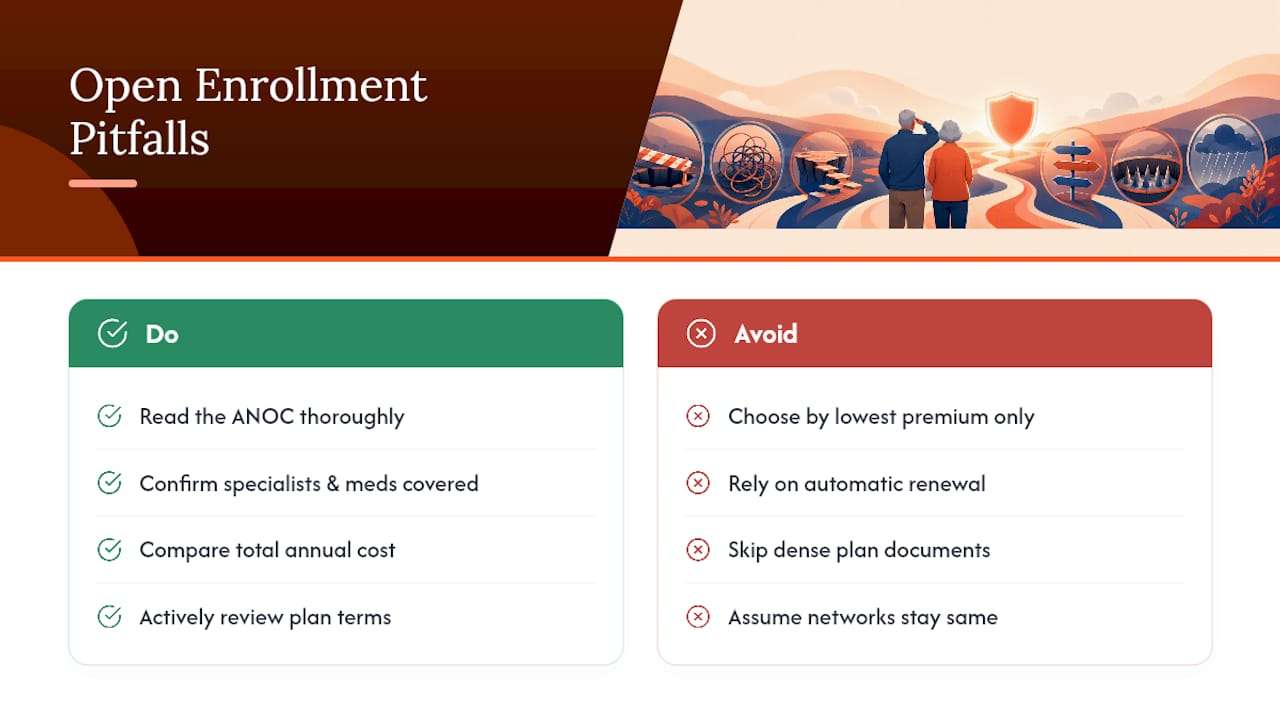
The conventional advice, “just compare premiums and pick the cheapest plan,” is exactly how people end up finding out in February that their specialist dropped out of network or their maintenance medication jumped two cost tiers. Total annual cost, not the sticker price on the monthly premium, is the number that actually predicts whether you’ll be happy with your choice in June. That’s not a minor caveat. It’s the whole game, and most plan-comparison tools bury it under a bigger, flashier premium number up top.
The other thing worth saying plainly: automatic renewal feels like the safe, low-effort choice. It isn’t. It’s the plan’s terms changing without your input, and the only reason it feels safe is that nobody actively chose it.
— Zach
Get Help Before the December 7 Deadline
Comparing formularies, checking provider networks, and cross-referencing premiums against copays is doable on your own with enough time and patience. If you’d rather have someone who does this daily walk through it with you, an insurance agency can offer something a spreadsheet can’t: a licensed agent who already knows which local plans cover your pharmacy and your doctors.

We’re an insurance agency offering Medicare-related consultations. We’ll review your ANOC, run your prescriptions against current Medicare Advantage options, and help you weigh Medicare Advantage against a Medicare Supplement plan if switching back to Original Medicare is on the table. The practical next step: request your free Medicare roadmap now, before the calendar gets tight, so your enrollment change is submitted and confirmed well ahead of the December 7 midnight cutoff. Book a consultation with Safeguard Benefit Services and get this handled with someone who does it every day.
This article is general information, not a substitute for advice from a qualified financial advisor. Consult a qualified financial professional about your own circumstances before acting on anything here.
Sources
Recommended
Request a No Obligation Phone Call








Get Connected