

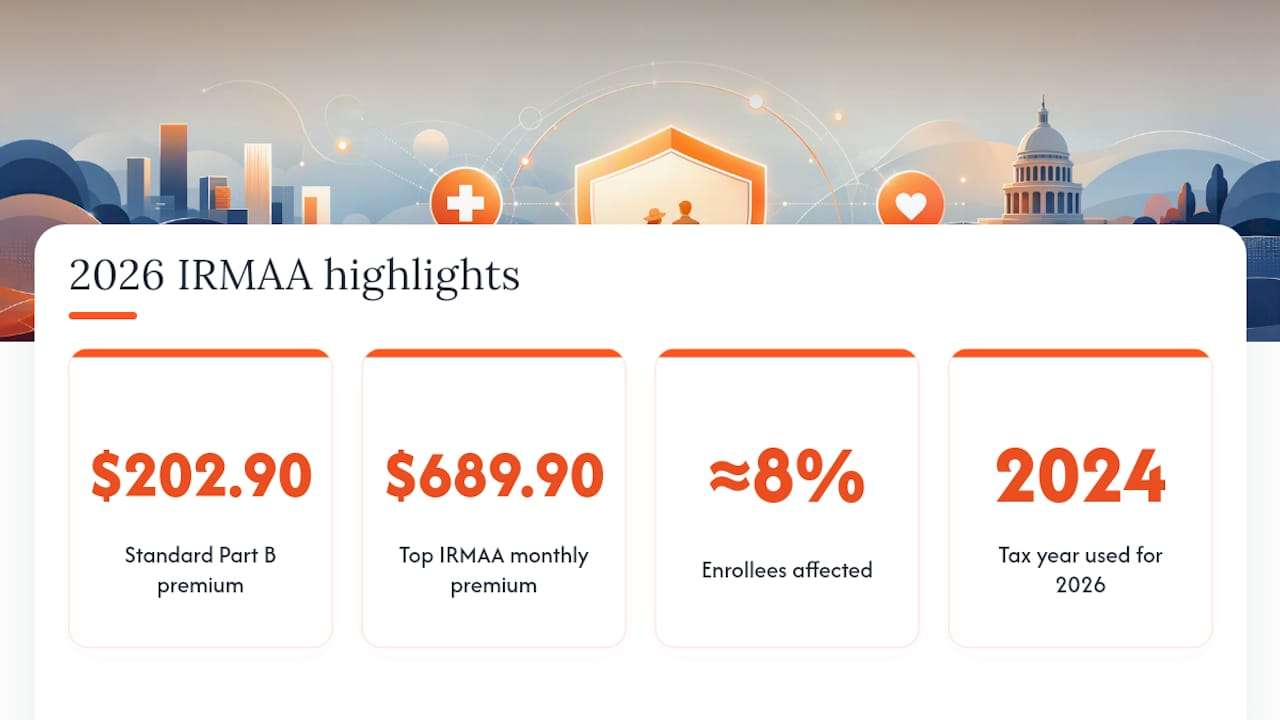
The standard monthly Medicare Part B premium for 2026 is $202.90, up from $185.00 in 2025, and the annual Part B deductible is $283. Most beneficiaries with income at or below the standard thresholds pay this amount, while higher earners face an added income-related monthly adjustment amount (IRMAA) that can push the total as high as $689.90. The Social Security Administration sends every beneficiary a notice with their exact figure before the new year begins.
TL;DR:
- Most beneficiaries will pay the standard Medicare Part B premium of $202.90 in 2026, unless their income exceeds the IRMAA thresholds.
- The IRMAA top rate of $689.90 applies to individuals with 2024 income above specific high brackets, which vary by filing status.
- The 2026 premium increased by about 9.7% from 2025, driven mainly by rising Part B costs for physician-administered drugs and high-cost infusions.
- Beneficiaries can verify their exact premium via Social Security notices, Medicare.gov accounts, or direct SSA contact, and can request recalculation with Form SSA-44 for income changes.
- People paying IRMAA or not enrolled through Social Security are not protected by the hold-harmless rule, and late enrollment penalties may apply if coverage is delayed.
Table of Contents
- 2026 Standard Premium and Deductible: The Headline Numbers
- What Are the 2026 IRMAA Tiers and the Highest Premium?
- Why Did the Medicare Part B Premium Go Up in 2026?
- How Do You Check Your Exact 2026 Part B Premium?
- Paying Your Part B Premium and Avoiding Penalties
- What Should You Prioritize This Year?
- Get Local Help Managing Your 2026 Medicare Costs
- Sources
- FAQ
2026 Standard Premium and Deductible: The Headline Numbers
The jump from $185.00 to $202.90 is a $17.90 increase, roughly a 9.7% rise year over year, according to the Centers for Medicare & Medicaid Services (CMS). That’s one of the larger single-year jumps in recent memory, and it lands on top of a deductible that rose to $283 for 2026, as confirmed by Medicare.
Most people don’t get to choose whether they pay the standard rate. You’ll typically pay the standard premium a month if you fall into one of these groups:
- You’re enrolling in Part B for the first time in 2026.
- You’re billed directly by Medicare rather than having premiums withheld from Social Security.
- Your state Medicaid program pays your premium on your behalf, in which case the state, not you, covers the cost.
- Your income falls below the IRMAA thresholds set for the 2026 coverage year, based on your 2024 tax return.
If none of those apply and your income is above certain limits, you’ll pay more. That’s where IRMAA comes in.
What Are the 2026 IRMAA Tiers and the Highest Premium?
IRMAA stands for income-related monthly adjustment amount, and it’s based on your modified adjusted gross income (MAGI) from your tax return two years prior. For 2026 premiums, that means your 2024 tax return sets your bracket. The Medicare.gov cost publication lays out the full schedule, and it applies to roughly 8% of Part B enrollees.
Filing status matters here. Individual filers, joint filers, and married people who file separately but lived with their spouse at any point during the year all fall on different scales, with the separate-filing category hitting the top bracket much faster.
The top bracket tops out at $689.90 a month, more than triple the standard premium. That’s the ceiling: no one pays more than that regardless of how high their income climbs.
Why Did the Medicare Part B Premium Go Up in 2026?
Part B premiums aren’t set by guesswork. Federal law ties the standard premium to roughly a quarter of the projected cost of running the Part B program for aged enrollees, with the government covering the rest. The Federal Register notice sets the 2026 monthly actuarial rate at $405.40 for aged enrollees and $548.60 for disabled enrollees, the raw cost estimates behind the premium math.
CMS points to rising Part B spending, particularly on physician-administered drugs, as a major driver of the increase. Cancer treatments, biologics, and other high-cost infusions administered in clinical settings all run through Part B, not Part D, and utilization of those drugs has climbed steadily. There’s also a separate, higher premium track for people taking immunosuppressive drugs after an organ transplant who don’t have other qualifying coverage. The premium isn’t a flat reaction to one line item. It reflects the program’s entire projected cost base for the year ahead, adjusted annually through this statutory formula.

How Do You Check Your Exact 2026 Part B Premium?
You don’t have to guess your bracket. Three sources will tell you your specific number:
- Check your Social Security notice. SSA mails an annual notice each fall showing your exact 2026 premium, typically arriving in your mailbox or your Social Security online account by early December.
- Log into your Medicare.gov account. Your premium and payment history show up under your account dashboard once you’re enrolled.
- Call Social Security directly at 1-800-772-1213 (TTY 1-800-325-0778) if you can’t find your notice or have questions about your bracket.
Because IRMAA relies on a two-year lookback, your 2026 premium is based on 2024 income, which can feel unfair if your income has since dropped due to retirement, job loss, divorce, or the death of a spouse. That’s what Form SSA-44 is for. It lets you report a qualifying life-changing event and request a recalculation based on more recent income instead of the outdated tax return.
Pro Tip: Keep documentation ready before you file SSA-44, things like a termination letter, a signed divorce decree, or a pension start letter. SSA processes these appeals faster when the paperwork is attached the first time, rather than requested after the fact.
Paying Your Part B Premium and Avoiding Penalties
Most people never write a check for Part B. If you already collect Social Security, Railroad Retirement, or Office of Personnel Management benefits, your premium is withheld automatically from that monthly payment. If you haven’t started collecting those benefits yet, Medicare bills you directly, usually on a quarterly basis, and you can pay online, by mail, or through automatic bank withdrawal.
A quirk called the hold-harmless rule protects some Social Security recipients from a Part B increase that would shrink their net Social Security check below the prior year’s amount. It doesn’t apply to everyone.
- New enrollees who didn’t have Part B and Social Security both active in 2025 aren’t covered by hold harmless.
- People who pay IRMAA are excluded from the protection entirely.
- Anyone billed directly, rather than through Social Security withholding, isn’t affected by the rule either way.
If you delayed signing up for Part B without qualifying employer coverage, a late-enrollment penalty gets added permanently to your premium. Safeguard Benefit Services offers a Part B penalty calculator to estimate what a coverage gap could cost you, and a companion guide on how to avoid the Part B penalty walks through enrollment timing in plain terms.
What Should You Prioritize This Year?
If there’s one thing I’d tell every reader staring at their new premium notice, it’s this: don’t assume the number is fixed just because it came from SSA. Go pull your actual 2024 MAGI, read your notice line by line, and if your income dropped since then, start gathering documentation for Form SSA-44 now rather than after you’ve paid three months of an inflated premium. If a higher premium or growing out-of-pocket exposure has you rethinking coverage, it’s worth comparing Medicare Advantage against Medigap before your next enrollment window. Safeguard Benefit Services publishes free calculators and local guidance built for exactly this kind of year, when the rules didn’t change but the math did.
— Zach
Get Local Help Managing Your 2026 Medicare Costs
There are agencies that help ensure your Medicare costs match your actual situation rather than a guess from a government form letter. Such agencies work with your specific numbers, your IRMAA bracket, your prescription needs, and your provider network to figure out whether a Medicare Advantage plan or a Medigap policy can close the gap a rising Part B premium has opened.

Our team walks Charlotte-area seniors through plan comparisons, penalty questions, and enrollment timing every week, and the consultation costs nothing. If your 2026 premium jumped because of an IRMAA bracket or a coverage gap, start by comparing Medicare Advantage and Medicare Supplement options side by side, then schedule a free consultation to see which one actually fits your budget and your doctors.
This article is general information, not a substitute for advice from a qualified financial advisor. Consult a qualified financial professional about your own circumstances before acting on anything here.
Sources
- 2026 Medicare Parts A & B Premiums and Deductibles
- Medicare Program; Medicare Part B Monthly Actuarial Rates, Premium Rates, and Annual Deductible Beginning January 1, 2026
- Medicare premiums (Social Security Administration)
FAQ
What Is the New Medicare Part B Amount for 2026?
The standard monthly Part B premium for 2026 is $202.90, up $17.90 from $185.00 in 2025, with an annual deductible of $283.
What Is the Highest Monthly Premium for Medicare Part B?
The highest total 2026 Part B premium is $689.90 a month, which applies to individuals and joint filers with high 2024 incomes above certain thresholds.
What Does Medicare Part B Not Cover in 2026?
Original Medicare, including Part B, generally does not cover routine dental, vision, or hearing services, and beneficiaries often add supplemental coverage such as a dental, vision, and hearing plan to fill those gaps.
Why Is My Medicare Part B Premium Higher Than My Spouse’s?
IRMAA is calculated individually based on your own MAGI from two years prior, so if you and your spouse file separately or have different income levels, you can land in different brackets and pay different premiums even while married.
Recommended
Request a No Obligation Phone Call








Get Connected