
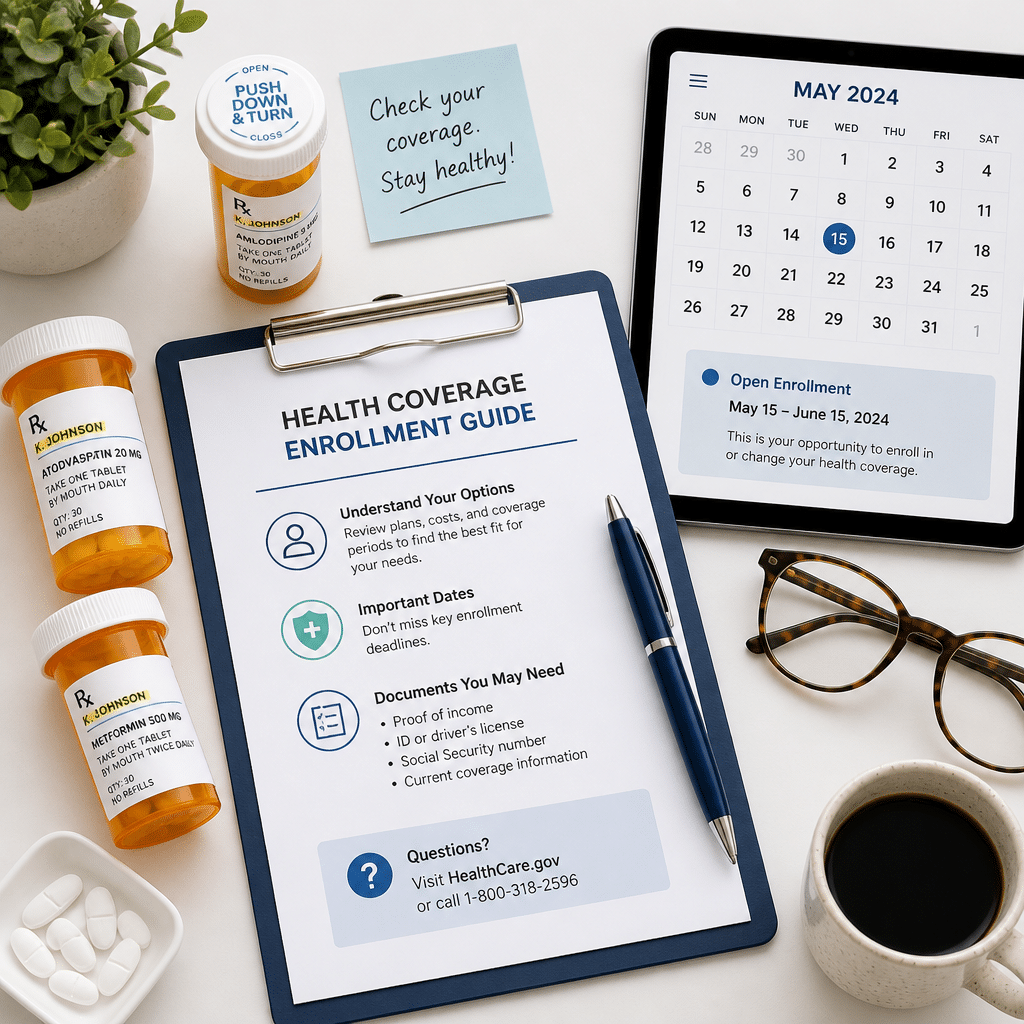
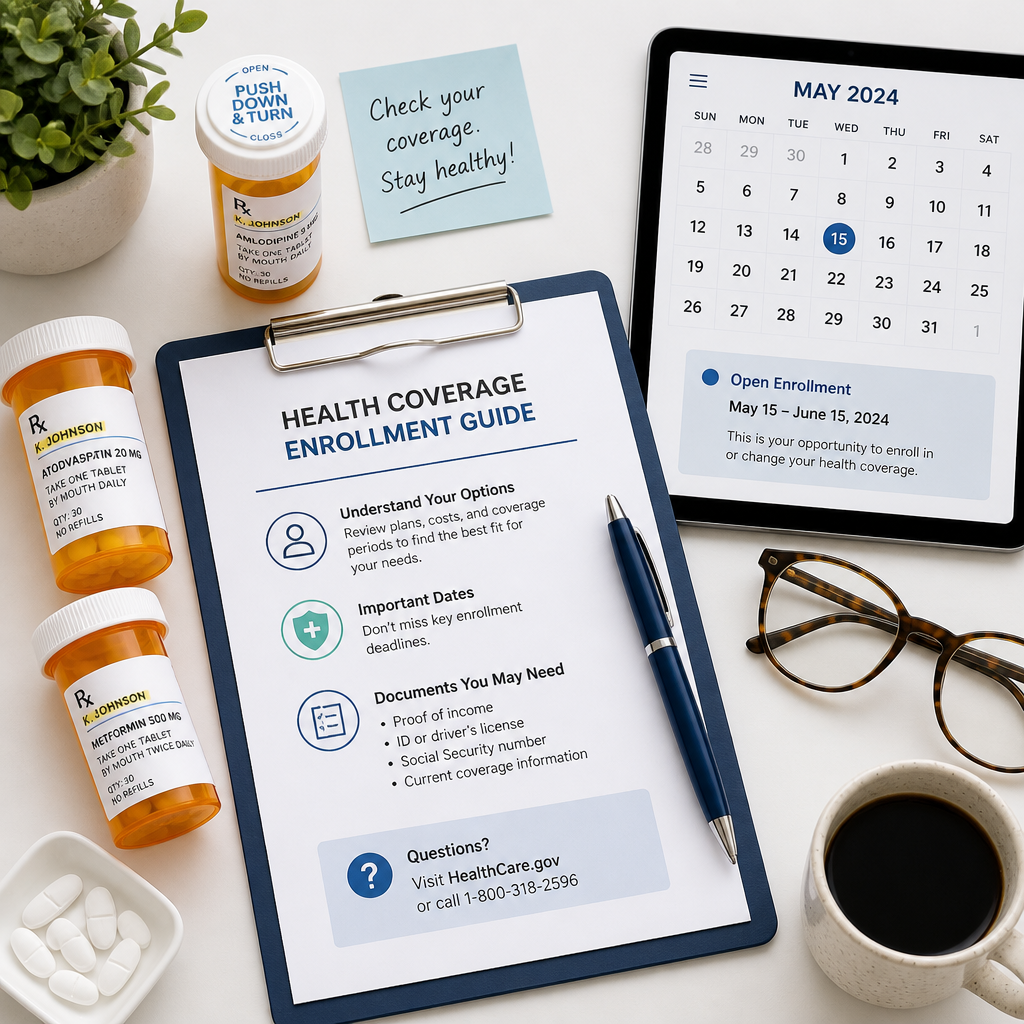
If you are turning 65 and wondering whether you actually need prescription drug coverage through Medicare, the short answer is yes, and the timing of when you enroll matters far more than most people realize. Medicare Part D explained simply: it is the part of Medicare that pays for outpatient prescription drugs, and skipping it, even for a few months without another creditable drug plan, can permanently raise your premium. For people approaching Medicare in North Carolina, understanding how Part D works, what it costs, and when to enroll is not optional background reading. It is the difference between affordable medication coverage and paying penalties for years.
Table of Contents
- Quick Takeaways
- What Is Medicare Part D?
- How Medicare Part D Works
- Understanding Drug Formularies and Tiers
- Major 2025 Changes You Need to Know
- Enrollment Periods and the Late Penalty Trap
- Standalone PDP vs. Medicare Advantage Drug Plan
- Part D in North Carolina: What to Expect
- Frequently Asked Questions
- References
Quick Takeaways
| Key Insight | Explanation |
|---|---|
| Part D is optional but carries real consequences if skipped | Going without creditable drug coverage for 63 or more consecutive days after your Initial Enrollment Period triggers a permanent late enrollment penalty added to your monthly premium. |
| A $2,000 out-of-pocket cap now applies in 2025 | The Inflation Reduction Act of 2022 introduced a hard annual cap on what you pay out of pocket for Part D drugs, a major change from prior years when costs were effectively unlimited. |
| Every plan has its own drug list (formulary) | Your specific medications may be covered at very different costs across plans. Checking that your drugs appear on a plan’s formulary before enrolling is non-negotiable. |
| Formularies change every January 1 | A drug covered this year may not be covered next year, or may move to a higher, more expensive tier. Reviewing your plan during Annual Enrollment Period (October 15 to December 7) every year is essential. |
| Extra Help is available for lower-income enrollees | Medicare’s Low-Income Subsidy program can dramatically reduce Part D premiums, deductibles, and copays for qualifying beneficiaries. |
| The “donut hole” is effectively eliminated as of 2025 | Prior coverage gap rules that exposed enrollees to full drug costs mid-year have been replaced by a streamlined three-phase structure with a hard spending cap. |
| Not all plans work the same way in North Carolina | Plan availability, premiums, and formularies vary by zip code. Comparing your options locally is the only way to find a plan that actually fits your prescriptions and budget. |
What Is Medicare Part D?
Medicare Part D is the prescription drug benefit within Medicare, and it is offered exclusively through private insurance companies approved by the federal government. It is not provided directly by Medicare itself. Part D is available to anyone enrolled in Medicare, whether through Original Medicare (Parts A and B) or a Medicare Advantage plan.
As of mid-2025, nearly 56 million Medicare beneficiaries had prescription drug coverage through Medicare Part D. That number reflects both standalone Prescription Drug Plans (PDPs) added to Original Medicare and Medicare Advantage plans that include drug coverage. If you are approaching 65 and taking any regular medications, this coverage is not a nice-to-have. It is a financial safety net.
Part D covers most outpatient prescription drugs, meaning medications you pick up at a pharmacy rather than drugs administered in a hospital or infused in a clinical setting. The specific drugs covered depend entirely on the plan you choose, which is why no two Part D plans are identical.
How Medicare Part D Works
The cost structure of Part D has three components you pay: a monthly premium, an annual deductible (for most plans), and cost-sharing in the form of copays or coinsurance at the pharmacy. The exact dollar amounts vary by plan, so comparing plans based only on the premium is one of the most common and costly mistakes new enrollees make.
The Three Benefit Phases in 2025
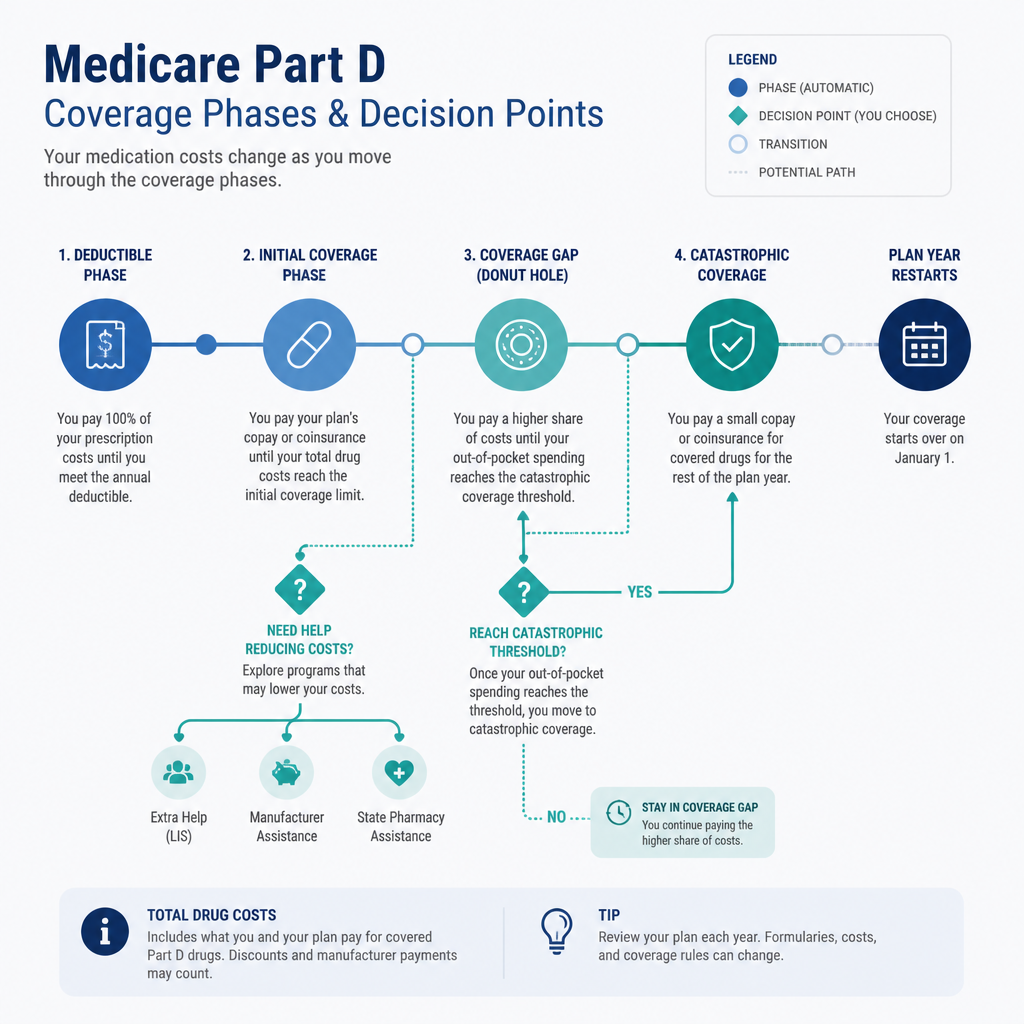
Starting in 2025, the Part D benefit structure was redesigned under the Inflation Reduction Act. The benefit now has three phases: a deductible phase, an initial coverage phase, and a catastrophic coverage phase. The old “coverage gap” or “donut hole” that left people paying full drug costs mid-year has been eliminated.
In the deductible phase, you pay the full cost of covered drugs until you meet your plan’s deductible (if the plan has one). In the initial coverage phase, you and the plan share costs through copays or coinsurance. Once your total out-of-pocket spending on covered drugs reaches $2,000 in 2025, you enter the catastrophic phase and pay nothing more for covered drugs for the rest of the year.
Monthly Premium Installment Option
Beginning in 2025, Part D enrollees have the option to pay their out-of-pocket drug costs in monthly installments over the course of the plan year rather than paying large lump sums at the pharmacy. Enrollees can voluntarily opt into this program at any time during the year. For people on fixed incomes managing expensive medications, this payment smoothing option is genuinely useful.
The biggest mistake people make with Part D is assuming their current plan will still cover their drugs the same way next year. Formularies and tiers shift every January 1, and the plan that was perfect last year may quietly become the most expensive option this year.
Pro tip: When comparing Part D plans, run your specific medication list through Medicare’s Plan Finder tool at Medicare.gov before making any decision. The premium is often not the most important cost to compare. Your total annual out-of-pocket estimate, including copays for your actual drugs, tells you far more.
Understanding Drug Formularies and Tiers
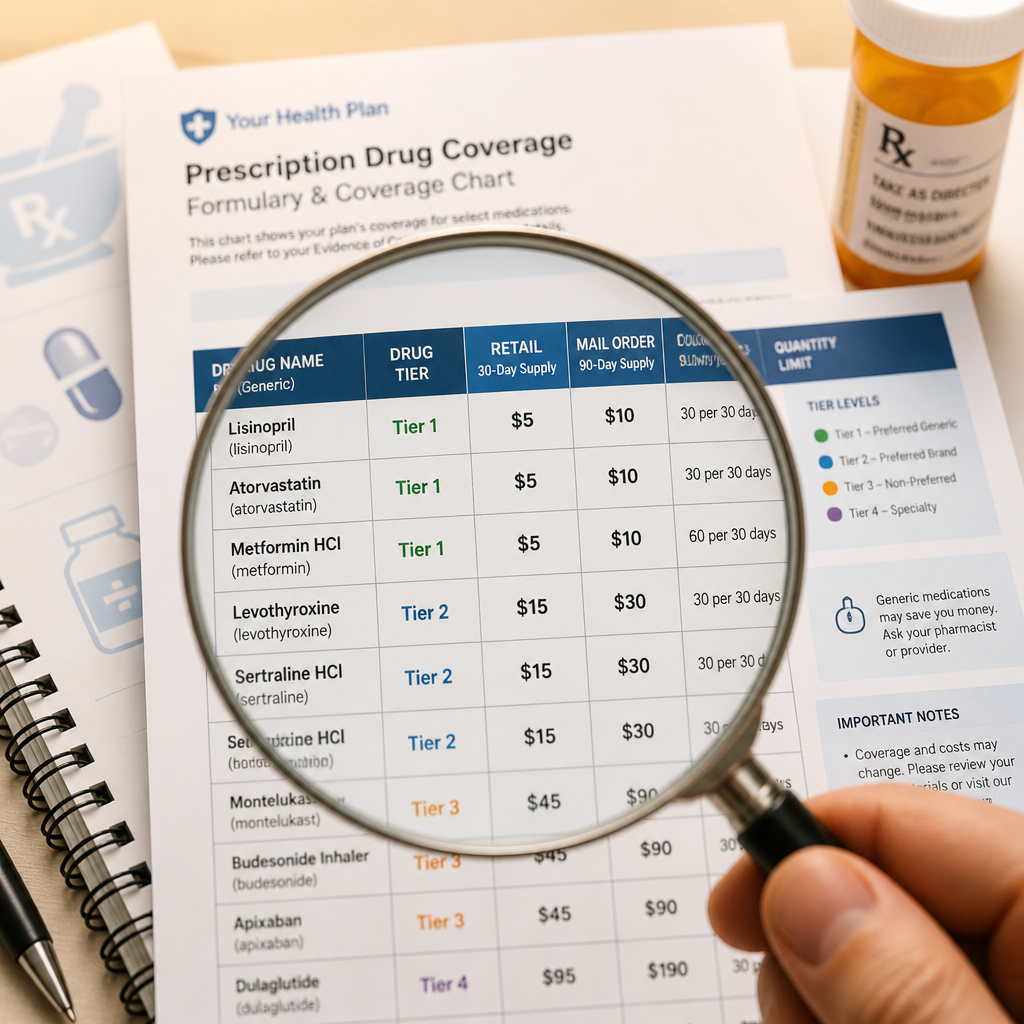
Every Medicare Part D plan maintains a formulary, which is a list of the prescription drugs the plan covers. Plans must cover at least two drugs in each therapeutic category and class, and they are required to cover all drugs in six protected classes: antidepressants, antipsychotics, anticonvulsants, immunosuppressants, antiretrovirals, and antineoplastics. Beyond those minimums, each plan decides what else it will cover and at what cost.
How Drug Tiers Affect Your Costs
Formularies are organized into tiers, typically ranging from Tier 1 through Tier 5. Tier 1 generally includes generic drugs with the lowest copays. Tier 5 covers specialty or high-cost medications with the highest cost-sharing. Drugs on lower tiers generally have lower cost-sharing than drugs on higher tiers, so a medication on Tier 2 under one plan might sit on Tier 4 under another, making a significant difference in what you pay each month at the pharmacy.
A common mistake is enrolling in whichever Part D plan has the lowest monthly premium, without checking whether your specific drugs are even on the formulary, or what tier they occupy. A $15/month premium plan that puts your maintenance medication on Tier 4 may cost you hundreds more per year than a $40/month premium plan that covers the same drug on Tier 2.
Mid-Year Formulary Changes
Plans are generally not allowed to remove covered drugs from the formulary mid-year or move them to a higher cost tier during the plan year, though some exceptions apply. However, formularies reset every January 1, meaning your drug could be dropped, moved to a higher tier, or subjected to new restrictions like prior authorization or step therapy at any annual renewal. This is exactly why reviewing your coverage during every Annual Enrollment Period matters, even if you feel satisfied with your current plan.
Pro tip: If your medication is not on your plan’s formulary or is placed on an unaffordable tier, you can request a formulary exception. Your prescribing physician must provide documentation supporting why the plan’s covered alternatives are not appropriate for your condition. At Safeguard Benefit Services, our licensed agents help clients navigate this process without charge.
Major 2025 Changes You Need to Know
The Inflation Reduction Act of 2022 produced the most significant overhaul of Medicare Part D in its history. If you heard about Part D years ago and assumed the rules are the same, they are not. The changes are largely beneficial, but understanding them is still essential before you choose a plan.
The $2,000 Out-of-Pocket Cap
Starting in 2025, out-of-pocket costs for drugs covered under Part D are capped at $2,000 for all enrollees. This includes your deductible and any copays or coinsurance you pay throughout the year. In 2026, the cap rises to $2,100, indexed to inflation going forward. Before the IRA, out-of-pocket drug costs under Part D were effectively unlimited for people in the catastrophic coverage phase. For enrollees with expensive brand-name drugs or specialty medications, this cap represents a profound financial protection.
Elimination of the Coverage Gap
The old “donut hole” coverage gap, where enrollees paid a larger share of drug costs after reaching an initial spending threshold, has been eliminated as of 2025. The restructured three-phase benefit is simpler and more predictable. Plans and drug manufacturers now bear greater responsibility for catastrophic coverage costs than they did before the IRA.
Drug Price Negotiation Under the IRA
The first ten drugs subject to Medicare price negotiation under the IRA will be available at negotiated prices starting in 2026. These include medications that treat serious chronic conditions including cancer, diabetes, blood clots, heart failure, autoimmune conditions, and chronic kidney disease. For North Carolina beneficiaries managing any of these conditions, it is worth confirming with a licensed agent whether your specific drug is on the negotiated list and how that affects your plan selection.
Enrollment Periods and the Late Penalty Trap
Part D enrollment is governed by specific windows, and missing them without having other qualifying drug coverage is the single most preventable and most financially damaging mistake a new Medicare enrollee can make.
Initial Enrollment Period
Your Initial Enrollment Period (IEP) is a seven-month window that begins three months before your 65th birthday month, includes your birthday month, and extends three months after. This is your primary opportunity to enroll in Part D without penalty.
The Late Enrollment Penalty
Medicare beneficiaries may incur a late enrollment penalty if there is a continuous period of 63 days or more, at any time after the end of their Initial Enrollment Period, during which they were eligible to enroll but were not enrolled in a Medicare Part D plan and did not have creditable prescription drug coverage from another source. The penalty equals 1% of the national base beneficiary premium for each full month without creditable coverage, and it is added to your monthly Part D premium permanently, for as long as you have Part D coverage.
To put that in concrete terms: the 2026 national base beneficiary premium is $38.99. A person with a 43-month gap without creditable drug coverage would face a penalty of 43% of $38.99, which equals approximately $16.80 per month, added on top of their plan premium, for life. That adds up to more than $200 per year, year after year, for a gap that could have been avoided entirely with timely enrollment.
Annual Enrollment Period and Special Enrollment Periods
The Annual Enrollment Period runs from October 15 through December 7 each year. Changes made during this window take effect January 1. Special Enrollment Periods exist for qualifying life events, such as losing employer-sponsored drug coverage. Medicare in North Carolina follows the same federal guidelines as all other states for these enrollment windows.
Pro tip: If you are still working at 65 and covered by a qualifying employer drug plan, confirm in writing from your HR department that the coverage is “creditable” under Medicare’s standard. Do not assume. If it is not creditable, you are accumulating penalty months whether you realize it or not. The team at Safeguard Benefit Services can help you verify your coverage status before you ever risk a single penalty month.
Standalone PDP vs. Medicare Advantage Drug Plan
There are two ways to get Medicare Part D coverage, and choosing between them is one of the most consequential decisions you will make when setting up your Medicare coverage.
| Feature | Standalone PDP (with Original Medicare) | Medicare Advantage Plan with Drug Coverage (MA-PD) |
|---|---|---|
| How drug coverage is delivered | Separate Part D plan added to Original Medicare Parts A and B | Drug coverage bundled into a single Medicare Advantage plan |
| Flexibility of provider network | See any Medicare-accepting provider nationwide; no network restrictions | Typically restricted to a plan’s network of doctors and hospitals |
| Cost structure | Separate PDP premium plus Original Medicare costs; often paired with a Medigap supplement | Single plan premium often includes medical and drug coverage; may have lower upfront cost |
| Best suited for | People who want maximum provider flexibility and are pairing coverage with a Medicare Supplement plan | People who prefer a bundled, lower-premium plan and are comfortable with network restrictions |
| Formulary control | Choose a PDP with the formulary that best matches your drug list | Drug coverage is tied to the MA plan; formulary choice is more limited |
In practice, the right answer depends on whether you prioritize provider access or premium simplicity. People who travel frequently, have established relationships with out-of-network specialists, or want to pair Medicare Supplement coverage with drug coverage tend to do better with a standalone PDP. People looking to consolidate their coverage into one manageable plan at a lower upfront cost often prefer an MA-PD. Neither is universally better, and the specific plans available in your North Carolina zip code matter enormously. Safeguard Benefit Services compares plans from 30-plus carriers at no cost to clients, which is exactly the kind of comparison that produces a real recommendation rather than a generic one.
Part D in North Carolina: What to Expect
North Carolina Medicare enrollees follow the same federal rules for Part D eligibility, enrollment periods, and penalties as beneficiaries in every other state. What differs at the state level is which plans are actually available in your county, what those plans charge, and which drugs appear on each plan’s formulary.
For North Carolinians approaching 65, the North Carolina Department of Insurance operates the Seniors’ Health Insurance Information Program (SHIIP), a free state resource for Medicare counseling. That program provides unbiased guidance, but it does not do what a licensed Medicare agent does: compare specific plan options across carriers, check whether your prescriptions are covered, and help you time your enrollment to avoid penalties.
If you are based in Charlotte or anywhere else in North Carolina, the combination of a licensed agent’s market knowledge and access to plans from 30-plus carriers is the most efficient way to find Part D coverage that actually matches your medications. The agents at Safeguard Benefit Services provide free consultations and year-round support, which matters because your needs, and the plans available to you, can change every year.
Frequently Asked Questions
Do I have to enroll in Medicare Part D if I do not take any prescription drugs right now?
You are not legally required to enroll, but skipping Part D without having other creditable drug coverage is risky. If you later develop a condition that requires prescription medication and you have been without creditable coverage for more than 63 days since your Initial Enrollment Period ended, you will owe a permanent late enrollment penalty. Enrolling in a low-premium plan while you are healthy is often the smarter financial move.
What counts as creditable prescription drug coverage?
Creditable coverage is drug coverage from another source, such as an employer or union plan, that is expected to pay at least as much as Medicare’s standard prescription drug coverage on average. If your current drug coverage qualifies, your plan administrator is required to notify you annually whether it meets this standard. If you are unsure, ask directly and get the answer in writing before your Initial Enrollment Period closes.
Can I change my Part D plan outside of Annual Enrollment Period?
Generally, you can only change your standalone Part D plan during the Annual Enrollment Period (October 15 to December 7) or during a Special Enrollment Period triggered by a qualifying life event such as losing other creditable coverage, moving to a new service area, or qualifying for Extra Help. Outside those windows, you are locked into your current plan for the remainder of the year.
What is the Extra Help program and who qualifies?
Extra Help, also called the Low-Income Subsidy (LIS), is a Medicare program that assists beneficiaries with limited incomes and resources in paying for Part D premiums, deductibles, and copays. Eligibility is based on income and asset thresholds that are updated annually. Qualifying for Extra Help can dramatically reduce your Part D costs, in some cases eliminating the premium and deductible entirely. Applications are handled through the Social Security Administration.
How do I know which Part D plan covers my medications?
Medicare’s Plan Finder tool at Medicare.gov allows you to enter your specific medications and compare plans based on estimated annual costs for your drug list. You can also work with a licensed Medicare insurance agent who can run the same comparison across multiple carriers and walk you through the results. Checking the formulary directly before enrolling is the only reliable way to confirm your drugs are covered at the tier you expect.
Is the $2,000 out-of-pocket cap the same across all Part D plans?
The $2,000 cap in 2025 applies to all Medicare Part D plans, both standalone PDPs and Medicare Advantage plans with drug coverage. It includes your deductible and all copays and coinsurance payments for covered drugs throughout the year. Once you hit that threshold, your covered drug costs for the rest of the year are zero. The cap is indexed to inflation, which is why it increases to $2,100 for 2026.
Have questions about Part D that your current plan or the Medicare website has not answered clearly? Share your experience in the comments or reach out directly. The specific details of your medication list and situation matter far more than any general guide can cover.
References
- KFF: Current snapshot of the Medicare Part D prescription drug benefit structure and plan availability
- Medicare Resources: Overview of Medicare Part D benefits, costs, and eligibility
- National Council on Aging: How the Medicare Part D late enrollment penalty is calculated and how to avoid it
- CMS: Creditable coverage standards and late enrollment penalty guidance for Medicare Part D
- Medicare Resources: How the Inflation Reduction Act changed Medicare Part D drug coverage and costs








Get Connected