

Most Medigap policyholders pay between $100 and $300+ a month, with a national average around $217, though your actual price depends far more on your plan letter, your insurer, and your state than on anything else. Before you buy, get quotes from at least three carriers for the exact same plan letter. Prices for identical coverage routinely differ by more than $100 a month between companies.
TL;DR:
- Premium prices for Medigap plans vary significantly by insurer, plan letter, and state, with current average costs around $217 monthly but new buyers paying more in many cases.
- Rate structures such as community-rated, issue-age-rated, and attained-age-rated heavily influence long-term costs, with attained-age plans generally becoming the most expensive over time.
- State rating rules and the level of carrier competition in your area can cause your premiums to differ by hundreds of dollars annually, making local quotes essential.
- Shopping multiple carriers for the same plan letter can save beneficiaries up to 40% annually, especially when factoring in household or electronic fund transfer discounts.
- Your total monthly healthcare costs include Part B premiums and Medigap, with supplementary costs from Part D and additional benefits, not just the Medigap premium alone.
Table of Contents
- How Much Do Medigap Plans Cost Now?
- What Affects Your Medigap Premium?
- Why Where You Live Matters
- When to Buy: How Timing Changes Your Price
- How to Lower What You Pay
- Fitting Medigap Into Your Monthly Budget
- Why Trust This Guide
- Average Annual Cost Trends and Historical Premium Changes
- What Medigap Doesn’t Cover
- Author Perspective: The One Thing Checklist
- How Safeguard Benefit Services Can Help
- Sources
- FAQ
How Much Do Medigap Plans Cost Now?
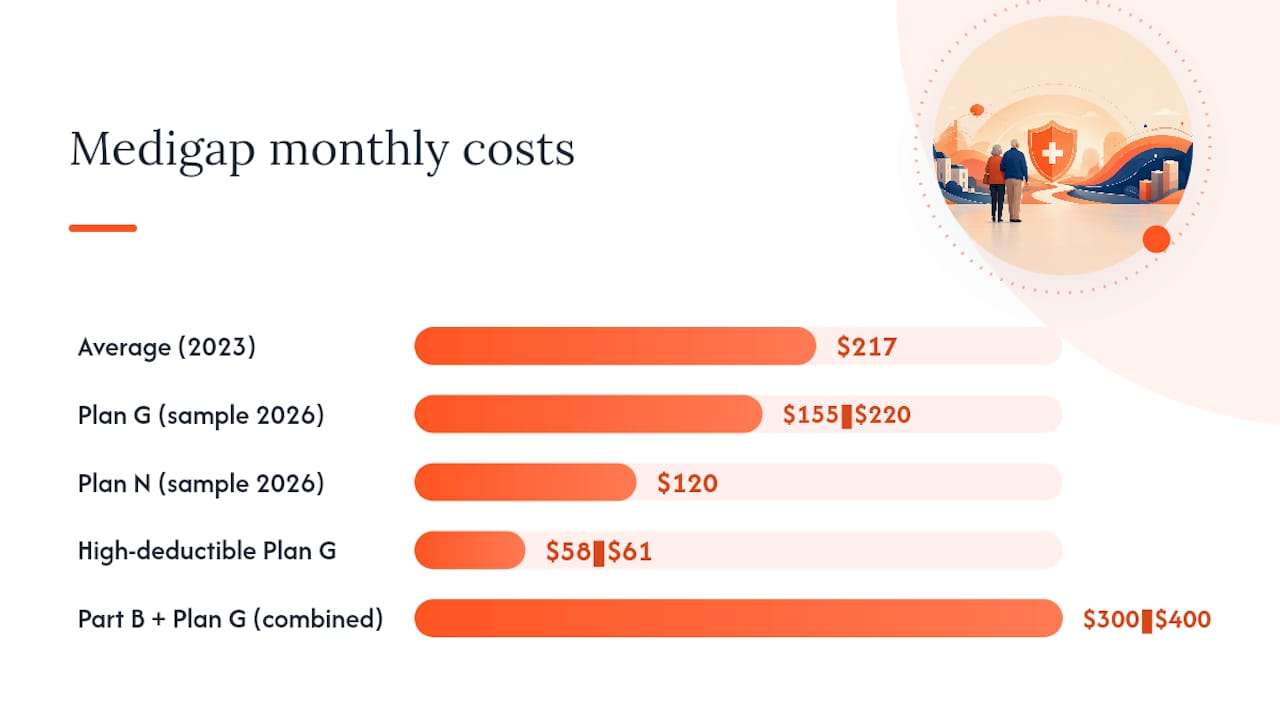
Medigap premiums vary more than most people expect for a product where the coverage itself is standardized by law. The average monthly premium among people already enrolled in a Medigap policy was $217 in 2023, according to KFF’s analysis of NAIC data. That figure blends every plan letter and every rating method in the country, so it’s a useful benchmark but not a number you should expect to match exactly.
Newer enrollees typically pay closer to current market rates than that blended average suggests, since older policies bought years ago at lower starting premiums pull the overall figure down.
Quick Stat: The average Medigap premium among current policyholders sits at $217 a month, but sample 2026 pricing shows new buyers often paying more depending on plan letter and location, according to KFF.
Plan-specific data paints a clearer picture. Here’s what recent sample pricing shows for a 65-year-old shopping in 2026:
- Plan G: Averages roughly $155 to $220 a month depending on the source and state, according to sample quotes from MoneyGeek and CostPrism.
- Plan N: Runs lower, averaging around $120 a month in CostPrism’s mid-2026 sample data, reflecting the trade off of small copays for office visits and ER trips.
- High-deductible Plan G: Can average as low as $58 to $61 a month at age 65, a fraction of standard Plan G, because you’re taking on a deductible before full coverage kicks in.
- Plan K and Plan L: Generally price lower than Plan G or N since they only cover a percentage of costs (Plan K around 50%, Plan L around 75%) rather than nearly all of them, shifting more risk back to you.
None of those numbers include your Medicare Part B premium, which is separate and mandatory for anyone buying a Medigap policy. If you’re paying the standard Part B premium and add an average Plan G policy, your combined monthly supplemental spend could land somewhere in the $300 to $400 range once you stack both together. That total, not the Medigap premium alone, is the number that actually hits your bank account every month. For a fuller breakdown of how these pieces interact, see Understanding Medicare Costs: Premiums, Deductibles, and Out-of-Pocket Expenses.
If you want a refresher on what separates Plan G from Plan N or Plan K before you start comparing prices, Medicare Supplement (Medigap) Plans Explained breaks down what each letter actually covers.
What Affects Your Medigap Premium?
Two identical Plan G policies from two different insurers can cost wildly different amounts, even though federal law requires the benefits to be exactly the same. The price gap comes down to how each company sets rates and what personal factors it weighs.
Rating method is the biggest structural factor, and it determines how your price behaves for decades, not just today:
- Community-rated: Everyone pays the same premium regardless of age. Prices still rise over time from inflation and claims experience, but your age alone won’t push your rate up.
- Issue-age-rated: Your premium is locked in based on your age when you first bought the policy. It won’t increase just because you get older, but carrier-wide rate hikes still apply to everyone in your rate class.
- Attained-age-rated: Premiums start lower but climb automatically as you age, often becoming the most expensive option over a 15 to 20 year retirement.
Personal factors layer on top of the rating method. Tobacco use typically adds a surcharge. Paying by electronic funds transfer or annually instead of monthly can shave a small percentage off as well.
Pro Tip: Ask every carrier specifically about household discounts and EFT discounts when you request a quote. Agents don’t always volunteer these, and stacking both can meaningfully lower your annual bill.
Company factors matter just as much as personal ones. Medicare’s own guidance confirms that premiums depend heavily on which insurer you choose, since benefits are standardized but pricing is not. Carriers also file for rate increases across their entire block of policyholders on a regular basis, and even issue-age or community-rated plans aren’t immune. Locking in a rating method protects you from age-based increases, not from the carrier deciding to raise everyone’s rate to cover higher claims costs.
That’s the part most shoppers misunderstand. An issue-age policy feels like a permanent discount, but it only removes one variable from the pricing formula. The rest of the increase math still applies.
Why Where You Live Matters
Your ZIP code can swing your Medigap premium by triple digits a month, and it has nothing to do with your health. It’s about regulation and competition.
Some states require insurers to community-rate every Medigap policy sold there, which spreads cost across all age groups and tends to produce higher starting premiums for younger, healthier buyers but more predictable pricing later in life. Other states allow attained-age rating, which can start cheap and climb steadily as policyholders age into their 70s and 80s. KFF’s analysis of state rating rules shows this patchwork of rules is one of the biggest reasons two people with identical health profiles pay such different amounts depending on their state.
The number of carriers competing in your area matters too. A metro area with a dozen insurers writing Medigap policies almost always produces better pricing than a rural county served by two or three companies. Less competition means less incentive to undercut on price.
Before you shop, take a few concrete steps:
- Check whether your state uses community, issue-age, or attained-age rating, since this shapes your entire long-term cost curve, not just your first-year premium.
- Confirm whether your state has annual guaranteed-issue windows (some do, beyond the federal minimum) that let you switch plans without underwriting.
- Get quotes from every carrier licensed to sell Medigap in your specific ZIP code, not just the two or three names you recognize from television ads.
When to Buy: How Timing Changes Your Price
Timing is the single biggest lever you have over what you’ll pay, and it has nothing to do with negotiating. It’s about which legal protections apply the moment you apply.
Your Medigap Open Enrollment Period runs for six months, starting the month you turn 65 and are enrolled in Medicare Part B. During this window, insurers must sell you any policy they offer at their best available rate, and they cannot use medical underwriting to deny you or charge more because of your health history. This is the cheapest and easiest window you will ever have to buy Medigap.
Here’s what changes if you miss it:
- You lose automatic guaranteed-issue rights. Outside your Open Enrollment window or a qualifying special situation, insurers can review your medical history before approving your application.
- Underwriting can raise your price or deny you outright. A carrier that would have accepted you automatically during Open Enrollment can charge substantially more, or reject your application, based on pre-existing conditions.
- Certain events restore guaranteed-issue rights temporarily. Losing employer coverage, moving out of your Medicare Advantage plan’s service area, or your insurer going bankrupt can trigger a new, limited guaranteed-issue window, but these are situational and time-limited.
If you already have a health condition that complicates underwriting, How To Choose A Medicare Plan If You Have Pre-existing Conditions walks through your options in more detail. And even outside a protected window, you can technically apply to switch carriers year round. You’ll just face medical underwriting without guaranteed-issue protection, which is a real risk worth understanding before you assume switching is always simple.
How to Lower What You Pay
The single most effective move you can make is shopping the same plan letter across multiple carriers. Comparing quotes for identical Plan G coverage, for instance, commonly turns up premium differences of $100 or more per month for the exact same benefits. Since benefits are standardized, there’s no coverage trade-off for choosing the cheaper option.
Quick Stat: Shopping multiple carriers for the same plan letter can save beneficiaries an estimated 20% to 40% annually compared to accepting the first quote offered, based on Medicare.gov guidance on carrier price variation.
A few tactics beyond basic comparison shopping:
- Ask about non-smoker and household discounts on every quote, since these can knock off another 5% to 15%.
- Consider a SELECT policy if your carrier offers one, which trades a network requirement for a noticeably lower premium.
- Run the high-deductible Plan G math yourself: if the standard plan costs $180 a month ($2,160 a year) and the high-deductible version costs $60 a month ($720 a year), you’d need to hit roughly $1,440 in covered costs before standard Plan G breaks even, close to the annual deductible itself.
- Weigh Plan N’s copays against Plan G’s higher premium. If you rarely visit the doctor, Plan N’s savings usually outweigh the occasional $20 copay.
Safeguard Benefit Services’ plan comparison resources can help you see these trade-offs side by side before you commit.
Fitting Medigap Into Your Monthly Budget
Your real monthly healthcare cost is Part B plus your Medigap premium, not just one or the other. If you’re comparing options, add them together before judging affordability.
- Low-use scenario: Few doctor visits, no hospital stays. A high-deductible Plan G or Plan N often costs less overall even with occasional out-of-pocket copays.
- High-use scenario: Frequent specialists, planned surgery, chronic condition management. Standard Plan G’s higher premium usually pays for itself through near-zero cost-sharing at the point of care.
Medigap also preserves broad provider access nationwide, unlike Medicare Advantage, which trades network restrictions for typically lower premiums. That access is the real product you’re buying with a higher monthly bill.
Why Trust This Guide
This guide is built to help people cut through Medigap pricing confusion with personalized guidance rather than generic web calculators. Agents complete training programs which keep advice grounded in current carrier rates and rules rather than outdated assumptions. This guide draws on that same expertise, cross-checked against Medicare.gov and KFF data, and written by Zach for Safeguard Benefit Services.
Average Annual Cost Trends and Historical Premium Changes
Medigap premiums don’t stay flat year over year, even under the most policyholder-friendly rating methods. Carriers routinely file for rate increases tied to rising claims costs, inflation in medical services, and the aging of their existing policyholder pool. This is true whether you hold a community-rated, issue-age-rated, or attained-age-rated policy, since carrier-wide increases apply across an entire rate class regardless of how your individual premium is structured.
The $217 average premium among current policyholders reflects a mix of old and new policies, some locked in years ago at lower starting rates and some purchased recently at current market pricing. That blended number tends to drift upward slowly each year as older, cheaper policies get replaced by newer ones sold at today’s rates, and as carriers push through their periodic increases across the board.
For budgeting purposes, a reasonable expectation is a low single-digit percentage increase most years, though any given carrier’s filing can run higher depending on regional claims experience. This is exactly why periodic re-shopping matters even after you’ve settled on a policy. A plan that was the cheapest option three years ago may not be today, and checking current rate trends before your policy’s renewal date can catch a better deal before an automatic increase locks in.
What Medigap Doesn’t Cover
Medigap fills most of Original Medicare’s cost-sharing gaps, but it isn’t a complete healthcare budget on its own. Several categories of expense sit entirely outside what any Medigap plan reimburses, no matter which letter you choose.
Prescription drugs are the biggest gap. Medigap plans stopped covering drug costs for new enrollees years ago, so you’ll need a standalone Part D plan layered on top of your Part B and Medigap premiums. Dental, vision, and hearing care are excluded across the board too, since Original Medicare doesn’t cover routine versions of these services and Medigap only supplements what Medicare already pays for. If those categories matter to your health picture, look into standalone dental, vision, or hearing coverage separately.
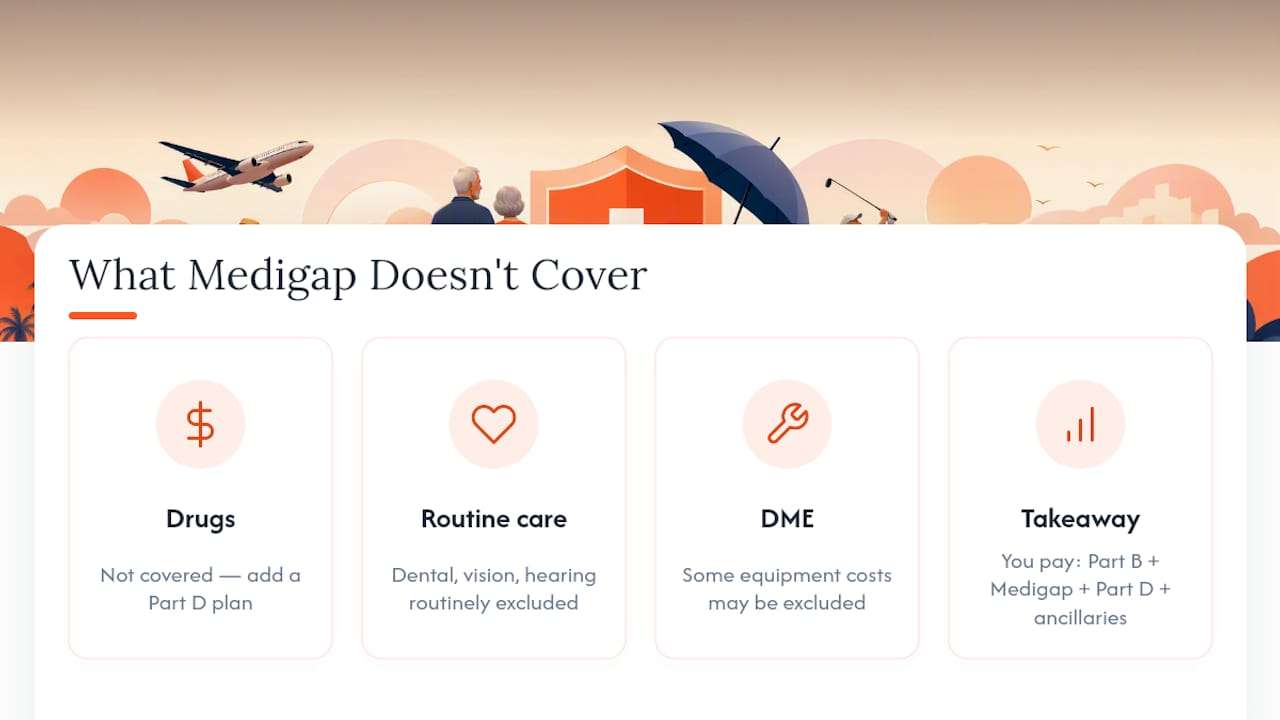
Durable medical equipment can also carry costs beyond what Medigap addresses, particularly around supplier network rules and equipment categories that fall outside standard coverage definitions. A closer look at DME categories and costs can help you anticipate these before they surprise you.
Add these pieces up, and your real monthly healthcare spend is Part B, plus Medigap, plus Part D, plus whatever ancillary coverage you decide you need. None of these show up in the headline Medigap premium number, but all of them show up on your bank statement.
Author Perspective: The One Thing Checklist
If you take away one thing from this guide, it’s this: the price you’re quoted first is rarely the price you have to pay. I’d tell anyone shopping right now to do three things before signing anything. Compare at least three carriers on the identical plan letter. Buy inside your six-month Open Enrollment window if you possibly can. And actually run the high-deductible math instead of assuming the standard plan is automatically worth it.
— Zach
How Safeguard Benefit Services Can Help
You can get help from licensed agents who compare carrier rates for your specific ZIP code and walk you through the trade-offs in plain language, at no cost. That’s the real advantage over spending hours cross-referencing quotes yourself or guessing which plan letter fits your health profile.

Our consultations start with understanding your health needs and budget, then move into a side-by-side comparison of Medigap carriers licensed in your area, including household and payment discounts you might otherwise miss. If Medigap isn’t the right fit once we look at the numbers together, we’ll also walk you through how Medicare Advantage compares to Medicare Supplement plans so you’re choosing based on your actual situation, not a guess. Visit the Medicare Supplement plans page to see how Safeguard Benefit Services supports Charlotte-area enrollees, or reach out directly to schedule a free consultation and get your personalized quote comparison started.
This article is general information, not a substitute for advice from a qualified financial advisor. Consult a qualified financial professional about your own circumstances before acting on anything here.
Sources
- Key Facts About Medigap Enrollment and Premiums for Medicare Beneficiaries
- Get Medigap Costs | Medicare
- Medicare Supplement Cost (2026 Plan Year) | MoneyGeek
- Medicare Supplement (Medigap) Cost Guide 2026: Plan Comparison & Rates by State | CostPrism
FAQ
Which States Have the Most Expensive Medigap Plans?
States that require community rating or offer stronger guaranteed-issue protections often show higher starting premiums, while states permitting attained-age rating can start cheaper but climb faster with age. Exact rankings shift yearly, so check your specific state’s rating rules and get local quotes rather than relying on a national list.
What Are Common Complaints About Medigap Plans?
The most frequent complaint is unexpected premium increases, even on issue-age or community-rated policies, since carrier-wide rate hikes apply regardless of rating method. Beneficiaries also report frustration discovering, after enrollment, that switching carriers later means facing medical underwriting rather than automatic approval.
What Is the Average Medigap Premium in 2026?
The most recent broad average among current policyholders is $217 a month, though new 2026 buyers often see different pricing depending on plan letter, insurer, and state, with Plan G samples running roughly $155 to $220 and Plan N closer to $120.
How Much Does a Good Medigap Plan Cost?
A solid Plan G policy typically runs $155 to $220 a month depending on your state and carrier, while a high-deductible Plan G can cost as little as $58 to $61 a month for healthy applicants willing to pay more out-of-pocket before coverage kicks in. Comparing at least three carriers on the same plan letter is the most reliable way to find your best price.
Recommended
Request a No Obligation Phone Call








Get Connected