

Your Medigap Open Enrollment Period starts the first month you’re both 65 or older and enrolled in Medicare Part B. During this window, insurers can’t turn you down or charge you more because of your health, no matter what conditions you have. Once that window closes, most states let insurers ask health questions again, so timing this correctly matters more than almost any other Medicare decision you’ll make.
TL;DR:
- The Medigap open enrollment starts the month you turn 65 and enroll in Medicare Part B, lasting exactly six months from that date.
- Applying during this window guarantees coverage without medical underwriting or extra charges for pre-existing conditions.
- Missing the OEP allows insurers to use health questions and charge higher premiums unless protected by state-specific guaranteed-issue rules.
- The start date depends on your age and Part B activation, not just your birthday, and delays can cause coverage gaps or higher costs.
- Proper documentation and timing, often coordinated with licensed agents, are essential to maximize benefits and avoid costly mistakes.
Table of Contents
- When Does Medigap Open Enrollment Start?
- Who Qualifies for the Medigap Enrollment Period?
- What Protections Do You Get During the OEP?
- What Happens If You Miss the OEP?
- How Do You Apply for a Medigap Plan?
- Your Six-Month Medigap Checklist
- Why Timing Trips Up More People Than the Rules Do
- Get Your Medigap Timing Right the First Time
- Sources
When Does Medigap Open Enrollment Start?
The federal rule is short, but it trips up a lot of people. Your Medigap Open Enrollment Period (OEP) begins the first day of the month in which you are age 65 or older and enrolled in Medicare Part B. It runs for exactly six months, and you only get this window once.
That word “and” matters. Turning 65 alone doesn’t start your clock. Having Part B alone doesn’t start it either. Both conditions have to be true at the same time.
Here’s how that plays out in real scenarios:
- You turn 65 on June 10 and your Part B starts June 1. Your OEP runs June 1 through November 30.
- You delay Part B while working, then enroll at 68. Your OEP starts the month Part B kicks in, not the month you turned 65.
- You enroll in Part B a few months before your 65th birthday because you’re aging into Medicare from disability coverage. Your OEP still won’t begin until you’re actually 65, even if Part B started earlier.
This is different from the annual Medicare Open Enrollment Period (October 15 through December 7), which lets you switch Medicare Advantage or Part D plans every year. Medigap Open Enrollment is a one-time federal guarantee tied to your personal Part B start date, not a recurring calendar event. Confusing the two is one of the most common mistakes beneficiaries make, and it’s worth reading through the key dates for annual Medicare enrollment to see exactly how the two periods differ.
Who Qualifies for the Medigap Enrollment Period?
Medigap eligibility requirements sound simple on paper, but several common situations change the calculation entirely.
- You’re 65 and enrolling in Part B for the first time. This is the standard case. Your OEP starts immediately.
- You’re still working and covered by an employer group plan. As long as you keep that coverage and delay Part B, your OEP hasn’t started yet. It begins the month you actually enroll in Part B, whether that’s at 66, 70, or later.
- You’re on COBRA or retiree coverage after leaving a job. Neither COBRA nor retiree coverage is treated as active employment for this purpose. Ending that coverage typically triggers an eight-month Special Enrollment Period to sign up for Part B, and your Medigap OEP starts once Part B does.
- You’re under 65 and have Medicare due to disability or ESRD. Federal law doesn’t guarantee you a Medigap OEP before age 65 in every state. Some states require insurers to offer at least one plan to younger beneficiaries; many don’t.
That last point is where readers get burned most often. If you’re under 65, don’t assume the federal protections in this article apply to you automatically. Check with your State Health Insurance Assistance Program (SHIP) or your State Insurance Department before you count on guaranteed pricing. It’s also worth reviewing how initial and special enrollment periods interact if you’re navigating Part B timing around a job change.
What Protections Do You Get During the OEP?
During your open enrollment window, federal law gives you specific guarantees. Insurers must sell you any Medigap policy they offer in your state. They can’t use medical underwriting to deny you. And they can’t charge you more because you have diabetes, heart disease, or any other pre-existing condition.
That’s a real guarantee, not marketing language. It’s why NCOA calls this window the single best opportunity to lock in supplemental coverage without a health screening standing in the way.
There’s one nuance worth understanding: pre-existing condition waiting periods. If you didn’t have creditable prior health coverage, an insurer can make you wait up to six months before it pays claims tied to a pre-existing condition, even though it can’t deny you the policy itself. Every month of prior creditable coverage, like an employer plan or COBRA, chips away at that waiting period. If you had continuous coverage for six months before enrolling, the waiting period disappears entirely.
Common events that preserve your guaranteed-issue rights include:
- Aging into Medicare with Part B for the first time
- Losing employer group coverage and enrolling in Part B within the SEP window
- Moving out of a Medicare Advantage plan’s service area
Pro Tip: Keep a copy of your COBRA or employer coverage termination letter. It’s the single document insurers ask for most often when calculating your waiting period, and having it ready can save weeks of back and forth.
What Happens If You Miss the OEP?
Missing your six-month window doesn’t lock you out of Medigap forever, but it does hand insurers the upper hand. Outside your OEP, companies can use medical underwriting to deny your application or charge you a higher premium based on your health history, unless you qualify for a guaranteed-issue right under federal or state law.
That’s the trade-off in plain terms: fewer choices, higher costs, and no promise of acceptance. KFF’s analysis of Medigap protections found that state rules vary widely here, which means your outcome depends heavily on where you live.
A handful of states go further than federal law requires:
- Connecticut, Massachusetts, Maine, and New York all maintain some form of continuous or expanded guaranteed-issue access outside the standard federal window.
- Some states offer annual “birthday rule” or “trial right” windows that let you switch Medigap plans without underwriting.
- A few states extend guaranteed-issue protections to younger, disabled Medicare beneficiaries that federal law doesn’t require.
If you missed your window, don’t assume you’re stuck. Call your SHIP office or your State Insurance Department directly and ask what protections apply where you live. If you have a pre-existing condition, it’s also worth reading through how to choose a plan with pre-existing conditions before you apply anywhere.
How Do You Apply for a Medigap Plan?
The application itself is straightforward, but timing it well takes some coordination. Here’s the order that avoids coverage gaps and paperwork headaches.
- Gather your documents first. You’ll need your Medicare number, your Part B effective date, and proof of any prior creditable coverage, such as an employer benefits letter.
- Apply one to three months before your Medicare start date, if you’re able to. You typically need your Medicare number in hand, which usually arrives a few months before your Part A and B effective dates. Applying early lets your Medigap coverage start the same day your Part B does, with no gap in between.
- Confirm your effective date directly with the insurer or your agent. Don’t assume the date on your application matches the date on your policy. Ask for written confirmation.
- Keep paying your Part B premium. Medigap doesn’t replace it; Medicare Part B premiums run alongside your Medigap premium, not instead of it.
Pro Tip: Applying too early, before you actually have your Medicare number, is the most common delay agents see. Wait until you’re within roughly 60 to 90 days of your Part B start date to submit paperwork.
For a broader walkthrough of Part A and B enrollment mechanics, the step-by-step Medicare enrollment guide covers the pieces that come before this stage.
Your Six-Month Medigap Checklist
Six months sounds generous until you’re three months in and haven’t started comparing plans. Breaking the window into stages keeps you from scrambling near the deadline.
- Month 1: Confirm your exact OEP start and end dates, and contact your local SHIP office for a free, unbiased rundown of your options.
- Month 2: Pull quotes for identical plan letters, like Plan G across three or four insurers, since benefits for a given letter are standardized but premiums are not.
- Month 3: Gather documentation of any prior creditable coverage to minimize or eliminate a waiting period.
- Month 4: Compare insurer reputation, rate history, and how each company handles rate increases over time, not just the starting premium.
- Month 5: Submit your application, ideally through a licensed agent who can confirm your effective date in writing.
- Month 6: Follow up to confirm your policy is active before your old coverage, if any, ends.
Your State Insurance Department can confirm which insurers sell Medigap in your area, and a licensed agent, such as one at Safeguard Benefit Services, can pull quotes across multiple carriers at once rather than making you call each one individually. For a plain-language breakdown of what each lettered plan actually covers, see this guide to Medigap plan letters.
Why Timing Trips Up More People Than the Rules Do
Most Medigap mistakes I see aren’t about misunderstanding the rules. They’re about miscalculating dates. Someone assumes their OEP started on their birthday when it actually started weeks earlier or later, tied to their Part B effective date instead. By the time they realize the mismatch, they’re applying with three weeks left in their window instead of five months, and that’s a stressful place to compare plans from.
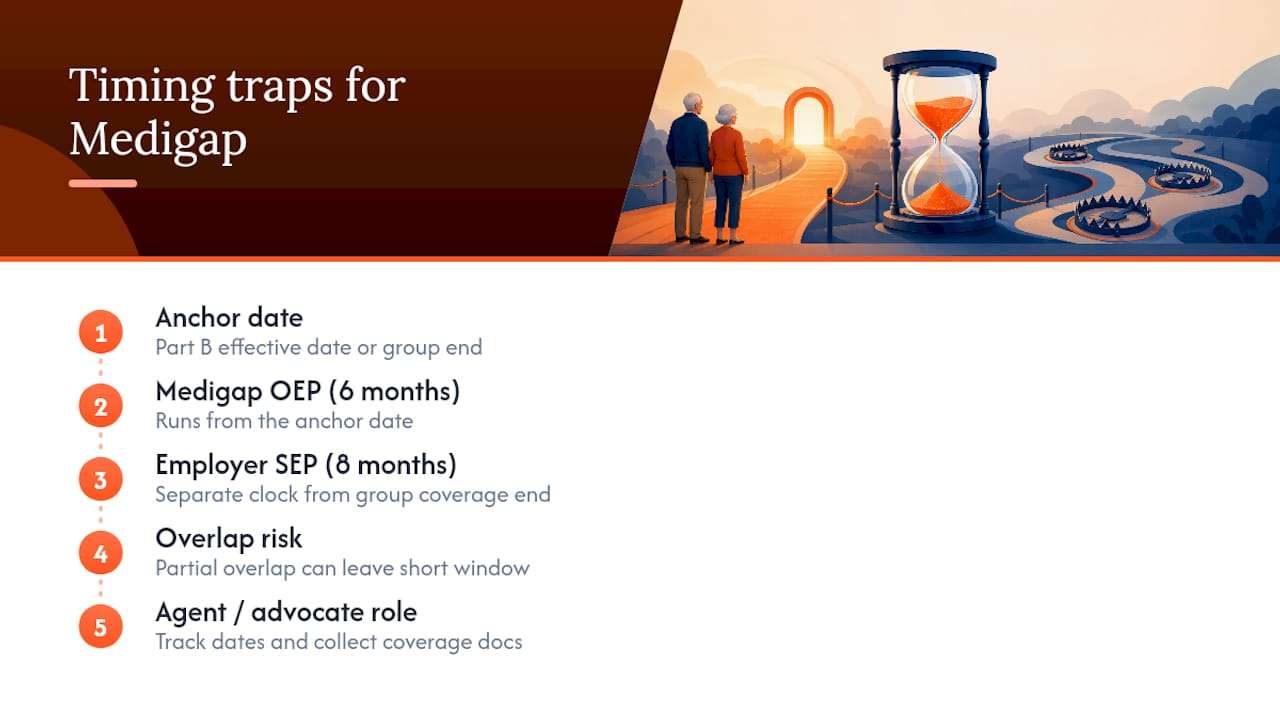
The employer coverage cases are where things get genuinely complicated. I’ve seen clients delay Part B for years while working, which is often the right move, but then miss the fact that their eight-month Special Enrollment Period and their six-month Medigap OEP run on separate clocks that only partially overlap. Documenting the exact day group coverage ends is not optional paperwork. It’s the anchor for every deadline that follows.
Agents earn their keep here by tracking these dates precisely and by collecting creditable coverage documentation before an insurer asks for it, which tends to head off waiting-period disputes before they start. A health advocate or agent who understands these mechanics can be the difference between a smooth enrollment and a denied application six months later.
— Zach
Get Your Medigap Timing Right the First Time
Licensed agents can track your exact OEP dates, pull quotes across multiple carriers for the same plan letter, and handle the paperwork that determines your effective date.

Getting this wrong costs real money over years of premiums, not just a few weeks of hassle. Before you apply anywhere, gather your Medicare number, your Part B effective date, and any proof of prior creditable coverage. Then schedule a free consultation and request your Medicare roadmap to see exactly which Medigap plan letters fit your situation and budget, based in Charlotte, North Carolina, and serving Medicare beneficiaries across the surrounding area.
This article is general information, not a substitute for advice from a qualified financial advisor. Consult a qualified financial professional about your own circumstances before acting on anything here.
Sources
- When can I buy a Medigap policy? | Medicare
- Medigap Open Enrollment Period | NCOA
- Key Facts About Medigap Enrollment and Premiums for Medicare Beneficiaries | KFF
Recommended
Request a No Obligation Phone Call








Get Connected