

Yes, Medigap underwriting exists in North Carolina. During your one-time Medigap Open Enrollment Period, insurers cannot use it against you. After that window closes, they can use your health history to decide whether to accept you and what to charge. If you live in Charlotte and are close to 65, the timing of your Part B start date matters more than almost any other choice you will make.
TL;DR
- Your Medigap Open Enrollment Period is a one-time, six-month window that starts the month you are 65 or older and enrolled in Part B. It cannot be repeated.
- Inside that window, insurers cannot deny you, charge more for health problems, or delay coverage, apart from a possible pre-existing condition waiting period of up to 6 months.
- Outside it, North Carolina insurers can use medical underwriting to accept, decline or price your application, unless a guaranteed issue right applies.
- Under 65 and on Medicare because of a disability? North Carolina has its own rules, limited to Plans A, D or G.
- Free, unbiased help is available from SHIIP at 855-408-1212.
Table of Contents
- What medical underwriting means for a Medigap plan
- Your Medigap Open Enrollment Period in North Carolina
- Pre-existing condition waiting periods
- What happens if you apply after the window
- Guaranteed issue rights: when underwriting is waived
- Under 65 and on Medicare in North Carolina
- Underwriting is not the same as an enrollment penalty
- Perspective
- Getting a plan in place before the window closes
- Free official help in North Carolina
- FAQ
- Sources
What medical underwriting means for a Medigap plan
Underwriting is the insurer’s review of your health before it agrees to sell you a policy. For Medigap, that usually means health questions on the application, and sometimes a look at your medical records. The result can be approval at the standard rate, approval at a higher rate, or a denial.
This is different from Original Medicare, which has no health screening at all. It is also different from Medicare Advantage, which is a separate type of plan. Underwriting is specific to Medigap, which is why the date you buy it carries so much weight.
The North Carolina Department of Insurance states that outside the Open Enrollment Period, companies can use medical underwriting to decide whether to accept a Medicare supplement application. Medicare.gov adds that after that window you may pay more, may have fewer policy options, and can be denied if you do not meet the insurer’s underwriting requirements.
Your Medigap Open Enrollment Period in North Carolina
This is the window where underwriting is off the table. According to Medicare.gov, it starts the first month you are both 65 or older and enrolled in Part B, and it lasts six months. During it, insurers cannot:
- refuse to sell you any Medigap policy they offer,
- charge you more because of pre-existing health problems,
- make you wait for coverage to start, except for the pre-existing condition waiting period described below.
North Carolina’s 2023 Medigap guide confirms the same protections. The NC DOI is explicit that this period does not repeat every year.
If you are still working at 65
Many Charlotte seniors keep employer coverage past 65. Medicare.gov explains that when employer coverage ends, you get a chance to sign up for Part B without a late enrollment penalty, and your Medigap Open Enrollment Period starts when you sign up for Part B and runs 6 months. Its Choosing a Medigap Policy booklet notes that delaying Part B this way means your window begins when you are ready to use it.
Worked example
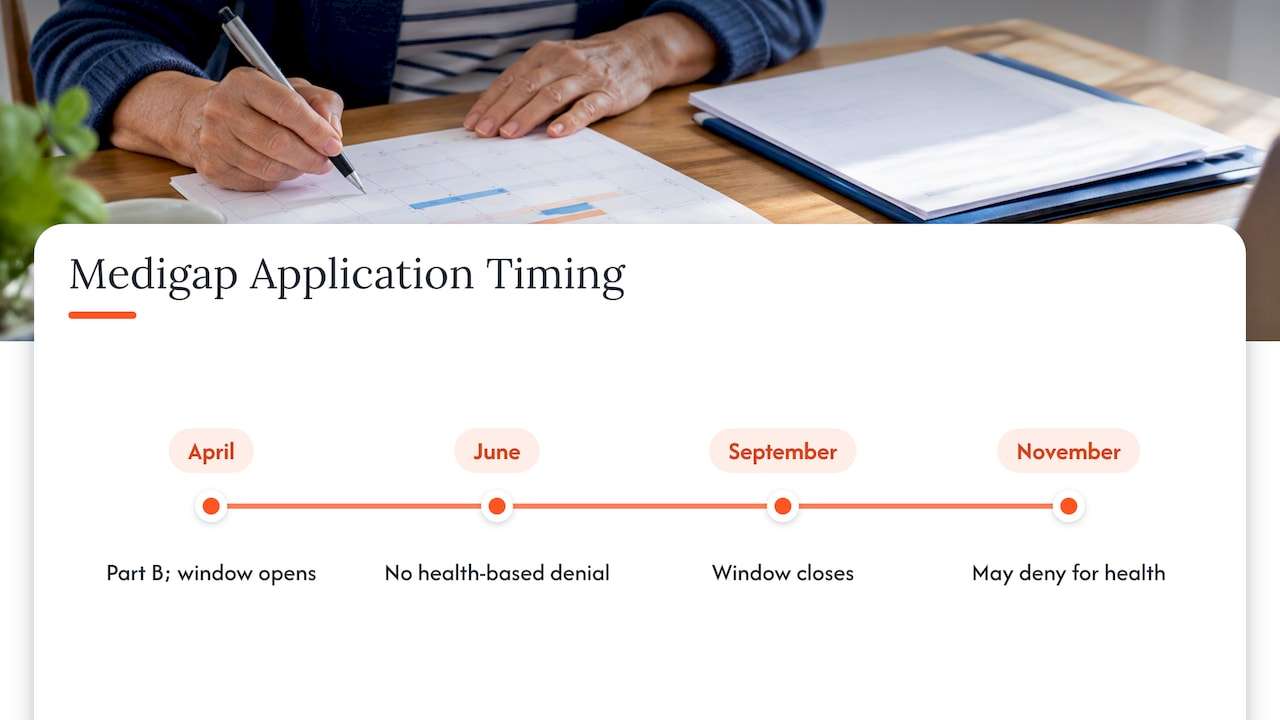
Say you turn 65 in April and enroll in Part B effective April 1. Your window runs April through September. An application in June cannot be turned down for your diabetes or heart history. An application in November can be. Put the end date on your calendar the day you enroll.
Pre-existing condition waiting periods
Even inside open enrollment, a waiting period can apply. Medicare.gov explains that a company may refuse to cover out-of-pocket costs for a pre-existing problem for up to 6 months, and only if the condition was treated or diagnosed within 6 months before the policy starts.
You can avoid or shorten it. The NC DOI guide says this works when you buy during open enrollment and replace certain creditable coverage, provided you had no break in coverage longer than 63 days. This is another reason to avoid a gap between your old plan and your new one.
What happens if you apply after the window
Federal law lets insurers use medical underwriting to deny a policy or charge higher premiums outside guaranteed issue periods, according to KFF. KFF also notes that some states go further with continuous or annual guaranteed issue. The NC DOI pages we reviewed describe open enrollment and specific rights rather than a year-round switching right, so plan on underwriting applying when you apply late.
In practice, an underwritten application can mean:
- health questions about conditions, medications and recent hospital stays,
- a decision to approve, decline, or approve at a higher premium,
- a pre-existing condition waiting period of no more than six months, waived if you have prior creditable coverage, per the NC DOI.
Guaranteed issue rights: when underwriting is waived
Federal law gives you guaranteed issue rights in specific situations, such as when a Medicare Advantage plan ends coverage in your area or during a Medicare Advantage trial period, as KFF summarizes. In most other cases, Medicare.gov says you have no right to switch policies outside open enrollment or a specific guaranteed issue right.
When you use one of these rights:
- Apply no more than 63 days after your coverage ends.
- Keep letters, notices, emails or claim denials showing your coverage ended. The same Medicare.gov page says you may need to include them with your application.
- If you buy during open enrollment, you have 30 days to decide whether to keep the policy. Do not cancel your old one until then.
North Carolina also gives you a 30-day right to return a new policy for a refund, which Coverage Classroom reports runs from the day you receive the policy, not the day you applied.
Under 65 and on Medicare in North Carolina
If you qualify for Medicare through a disability, the rules differ. Medicare.gov states that some states let anyone with Medicare under 65 buy Medigap, and that people with a disability or ESRD may not be able to buy the policy they want until 65 elsewhere.
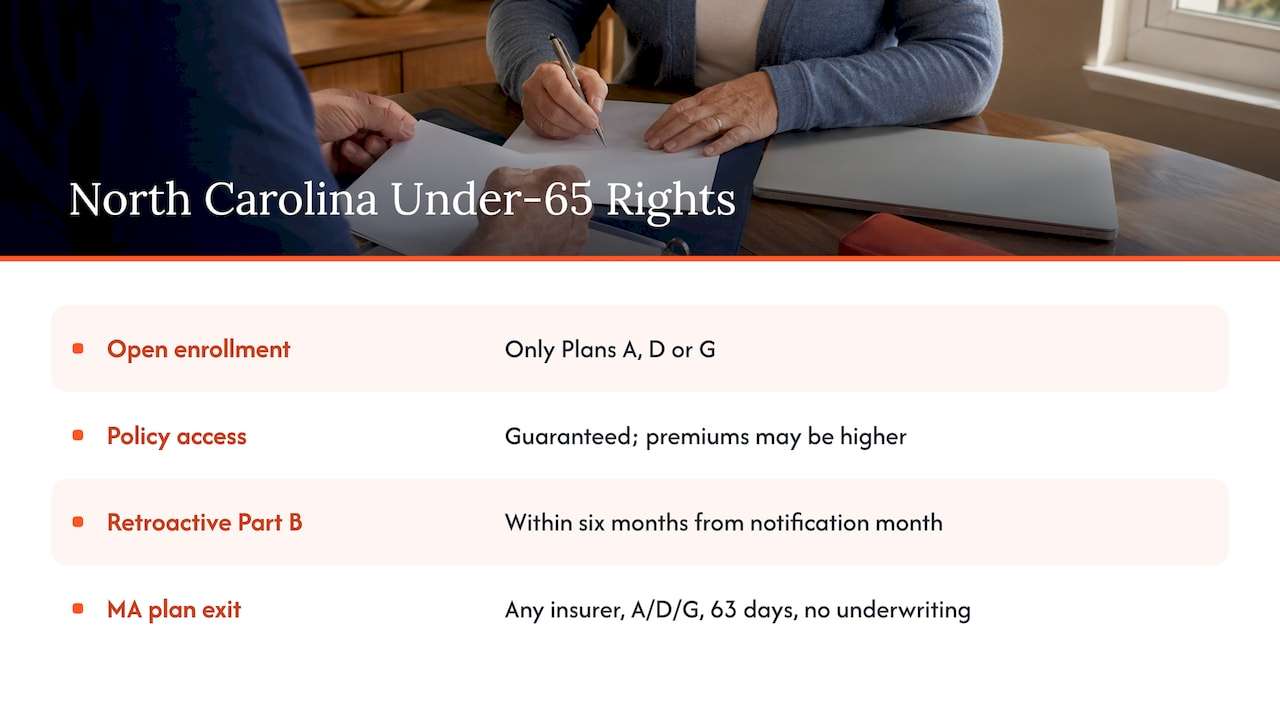
In North Carolina, the NC DOI’s under-65 page says that during the six-month open enrollment period, you can buy only Plans A, D or G under a special state law. You are guaranteed a policy, though premiums may be higher than for someone 65 or older. If Social Security decides retroactively that you were eligible for Part B, your application must be submitted within six months starting the month you are notified.
Coverage Classroom reports, citing state statute, that people on Medicare through disability who leave a Medicare Advantage plan through cancellation, nonrenewal or disenrollment can also buy Plan A, D or G from any insurer within 63 days, without underwriting.
Underwriting is not the same as an enrollment penalty
People often blur the two. They are separate problems with separate costs.
| Medigap underwriting | Part B late enrollment penalty | |
|---|---|---|
| What it is | Insurer screens your health after your open enrollment window | Extra premium for delaying Part B without qualifying coverage |
| Cost | Possible denial or higher Medigap premium | 10% more for each full 12-month period you could have had Part B, for as long as you have it |
| How to avoid | Buy during your six-month window or use a guaranteed issue right | Sign up on time or keep qualifying employer coverage |
The penalty figures come from CMS’s Welcome to Medicare brochure. Medicare.gov says that in most cases it makes sense to sign up for Part B and buy Medigap when first eligible, otherwise you might pay a penalty or miss your six-month window.
Perspective
Most of the underwriting problems we see in Charlotte are timing problems, not health problems. Someone turns 65, assumes they have plenty of time, and finds out months later that the window has closed.
Our approach is to map your dates first: when you become eligible, when Part B starts, and when your open enrollment window ends. We want you choosing a Medigap plan while the choice is entirely yours, with no health questions in the way.
Our agents go through a comprehensive training program so the guidance you get is personalized and educational, and it comes at no extra cost to you. We also do annual plan reviews, so your coverage keeps fitting your life.
Zach
Getting a plan in place before the window closes
If you are approaching 65, we can build you a free Medicare roadmap that lays out your eligibility, your dates and your options. We help with Medicare Supplement plans in Charlotte, as well as Advantage, Part D, dental, vision and hearing, and hospital indemnity coverage. If you are weighing the two main paths, our guide to Medicare Advantage versus Medigap is a good place to start. To talk through your own timeline, reach out to our Charlotte team.

Free official help in North Carolina
The state’s SHIIP program offers free, unbiased Medicare information. Counselors are not licensed agents and do not sell or endorse plans. Call SHIIP at 855-408-1212, Monday through Friday, 8 a.m. to 5 p.m. Counselors are available in every county. If an insurer denies you and you believe it was wrong, SHIIP is the right first call. The NC DOI lists its Consumer Services contact details too, including the Raleigh address at 3200 Beechleaf Court.
FAQ
Is there underwriting for Medicare Supplement plans in North Carolina?
Yes. Outside your Open Enrollment Period, insurers can use medical underwriting to decide whether to accept your application. Inside the six-month window, they cannot deny you or charge more for health reasons.
Can I switch Medigap plans whenever I want in North Carolina?
In most cases, federal law gives you no right to switch unless you are in open enrollment or have a specific guaranteed issue right. Outside those, expect underwriting, so talk with an agent or SHIIP before you cancel anything.
Does my Medigap Open Enrollment Period start at 65?
It starts the first month you are 65 or older and enrolled in Part B. If you delay Part B because of current employer coverage, your window starts when you later sign up.
What if I am under 65 and on Medicare?
In North Carolina, you are guaranteed a policy during the six-month window, but only Plans A, D or G are available under state law. Premiums may be higher than for people 65 or older.
Sources
- Medicare Supplement (Medigap) Plans, NC DOI
- Get ready to buy, Medicare.gov
- When can I buy a Medigap policy?, Medicare.gov
- Can I change my Medigap policy?, Medicare.gov
- Choosing a Medigap Policy, Medicare.gov
- 2023 Choosing a Medigap Policy, NC DOI
- Medicare supplemental insurance under 65, NC DOI
- Medigap Guaranteed Issue Requirements, KFF
- Welcome to Medicare, CMS
- Medicare Supplement (Medigap) in North Carolina, Coverage Classroom
- Contact SHIIP, NC DOI
- Contact NCDOI
Recommended
Request a No Obligation Phone Call








Get Connected