

Original Medicare does not have an annual out-of-pocket maximum, so your costs depend entirely on the care you use each year. The main drivers are the Part A hospital deductible and coinsurance, the Part B premium, deductible, and 20% coinsurance, plus whatever you pay for a separate Part D drug plan. If you want to cap your risk, look at Medigap, Medicare Advantage, or a Medicare Savings Program if your income qualifies you.
TL;DR:
- Without an out-of-pocket maximum, hospital stays beyond 60 days can lead to daily coinsurance of up to $868, significantly increasing total costs.
- A single hospital admission early in the year can trigger the full $1,736 Part A deductible repeatedly if benefit periods restart, compounding expenses.
- Most beneficiaries pay a $202.90 monthly Part B premium and face potential income-based adjustments, with no cap on annual out-of-pocket expenses for outpatient care.
- Adding Medigap or enrolling in Medicare Advantage can substantially reduce financial risk, as only Medicare Advantage plans are required to cap annual out-of-pocket spending.
- High healthcare utilization, such as extended hospital stays or multiple outpatient procedures, can push total annual costs past $6,000 without supplemental coverage.
Table of Contents
- 2026 Quick Cost Snapshot for Parts A and B
- Part A Costs: Hospital Stays, Benefit Periods, and Repeated Deductibles
- Part B Costs: Premiums, Deductible, Coinsurance, and Income Adjustments
- Prescription Drugs and Other Common Cost Drivers
- What Counts as Out-of-Pocket Under Original Medicare
- How to Limit Your Out-of-Pocket Risk
- Estimate Your Yearly Out-of-Pocket: Three Scenarios Using 2026 Figures
- Practical Steps to Reduce Out-of-Pocket Spending
- Why Planning for This Gap Matters More Than People Expect
- Get Help Lowering Your Medicare Out-of-Pocket Exposure
- FAQ
- Sources
2026 Quick Cost Snapshot for Parts A and B
Before anything else, it helps to see the actual numbers you’re budgeting around. These figures come from the official Medicare cost guidance and the 2026 CMS rate update.
| Cost item | 2026 amount |
|---|---|
| Part A inpatient deductible (per benefit period) | $1,736 |
| Part A coinsurance, hospital days 61 to 60 | $434 per day |
| Part A coinsurance, lifetime reserve days | $868 per day |
| Skilled nursing facility coinsurance, days — | $434 per day |
| Part B standard monthly premium | $202.90 |
| Part B annual deductible | $283 |
| Part B coinsurance after deductible | 20% |
Most people don’t pay a Part A premium because they or a spouse paid Medicare payroll taxes long enough. Part D premiums vary widely by plan and aren’t shown here, but Extra Help and Medicare Savings Programs can lower several of these amounts for people who qualify.
Part A Costs: Hospital Stays, Benefit Periods, and Repeated Deductibles
Part A covers inpatient hospital care, skilled nursing facility stays, hospice, and some home health care. Most beneficiaries pay no monthly premium for it because of sufficient work history, though those who don’t qualify can buy into it.
The part that catches people off guard is the benefit period. Medicare doesn’t track your deductible by calendar year. A new benefit period starts each time you’re admitted after being out of a hospital or skilled facility for 60 days in a row, according to Medicare’s own cost explanation, and that resets your Part A deductible.
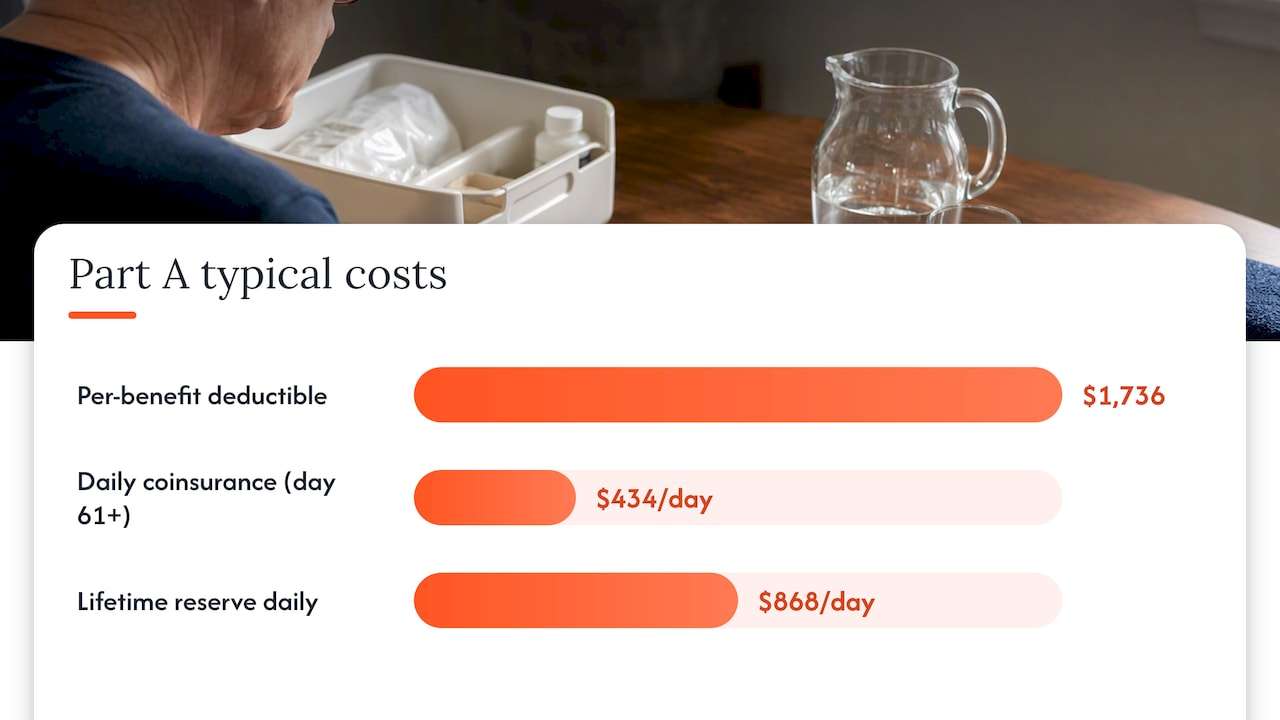
- A single hospital admission in January could trigger the full $1,736 deductible.
- If you’re readmitted in April after a 61-day gap, a second benefit period begins and you owe the $1,736 deductible again.
- A long stay past day 60 adds $434 per day in coinsurance, climbing to $868 per day once you dip into lifetime reserve days.
Someone hospitalized twice in one year, each stay lasting under 60 days, could owe $3,472 in deductibles alone before any Part B or drug costs.
Part B Costs: Premiums, Deductible, Coinsurance, and Income Adjustments
Part B covers outpatient care: doctor visits, lab work, durable medical equipment, and preventive screenings. Unlike Part A, nearly everyone pays a monthly premium for it.
- The standard 2026 Part B premium is $202.90 a month, billed regardless of how much care you use.
- You pay the first $283 of Part B-covered services yourself each year before Medicare starts sharing costs.
- After that deductible, Medicare pays 80% of the approved amount and you pay the remaining 20%. A $500 outpatient procedure leaves you with a $100 coinsurance bill on top of whatever you already paid toward the deductible.
Higher earners pay more. Beneficiaries above certain income thresholds owe an Income-Related Monthly Adjustment Amount on top of the standard premium, usually deducted straight from Social Security benefits. Enrolling late without a valid exception can also trigger a permanent premium penalty, so timing your sign-up matters.
Prescription Drugs and Other Common Cost Drivers
Part D isn’t part of Original Medicare, it’s a separate plan you choose, and that means premiums, deductibles, and the list of covered drugs vary by plan and by state. Some beneficiaries pay an extra income-related surcharge on top of their chosen plan’s premium.
- Part D premiums, formularies, and pharmacy networks differ by carrier, so two people on the same medication can pay very different amounts.
- Extra Help reduces drug premiums and copays for people who meet income and resource limits, and qualifying for a Medicare Savings Program can trigger automatic enrollment in it.
- Durable medical equipment carries the standard 20% Part B coinsurance, while dental, vision, and hearing services are largely excluded from Original Medicare altogether, leaving those costs entirely on you unless you carry separate coverage.
Our guide to Part D drug plans walks through how plan selection affects your annual drug spending.
What Counts as Out-of-Pocket Under Original Medicare
Not every dollar you spend on health care falls into the same bucket. Knowing the difference helps you see exactly where the “no cap” actually applies.
- Premium: the amount you pay monthly just to keep coverage active, whether or not you use any care.
- Deductible: the amount you pay before Medicare starts covering its share, reset each Part A benefit period or each calendar year for Part B.
- Coinsurance: your percentage share of the bill after the deductible is met, typically 20% under Part B.
- Copayment: a flat dollar amount charged for a specific service, more common under Part D or Medicare Advantage than under standard Part B.
The absence of an annual limit, confirmed by Medicare’s own cost page, applies specifically to Part A and Part B covered services. It doesn’t extend to things Original Medicare never covers in the first place, like routine dental work or most hearing aids. Also watch for balance billing: a provider who doesn’t accept Medicare assignment can legally charge you more than the Medicare-approved amount for a service.
How to Limit Your Out-of-Pocket Risk
Three main paths exist for capping or reducing what you’d otherwise pay without limit under Original Medicare.
- Medigap policies pay some or all of the deductibles and coinsurance Original Medicare leaves to you. You generally get the best rates and guaranteed acceptance during your Medigap open enrollment window right after turning 65, and in exchange for a monthly premium you gain freedom to see any provider who accepts Medicare. Our Medigap explainer covers how the different lettered plans compare.
- Medicare Advantage plans are required by law to set an annual out-of-pocket maximum, a structural difference from Original Medicare noted on Medicare.gov. The trade-off is usually a defined network and referral rules rather than open access to any Medicare provider.
- Medicare Savings Programs can pay your Part A and Part B premiums, deductibles, coinsurance, and copayments if you qualify, and many beneficiaries who assume they’re over the limit turn out to qualify anyway because states often use more generous rules than the federal baseline. Apply through your state Medicaid office.
Pro Tip: Mark your 65th birthday and any Medicare Advantage disenrollment date on a calendar now, and keep copies of every enrollment confirmation. Missing a Medigap or Part B enrollment window by even a few weeks can mean permanent penalties or medical underwriting later.
For a side-by-side look at the two main strategies, this comparison of Medicare Advantage and Medigap for 2026 breaks down the decision factors in more depth.
Estimate Your Yearly Out-of-Pocket: Three Scenarios Using 2026 Figures
A simple formula gets you most of the way there: Part B premium times 12, plus any deductibles you’re likely to hit, plus 20% of your expected Part B services, plus your Part D plan’s costs.
- Low use: You see a doctor a few times for routine visits. You pay the $2,434.80 annual Part B premium ($202.90 times 12, per CMS), the $283 Part B deductible, and modest Part D costs, landing roughly in the $3,000 to $3,500 range for the year.
- Moderate use: Add one outpatient procedure billed at $2,000 after the deductible. Your 20% coinsurance adds $400, pushing your total closer to $4,000 to $4,500.
- High use: A hospital stay triggers the $1,736 Part A deductible on top of the moderate scenario, plus possible daily coinsurance if the stay runs past 60 days. Totals can climb past $6,000 quickly, with no ceiling in sight.
A Medigap policy or a qualifying Medicare Savings Program can absorb most of the deductible and coinsurance amounts in each scenario, flattening the gap between the low and high cases. For a personalized version of this math, our Part A and Part B premium calculator plugs in your own numbers.
Practical Steps to Reduce Out-of-Pocket Spending
A few timed actions do more to control your costs than anything else on this list.
- Enroll during your Initial Enrollment Period around your 65th birthday, or during a Special Enrollment Period if you’re still covered by employer insurance, to avoid late penalties.
- Apply for a Medicare Savings Program and Extra Help through your state Medicaid office if your income is limited, even if you’re unsure you’ll qualify.
- Compare Medigap premiums and Medicare Advantage out-of-pocket maximums side by side during open enrollment, and check that your prescriptions are on a plan’s formulary before committing.
- Talk with a licensed agent or run your numbers through our Medicare cost resource to see how the pieces fit together for your situation.
Why Planning for This Gap Matters More Than People Expect
The lack of a cap under Original Medicare isn’t a minor technicality, it’s the reason a bad year can cost thousands more than a routine one. Most people don’t plan for that swing until they’re in a hospital bed watching it happen. Reviewing your coverage every year, not just at 65, catches changes in your health, your drug list, or your budget before they turn into a surprise bill. A short annual checkup on your Medicare setup, the kind of review we recommend, tends to save more money than any single plan switch.
— Zach
Get Help Lowering Your Medicare Out-of-Pocket Exposure
We work with Medicare Advantage Plans, Medicare Supplements, Prescription Drug Plans, and supplemental Dental, Vision, and Hearing coverage, matching the gaps in your Original Medicare costs to the right combination of plans. Our agents receive training before advising clients, so the guidance you get is grounded in how these plans actually pay out, not just how they’re marketed.

- We walk through Medigap and Part D options side by side so you can see the real cost trade-offs.
- We help determine if you qualify for Medicare Savings Programs or Extra Help before you assume you don’t.
- We offer annual plan reviews so your coverage keeps pace with your health and budget.
Visit Safeguard Benefit Services to request a free consultation and get a personalized Medicare roadmap built around your actual costs.
This article is general information, not a substitute for advice from a qualified financial advisor. Consult a qualified financial professional about your own circumstances before acting on anything here.
FAQ
Is there a maximum out-of-pocket for Original Medicare?
No. Original Medicare has no annual limit on what you can pay for covered Part A and Part B services, as confirmed on Medicare’s cost page. Medicare Advantage plans, by contrast, are required to include an annual out-of-pocket maximum.
What is the downside of Original Medicare?
The biggest downside is that nothing stops your costs from adding up if you have a serious illness or repeated hospital stays within the same year. Many people offset this by adding a Medigap policy, which AARP describes as close to essential given the absence of a cap.
Which Medicare is free for seniors?
No version of Medicare is entirely free. Most people pay no Part A premium if they have enough work history, but Part B carries a standard monthly premium of $202.90 in 2026, and Medicare Savings Programs can cover that premium for those who qualify based on income.
What state has the cheapest Medicare?
Original Medicare’s federal premiums and deductibles are the same nationwide, so the state itself doesn’t change your Part A or Part B costs. What does vary by state is Medicare Savings Program eligibility and Medigap pricing, so your actual total cost depends more on your income and plan choice than on where you live.
Recommended
Request a No Obligation Phone Call








Get Connected