

Medicare pays its share of the approved amount, but not a cent of that markup, leaving you on the hook for the difference. Ask any provider directly whether they accept Medicare assignment before you book, and stick with participating providers when you can. If you often see specialists who don’t take assignment, certain Medigap plans like Plan G or legacy Plan F (if eligible) can cover that excess charge.
TL;DR:
- Most providers accept Medicare assignment, so excess charges are less common than many beneficiaries assume, especially outside states with restrictions.
- Nonparticipating providers can bill up to 15% above Medicare’s approved amount, leading to potential steep out-of-pocket costs without Medigap Plan G coverage.
- Verify provider participation status through Medicare tools and ask directly before services to prevent unexpected bills, especially for specialists or outpatient procedures.
- Excess charges are separate from Part B deductibles and coinsurance, often resulting in full payment upfront before Medicare or supplementary plans reimburse.
- Medigap Plan G fully covers Part B excess charges for new enrollees, making it a worthwhile option in areas where providers frequently bill above Medicare limits.
Table of Contents
- What Are Part B Excess Charges and How Do Providers Calculate Them?
- How Big Can Excess Charges Get, and Which States Block Them?
- Do Excess Charges Count Toward Your Part B Deductible?
- Does Medigap Cover Part B Excess Charges?
- How to Avoid Part B Excess Charges Before You Book an Appointment
- What to Do If You Get Billed an Excess Charge
- 2026 Part B Costs: Where Excess Charges Fit In
- Your Legal Rights When a Provider Bills Above the Limit
- The Real Risk Isn’t the Charge, It’s Not Knowing Your Provider’s Status
- How Safeguard Benefit Services Helps You Avoid Billing Surprises
- Sources
- FAQ
What Are Part B Excess Charges and How Do Providers Calculate Them?
Every doctor who bills Medicare falls into one of three categories: participating, nonparticipating, or opted out. Participating providers agree to accept Medicare’s approved amount as full payment, called “accepting assignment.” Nonparticipating providers can still bill Medicare, but they’re allowed to charge more.
Here’s the math. That provider can then bill you a limiting charge of up to 15% on top of that reduced approved amount, according to NerdWallet’s breakdown of excess charge rules. For example, if Medicare’s normal approved amount for a service is $100, the nonparticipating rate drops to $95, and the provider can bill up to about $109 in total. You’d owe the gap between what Medicare pays and that ceiling.
A few things worth knowing upfront:
- Participating providers never charge excess fees. They accept assignment on every claim.
- Nonparticipating providers can still bill Medicare but add up to 15% extra.
- Opted-out providers aren’t in the Medicare system at all and can charge whatever they set with you directly.
- Durable medical equipment suppliers sometimes follow different assignment rules, so confirm assignment before ordering equipment.
How Big Can Excess Charges Get, and Which States Block Them?
Connecticut, Massachusetts, Minnesota, New York, Ohio, Pennsylvania, Rhode Island, and Vermont all restrict or eliminate the limiting charge for at least some services, meaning residents there face little to no excess billing risk regardless of which provider they see.
Outside those states, the practical risk is lower than the rule might suggest. Most doctors accept Medicare assignment.
By the numbers: Physician opt-out rates from Medicare remain extremely low nationwide, according to KFF’s analysis of Medicare participation, which means excess charges show up far less often than beneficiaries fear.
- States with full or partial bans: Connecticut, Massachusetts, Minnesota, New York, Ohio, Pennsylvania, Rhode Island, Vermont.
- All other states follow the federal 15% cap.
- Limits can vary by service type and provider category within a state.
Do Excess Charges Count Toward Your Part B Deductible?
No. Excess charges sit outside your Part B deductible and coinsurance calculations entirely. The excess charge is a separate out-of-pocket cost layered on top of your normal cost sharing.
In practice, you’ll often pay the full billed amount at the time of service, then wait for Medicare’s payment and any supplemental insurance reimbursement to work through afterward. That timing gap catches a lot of people off guard, especially if they expected their Medigap policy to pay the provider directly.
Does Medigap Cover Part B Excess Charges?
Yes, but only two Medigap plans include this benefit. Plan G covers Part B excess charges fully, and it’s available to anyone newly eligible for Medicare. Legacy Plan F also covers excess charges, but only if you became eligible for Medicare before January 1, 2020, according to Medicare.
A few practical notes before you assume you’re covered:
- Confirm your specific policy actually includes the excess charge benefit, since older or state-specific Medigap policies can vary.
- Expect to pay the provider first in many cases, then file for reimbursement, since claim processing doesn’t always happen automatically.
- If you’re unsure how your plan handles this, your State Health Insurance Assistance Program (SHIP) offers free, unbiased guidance.
If you regularly see specialists outside your area or travel frequently, Plan G’s excess charge coverage often justifies the higher premium compared to plans that skip it, an idea worth weighing against the rate increases Medigap plans see over time.
How to Avoid Part B Excess Charges Before You Book an Appointment
A little homework before you schedule care saves you from a surprise bill later. Follow this order:
-
Call and ask directly: “Do you accept Medicare assignment for this specific service?” Accepting Medicare and accepting assignment aren’t the same thing, and Healthline’s guidance on excess charges makes that distinction the top avoidance tip for a reason.
-
Verify through Medicare’s own tools. Use the Medicare Physician Compare lookup to check a provider’s participation status before your visit.
-
Request a written estimate for any service where assignment status is unclear, especially for procedures or specialist visits.
-
Choose participating providers when you have a choice. Predictable costs beat convenience for anything beyond routine care.
-
Confirm supplier assignment separately for durable medical equipment, since DME billing sometimes runs under different rules than physician services.
-
Consider Plan G if nonparticipating providers are unavoidable in your area or specialty.
-
Keep a written record of who told you what and when, in case a dispute comes up later.
Pro Tip: Save the name of whoever confirms assignment status over the phone, along with the date. If a bill arrives that doesn’t match what you were told, that record becomes your strongest evidence in a dispute.
What to Do If You Get Billed an Excess Charge
First, confirm the provider’s actual status. A quick check through Medicare’s provider lookup tells you whether you’re dealing with a nonparticipating provider following the 15% cap or an opted-out provider operating entirely outside Medicare’s billing rules. That distinction determines your recourse.
Gather your documentation before making any calls:
- Your Explanation of Benefits (EOB) from Medicare
- The itemized bill from the provider
- Any written estimate you received in advance
- Notes from your assignment verification call
If the charge exceeds the legal limiting charge, file an appeal through Medicare’s claims and appeals process. For out-of-network reimbursement questions specifically, guidance on filing out-of-network claims walks through the paperwork flow. Your state insurance department or local SHIP office can also weigh in if the provider seems to be billing outside legal bounds.
2026 Part B Costs: Where Excess Charges Fit In
The standard Part B premium for 2026 is specified as $202.90 a month, with an annual deductible specified as $283, according to Medicare’s official cost page. Higher earners pay additional surcharges based on income, as detailed in CMS’s 2026 premium fact sheet.
| Cost Component | 2026 Amount | Applies To Excess Charges? |
|---|---|---|
| Standard Part B premium | $202.90/month | No |
| Part B annual deductible | $283 | No |
| Standard coinsurance | Calculated separately | Calculated separately |
| Limiting charge (federal cap) | Up to 15% over approved amount | This is the excess charge |
A $200 approved service billed by a nonparticipating provider could run close to $219 with the full limiting charge added. That’s a real dollar gap on a single visit, and it repeats every time you see a nonparticipating provider without Medigap coverage. For a fuller breakdown of how these pieces interact across a full year, see Safeguard Benefit Services’ 2026 Medicare cost guide.
Your Legal Rights When a Provider Bills Above the Limit
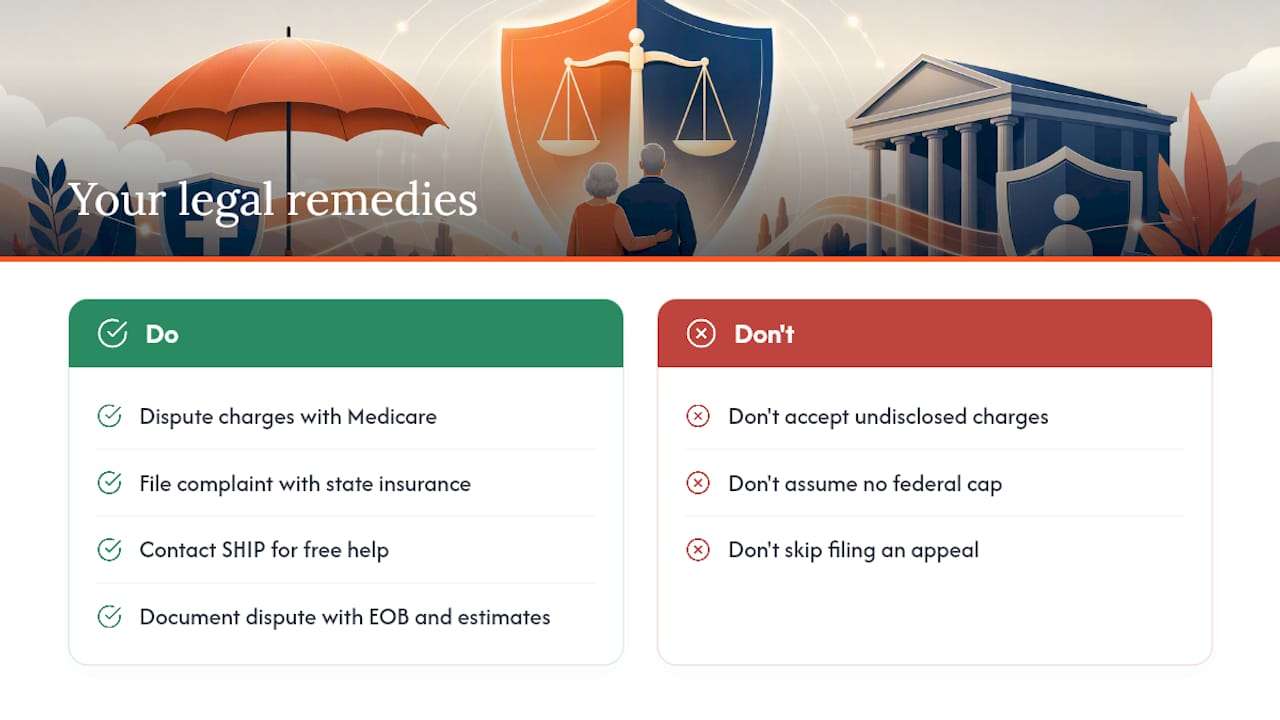
Federal law sets a hard ceiling on what nonparticipating providers can charge you, and that ceiling exists whether or not your state adds its own restrictions. A provider who bills you above that limit has broken the rule, and you have standing to dispute it regardless of where you live.
Your protections extend beyond the dollar cap itself. Providers are required to inform you in advance, in many cases, when a service won’t be covered at the standard rate or when they don’t accept assignment. If a provider fails to disclose their status and you’re billed unexpectedly, that’s grounds for a complaint to Medicare or your state insurance regulator, not just a billing correction request.
States that ban excess charges outright, like New York and Massachusetts, give residents an even stronger floor, but the federal cap still applies everywhere else and doesn’t disappear just because a state hasn’t added extra rules. You’re never left without recourse. Filing an appeal through Medicare’s official channels, contacting SHIP for free advocacy help, or escalating to your state’s insurance department are all legitimate paths, and providers who repeatedly violate the limiting charge risk sanctions from Medicare itself.
None of this requires a lawyer or a formal hearing in most cases. A documented dispute, backed by your EOB and any written estimate, resolves the majority of these situations at the administrative level.
The Real Risk Isn’t the Charge, It’s Not Knowing Your Provider’s Status
Most beneficiaries picture excess charges as some sneaky fee buried in a phone bill. It’s not. It’s a legal, disclosed practice that only becomes a problem when nobody asks the right question ahead of time. Given how rare true opt-out providers actually are, the bigger issue isn’t malicious billing. It’s beneficiaries assuming “accepts Medicare” and “accepts assignment” mean the same thing, when they don’t.
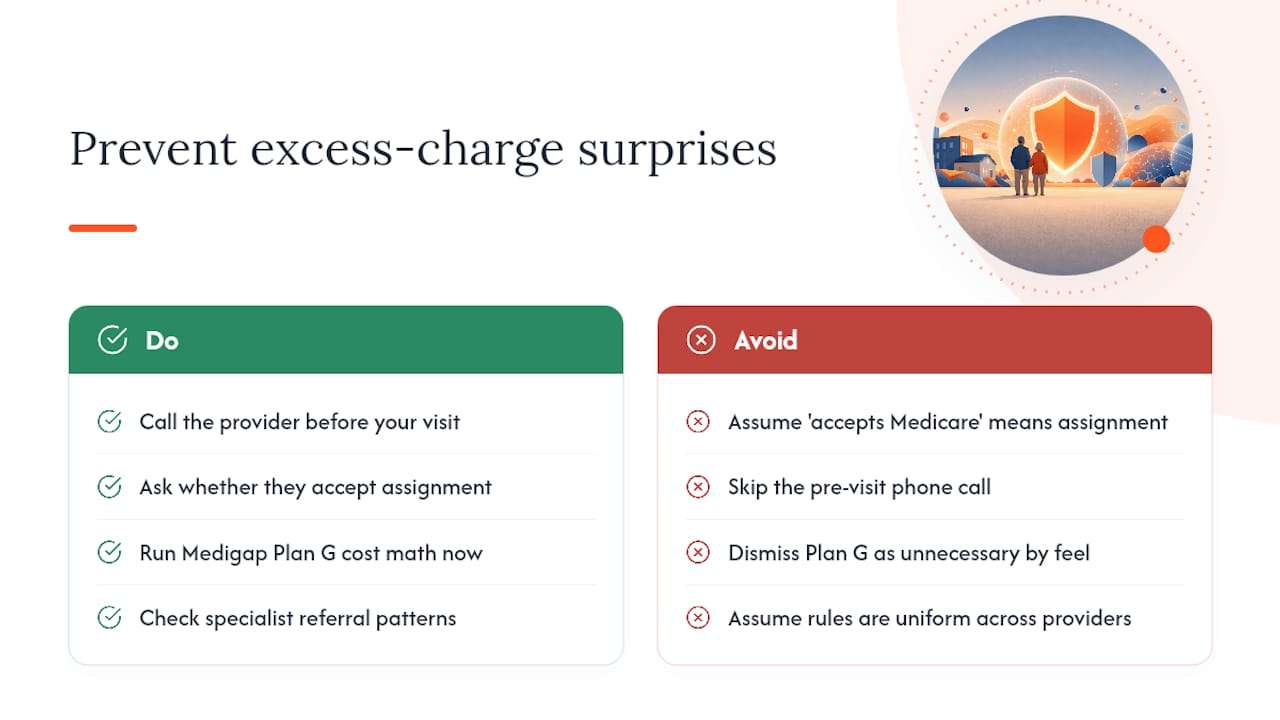
What surprises people most is how little effort it takes to close that gap. One phone call before an appointment either confirms you’re safe or tells you exactly what you’re walking into financially. Yet most people skip that call because they assume Medicare’s rules are uniform across every provider they see. They aren’t, and that assumption is where most excess-charge surprises actually come from.
The other underrated piece here is the Medigap decision. People often treat Plan G’s slightly higher premium as an unnecessary expense if they’re generally healthy. But the excess charge exposure isn’t about how healthy you are, it’s about how often you see specialists outside a tight network, especially as referrals pile up later in life. That’s a math problem worth running now, not after a bill arrives.
— Zach
How Safeguard Benefit Services Helps You Avoid Billing Surprises
Sorting out whether a provider accepts assignment, or whether Plan G’s premium is worth it for your situation, isn’t something you should have to figure out alone from a government website. A Medicare insurance agency can help beneficiaries navigate decisions like these, comparing Medigap options against your provider habits instead of generic advice.

If you’re weighing Plan G against other supplement options, or trying to figure out if your current coverage protects you from excess billing at all, a free consultation with a Medicare insurance agency may start with a personalized Medicare roadmap. Explore Medicare Supplement plans explained to see how Plan G fits your specific mix of providers, then schedule a conversation to get answers specific to your coverage, not a generic checklist.
This article is general information, not a substitute for advice from a qualified financial advisor. Consult a qualified financial professional about your own circumstances before acting on anything here.
Sources
- 2026 Medicare Parts B premiums & deductibles (CMS)
- How to avoid Medicare Part B excess charges (Healthline)
- Compare Medigap Plan Benefits | Medicare
- How many physicians have opted out of the Medicare program? (KFF)
FAQ
Which states prohibit or limit Medicare Part B excess charges?
Connecticut, Massachusetts, Minnesota, New York, Ohio, Pennsylvania, Rhode Island, and Vermont restrict or ban excess charges for at least some services.
What are some real-world examples of Part B excess charges?
If Medicare’s approved amount for a service is $200, a nonparticipating provider gets paid less than that and can bill you up to 15% above Medicare’s approved amount, leaving you responsible for the gap beyond your normal coinsurance.
How common are Part B excess charges in practice?
They’re less common than many beneficiaries expect, since KFF’s research shows very few physicians opt out of Medicare entirely and most accept assignment.
How do I avoid Part B excess charges before an appointment?
Ask your provider directly whether they accept Medicare assignment for the specific service, verify their status through Medicare’s Physician Compare tool, and consider a Medigap Plan G policy if you frequently use nonparticipating providers.
Does Medigap Plan G actually cover Part B excess charges?
Yes, Plan G covers Part B excess charges in full, and it’s available to anyone newly eligible for Medicare, unlike legacy Plan F, which only covers this benefit for those eligible before January 1, 2020.
Recommended
Request a No Obligation Phone Call








Get Connected