

The maximum Part D deductible for 2026 is $615, but plenty of plans charge less, and some charge nothing at all. Once your out-of-pocket spending hits $2,100, catastrophic coverage kicks in and copays disappear. Your next move: pull up your plan’s Evidence of Coverage or call an agent to see exactly where your plan lands.
TL;DR:
- Most plans charge a deductible less than the maximum $615 limit in 2026, with the majority of standalone plans imposing a deductible.
- Since the deductible resets annually and only applies to covered drugs, selecting a plan depends on whether your prescriptions fit within a lower or no deductible structure.
- Once out-of-pocket spending hits $2,100, catastrophic coverage begins, eliminating copays for the rest of the year.
- Comparing total annual costs requires factoring in premiums, expected drug expenses, and the deductible, not just the deductible alone.
- Assistance from agents and tools can help ensure you choose a plan that minimizes your overall yearly prescription costs.
Table of Contents
- What Is the Part D Deductible and What Are the 2026 Limits?
- How the Deductible Fits Into the Part D Coverage Stages
- Who Skips the Deductible: Extra Help and Special Cases
- How to Check Your Plan’s Deductible and Lower What You Pay
- How Safeguard Benefit Services Helps With Part D Deductible Decisions
- What Actually Matters When Deductibles Go Up
- Get Help Choosing the Right Part D Plan
- Sources
- FAQ
What Is the Part D Deductible and What Are the 2026 Limits?
A Part D deductible is the amount you pay out of pocket for covered prescription drugs before your plan starts sharing the cost. It resets every January 1, and it applies specifically to drugs your plan covers under its formulary, not to premiums or to drugs excluded from coverage.
Medicare sets a hard ceiling on how high that number can go. For 2026, no standalone Part D plan or Medicare Advantage plan with drug coverage (MA-PD) can charge more than $615 annually. That’s the cap, not a mandate. Insurers can and do offer lower deductibles, partial deductibles that apply only to certain drug tiers, or no deductible whatsoever, often in exchange for a higher monthly premium.
That tradeoff shows up clearly across plan types:
- Standalone prescription drug plans (PDPs) are far more likely to charge a deductible. About 96% of PDP enrollees are in plans that charge one.
- Medicare Advantage plans with drug coverage charge deductibles less consistently. 82% of MA-PD enrollees face a deductible, but many plans absorb that cost into a bundled premium.
- A $0-deductible plan almost always carries a higher premium to offset it. National average premiums for standalone Part D plans run around $34.50 a month, though that figure swings widely by plan and region.
If you take one drug that costs $15 a month, a low-premium, high-deductible plan probably wins. If you’re managing several brand-name prescriptions, a plan with a smaller deductible or none at all often costs less across the full year. Our Medicare Part D guide breaks down how formularies and tiers factor into that math.
How the Deductible Fits Into the Part D Coverage Stages
Your Part D costs move through three distinct stages each year, and knowing where you stand determines what you’ll actually pay at the pharmacy counter.
- Deductible stage. You pay 100% of your drug costs, up to your plan’s deductible amount (up to $615 in 2026). Once you’ve spent that much, you move to the next stage.
- Initial coverage stage. Your plan starts sharing costs, typically around 25% coinsurance for both brand and generic drugs, while the plan covers the rest. This stage continues until your total out-of-pocket spending reaches the year’s threshold.
- Catastrophic coverage. Once you hit the threshold, your copays and coinsurance for covered drugs drop to $0 for the rest of the calendar year.
That threshold, known as True Out-of-Pocket spending or TrOOP, is set at $2,100 for 2026.
The $2,100 Trigger: Once your TrOOP spending for the year reaches $2,100, you pay nothing further for covered drugs under your plan for the rest of 2026.
Not every dollar you spend counts toward TrOOP the same way. Your own payments count, as does financial help from family, most charities, and State Pharmaceutical Assistance Programs. Manufacturer discounts on brand-name drugs during the coverage gap also count toward TrOOP under CMS rules, even though you didn’t technically pay that portion yourself. The final CY 2026 Part D program instructions from CMS spell out exactly how sponsors, manufacturers, and CMS split these costs behind the scenes, and how that split shapes what shows up on your statement.
Who Skips the Deductible: Extra Help and Special Cases
Extra Help, also called the Low-Income Subsidy, eliminates the deductible entirely for people who qualify. It also caps copays at a fraction of what most enrollees pay.
- Full Extra Help recipients often pay $0 for their deductible and premium, with copays as low as $0 to $12.65 per drug depending on the medication and income level.
- You typically qualify automatically if you’re enrolled in Medicaid, receive Supplemental Security Income (SSI), or participate in a Medicare Savings Program.
- Others qualify by applying directly through the Social Security Administration based on income and resource limits.
- Extra Help recipients are also exempt from Part D late enrollment penalties while the subsidy is active.
A few other situations change how the deductible applies. Some drugs, particularly certain infused or injectable medications, fall under Part B instead of Part D and follow different cost rules entirely. Insulin costs are capped separately under federal rules regardless of deductible status. If any of this sounds like your situation, Medicare’s official guide to prescription drug coverage walks through the specifics.
How to Check Your Plan’s Deductible and Lower What You Pay
Finding your actual deductible takes five minutes if you know where to look. Skip the marketing brochure and go straight to your plan’s Evidence of Coverage (EOC) document, usually mailed each fall and always available online through your plan’s member portal. The deductible amount appears in the “Medicare Part D Prescription Drug Benefit” section, typically within the first few pages. You can also search by plan name on Medicare’s Plan Finder tool, or call your agent directly and ask.
Once you know the number, the real question isn’t “what’s the deductible” but “what’s my total annual cost.” Run this simple calculation for any plan you’re considering:
Total annual cost = (12 × monthly premium) + deductible + expected copays and coinsurance
A plan with a $0 deductible and a $45 premium can easily beat a plan with a $20 premium and a $615 deductible, once you factor in a full year of prescriptions.
Beyond picking the right plan, a few tactics cut your actual drug spending:
- Ask your doctor about generic or therapeutic alternatives on your plan’s preferred formulary tier.
- Use your plan’s preferred or mail-order pharmacy, which often prices the same drug lower than a standard retail pharmacy.
- Request partial fills when starting a new medication. Costs get prorated based on the quantity dispensed, so you’re not stuck paying a full month’s deductible hit on a drug you might not tolerate.
- Look into manufacturer patient assistance programs for expensive brand-name drugs, especially specialty medications.
- Check whether specific maintenance drugs on your plan are covered before the deductible kicks in. Some plans exempt certain generics.
Pro Tip: Before you switch plans for a lower deductible, check whether your current specialty drugs are on the new plan’s formulary at all. A cheaper deductible means nothing if your medication isn’t covered.
Our guide to saving on Medicare prescription drug costs covers more of these tactics in depth, and the independent perspective from Geneva Insurance Group on standard versus zero-deductible plan designs is worth a look if you want a second read on how these tradeoffs play out.
How Safeguard Benefit Services Helps With Part D Deductible Decisions
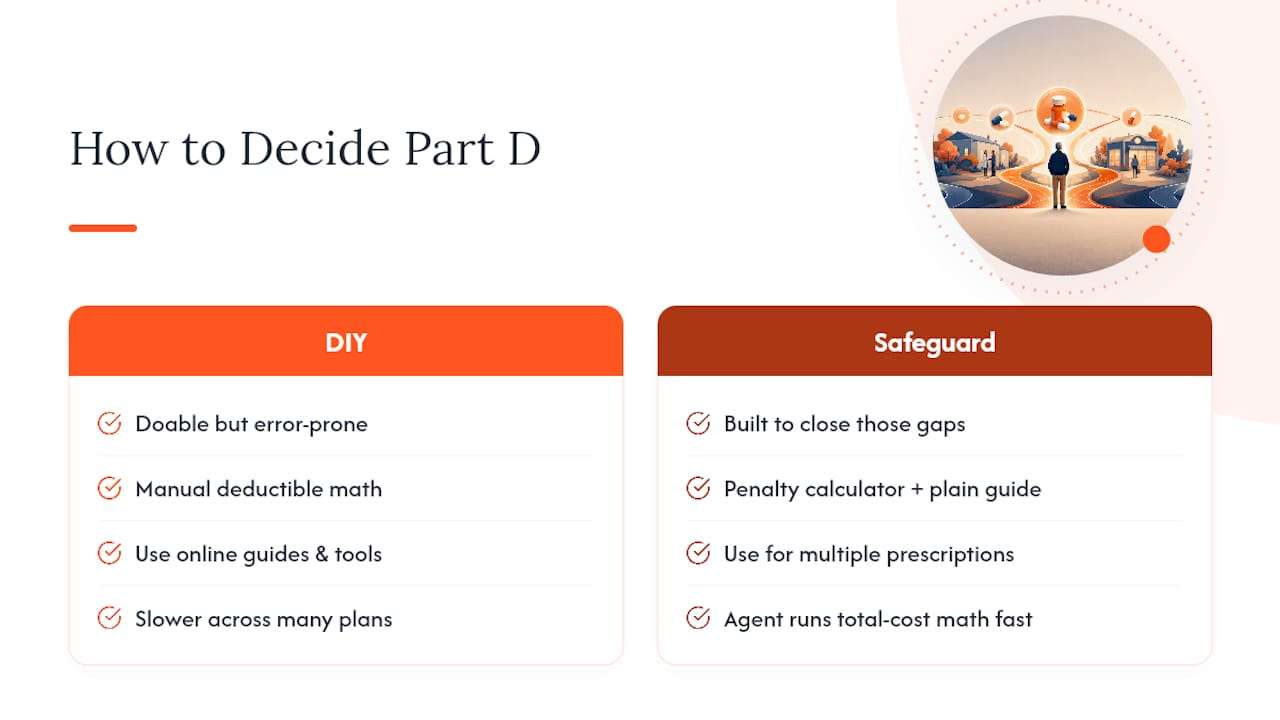
Working through deductible math, formulary tiers, and Extra Help eligibility on your own is doable, but it’s also where most enrollment mistakes happen. That’s exactly the gap Safeguard Benefit Services was built to close.
Our Part D late enrollment penalty calculator shows you what a coverage gap actually costs before you make a decision, and our Medicare Part D explained guide breaks down formularies and tiers in plain language. A one-on-one consultation makes the most sense if you’re managing multiple prescriptions, think you might qualify for Extra Help, or you’re switching plans mid-year and worried about penalties. An agent can run the total-cost math across every plan available in your area in a fraction of the time it takes to do it yourself.
What Actually Matters When Deductibles Go Up
Most people fixate on the deductible number and ignore the arithmetic that actually determines their annual cost. That’s backwards. A $615 deductible on a plan with a low premium can still beat a $0-deductible plan with an inflated monthly rate, depending entirely on what you actually take.
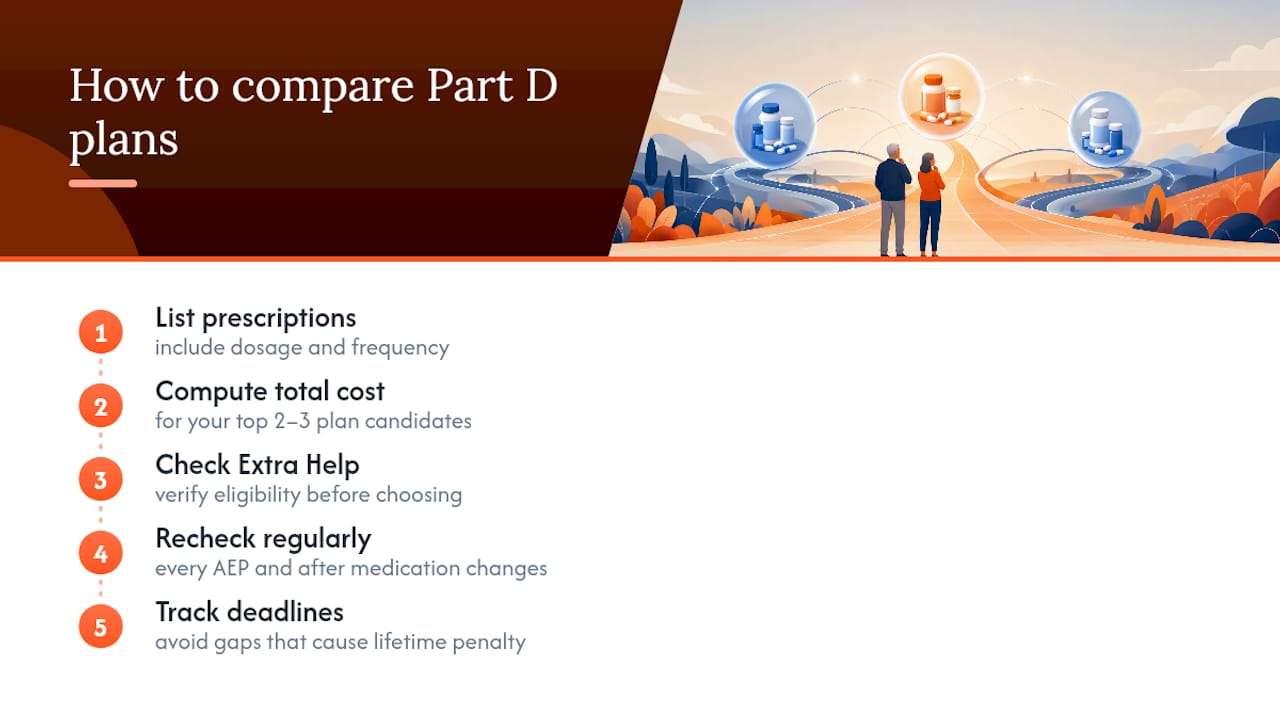
Here’s the three-step process I’d tell any Medicare-eligible reader to run before locking in a plan: First, list every prescription you expect to fill this year, including dosage and frequency. Second, plug those into the total-cost formula for your top two or three plan candidates, not just the one with the flashiest deductible. Third, check your Extra Help eligibility before you do anything else, because it can flip the entire calculation.
Do this every Annual Enrollment Period, and again whenever a doctor adds or changes a medication. And if you’re new to Medicare or coming off employer coverage, keep an eye on enrollment deadlines. A gap in credible drug coverage triggers a late enrollment penalty that follows you for as long as you have Part D.
— Zach
Get Help Choosing the Right Part D Plan
Comparing deductibles, premiums, and formularies across a dozen plans is tedious work, and getting it wrong costs real money over a full year. Free, personalized consultations are available to Medicare-eligible individuals to review specific medications and pharmacy preferences rather than a generic plan summary.

Bring your current medication list, your preferred pharmacy, and your existing Evidence of Coverage if you have one. From there, an agent can run the total annual cost across the plans available to you, check whether you qualify for Extra Help, and flag any enrollment penalty risk before it becomes a problem. Visit Safeguard Benefit Services to schedule your free consultation and get a clear picture of what your actual Part D costs would look like this year.
This article is general information, not a substitute for advice from a qualified financial advisor. Consult a qualified financial professional about your own circumstances before acting on anything here.
Sources
- How much does Medicare drug coverage cost? | Medicare
- Medicare Part D enrollment, premiums, and cost sharing in 2026 | KFF
- Final CY 2026 Part D redesign program instructions | CMS
FAQ
What Is the Maximum Medicare Part D Deductible in 2026?
The maximum is $615 for 2026. Plans can charge less, offer a partial deductible on certain tiers, or charge nothing at all, so your actual amount depends entirely on the plan you pick.
Do All Medicare Part D Plans Have Deductibles?
No. Most do, but not all. Roughly 96% of standalone PDP enrollees are in plans with a deductible, compared to about 82% of MA-PD enrollees, and some plans waive it entirely in exchange for a higher premium.
Is Medicare Part D Free at Age 65?
No, Part D isn’t automatically free at 65. You pay a monthly premium plus any applicable deductible and copays, unless you qualify for Extra Help, which can reduce your premium and deductible to $0 depending on income and resources.
What Do Most People Pay for Medicare Part D?
Costs vary widely based on the plan and your medications, but the national average premium for a standalone Part D plan runs around $34.50 a month, on top of any deductible and copays. A free consultation with an agent at Safeguard Benefit Services can pin down your specific plan’s total cost based on the drugs you actually take.
Recommended
Request a No Obligation Phone Call








Get Connected