

A Part D exception is a formal request asking your drug plan to make a rule bend for you. It can cover a drug that is not on the plan’s formulary, waive a restriction such as step therapy, or lower what you pay for a drug in a costly tier. Your prescriber has to back the request with a statement of medical need, and the plan has to answer within set deadlines. If it says no, you have appeal rights.
This guide walks through the three kinds of exceptions, who qualifies, how to file, how fast the plan must respond and what to do after a denial.
TL;DR
- A formulary exception asks the plan to cover a drug it does not list, or to waive a rule on a drug it does list. A tiering exception asks for a lower copay on a non-preferred drug.
- Your prescriber must send a supporting statement saying the requested drug is medically necessary and why the plan’s alternatives would not work.
- Standard benefit decisions take up to 72 hours. Expedited decisions take 24 hours once the plan has the prescriber’s statement.
- If the plan denies you, you have 65 days to file a Level 1 appeal.
- Excluded drugs and out-of-network purchases cannot get a formulary exception.
Table of Contents
- What a Part D exception actually is
- Who can request one, and what is off limits
- How to request a formulary exception, step by step
- Asking for a tiering exception
- How long the plan has to answer
- If the plan says no
- Where to get help
- Preventing the problem before it starts
- Perspective
- Get a plan that fits your prescriptions
- FAQ
- Sources
What a Part D exception actually is
Every Part D plan keeps a formulary, the list of drugs it covers. It also sorts those drugs into cost tiers and may attach rules to some of them. An exception is the plan’s official way of making a case-by-case decision outside those lists and rules.
CMS describes two main types. According to CMS’s exceptions page, a formulary exception requests coverage for a Part D drug that is not on the plan’s formulary, or waiver of a utilization management requirement for a drug that is. The second type, a tiering exception, lets an enrollee get a non-preferred drug at the lower cost sharing that applies to drugs in a preferred tier.
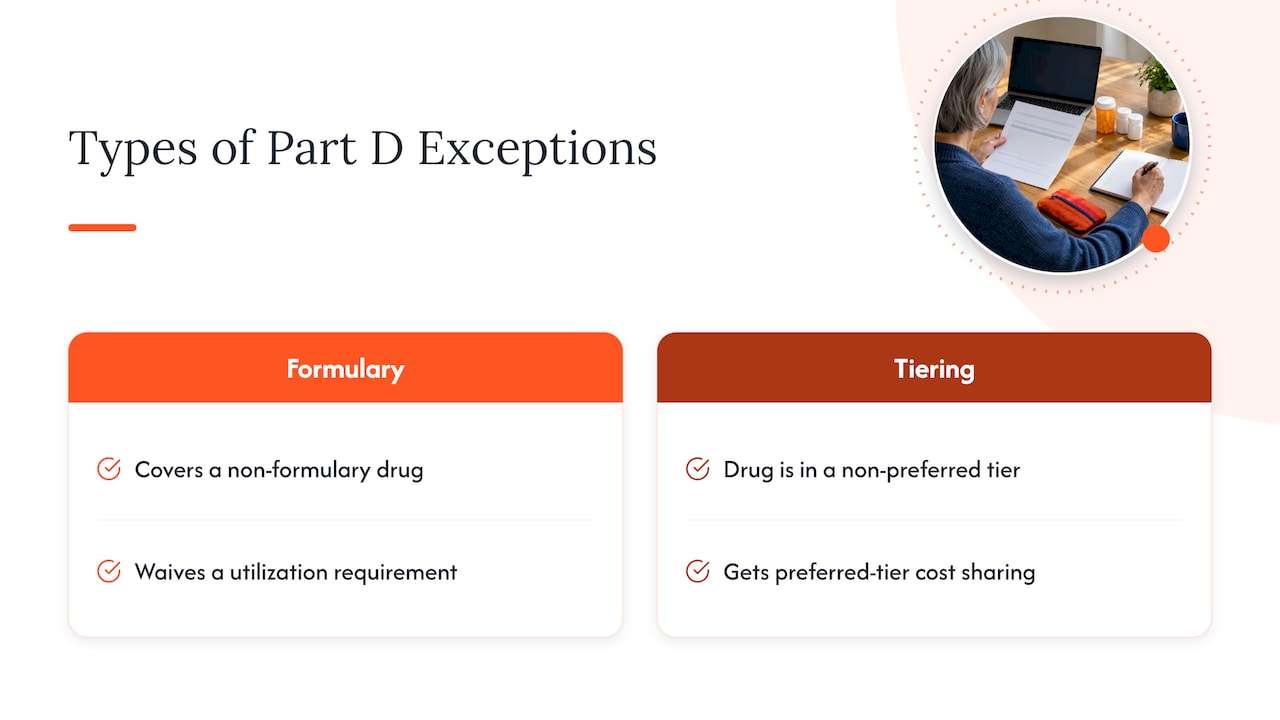
You have the right to ask. A federal guide on how Medicare plans use pharmacies and formularies says you can request an exception if your plan won’t cover or pay for a prescription drug you need.
The three situations an exception covers
| Situation | What you ask for | Typical example |
|---|---|---|
| Drug is not on the formulary | Coverage of the specific drug | Your cardiologist prescribes a medication the plan does not list |
| Drug is covered but restricted | Waiver of a rule such as step therapy, prior authorization or a quantity limit | The plan wants you to fail two cheaper drugs first |
| Drug is covered but in a high-cost tier | Lower cost sharing, as if the drug were in a preferred tier | A needed brand-name drug sits in a non-preferred tier |
The first two are formulary exceptions. The third is a tiering exception. Knowing which one you need shapes everything that follows, including what your prescriber writes.
Who can request one, and what is off limits
You or your prescriber can start the request. The usual reason is that none of the drugs on the formulary will work for your medical condition. The federal guide says enrollees can request an exception if they or their prescriber believe no formulary drug will work.
Some limits matter before you spend time on paperwork. Under CMS’s appeals guidance, drugs excluded from Part D by the Social Security Act, and drugs obtained out of network, are not eligible for formulary exceptions. They still carry coverage determination and appeal rights. The same guidance says you cannot ask for a tiering exception on a drug that was already approved through a formulary exception as a non-formulary drug.
If your plan drops a drug because the FDA considers it unsafe or the manufacturer pulls it from the market, the plan may remove it immediately. That is a different situation from a drug being left off the list for cost reasons.
Drugs Part D never covers
Certain categories are excluded by law no matter how strong your case is, including drugs for weight loss when used for that purpose, fertility drugs and over-the-counter products. If you are unsure whether your drug falls into one of those groups, ask the plan before filing. Our guide on what Medicare Part D covers gives the broader picture.
How to request a formulary exception, step by step
- Confirm the problem. Look up your drug in your plan’s current formulary. Note whether it is missing, restricted or in a high tier. Your plan’s website or member services line will tell you.
- Talk to your prescriber first. Explain what the plan said. Ask whether a formulary alternative is clinically reasonable. If it is not, ask your prescriber to support an exception.
- Get the supporting statement. Under federal rules, your prescriber must submit a statement that the requested drug is medically necessary because the alternatives would be ineffective, cause adverse effects, or both. The rule is at 42 CFR 423.578.
- Submit the request. You can send a completed Model Coverage Determination Request form, write a letter or call your plan, according to Medicare.gov. Many prescriber offices file this for you by phone or online.
- Say whether it is urgent. If waiting could seriously harm your health, ask for an expedited decision.
- Keep records. Write down dates, names and reference numbers, and keep copies of what was sent.
What a strong supporting statement includes
The regulation sets the standard, and a statement that speaks to it is easier for the plan to approve. Useful details include:
- The diagnosis and why this drug is prescribed for it
- Each formulary drug already tried, with dates, doses and the result
- Side effects or reactions you had, or the specific reason a formulary drug is unsafe for you
- Why a restricted step, such as trying a cheaper drug first, would be inappropriate in your case
Plans must keep a process for gathering and comparing medical and scientific evidence on the safety and effectiveness of the requested drug against formulary drugs, per the same federal rule. A clear, specific statement gives the reviewer something concrete to weigh.
Asking for a tiering exception
A tiering exception is the one people overlook. If your drug is covered but sits in a non-preferred tier with a high copay, and the lower-tier alternatives would not work for you, you can ask the plan to price it as a preferred drug. CMS says plan sponsors have flexibility in setting cost sharing for approved exceptions, as long as it fits their existing tier structure and is applied uniformly. So the approved price depends on how your plan sets up its tiers.
This matters most for expensive injectables and brand-name drugs. Newer therapies such as GLP-1 drugs can carry steep monthly bills, and a breakdown of GLP-1 medication costs shows how fast those add up, which is why checking a drug’s tier before you commit to a plan is worth the time. To see how tiers shape your costs, read our guide to checking Part D tiers.
How long the plan has to answer
The clock starts when the plan has what it needs, and the speed depends on the type of request. According to CMS:
| Type of request | Decision deadline |
|---|---|
| Standard, for a benefit (getting the drug) | 72 hours |
| Standard, for payment (reimbursement for a drug you already paid for) | 14 calendar days |
| Expedited, for a benefit | 24 hours after the plan receives the prescriber’s supporting statement |
An expedited request fits when your health, life or ability to function could be seriously harmed by waiting. Your prescriber’s support carries weight here, so tell the office plainly that the request is urgent.
Step therapy and prior authorization
Most exception requests from people on common medications involve a restriction rather than a missing drug. Step therapy, where the plan wants you to try cheaper drugs first, is the classic case. A waiver of that rule is a formulary exception too. We cover the tactics in more detail in our article on winning step therapy exceptions. If you have a Medicare Advantage plan, related approval rules apply to medical services, which we explain in Medicare Advantage prior authorization.
If the plan says no
A denial is not the end. Medicare.gov lays out the next steps. You can file a Level 1 appeal, called a redetermination, within 65 days of the denial notice. If that decision goes against you, you have 60 days to take a Level 2 appeal to an independent reviewer.
The same page says standard Level 1 appeals for a benefit must be decided within 7 days, and expedited ones within 72 hours.
Practical points for an appeal:
- Read the denial notice closely. It states the reason, and your appeal should answer that reason directly.
- Ask your prescriber to add anything the first statement missed, such as lab results, records of failed drugs or a stronger explanation of risk.
- File well inside the deadline. Do not wait until day 64.
- Request an expedited appeal if delay could harm your health.
What happens to your supply while a request or appeal is pending depends on your plan’s rules and your situation. Ask the plan directly, and ask your pharmacist about options for the days in between. Do not stop a medication without talking to your prescriber.
Where to get help
You are not expected to do this alone. Your plan’s member services number is on your card. The federal guide points to your plan, Medicare.gov’s appeal pages and 1-800-MEDICARE as places to ask for help. Your prescriber’s office, especially a staff member who handles prior authorizations, is often the fastest route.
Preventing the problem before it starts
Exceptions are a safety net. The better fix is choosing a plan whose formulary fits your medications to begin with. Plans change their formularies, tiers and restrictions from year to year, so the plan that worked last year may not work now.
Before you choose or renew a plan:
- List every drug you take, with the dose and how often.
- Check each one against the plan’s formulary, tier and any restrictions.
- Estimate your yearly costs, not just the premium.
- Confirm your pharmacy is in network.
Our guides on how Part D plans work and on saving money on Medicare prescription drug costs walk through this. Also watch your enrollment timing. A gap in drug coverage can bring a penalty, which you can explore with our Part D penalty calculator and our guide to creditable coverage.
Perspective
Most of the exception problems we see started months earlier, at plan selection. Someone picked a plan on premium alone, then found at the pharmacy counter that a key drug was restricted or sat in a high tier.
Our agents go through a comprehensive training program so that the advice you get is education first. We sit down with your actual medication list, check it against the plans available where you live, and explain the rules in plain words. Our guidance comes at no extra cost to you.
When an exception is needed, we help you understand what your prescriber should document and which deadlines apply. We also review your coverage every year, because formularies change and your health does too. That ongoing local support is how we help clients avoid coverage gaps and surprise costs.
Zach
Get a plan that fits your prescriptions
If you are choosing or reviewing a Part D plan, we can compare plans against your medication list and explain how each handles tiers and restrictions. Safeguard Benefit Services is a Charlotte, North Carolina Medicare agency, and we help with Prescription Drug Plans, Medicare Advantage and Medicare Supplements. Ask for your free Medicare roadmap and a personalized consultation through our main site.
FAQ
Is a formulary exception the same as an appeal?
No. An exception is the first request, asking the plan to cover a drug or waive a rule. An appeal comes after the plan denies a request. Both rest on your prescriber’s explanation of medical need.
Does my doctor have to be involved?
Yes, in practice. Federal rules require a prescriber’s supporting statement that the requested drug is medically necessary because formulary alternatives would be ineffective, cause adverse effects, or both. You can start the request yourself, but the plan cannot decide without that statement.
How fast will I hear back?
For a standard request to get a drug, the plan has 72 hours. For an expedited request, it has 24 hours after it receives your prescriber’s statement. A request for reimbursement takes up to 14 calendar days.
What if my drug is excluded from Part D by law?
A formulary exception cannot cover a drug that the Social Security Act excludes from Part D. You still have the right to a coverage determination and to appeal. Ask your prescriber whether a covered alternative exists, and ask your plan which of its options apply.
Can I ask for a lower copay on a drug that is already covered?
Yes, through a tiering exception. You show that the preferred-tier drugs would not work for you, and ask the plan to charge preferred-tier cost sharing. It is not available for a drug already approved through a formulary exception as non-formulary.
Sources
- Exceptions | CMS
- 2025 Medicare Parts C and D Enrollee Grievances, Organization Determinations, and Appeals Guidance | CMS
- 42 CFR 423.578, Exceptions process | eCFR
- Appeals in a Medicare drug plan | Medicare.gov
- How Medicare plans use pharmacies, formularies, and common coverage rules | GovInfo
- U.S. GLP-1 program costs
Recommended
Request a No Obligation Phone Call








Get Connected