

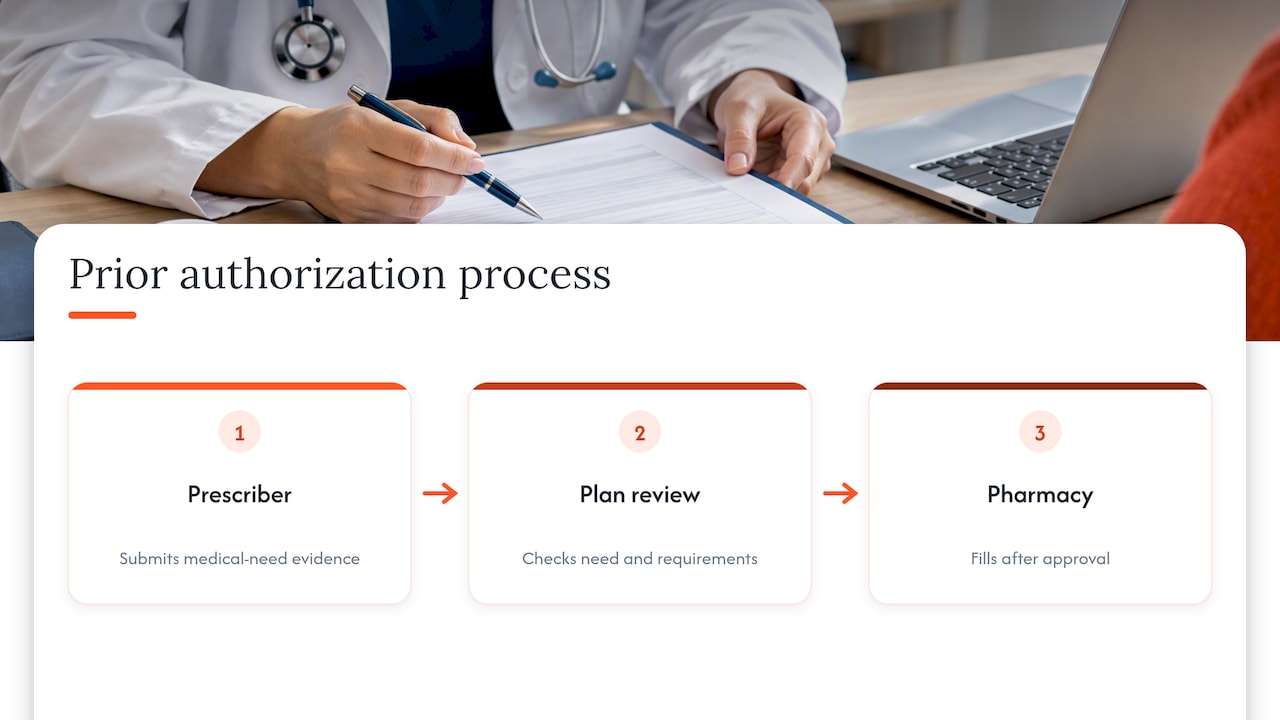
Part D prior authorization is approval your drug plan requires before it will cover certain prescriptions. Your prescriber usually has to show that the drug is medically necessary and that you meet the plan’s rules. The plan then has 72 hours to decide on a standard request and 24 hours on an expedited one. If it says no, you have appeal rights with firm deadlines.
This guide explains what the process looks like from your side of the pharmacy counter, who does what, how long it takes, and what to do when the answer is no.
TL;DR
- Prior authorization is a plan-side approval your prescriber requests before the plan will pay for a restricted drug. Your formulary shows which drugs carry the restriction.
- For standard requests without an exception, plans have 72 hours to decide. Expedited requests get 24 hours.
- If the plan denies the request, you have 65 days from the date on the denial notice to ask for a redetermination (a Level 1 appeal).
- Missing a deadline does not mean automatic approval. You still have to use the official coverage determination or appeal process.
- Check the formulary before you enroll or switch plans, and review it every year, because each plan sets its own rules.
Table of Contents
- What prior authorization means in Part D
- Why plans require it
- How to find out whether your drug needs approval
- Who submits the request and how
- How long a decision takes
- What to do if you need the medication now
- If the plan says no: exceptions and appeals
- Prior authorization in Part D vs. Medicare Advantage
- How to avoid surprises at the pharmacy
- Our perspective
- Get your drugs checked against the plan before you enroll
- FAQ
- Sources
What prior authorization means in Part D
Medicare drug coverage comes from private plans, and each plan decides which drugs it covers and under what conditions. One of those conditions is prior authorization. Medicare describes it as approval you and your prescriber must get from your plan before it covers certain drugs. Your prescriber may need to show that the drug is medically necessary and that you meet the plan’s requirements.
You will hear several names for the same idea: preauthorization, prior approval, precertification, or simply “a PA.” Part D itself uses a more formal term. According to a University of Connecticut pharmacy guide, consumers use “prior authorization” broadly, while the formal Part D name for the approval process is a coverage determination. That matters when you call your plan, because a request to “start a coverage determination” is the phrase that triggers the official clock.
The approval happens before the pharmacy fills the prescription. If you show up and the pharmacist says the claim was rejected and needs prior authorization, nothing is wrong with your coverage. The plan is waiting for your prescriber’s paperwork.
Why plans require it
Medicare’s own explanation is that plans may use prior authorization when they cover a drug for certain medical conditions but not others. The plan may also ask for proof that the drug is medically necessary and meets its requirements.
The UConn guide adds the practical side: plans use prior authorization to ensure appropriate coverage and to control costs. The criteria often involve things like a specific diagnosis, particular lab results, or involvement of a specialist physician. So a drug can be fully covered for one condition and need approval for another, or need approval when a general practitioner prescribes it but not when a specialist does.
Quantity limits are a close cousin. Aetna’s formulary FAQ explains that quantity limits restrict how much of a drug you can fill in a certain timeframe, and that taking more than the recommended amount requires prior authorization. Other plans word it differently, but the pattern is common.
Which drugs are affected
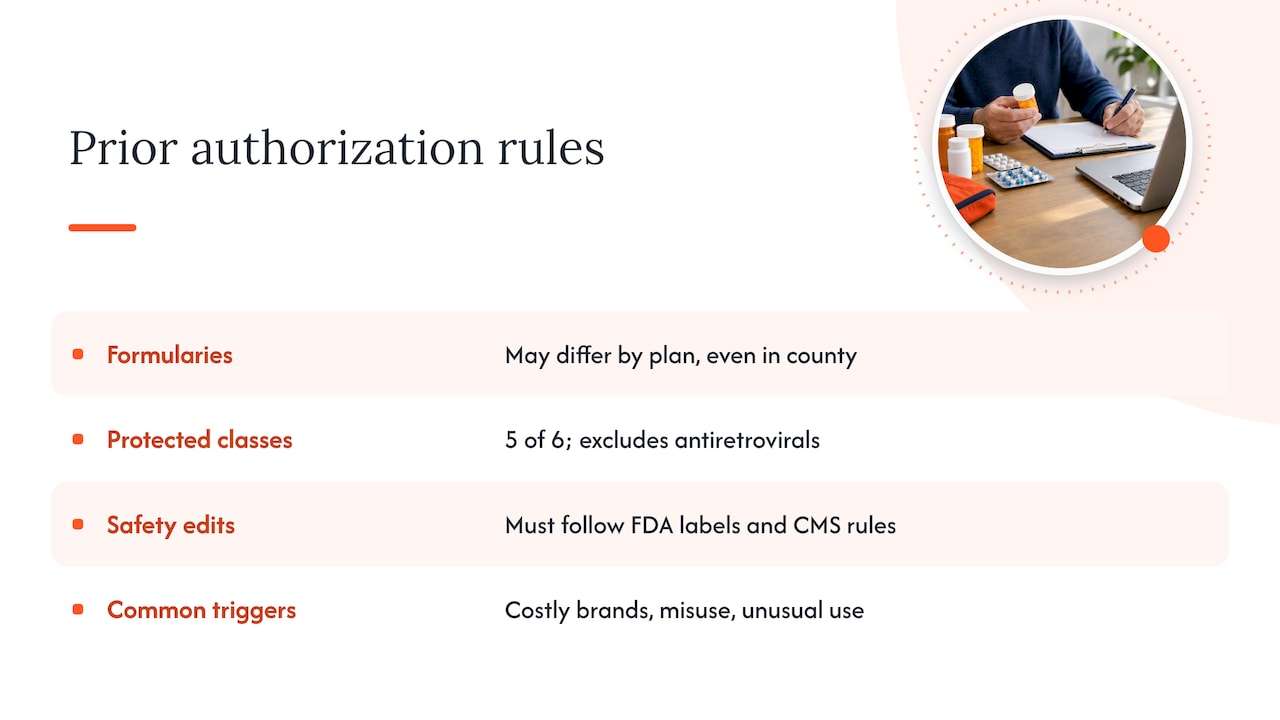
There is no national list. A JAMA Health Forum study notes that Part D benefits are run by numerous private plans, each with its own formulary and benefit design. A drug that needs approval on one plan may not on another in the same county.
There are some federal guardrails. Under the policy described in CMS’s 2019 fact sheet, Part D sponsors may apply prior authorization to new therapy starts in five of the six protected classes, but not to antiretrovirals. And plans have flexibility with safety edits, but the CMS Part D manual indicates they cannot contradict FDA-approved labeling or CMS-approved formulary requirements.
In practice, prior authorization tends to show up on expensive brand-name drugs, drugs with a risk of misuse, and drugs prescribed for conditions outside their usual use. It can also appear alongside step therapy, where the plan wants you to try a lower-cost drug first. If that is your situation, our guide on winning step therapy exceptions covers that path in detail.
How to find out whether your drug needs approval
Do this before you need the refill, not at the pharmacy counter.
- Open your plan’s formulary. The UConn guide notes that a Part D formulary helps you determine a drug’s coverage restrictions and the right type of coverage determination. Look for codes next to your drug such as PA, ST (step therapy) or QL (quantity limit). The exact labels vary by plan.
- Search by your exact drug and dose. Restrictions can differ by strength or form.
- Call the number on your member card if the formulary is unclear. Ask whether the drug needs prior authorization, step therapy or a quantity limit, and what criteria apply.
- Tell your prescriber’s office early. Staff handle these requests often, and starting before you run out avoids a gap.
If you are still choosing a plan, this check is the single most useful step. Our overview of what Part D covers explains how formularies are built, and the 2026 Part D guide walks through formularies and pharmacies.
Who submits the request and how
The request is usually your prescriber’s job, but you have rights too. CMS states that an enrollee, their prescriber, or their representative may request a standard or expedited coverage determination from the plan sponsor, verbally or in writing.
A practical sequence looks like this:
- The pharmacy tells you the claim needs prior authorization.
- You or the pharmacy contacts your prescriber.
- The prescriber’s office sends the plan the clinical information it asks for: diagnosis, prior treatments, lab results, or a statement of medical necessity.
- The plan reviews it and sends you and your prescriber a decision.
If your prescriber is working through insurance paperwork for a newer or higher-cost medication, such as a weight loss drug, this walkthrough of insurance for weight loss medication shows the kind of documentation that often comes up. You can also read about Medicare coverage for weight loss drugs to see how coverage questions affect who qualifies.
One CMS detail protects prescribers and, indirectly, you. According to the 2025 Medicare Parts C and D appeals guidance update, plans are prohibited from using peer-to-peer discussions to pressure providers into changing a pending request to improve its chance of approval, for example by suggesting a lower level of service.
How long a decision takes
The timelines are set by CMS. Per its coverage determinations page:
| Request type | Standard | Expedited |
|---|---|---|
| Benefit request without an exception | 72 hours | 24 hours |
| Request involving an exception | Clock starts when the plan receives the prescriber’s supporting statement | Same start rule |
Two details trip people up. First, with exceptions, the adjudication clock does not begin until the plan has the prescriber’s supporting statement. A request that sits in a fax queue without that statement is not yet ticking. Second, the CMS guidance says the day the plan receives a request is not day one; the following day is.
Ask your prescriber for an expedited review if waiting could harm you. The appeals rules use the standard of waiting seriously jeopardizing your life or health, or your ability to regain maximum function.
What if the plan is late?
The same CMS guidance says a plan missing its deadline does not automatically count as an approval. You still have to follow the coverage determination or appeal process. So if the clock runs out, call the plan, confirm the status in writing, and ask your prescriber to keep the request moving rather than assuming the drug will be covered.
What to do if you need the medication now
While you wait, talk to your prescriber and pharmacist about options. Some people ask whether a short supply, a formulary alternative, or a sample is appropriate while the decision is pending. That is a clinical judgment for your prescriber, and the answer depends on the drug and your condition.
If the delay is dangerous, say so plainly when you request the review, and have your prescriber state it in the request so it qualifies for the 24-hour expedited track. For an urgent situation involving your health right now, contact your doctor or emergency services first and sort out coverage afterward.
If the plan says no: exceptions and appeals
A denial is not the end. Medicare’s appeals page for drug plans lays out two related routes.
Exception request. You can ask your plan for an exception. Your prescriber must provide a statement explaining the medical reason it should be approved. Exceptions cover drugs with restrictions such as prior authorization, step therapy and quantity limits. The UConn guide notes that plans must generally maintain approvals for qualifying exception requests through the end of the calendar year, so an approval is not a monthly worry.
Appeal. If you disagree with a coverage decision, you can start an appeal through your plan:
- Level 1, redetermination. You, your representative or your prescriber must ask within 65 days of the date on the initial denial notice. The standard decision window is 7 days.
- Expedited Level 1. If waiting 7 days could seriously jeopardize your health, ask for a fast appeal. The plan must decide within 72 hours.
- Level 2, reconsideration. If the plan denies your redetermination, you have 60 days to request reconsideration by a Part D Independent Review Entity.
Write the dates on your calendar the day the denial arrives. Keep copies of the notice, your prescriber’s statement and any lab results you send.
Prior authorization in Part D vs. Medicare Advantage
People often mix up the two. Medicare Advantage (Part C) plans require prior authorization for many medical services, such as certain procedures and imaging. Part D prior authorization is about prescription drugs. If your Medicare Advantage plan includes drug coverage, both can apply in the same plan. We explain the medical-services side in our Medicare Advantage prior authorization guide, and the basics of the plan type in Medicare Advantage Plans explained.
If you have Original Medicare with a stand-alone drug plan, your Part D plan is separate and handles its own approvals.
How to avoid surprises at the pharmacy
- Compare formularies during open enrollment. List every drug you take with its strength, then check each plan’s restrictions, not only the premium.
- Ask about restrictions for new prescriptions. A new start can face rules that a refill does not.
- Keep your prescriber’s office in the loop. Tell them when you change plans, since each plan has its own forms and criteria.
- Do not let coverage lapse. A gap in drug coverage can bring a late enrollment penalty. See our explanation of creditable coverage and the 63-day gap and how the Part D penalty works.
- Review the plan every year. Formularies and restrictions can change from one plan year to the next.
Our perspective
Most of the Part D problems we see in Charlotte are not about the plan being bad. They are about a person choosing it by premium alone and learning about prior authorization at the pharmacy counter, with a prescription in hand and a refill running out.
That is why we start with your medication list, not a plan brochure. We check each drug against each plan’s formulary, flag the ones that carry prior authorization, step therapy or quantity limits, and talk through what your prescriber would need to supply. It costs you nothing extra, and it turns a surprise into a plan.
Our agents go through a comprehensive training program so the guidance is educational and unbiased, and we stay with clients after enrollment. An annual plan review matters here: restrictions can shift from year to year, and the plan that fit your drugs last year may not fit them now.
Zach
Get your drugs checked against the plan before you enroll
If you are choosing or changing a Part D plan, we can compare your medications against the formularies available to you and point out where approval will be needed. We also help you avoid enrollment penalties and coverage gaps, and we offer a free Medicare roadmap that lays out your options and eligibility.

Look at our Charlotte prescription drug plans or start from the Safeguard Benefit Services home page to book a personalized consultation.
FAQ
Does every Part D drug need prior authorization?
No. Most covered drugs do not. Plans apply prior authorization to selected drugs, and each plan chooses its own. Your plan’s formulary shows which of your drugs carry the restriction.
Can I ask for the decision to be faster?
Yes. You or your prescriber can request an expedited coverage determination, which the plan must decide within 24 hours for a benefit request without an exception. The request should explain that waiting could seriously harm your health.
What happens if my plan misses the deadline?
A late response is not an automatic approval under CMS guidance. Contact the plan for the status, ask your prescriber to follow up, and use the official coverage determination or appeal process if needed.
How long do I have to appeal a denial?
You have 65 days from the date on the initial denial notice to ask for a redetermination. If the plan upholds its denial, you then have 60 days to request reconsideration by an Independent Review Entity.
Is prior authorization the same as a coverage determination?
In everyday talk, yes. Formally, a coverage determination is the Part D term for the plan’s decision on whether it will cover a drug and under what rules, including requests for prior authorization or exceptions.
Sources
- Drug plan rules, Medicare.gov
- Coverage Determinations, CMS
- Appeals in a Medicare drug plan, Medicare.gov
- 2025 Medicare Parts C and D appeals guidance update, CMS
- Medicare Advantage and Part D Drug Pricing Final Rule fact sheet, CMS
- Medicare Part D Manual, chapter 6, CMS
- All “Prior Authorizations” are Not Created Equal, UConn School of Pharmacy
- Characteristics of Prior Authorization Policies, JAMA Health Forum
- Medicare Prescription Drug Formulary FAQ, Aetna Medicare





Get Connected