

Part D star ratings are a one-to-five score from Medicare that shows how well a prescription drug plan performs, with five stars the best and one the lowest. Medicare updates them every year, and the newest ones appear in the plan comparison tool during fall open enrollment. They are a useful quality check, but they do not tell you whether your own medications are covered or what you will pay. This guide explains what the stars measure, how they are calculated, and how to use them without letting them override the things that decide your actual costs.
TL;DR
- Part D star ratings run from 1 to 5 stars and are published every year by the Centers for Medicare & Medicaid Services (CMS).
- The stars score plan quality: customer service, complaints, member experience and drug safety. They do not tell you if your drugs are covered.
- A 5-star plan in your area can be joined through a one-time special enrollment period, outside the usual windows.
- Ratings change from year to year, so check the current ones each fall before you renew or switch.
- Use stars as a tiebreaker after you confirm your drugs, your pharmacy and the total yearly cost.
Table of Contents
- What Part D star ratings are
- What each star level means
- What CMS measures for Part D
- How CMS turns data into stars
- When the ratings come out
- The 5-star special enrollment period
- What the stars do not tell you
- How to use star ratings when you compare plans
- Where the stars help most
- Our perspective
- Get a plan review that starts with your medications
- Local angle for North Carolina readers
- FAQ
- Sources
What Part D star ratings are
CMS publishes Medicare Advantage (Part C) and Part D Star Ratings every year to measure the quality of the health and drug services that Medicare plans provide. The scale is one to five stars, and five is the highest rating and one the lowest.
The ratings are meant to help you and your caregivers compare plan quality alongside benefits and costs. Think of them as a report card on how the insurance company runs the plan, not a measure of how good the drugs are.
The ratings apply to two kinds of plans:
- Stand-alone prescription drug plans (PDPs). These pair with Original Medicare and are rated only on drug-related measures.
- Medicare Advantage plans with drug coverage (MA-PDs). These get an overall rating that blends medical and drug measures, and a separate Part D summary rating.
If you are still sorting out which type of plan you have, our guide to Medicare Part D prescription drug plans covers the basics.
What each star level means
CMS does not publish a plain-English label for every number, but the direction is simple. More stars mean the plan scored better against the measures CMS tracks and against other plans.
| Rating | What it generally signals |
|---|---|
| 5 stars | Highest level of performance. Qualifies for the 5-star special enrollment period. |
| 4 stars | Strong performance across most measures. |
| 3 stars | Middle of the range. |
| 1 to 2 stars | Weaker performance on one or more measure areas. |
A few things to keep in mind when you read a number:
- The rating belongs to the plan contract run by the insurer, so several plan options under one contract can share the same stars.
- A half-star rating is possible, so you may see 3.5 or 4.5.
- A plan can be new and have no rating yet. That says nothing good or bad about it.
What CMS measures for Part D
CMS sorts Part D measures into four domains:
- Drug plan customer service.
- Member complaints and changes in the drug plan’s performance.
- Member experience with the drug plan.
- Drug safety and accuracy of drug pricing.
In plain terms: how quickly the plan answers the phone and handles appeals, how many members complain or leave, what members say in satisfaction surveys, and whether the plan helps prevent unsafe prescribing and prices drugs on Plan Finder correctly.
The number of measures varies by plan type. For 2027, Part D plans are rated on up to 12 measures, while MA-PD contracts are rated on up to 43. That is why a Medicare Advantage plan with drug coverage can have a very different overall rating from its own Part D summary rating.
How CMS turns data into stars
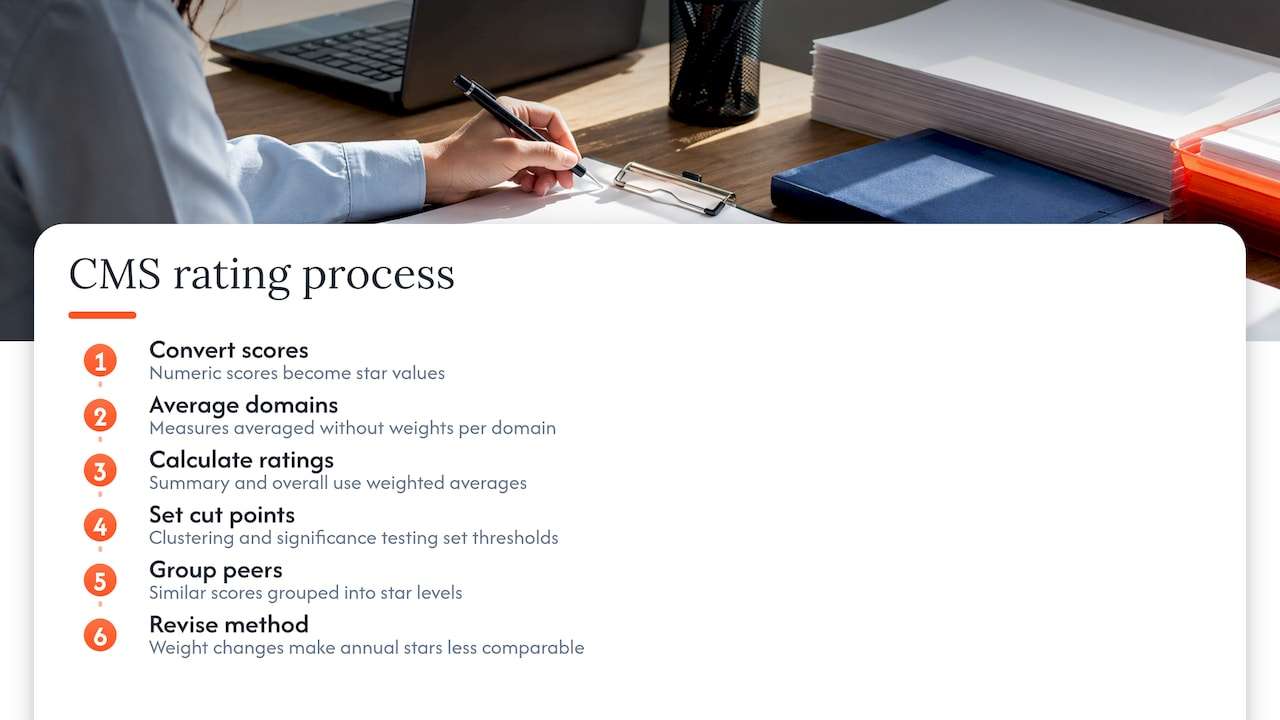
The math is less mysterious than it looks. According to the CMS technical notes, the agency converts each numeric score to a star value, averages the measures within each domain without weights, and then calculates summary and overall ratings from weighted averages.
The key piece is the cut point. CMS sets the thresholds for each measure using clustering algorithms and significance testing. Plans with similar scores are grouped together, and each group gets a star level. This means a plan is judged partly against its peers, so a plan can slip a star even if its own performance stayed flat.
CMS also keeps adjusting the method. It has said that changes such as modifying measure weights are meant to push plans toward continuous quality improvement. So a plan’s stars from one year to the next are not perfectly comparable.
When the ratings come out
The 2027 Star Ratings were released on October 8, 2026 and appear on the Medicare Plan Finder for the 2027 open enrollment period. The pattern repeats every year: CMS releases new ratings in early October, shortly before the annual fall enrollment window opens.
Because ratings are reviewed yearly and can change, a plan that earned 4.5 stars last year may not hold that rating this year. That is one more reason to review your coverage every fall instead of letting it renew on autopilot. Our page on Medicare open enrollment dates lays out the window and the steps to take.
The 5-star special enrollment period
A 5-star rating comes with a real enrollment perk. If a five-star Medicare Advantage or Part D plan is available where you live, you can join it through a one-time special enrollment period, running from December 8 through November 30 of the following year.
CMS guidance describes the same rule: the option is a one-time enrollment change that starts December 8 of the year before the plan’s 5-star rating period and ends November 30 of the year the plan holds the rating. It is a switch to a plan in your service area, and you get to use it once in that period.
Two practical points:
- Check that the 5-star plan actually covers your medications and includes your pharmacy before you use your one switch.
- If you are weighing a change at another time of year, read our guides on changing your Medicare plan mid-year and life events that open a special enrollment period.
What the stars do not tell you
This is where people get tripped up. A five-star plan is not automatically the right plan for you.
The four measure domains describe service, member experience and drug safety. None of them is a promise that a specific drug is on the plan’s formulary, that it sits on a low-cost tier, or that it will be free of prior authorization. Nor do they guarantee a health outcome. Two plans with the same stars can cover very different drug lists and charge very different premiums and copays.
That is why the guidance for beneficiaries is to use Star Ratings after considering whether coverage, costs and provider and pharmacy networks meet your needs. The ratings should be weighed alongside costs and your specific coverage needs, not instead of them.
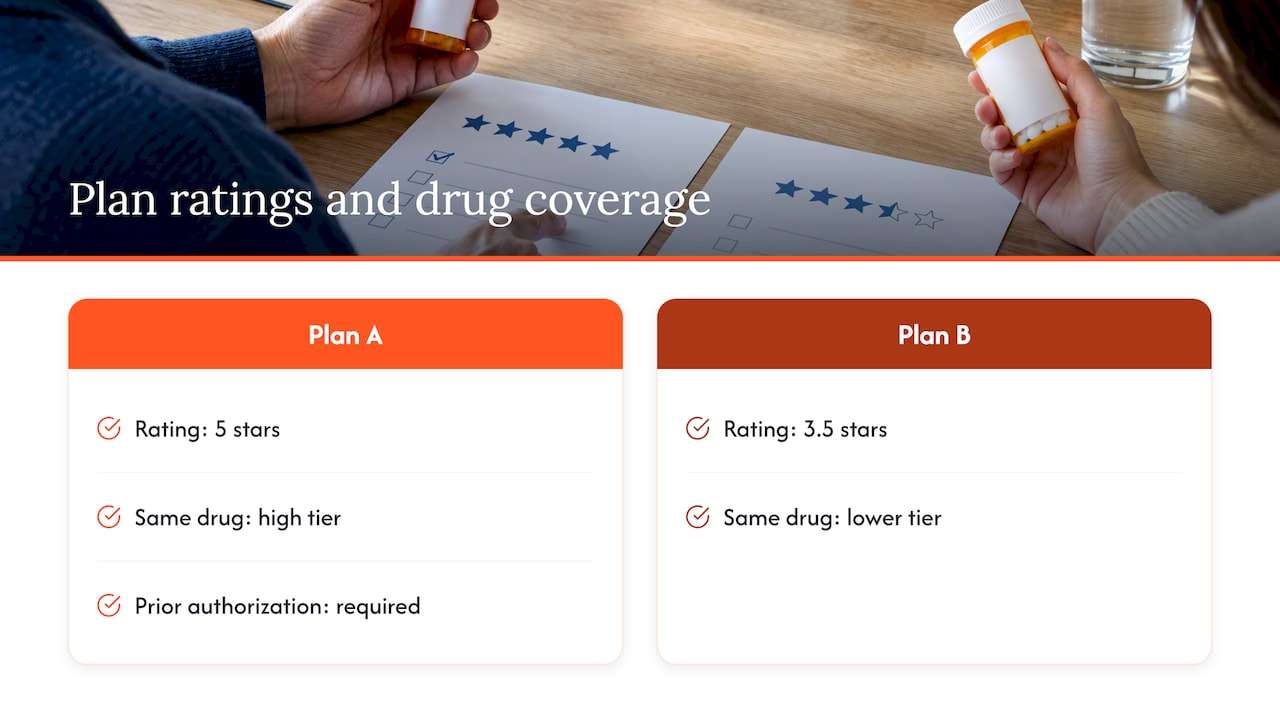
A short example of why this matters. Say you take a brand-name medication for a chronic condition. Plan A has 5 stars but places your drug on a high tier with a prior authorization requirement. Plan B has 3.5 stars and covers the same drug on a lower tier. For you, the cheaper and simpler path may be Plan B. The stars were never designed to settle that question. If prior authorization is a concern, see our explainer on how Part D prior authorization works.
How to use star ratings when you compare plans
Here is a sequence that keeps the stars in their proper place.
- List your drugs and doses. Include every prescription, plus the pharmacy you use now.
- Run them through Medicare Plan Finder. Look at the estimated total yearly cost for each plan, not just the monthly premium.
- Check the formulary details. Note the tier, any prior authorization, step therapy or quantity limits for each of your drugs.
- Confirm your pharmacy. Preferred pharmacies can mean lower copays, and your usual pharmacy may not be preferred on every plan.
- Now look at the stars. Among plans that cover your drugs at a cost you can live with, favor the higher-rated one.
- Look at the trend. If you can, compare last year’s rating to this year’s. A plan that dropped sharply deserves a closer look at why.
- Repeat every fall. Plans change formularies, premiums and ratings every year.
If you are choosing between a stand-alone drug plan and a Medicare Advantage plan with drug coverage, remember that the Medicare Advantage overall rating mixes in many medical measures. For those plans, our page on Medicare Advantage star ratings shows what to check beyond the headline number, and this guide to how stars influence plan selection goes deeper.
Where the stars help most
Star ratings earn their keep in a few situations.
- Choosing between two similar plans. When premiums and drug costs are close, the better-rated plan is the safer bet on service and drug safety.
- Spotting a plan to avoid renewing. A low rating, combined with complaints you have had yourself, is a good reason to shop.
- Deciding whether to use the 5-star switch. If a 5-star plan fits your drugs and pharmacy, the special enrollment period gives you a way to move outside the regular window.
- Helping an adult parent. Caregivers can use the stars as a quick filter before digging into formularies.
They help least when you take expensive or specialty drugs. In that case, the formulary and tier placement will matter far more than a half-star difference.
Our perspective
We see the same pattern every fall. Someone opens Plan Finder, spots a five-star badge and stops looking. A few months later, the pharmacy counter tells them their medication is on a tier they did not expect.
Our view is that stars are worth checking, and they should be the last filter, not the first. Start with your drug list, your pharmacy and your total yearly cost. Then let the star rating break the tie between plans that already fit.
This is also why we train our agents to educate before they recommend. Our goal is unbiased, personalized guidance, at no extra cost to you, so you understand why a plan fits and not just that it was rated well. We stay in touch after enrollment and review your plan each year, because ratings, formularies and premiums all change.
If you are near 65, or a missed deadline could cost you a late-enrollment penalty, getting this right the first time matters even more. We would rather spend an hour on your list of medications now than have you discover a gap in January.
Zach
Get a plan review that starts with your medications
Safeguard Benefit Services is a Medicare insurance agency in Charlotte, North Carolina. We help with Medicare Advantage plans, Medicare Supplements and prescription drug plans, along with dental, vision and hearing coverage. We also offer a free Medicare roadmap that lays out your options and eligibility.

If you want a second set of eyes on your Part D options, we will compare plans against your actual prescriptions, pharmacy and budget, and show you how the star ratings fit in. Start with our Charlotte prescription drug plans page or reach us through our main site.
Local angle for North Carolina readers
Star ratings are national, but your choices are local. The plans available in Mecklenburg County are not the same as those in another state, and a plan that is five stars in one region may not be sold in yours. The 5-star enrollment period applies only to a plan available in your service area, so confirm availability using your ZIP code in Plan Finder.
For what is changing in the coming plan year for Charlotte-area beneficiaries, see our 2027 Medicare Advantage and Part D updates. You can also read how Charlotte beneficiaries can use star ratings to pick a quality plan.
FAQ
Do Part D star ratings guarantee that a plan will cover my drug?
No. The stars rate areas such as customer service, complaints, member experience and drug safety. They say nothing about whether a particular medication is on the plan’s formulary or what tier it falls in. Always check your own drugs in Plan Finder and in the plan’s formulary, and confirm with the plan if you take an expensive medication.
How often do Part D star ratings change?
CMS publishes new ratings every year, and a plan’s stars can go up or down. The 2027 ratings were released in October 2026 for the fall enrollment period. Check the current ratings each fall before you renew or switch.
What is the 5-star special enrollment period?
It is a one-time chance to move into a five-star Medicare Advantage or Part D plan in your area outside the normal enrollment windows. It runs from December 8 through November 30 of the following year. Make sure the plan covers your drugs and pharmacy before you use it.
Should I pick the highest-rated Part D plan?
Not automatically. Start with plans that cover your medications and pharmacy at a total yearly cost you can afford. Among those, the higher-rated plan is usually the better choice. If the highest-rated plan costs you more or leaves a drug uncovered, a lower-rated plan may suit you better.
Sources
- 2025 Medicare Advantage and Part D Star Ratings, CMS
- 2027 Medicare Advantage and Part D Star Ratings, CMS
- Medicare 2026 Part C & D Star Ratings Technical Notes, CMS
- 2026 Star Ratings Fact Sheet, CMS
- Contract Year 2027 Medicare Advantage and Part D Final Rule, CMS
- Medicare Prescription Drug Benefit enrollment and disenrollment guidance, CMS
- How to compare plans using the Medicare Star Rating System, Medicare Interactive
- Switching to a 5-star plan outside open enrollment, KFF
Recommended
Request a No Obligation Phone Call








Get Connected