

Part D tiers are the cost-sharing levels a plan assigns to the drugs on its formulary, and the label does not tell you the price on its own. The single most important action is to check your plan’s formulary and Summary of Benefits for the exact copay or coinsurance tied to each tier. In 2026, revised deductible and out-of-pocket thresholds also change how those tier costs stack up across the year.
TL;DR:
- The actual cost-sharing for each drug depends on your specific formulary and tier placement, which varies by plan and can change during the year.
- Many drugs cost significantly more in higher tiers, with specialty drugs in Tier 4 often involving coinsurance that translates to higher dollar amounts.
- To avoid surprises, always verify your plan’s formulary, copay, or coinsurance details for each medication and check for utilization management like prior authorization or step therapy.
- Checking your medications against plan formularies before each open enrollment or medication change helps prevent unexpected costs and allows for exception requests if needed.
- The 2026 Part D redesign caps the deductible at $615 and the catastrophic threshold at $2,100, influencing overall out-of-pocket expenses across the year.
Table of Contents
- What Part D tiers are and how plans use them
- Typical tier examples from Tier 1 to the specialty tier
- How tiers interact with the 2026 Part D cost stages
- How to find your drug’s tier in your plan’s formulary
- How to request a tiering or formulary exception
- Why the same drug can cost different amounts on different plans
- A local perspective on navigating Part D tiers
- Get a personalized Part D tier review
- FAQ
- Sources
What Part D tiers are and how plans use them
A formulary is the list of drugs a Medicare Part D plan covers, and every drug on it sits in a tier that sets your cost-sharing. Plans can structure their formularies with three, four, or five tiers, and Medicare does not require a single national tier structure, so the same drug can carry a different price depending on the plan.
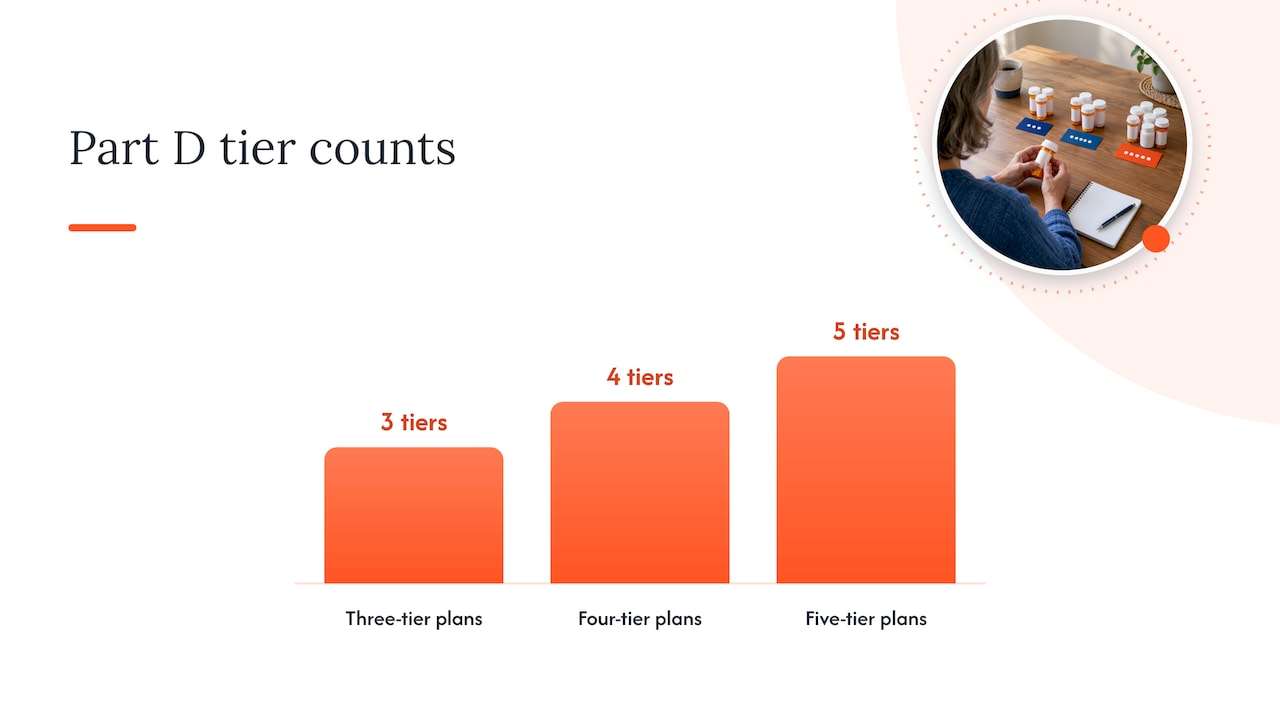
Medicare requires every plan to cover a minimum number of drugs in each therapeutic category and to include certain protected classes, such as cancer and HIV medications, but it leaves tier placement and pricing largely up to the plan sponsor. That flexibility is why two plans covering the same drug can charge noticeably different amounts.
The practical consequence: a tier number by itself is not a price tag.
- Tier labels and names vary from plan to plan, even for the same drug.
- The only reliable way to know your cost is to check your specific plan’s documents.
- Formularies can change during the year, and plans must notify you when a change affects a drug you take.
Typical tier examples from Tier 1 to the specialty tier
Most Part D plans follow a familiar pattern, even though exact copays differ by plan. These sample tier descriptions give you a general sense of what to expect before you check your own formulary.
- Tier 1 usually holds most generic drugs and carries the lowest copay.
- Tier 2 typically covers preferred brand-name drugs or certain higher-cost generics, with a moderate copay.
- Tier 3 generally includes non-preferred brand-name drugs, priced higher than Tier 2.
- Tier 4 or a specialty tier covers high-cost biologics and specialty medications, often with coinsurance instead of a flat copay.
- Some plans place expensive generics or specialty oral drugs in a different tier than you might expect, so the pattern is a guide, not a guarantee.
A drug that seems like a routine generic can land in a higher tier if it is new or expensive to manufacture, and a brand-name drug can sometimes sit in a lower tier than a generic competitor. That is another reason to check the actual formulary rather than assume based on drug type alone.
How tiers interact with the 2026 Part D cost stages
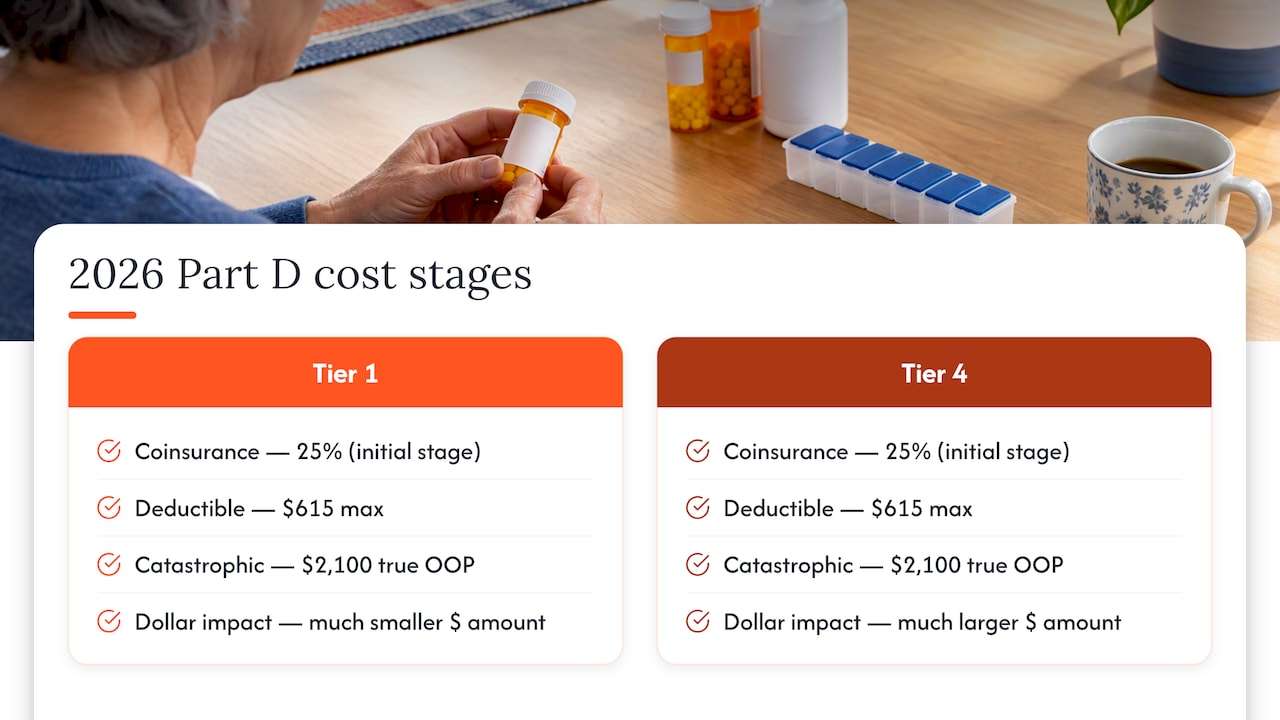
Your tier determines the copay or coinsurance percentage, but the Part D benefit design determines when that cost-sharing applies and how much you pay overall. For 2026, the maximum Part D deductible is $615, though some plans set a lower deductible or none at all.
The 2026 catastrophic threshold is $2,100 in true out-of-pocket spending, and reaching it ends your cost-sharing for the rest of the year on covered Part D drugs. Until then, most plans apply standard 25% coinsurance during the initial coverage stage, after your deductible is met, regardless of which tier your drug sits in. Tier placement still matters inside that structure because a Tier 4 specialty drug’s 25% coinsurance is a much larger dollar amount than a Tier 1 generic’s 25%.
The 2026 redesign also introduced a selected drug subsidy and negotiated prices for certain high-cost medications, which shifts some financial liability from plans to manufacturers and CMS during the initial coverage phase. For beneficiaries, the practical effect shows up as pricing that can look different from prior years, even for drugs in the same tier. Payment plan examples show how spreading these costs across the year changes monthly cash flow without changing the total amount owed once you hit the $2,100 threshold.
How to find your drug’s tier in your plan’s formulary
Checking your exact cost takes a few minutes and saves you from surprises at the pharmacy counter.
- Search your plan’s online formulary tool or use Medicare’s Plan Finder to look up each medication by name and dosage.
- Open your plan’s Summary of Benefits or Evidence of Coverage to confirm the listed copay or coinsurance for that tier.
- Check whether your pharmacy is in the plan’s preferred network, since preferred pharmacies often charge less for the same tier.
- Note any quantity limits tied to the drug, which can affect how much you pay per fill; learn more about how insurance quantity limits work for diabetics.
- Look for utilization management flags like prior authorization or step therapy, which can delay or block coverage even if the tier looks affordable.
Pro Tip: Review your formulary every fall during open enrollment and again anytime your prescriber adds or changes a medication, since tier placement and plan rules can shift year to year.
How to request a tiering or formulary exception
If a drug you need sits in a high-cost tier or is not on the formulary, you can ask your plan to make an exception. The process depends on clear documentation from your prescriber and timely follow-up.
- Contact your plan using the submission details in your Evidence of Coverage to start a coverage determination request.
- Ask your prescriber to submit a supporting statement explaining the clinical reason for the request, such as a documented failure of formulary alternatives or a contraindication.
- Specify whether the request is urgent, since plans must respond faster to expedited requests than to standard ones.
- If the plan denies the request, file an appeal following the timeline and instructions included in the denial notice.
The strongest requests focus on medical necessity, not cost. A prescriber’s statement that says “the patient tried and failed two preferred alternatives due to documented adverse effects” carries far more weight than one that simply asks for a lower price.
Why the same drug can cost different amounts on different plans
Tier numbers are not portable. A drug that sits in Tier 2 on one plan’s formulary can sit in Tier 3 or higher on another, so comparing plans by tier alone tells you very little.
- Enter your exact medications, including dosage and frequency, into Medicare’s Plan Finder or a plan’s drug-cost estimator to see projected annual spending.
- Weigh both the monthly premium and the expected cost-sharing together, since a low-premium plan can still cost more overall if your drugs sit in expensive tiers.
- Watch for utilization rules like prior authorization, since a drug tiered lower can still cost more in practice if coverage gets delayed or denied.
- Recheck your plan’s formulary at the annual notice of change and any time your pharmacy flags a coverage difference.
Readers who want a broader primer on how Part D coverage works can start with this guide to Medicare Part D before comparing specific plans.
A local perspective on navigating Part D tiers
Reviewing a formulary line by line against an Evidence of Coverage document is tedious, and most people do it once a year if at all. Trained agents can do that medication-by-medication comparison, flag when a tier change will hit a client’s wallet, and help draft and submit exception requests rather than leaving a beneficiary to chase down a prescriber and a plan on their own. That kind of ongoing attention, not a one-time enrollment call, is what actually prevents a coverage gap from turning into a real cost problem.
— Zach
Get a personalized Part D tier review
A plan comparison tool can show you numbers, but someone who checks your actual medication list against a formulary and flags a tiering problem before it costs you money is a different kind of help. Personalized consultation services are available that are built around your specific prescriptions, not a generic plan summary.

A medication and plan review typically covers the following.
- A line-by-line check of your current medications against available plan formularies.
- A cost comparison across plans that weighs premiums, deductibles, and expected tier cost-sharing together.
- Help preparing and submitting a tiering or formulary exception request if one of your drugs needs it.
Bring your current medication list, including dosages, and your plan’s Evidence of Coverage if you have it on hand. You can request a consultation and the free Medicare roadmap directly through Safeguard Benefit Services.
This article is general information, not a substitute for advice from a qualified financial advisor. Consult a qualified financial professional about your own circumstances before acting on anything here.
FAQ
What are Medicare Part D tiers?
Part D tiers are the cost-sharing categories a plan assigns to drugs on its formulary, usually ranging from three to five levels. The tier determines your copay or coinsurance, but the exact amount and tier structure vary by plan, so you need to check your specific formulary.
What are tier 1, 2, 3, 4, and 5 drugs?
Tier 1 typically covers most generic drugs at the lowest copay, Tier 2 covers preferred brand-name or higher-cost generic drugs, and Tier 3 covers non-preferred brand-name drugs at a higher copay. Tier 4 or a specialty tier covers high-cost biologics and specialty medications, usually with coinsurance rather than a flat dollar copay.
Which Medicare Part D plans are the highest rated?
Plan ratings change each year and depend on factors like customer service, pricing, and formulary coverage for your specific medications, so there is no single best plan for every beneficiary. The most reliable approach is to compare your exact drug list across available plans using Medicare’s Plan Finder rather than relying on a general ranking.
What changes are coming to Medicare Part D tiers in 2026?
Tier structures themselves are not standardized nationally, but the 2026 Part D redesign set the maximum deductible at $615 and the catastrophic threshold at $2,100 in true out-of-pocket spending. The redesign also introduced negotiated prices and a selected drug subsidy for certain high-cost medications, which can affect pricing within tiers without changing the tier labels themselves.
How do I request a formulary exception for a drug in a high-cost tier?
You or your prescriber contact your plan using the instructions in your Evidence of Coverage to file a coverage determination request. Your prescriber needs to submit a supporting statement documenting medical necessity, such as a failed trial of formulary alternatives, and you can request an expedited review if your situation is urgent.
Sources
- How do drug plans work? | Medicare
- Final CY 2026 Part D redesign program instructions (fact sheet) | CMS
- 42 C.F.R. § 423.578 — Coverage determination and appeals procedures
Recommended
Request a No Obligation Phone Call








Get Connected