
Medicare covers sleep studies, CPAP therapy and supplies, and certain implanted devices for obstructive sleep apnea, but each comes with specific rules. You need a physician order and a qualifying test result for CPAP, a 12-week trial plus an in-person follow-up to keep that coverage, and in most cases you cannot get routine dental devices paid for unless they meet strict medical necessity criteria. Confirm your doctor’s order matches the right test type and that your supplier accepts Medicare assignment before you schedule anything.
TL;DR:
- Medicare requires a physician-ordered sleep test that documents the Apnea-Hypopnea Index or Respiratory Disturbance Index with clear event counts for CPAP coverage approval.
- The 12-week CPAP trial includes in-person re-evaluation between days 31 and 91 to confirm device effectiveness and adherence, or coverage may be terminated.
- Routine dental devices are usually not covered unless supported as medical equipment and billed through a Medicare-enrolled supplier based on sleep study results.
- Hypoglossal nerve stimulation is only covered under strict eligibility criteria, including unsuccessful CPAP trials and specific sleep study findings, with exclusions based on anatomy or prior surgeries.
- Accurate documentation, confirming supplier participation, and early scheduling of re-evaluations are essential to prevent coverage lapses or claim denials.
Table of Contents
- Which sleep studies Medicare covers and how they qualify you for treatment
- CPAP therapy, rental rules, and what keeps your coverage active
- Oral appliances and dental limitations: when Medicare will and won’t pay
- Hypoglossal nerve stimulation (Inspire): eligibility, criteria, and exclusions
- How to get Medicare to cover a test or treatment: a step-by-step checklist
- Costs, coinsurance, and how your plan type changes what you pay
- Common reasons Medicare stops covering a device and how to avoid problems
- How Safeguard Benefit Services helps beneficiaries navigate coverage for sleep apnea
- Review your Medicare plan and supplier options with us
- FAQ
- Sources
Which sleep studies Medicare covers and how they qualify you for treatment
Medicare recognizes four categories of sleep tests, and which one your doctor orders affects both the diagnosis and your path to CPAP coverage. Type I studies are attended polysomnography performed overnight in a sleep lab with a technician present. Types II through IV are unattended tests, often done at home, that measure fewer channels but still need to meet specific equipment standards to count toward a Medicare-covered diagnosis.
Your physician must order the test, and the report has to document your Apnea-Hypopnea Index or Respiratory Disturbance Index clearly enough to support a treatment decision. The CPAP therapy NCD sets the thresholds Medicare uses:
- An AHI or RDI above a certain threshold qualifies you for CPAP regardless of symptoms.
- A lower AHI or RDI range qualifies you only with documented symptoms like excessive daytime sleepiness or a related condition such as hypertension or a history of stroke.
Before you leave your test appointment, ask for a copy of the report and check that the event count and test type are recorded. A missing number here is one of the most common reasons CPAP coverage gets held up later.
CPAP therapy, rental rules, and what keeps your coverage active
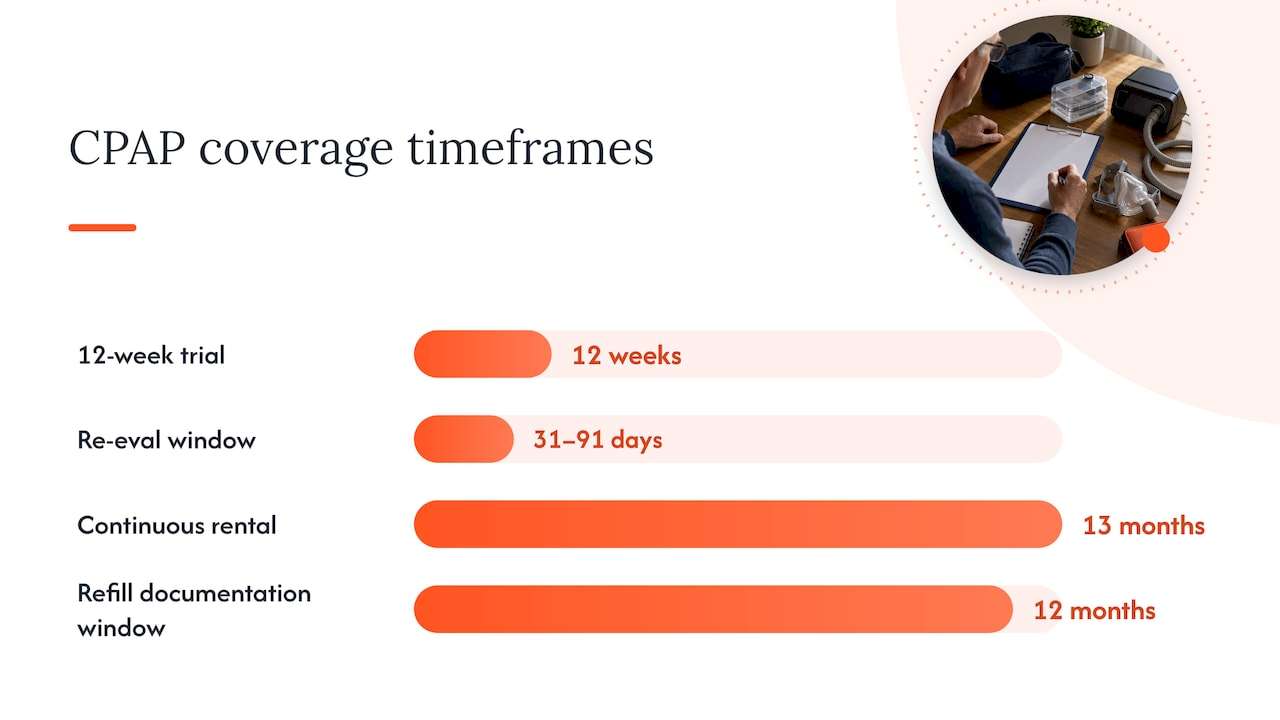
Medicare does not simply approve CPAP once and leave it at that. It starts you on a 12-week trial during which your clinician is expected to document that the device is actually helping, meaning your symptoms are improving and you are using it consistently.
- During the trial, your supplier bills Medicare for the device and accessories, and your prescribing clinician tracks your response.
- Medicare pays for CPAP through continuous rental for 13 months, after which the machine becomes yours.
- Between day 31 and day 91 of the trial, you need an in-person visit with your treating practitioner who documents that the therapy is working and that you are adhering to it, usually based on data pulled from the machine itself.
- If that re-evaluation does not happen, or if the documentation is thin, Medicare can stop paying for the rental before the 13 months are up.
Supplies like masks, tubing, and filters are replaced on a schedule, and a 2025 CMS transmittal clarified that suppliers need documentation from your treating practitioner within the preceding 12 months to bill for accessory refills on a beneficiary-owned machine. If your supplier doesn’t accept Medicare assignment, you could end up paying the full cost upfront and waiting on reimbursement.
Pro Tip: Put your day 31 re-evaluation on the calendar the same week you start the CPAP trial, so it doesn’t slip past day 91.
Oral appliances and dental limitations: when Medicare will and won’t pay
Original Medicare generally excludes routine dental care, including most dentures and standard oral devices, which surprises a lot of beneficiaries who assume a mouth guard-style device is an easy alternative to CPAP. The Medicare & You handbook confirms that most routine dental services fall outside Original Medicare coverage.
There is a narrow path, though. An oral appliance for obstructive sleep apnea can be covered as durable medical equipment when it is:
- Ordered by your treating physician as medically necessary, not requested by a dentist on your own initiative.
- Supported by sleep study results showing a qualifying AHI or RDI.
- Billed through a Medicare-enrolled DME supplier rather than a dental office alone.
Oral appliance therapy can work well for people who cannot tolerate CPAP, but getting it covered means looping in your physician, a sleep specialist, and a DME supplier together before you buy anything.
Hypoglossal nerve stimulation (Inspire): eligibility, criteria, and exclusions
For people who have tried CPAP and genuinely cannot tolerate it, implanted upper airway stimulation is an option under Medicare, though the eligibility bar is specific. LCD L38387 lays out the requirements:
- Age eligibility criteria at the time of implant.
- A body mass index below a specified threshold.
- An AHI within a specified range, based on a qualifying sleep study.
- Documented failure or intolerance of CPAP therapy, not just a preference against it.
- Favorable findings on drug-induced sleep endoscopy showing the airway collapse pattern responds well to this type of stimulation.
Only FDA-approved devices meeting these LCD criteria are covered, and certain anatomical findings or prior airway surgeries can exclude a candidate entirely. If you think you might qualify, this is a conversation to have with an ear, nose, and throat specialist or sleep surgeon who already works with Medicare’s documentation requirements, since the paperwork trail matters as much as the clinical picture.
How to get Medicare to cover a test or treatment: a step-by-step checklist
Getting from symptoms to covered equipment involves a sequence of steps, and skipping one is usually what causes a denial later.
- Get evaluated and get an order. Your treating practitioner documents your symptoms and writes an order for the specific sleep test type that fits your situation, attended or home-based.
- Confirm the test meets Medicare’s standards. The report needs to clearly state your AHI or RDI and, if it falls in the 5 to 14 range, document the symptoms or comorbidities that justify treatment.
- Schedule the CPAP re-evaluation early. Book the in-person follow-up for somewhere between day 31 and day 91 of your trial, and ask your clinician to pull adherence data from the device.
- Verify your supplier before equipment ships. Confirm the DME supplier is enrolled in Medicare and accepts assignment, so you’re not billed more than the Medicare-approved amount.
Pro Tip: Keep a simple folder, paper or digital, with your test report, physician order, and re-evaluation notes. You will need all three if a claim is ever questioned.
Costs, coinsurance, and how your plan type changes what you pay
Once your sleep test or CPAP equipment is approved, Medicare Part B picks up most of the bill, but not all of it. After you meet the Part B deductible, you generally pay 20% of the Medicare-approved amount for covered sleep tests and durable medical equipment, as long as your supplier accepts assignment.
- CPAP is paid through rental for 13 continuous months, after which you own the machine outright.
- A supplier who does not accept assignment can charge more than the Medicare-approved amount, raising your upfront cost before any reimbursement.
- A Medigap policy can cover that 20% coinsurance, leaving you with little to no out-of-pocket cost for covered services.
- A Medicare Advantage plan has to cover what Original Medicare covers, but often adds prior authorization steps or network restrictions, so check your plan’s Evidence of Coverage before scheduling a test or ordering equipment.
Common reasons Medicare stops covering a device and how to avoid problems
Coverage usually lapses for administrative reasons rather than clinical ones. The most frequent culprits are a missed in-person re-evaluation, thin documentation of medical necessity, missing adherence data from the CPAP device, the wrong test type ordered for your situation, and supplier billing errors.
- Request copies of every order and test report as soon as they’re issued.
- Confirm in writing that your re-evaluation visit happened and was documented.
- Keep a simple log of nightly CPAP use if your device doesn’t track it automatically.
- Verify your supplier’s Medicare participation before equipment arrives, not after.
If a claim is denied, request your medical records, file an appeal with Medicare within the stated deadline, and reach out to your plan or a local State Health Insurance Assistance Program counselor for free help working through the paperwork.
Pro Tip: A denial isn’t final. Most sleep apnea coverage denials get resolved once the missing documentation is submitted.
How Safeguard Benefit Services helps beneficiaries navigate coverage for sleep apnea
We help you make sense of plan rules before a coverage gap turns into an unpaid bill. We can assist you in confirming whether a supplier is in-network and Medicare-enrolled, and walk you through what Evidence of Coverage may require for sleep apnea testing and equipment. We provide resources that lay out your options in plain terms, and can point you toward next steps if a claim gets denied. If you want help sorting through your specific plan, scheduling a consultation is a practical next move.
Review your Medicare plan and supplier options with us
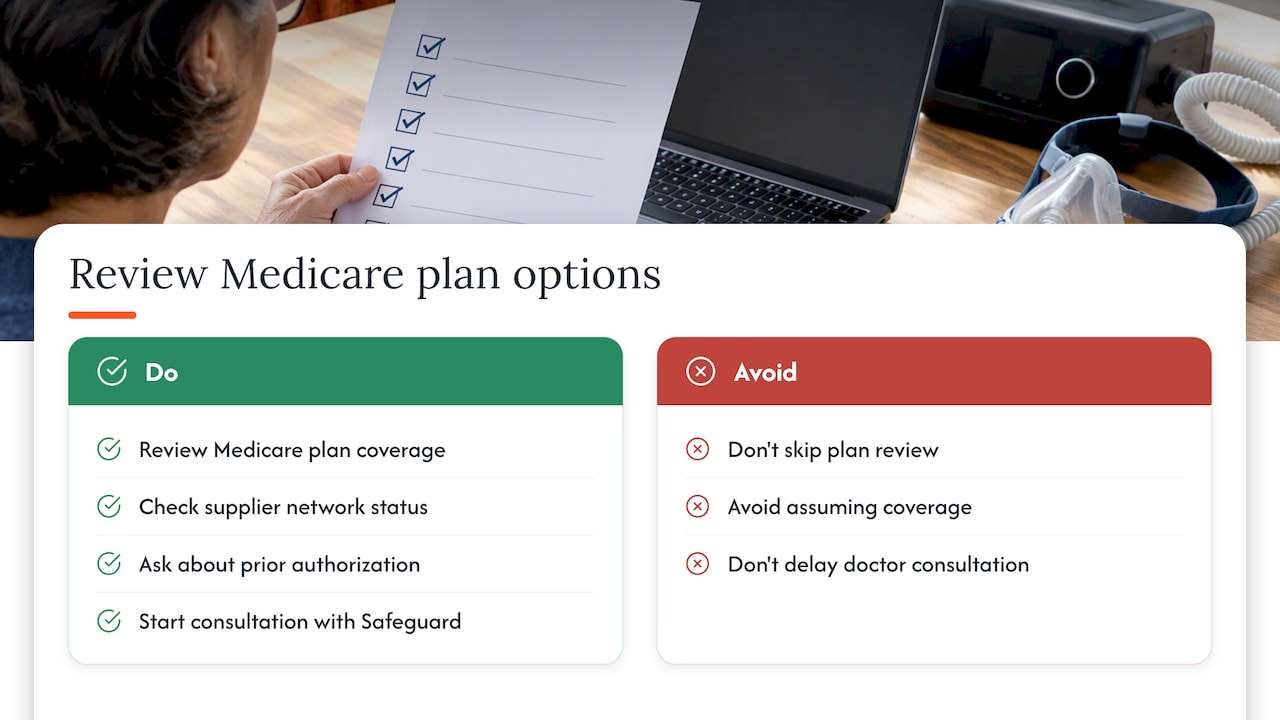
Plan reviews can check whether your current Medicare Advantage or Medigap coverage lines up with what your sleep apnea testing and equipment will actually require, including supplier network status and prior authorization rules. A short conversation can catch a coverage gap before it becomes a denied claim.

If you want a clear picture of your options before your next sleep study or CPAP renewal, start a consultation with Safeguard Benefit Services and get your questions answered directly.
This article is general information, not a substitute for advice from a qualified doctor. Consult a qualified healthcare professional about your own circumstances before acting on anything here.
FAQ
Does Medicare cover dental appliances for sleep apnea?
Original Medicare generally excludes routine dental devices, but an oral appliance for obstructive sleep apnea can be covered as durable medical equipment when your physician orders it as medically necessary and a Medicare-enrolled supplier bills it correctly. Coordination between your doctor, a sleep specialist, and the supplier is what makes this path work.
What is the average cost of sleep apnea surgery?
Costs vary widely depending on the procedure, the surgeon, and your location, and we don’t have a sourced figure to cite here. For Medicare beneficiaries, what matters most is whether the specific procedure, such as hypoglossal nerve stimulation, meets the coverage criteria under the applicable LCD, since that determines your out-of-pocket exposure.
What’s the average lifespan of a CPAP machine?
We don’t have a sourced figure for typical CPAP machine lifespan. What’s documented is that Medicare pays for CPAP through rental for 13 continuous months under the Medicare CPAP benefit, after which you own the device outright.
Does my Medicare plan cover sleep apnea the same way for everyone?
Original Medicare’s sleep apnea coverage rules apply nationally, but a Medicare Advantage plan must cover the same services while potentially adding its own prior authorization or network requirements. Checking your plan’s Evidence of Coverage is the only way to know your specific terms.
Sources
These are the official pages behind the coverage rules described in this guide, useful if you want to verify details directly with Medicare or share them with your doctor and supplier.
- Medicare
- CMS NCD — Continuous Positive Airway Pressure (CPAP) Therapy For Obstructive Sleep Apnea (OSA) (240.4)
Recommended
Request a No Obligation Phone Call








Get Connected