

Yes, Medicare still covers most telehealth services, and most of those flexibilities are extended through December 31, 2027. Behavioral and mental health telehealth exceptions are permanent and include audio-only visits when video isn’t available. Before your next virtual visit, ask your provider what you’ll owe and confirm they’re billing it correctly, since the codes and place-of-service rules matter more than most patients realize.
TL;DR:
- Most Medicare telehealth flexibilities are extended through December 31, 2027, but broader service access depends on future legislative action before that date.
- Permanent rules now allow behavioral and mental health telehealth services to be provided without geographic restrictions and include permanent audio-only options.
- Medicare covers a wide range of telehealth services from various practitioners, but private plans and Medicare Advantage may have different coverage and costs.
- Telehealth visits cost the same as in-person visits for beneficiaries, with a 20% coinsurance and specific billing codes for originating sites and service types.
- The current legal framework could revert in 2028 if Congress or CMS do not extend or make these flexibilities permanent.
Table of Contents
- What changed and what the rules say through 2027
- Which telehealth services and providers qualify right now
- What a telehealth visit actually costs you
- Audio-only visits and what’s permanent for behavioral health
- A readiness checklist for beneficiaries and providers
- How Medicare telehealth coverage looked before COVID-19
- How Medicare telehealth rules compare with Medicaid and private plans
- What telehealth has meant for access to care
- Where telehealth still falls short for patients and providers
- Who could use telehealth before the recent flexibilities
- A local perspective on navigating these changes
- Where to check these Medicare telehealth policies yourself
- Sources
- FAQ
What changed and what the rules say through 2027
Congress extended most temporary Medicare telehealth flexibilities through December 31, 2027, giving beneficiaries continued access to covered telehealth services from home and other locations across the country. That extension matters because, without it, many of the geographic and site restrictions that existed before the COVID-19 pandemic would have snapped back into place.
Not everything is temporary, though. A handful of changes are now permanent, separate from the 2027 deadline:
- Behavioral and mental health telehealth services keep their permanent removal of geographic and originating-site restrictions, so patients anywhere can get covered mental health care by video or phone.
- Certain supervision flexibilities for auxiliary staff have also been made permanent under recent rulemaking.
- Everything else, including most medical and specialty telehealth visits, rides on the 2027 extension rather than a permanent fix.
That last point is the one to watch. If Congress or the Centers for Medicare & Medicaid Services don’t act again before the deadline, the broader flexibilities revert, and many services would again require patients to be in a rural area or a clinical facility rather than at home. Providers and patients who built workflows around home-based virtual care would need to adjust quickly.
Which telehealth services and providers qualify right now
Medicare maintains a list of covered telehealth services that CMS updates annually through the Physician Fee Schedule. For CY 2026, CMS finalized additions to that list along with rules for how new services get added going forward, a process the agency has streamlined to respond faster to clinical needs, according to its CY 2026 fee schedule summary.
Coverage isn’t limited to physicians. A range of practitioner types can bill as distant-site providers under current rules:
- Physicians and many nonphysician practitioners, including nurse practitioners and physician assistants, can deliver and bill for telehealth visits.
- Federally Qualified Health Centers and Rural Health Clinics can serve as distant-site providers, not just originating sites, under the extended flexibilities.
- Licensed clinical social workers, psychologists, and other behavioral health specialists retain full telehealth billing rights given the permanent behavioral health exceptions.
If you’re on Original Medicare, these federal rules apply directly. If you have a Medicare Advantage plan, the picture can look different since private plans set their own telehealth benefit details, sometimes offering broader virtual care networks or different cost sharing. Check your plan’s Summary of Benefits before assuming a service is covered the same way it would be under Original Medicare.
What a telehealth visit actually costs you
For most telehealth visits under Original Medicare Part B, you pay 20% coinsurance after meeting your annual Part B deductible, the same cost-sharing structure that applies to in-person visits. Telehealth isn’t a discounted alternative, it’s billed at parity with an office visit for most covered services.
One figure worth knowing: the Q3014 originating site facility fee is set at the published Medicare amount for CY 2026, the payment a facility receives for hosting a patient during a telehealth visit with a distant-site provider.
Billing staff handling telehealth claims should keep a few specifics straight:
- Use place-of-service code 02 when the patient is not located in their home for the telehealth visit.
- Use place-of-service code 10 when the visit happens with the patient at home, which pays at the nonfacility rate rather than the facility rate.
- Bill HCPCS code Q3014 separately when your site serves as the originating location and the patient is not at home.
- Apply the correct modifier for the service type and confirm your Medicare Administrative Contractor’s specific submission requirements before filing.
Getting the place-of-service code wrong is one of the most common reasons telehealth claims get kicked back, so it’s worth double-checking before submission rather than after a denial. For a deeper look at how Part B deductibles and coinsurance work across services, see our guide to Part B coverage.
Audio-only visits and what’s permanent for behavioral health
Phone-only visits aren’t a gray area anymore, at least not for behavioral health. CMS guidance confirms that behavioral and mental health telehealth services have permanent audio-only allowances when video isn’t available or the patient hasn’t consented to it, alongside the permanent removal of geographic restrictions for that category of care.
For nonbehavioral services, audio-only remains available through the December 31, 2027 extension, but only when the specific service is on the Medicare telehealth list and a clinician judges that an audio-only format is clinically appropriate for that visit.
- Behavioral health audio-only visits: permanent, no geographic restriction, available nationwide.
- Nonbehavioral audio-only visits: allowed through 2027 when clinically appropriate and the service is on the covered list.
- Documentation should note why video wasn’t used and confirm the patient understood and agreed to an audio-only format.
Our guide to Medicare mental health coverage breaks down which behavioral health services qualify and how billing differs from standard telehealth visits.
Pro Tip: Keep a short documentation template on hand for audio-only visits that captures the clinical reason and patient consent in one line, it saves time and reduces claim disputes later.
A readiness checklist for beneficiaries and providers
Whether you’re the patient or the one submitting the claim, a few concrete steps now prevent headaches later.
- Beneficiaries should confirm with their provider’s office that the specific service is covered by telehealth and ask for an estimated out-of-pocket cost before the appointment.
- Medicare Advantage members should check their plan’s Summary of Benefits, since telehealth cost sharing and network rules can differ from Original Medicare.
- Providers should verify the service appears on the current Medicare telehealth list before scheduling a virtual visit rather than after.
- Billing staff should update place-of-service codes, modifiers, and Q3014 billing practices to reflect the CY 2026 Physician Fee Schedule changes.
- Practices should document the clinical rationale for any audio-only visit at the time of the encounter, not retroactively.
- Everyone involved should watch for CMS and congressional updates as the December 31, 2027 deadline approaches, since another extension isn’t guaranteed.
Building these habits now, rather than scrambling later, is the difference between a smooth claim and a rejected one.
How Medicare telehealth coverage looked before COVID-19
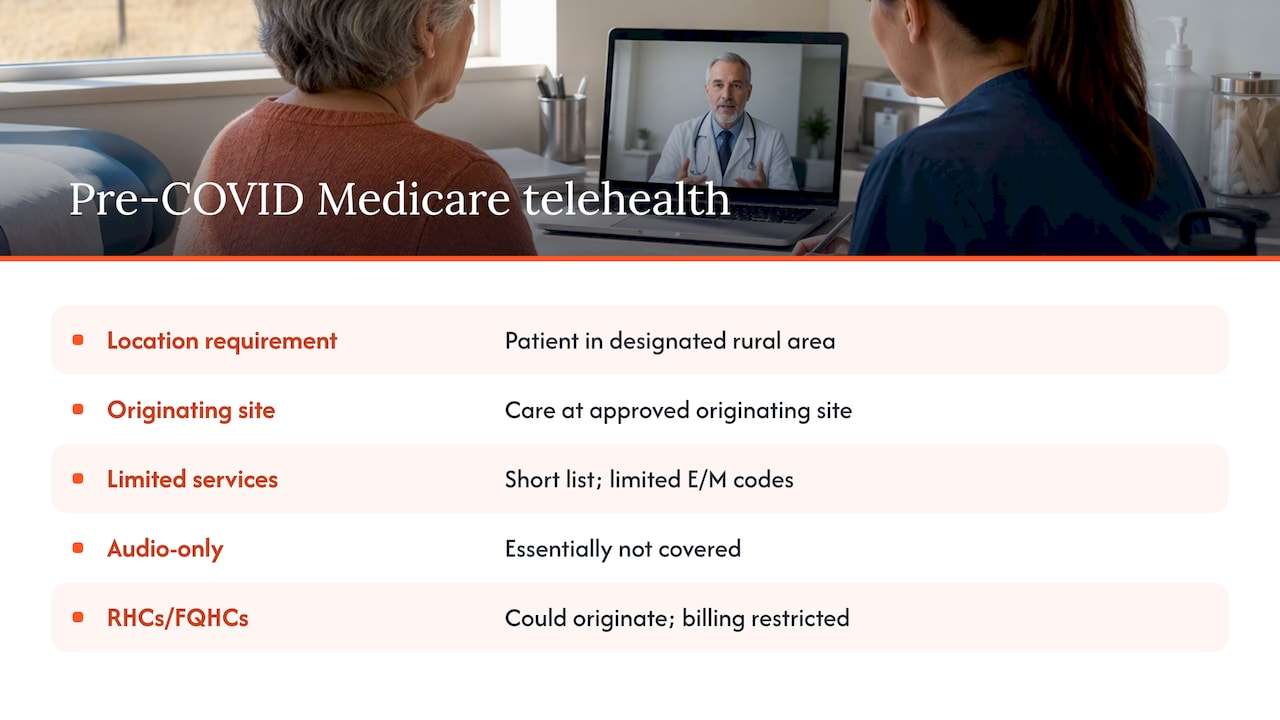
Before the pandemic, Medicare telehealth coverage was narrow by design. Beneficiaries generally had to live in a designated rural area and travel to an approved originating site, such as a doctor’s office, hospital, or rural health clinic, to receive a covered telehealth visit. Receiving a virtual visit from home was not an option for the vast majority of beneficiaries.
The list of covered services was also much shorter, and originating sites received a facility fee while distant-site providers billed for a limited set of evaluation and management codes. Audio-only visits were essentially not covered outside of a narrow set of exceptions. Rural Health Clinics and Federally Qualified Health Centers could serve as originating sites but faced restrictions on billing as distant-site providers themselves.
The COVID-19 public health emergency changed that picture almost overnight, when CMS and Congress temporarily waived the geographic and site restrictions to keep patients out of waiting rooms and let providers keep treating them remotely. That emergency response became the template for the extensions that followed, including the current one running through 2027. Understanding that history matters because it shows how much of today’s flexibility is still built on temporary waivers rather than a permanent rewrite of the underlying law, which is exactly why the 2028 cliff is a real possibility rather than a hypothetical.
How Medicare telehealth rules compare with Medicaid and private plans
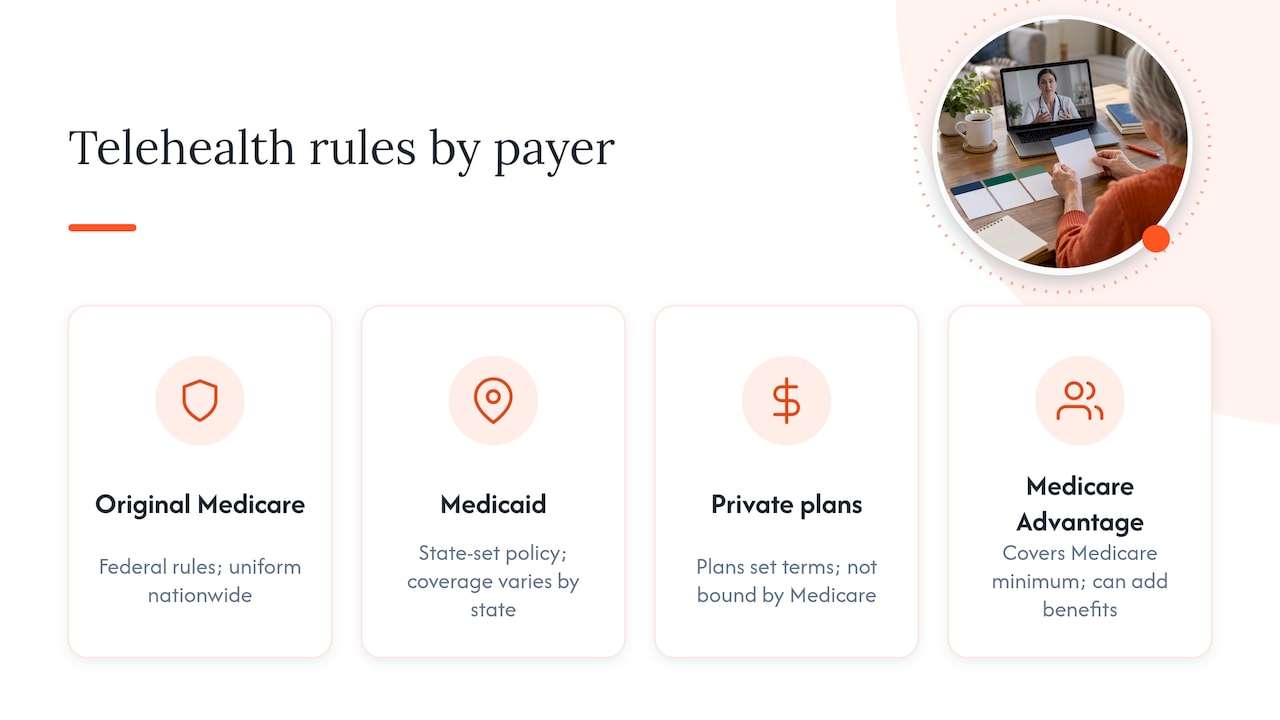
Medicare’s telehealth rules are federal and apply uniformly across the country, but that’s not true everywhere else. Medicaid telehealth policy is set largely at the state level, so coverage, reimbursement rates, and which services qualify can vary significantly from one state to another. A service covered by telehealth in North Carolina’s Medicaid program may be handled differently in a neighboring state.
Private insurers, including employer-sponsored plans, generally set their own telehealth coverage terms and are not bound by the Medicare telehealth list or the December 31, 2027 deadline. Some private plans have covered virtual visits more broadly, and for longer, than Medicare’s temporary flexibilities allowed, while others impose their own network restrictions or copay structures unrelated to Medicare rules.
Medicare Advantage plans sit in an interesting middle ground: they must cover at least what Original Medicare covers, but they can offer additional telehealth benefits, different provider networks, or lower cost sharing as a plan feature. That’s part of why comparing Advantage plans matters if telehealth access is a priority, since two plans available in the same county can differ meaningfully in what virtual care looks like day to day. Beneficiaries weighing that decision often find it useful to see how Medicare Advantage plans are structured before enrolling.
What telehealth has meant for access to care
Telehealth’s biggest impact on Medicare beneficiaries has been access, particularly for people who face transportation barriers, live far from specialists, or manage chronic conditions that make frequent office visits burdensome. A virtual visit removes the need for a caregiver to drive a patient across town or take time off work, which matters for people managing conditions like diabetes or heart disease that require regular check-ins.
Behavioral health is where the effect has been most visible, since the permanent removal of geographic restrictions means beneficiaries in areas with few in-person mental health providers can still connect with a therapist or psychiatrist by video or phone. That permanence reflects a policy judgment that access to mental health care shouldn’t depend on where a patient happens to live.
Telehealth use overall has settled well above pre-pandemic levels, and policy trackers have noted that pattern even as extensions have remained temporary rather than permanent. That gap between sustained demand and time-limited authorization is part of what’s driving the current push for a longer-term legislative fix before the 2027 deadline arrives.
Where telehealth still falls short for patients and providers
Telehealth isn’t a complete substitute for in-person care, and both patients and providers run into real limits under current Medicare policy. Some conditions simply require a physical exam, imaging, or lab work that can’t happen over a screen, so virtual visits work best as a complement to in-person care rather than a replacement for it.
Technology access is another persistent barrier. Beneficiaries without reliable internet, a smartphone, or the comfort level to navigate video software can find themselves shut out of the video option, which is part of why audio-only allowances matter so much for older adults. Rural broadband gaps compound this problem even as geographic restrictions on where a patient can receive care have loosened.
For providers, the billing complexity itself is a burden. Keeping place-of-service codes, modifiers, and the annually updated telehealth services list straight requires ongoing staff training, and a coding mistake can mean a denied claim or a compliance headache. The temporary nature of most flexibilities adds another layer of uncertainty, since practices investing in telehealth infrastructure are doing so without a guarantee those investments will keep paying off past 2027.
Who could use telehealth before the recent flexibilities
Understanding today’s rules is easier with the old eligibility criteria as a reference point. Before recent flexibilities took hold, a Medicare beneficiary generally needed to meet several conditions to have a telehealth visit covered at all. They had to be located in a rural Health Professional Shortage Area or outside a Metropolitan Statistical Area at the time of the visit, a geographic test that excluded most urban and suburban beneficiaries entirely.
On top of the geographic test, the patient typically had to travel to an approved originating site, such as a physician’s office, hospital, critical access hospital, rural health clinic, or Federally Qualified Health Center, rather than receiving the visit at home. The originating site received a separate facility fee for hosting the visit, and only a limited list of CPT and HCPCS codes qualified for distant-site billing.
These restrictions meant that, for the average Medicare beneficiary living in a city or suburb, telehealth simply wasn’t an option before 2020. The temporary waivers issued during the COVID-19 public health emergency removed the geographic and originating-site tests for the duration of the emergency, and the extensions passed since then, including the current one through December 31, 2027, have kept most of that broader access in place for beneficiaries regardless of where they live.
A local perspective on navigating these changes
Some local agencies spend a lot of time helping Charlotte-area Medicare beneficiaries make sense of policy shifts like this one, especially when it comes to how Medicare Advantage plans handle telehealth differently than Original Medicare. Our free Medicare eligibility calculator is a good starting point if you’re trying to figure out your enrollment timing alongside these coverage questions.
If you’re comparing plans and want to know how telehealth benefits, costs, and networks differ between Medicare Advantage and Medigap options, annual plan reviews can help clarify these questions. Personalized consultations are often available, providing guidance to better understand how these federal changes apply to your coverage.
— Zach
Where to check these Medicare telehealth policies yourself
For the latest on telehealth policy status, HHS maintains an updated policy tracker that reflects the current extension through 2027. CMS’s CY 2026 Physician Fee Schedule summary covers billing and coding changes in detail, while its February 2026 telehealth FAQ addresses behavioral health exceptions and audio-only rules directly.
Providers managing billing across specialties, including clinical practices with their own telehealth documentation needs such as medical marijuana telehealth renewal rules, should build a habit of checking these sources quarterly. Recheck these pages after December 31, 2027, since coverage terms could change if Congress or CMS don’t act before then.
This article is general information, not a substitute for advice from a qualified doctor. Consult a qualified healthcare professional about your own circumstances before acting on anything here.
Sources
- HHS Telehealth policy updates
- Medicare
- MM14315 – Medicare Physician Fee Schedule Final Rule Summary: CY 2026
FAQ
Will Medicare extend telehealth flexibilities again in 2026?
Congress already extended most Medicare telehealth flexibilities through December 31, 2027, so no additional action was needed in 2026 to keep current coverage in place. Whether another extension happens before the 2027 deadline depends on future legislation, which isn’t guaranteed.
Does Medicare still allow telehealth visits today?
Yes, Medicare covers a wide range of telehealth services today, with most flexibilities extended through December 31, 2027. Behavioral and mental health telehealth exceptions, including audio-only visits, are permanent regardless of that deadline.
Did Congress pass a Medicare telehealth extension?
Yes, Congress passed legislation extending most temporary Medicare telehealth flexibilities through December 31, 2027, preventing the geographic and originating-site restrictions from reverting. Some provisions, like behavioral health exceptions, were made permanent separately from that extension.
What is the current CMS position on telehealth visits?
CMS’s most recent guidance confirms that behavioral health telehealth services have permanent geographic and originating-site exceptions, with audio-only allowed when video isn’t available or consented to, according to its February 2026 telehealth FAQ. For most other services, CMS follows the extension through 2027 while continuing to update the covered telehealth list annually through the Physician Fee Schedule.
What happens to Medicare telehealth coverage in 2028?
If Congress or CMS don’t act before the December 31, 2027 deadline, most temporary telehealth flexibilities are set to expire, which would reinstate geographic and originating-site restrictions for many services. Permanent provisions, including behavioral health exceptions and audio-only allowances for mental health care, would remain in place regardless of what happens in 2028.
Recommended
Request a No Obligation Phone Call








Get Connected