

Cancer insurance pays benefits only if you are diagnosed with cancer. Critical illness insurance pays a benefit, usually a lump sum, if you are diagnosed with any condition on its list, which typically includes cancer, heart attack and stroke. Both are “specified disease” policies, and neither replaces health insurance. If you are on Medicare, or about to be, the more useful question is usually whether your main coverage already closes the gaps these policies try to fill.
This guide explains how the two policies differ, where each one falls short, and how to decide. We are a Medicare agency in Charlotte, North Carolina, so we also cover what changes once you have Original Medicare, a Medicare Supplement or a Medicare Advantage plan.
TL;DR
- Cancer insurance covers one disease. Critical illness insurance covers a list of diseases, so it is broader but still limited to what the policy names.
- Neither is a substitute for major medical coverage. The National Association of Insurance Commissioners (NAIC) says to secure comprehensive coverage first and treat these policies as an optional supplement.
- Many cancer policies lean on hospital stays, while much cancer care is now outpatient, so read exactly what triggers a payout.
- If you have Medicare, the first step is making sure your core plan, such as a Medigap policy, handles deductibles and coinsurance. Then decide whether a supplement adds anything.
- Pre-existing conditions are excluded. Buying after a diagnosis is not an option.
Table of Contents
- How the two policies work
- Side-by-side comparison
- Where each one falls short
- Why people buy them anyway: financial toxicity
- What changes when you have Medicare
- How to decide: six questions
- Our perspective
- Getting help in Charlotte
- Costs these policies rarely cover
- FAQ
- Sources
How the two policies work
The NAIC describes cancer insurance as a policy that provides benefits only if you get cancer, and notes that no policy covers cancer diagnosed before you applied. It lists heart attack and stroke policies as other examples of specified-disease coverage. Critical illness insurance sits in the same family, just with a wider list.
Cancer insurance
A cancer policy is built around one diagnosis. Depending on the product, it may pay:
- a lump sum when cancer is first diagnosed,
- fixed daily or per-event amounts for hospital stays, treatments or surgery,
- or reimbursement of certain listed expenses.
The details vary a great deal from one policy to the next. That is the first thing to understand: “cancer insurance” is a category, not a standard product, and two policies with the same label can pay very differently.
Critical illness insurance
A critical illness policy pays a benefit when you are diagnosed with a covered condition. Typical lists include cancer, heart attack and stroke, and some also name procedures such as bypass surgery or angioplasty. The payout is generally a lump sum that you can spend on anything: medical bills, mortgage payments, groceries, or the income you lose while you recover. Some policies reduce or exclude early-stage cancers and some skin cancers, so the definition of “cancer” inside the contract matters.
The lump sum is the main appeal. It is flexible, and it is not tied to a particular bill.
Side-by-side comparison
| Feature | Cancer insurance | Critical illness insurance |
|---|---|---|
| Conditions covered | Cancer only | A listed set, such as cancer, heart attack, stroke |
| Typical payout | Lump sum, fixed per-event amounts, or both, depending on the policy | Usually a lump sum |
| Tied to actual bills? | Often not, though some policies reimburse specific costs | Usually not |
| Pre-existing conditions | Excluded | Excluded |
| Main weakness | Narrow, and some policies focus on hospital stays | Only pays for what the list names, and definitions can be strict |
| Replaces major medical? | No | No |
Treat this table as a starting point. Your own policy document, not a category description, decides what is paid.
Where each one falls short
Hospital-centered payouts
The NAIC warns that many cancer policies focus heavily on hospital stays. Modern treatment often happens outside the hospital: chemotherapy and radiation are commonly given in outpatient settings. A policy that pays mainly when you are admitted may do little for the most frequent and costly parts of care. Before you buy, ask what happens on a day you receive treatment without being admitted.
Costs the policies do not touch
Cancer-specific policies generally do not cover non-medical costs such as transportation to the clinic, home care help or rehabilitation, according to the same NAIC guide. A flexible lump sum from a critical illness policy can cover those, which is a real advantage. A policy that only reimburses medical items cannot.
No double payment
A common assumption is that two policies mean two payouts for the same bill. The NAIC points out that coordination of benefits clauses in many insurance plans prevent that, so duplicate coverage can be redundant and expensive. Fixed-benefit policies that pay cash regardless of your bills work differently from reimbursement plans, so ask which kind you are looking at.
Only a slice of spending
The NAIC notes that cancer treatment accounts for roughly 10% of total U.S. health expenses, and that specified-disease policies address only a fraction of overall health costs. Someone buying a cancer policy to feel “covered” is still exposed to every other illness and injury.
Why people buy them anyway: financial toxicity
The worry behind these products is real. The National Cancer Institute defines financial toxicity as the problems a patient has related to the cost of medical care, and reports that people with cancer and survivors are more likely to experience it than people without cancer. A review of the research puts it at about half of people with cancer facing personal economic burdens from the disease and its treatment.
The Cancer Trends Progress Report from the NCI describes how higher deductibles and coinsurance shift more cost to patients, which is why even insured people struggle with the price of specialized therapies. The point for your decision: the exposure comes mostly from cost sharing in your main plan. The cleanest fix is a main plan with predictable cost sharing, and a supplement second.
It is also worth knowing that many cancer centers now offer help that no policy provides. NCI reports that financial navigation programs can reduce the cost of care and improve quality of life. These navigators help patients apply for assistance, understand bills and work through coverage. If you or a family member is diagnosed, ask the cancer center’s billing or social work office whether one is available.
What changes when you have Medicare
This is the part most generic comparisons skip. Medicare is a major medical program, and the right comparison for a 65-year-old is not “cancer policy or critical illness policy.” It is “what does my Medicare setup leave me paying, and is a supplement the best way to cover it?”
What Original Medicare covers and what you still pay
Medicare publishes a booklet on coverage of cancer treatment services. Part A covers inpatient hospital stays, including cancer treatments you get as an inpatient, and Part B covers outpatient care. With Original Medicare you pay for services as you get them: Medicare pays part of the cost and you pay the rest.
That “rest” is the gap. CMS set the 2026 Part B deductible at $283, and after that, Part B generally leaves you responsible for coinsurance on covered services. Over a long course of outpatient treatment, coinsurance is what adds up.
Medigap closes the gaps directly
A Medicare Supplement (Medigap) policy is built for exactly this problem. Per the NAIC’s guidance, for seniors who have a comprehensive Medigap policy, a separate cancer policy is generally unnecessary, because Medigap is designed to cover the deductibles, coinsurance and copayments of Original Medicare. Medigap plans are also standardized by plan letter, so the benefits are identical across companies and only the price differs. We explain the mechanics in our Medigap guide and show the plan letters side by side in our Medicare Supplement plan comparison.
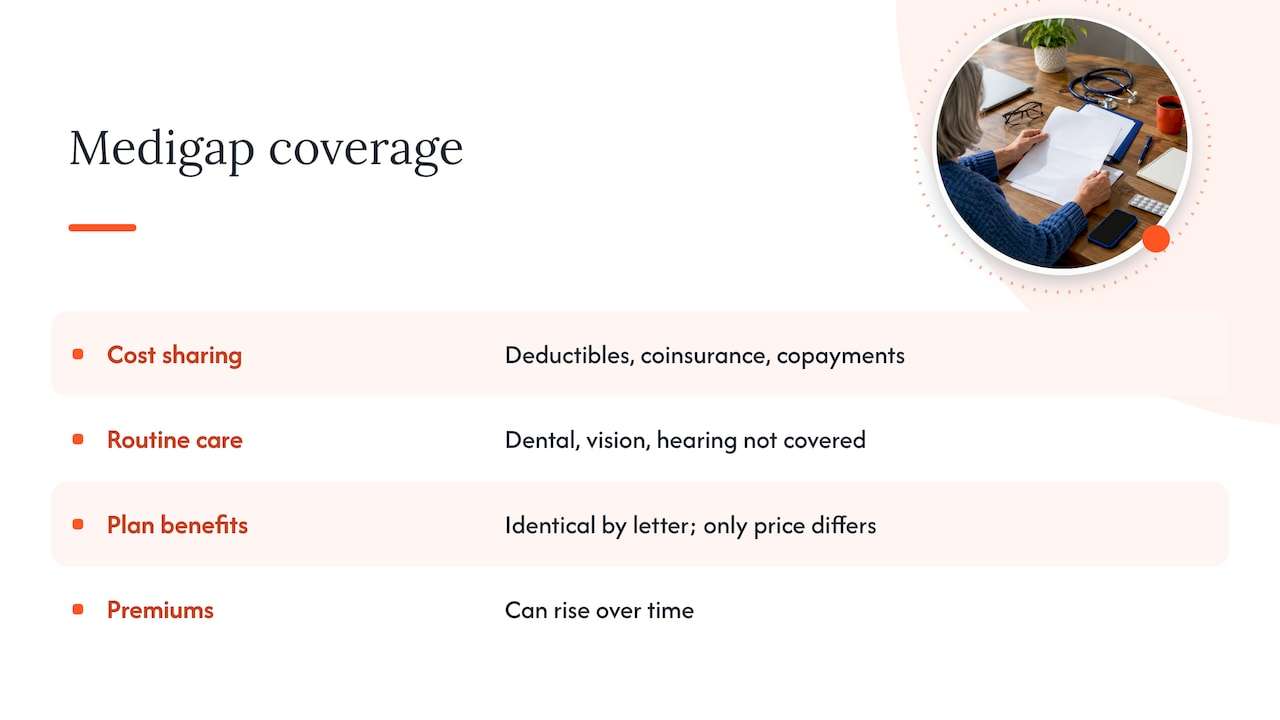
Two cautions. Medigap does not cover everything Medicare does not, such as routine dental, vision and hearing, and Medigap premiums can rise over time, which we cover in our article on Medigap rate increases.
If you choose Medicare Advantage
Medicare Advantage replaces Original Medicare with a private plan that has its own network, copays and coinsurance. Because cost sharing varies by plan, the question for you is what your plan charges for chemotherapy, radiation, specialist visits and drugs, and what its yearly out-of-pocket limit is. Our pages on Medicare Advantage versus Medicare Supplement and on Original Medicare versus Advantage walk through the tradeoffs. Check the plan’s Evidence of Coverage for the real numbers before you lean on a cancer policy to fill a hole you have not measured.
Where a fixed-benefit policy can still make sense
Cash-benefit policies do one thing Medigap and Advantage do not: they pay you directly, in cash, which you can use for costs that insurance never covers. Those include travel to a treatment center, lodging, help at home and lost household income. If you have already secured solid core coverage and have room in your budget, a supplement can be a reasonable add-on. The alternative we most often discuss is hospital indemnity insurance, which pays fixed cash amounts for covered hospital stays. We compare it with Medigap in this guide to hospital indemnity versus Medigap.
How to decide: six questions
- Do I already have comprehensive coverage? If not, fix that first. This is the NAIC’s advice, and ours.
- What would a serious diagnosis cost me under my current plan? Add up deductibles, coinsurance and the out-of-pocket maximum, if your plan has one.
- What does the policy actually pay for? Ask for the outline of coverage. Look for hospital-only triggers, waiting periods, and the definition of cancer (invasive only, or early-stage too).
- Is the benefit a lump sum or reimbursement? A lump sum is flexible. Reimbursement may overlap with insurance you already have.
- Can I keep paying the premium? Check whether the premium can increase and whether benefits reduce with age. A policy you drop after three years protects nothing.
- Is the money better spent elsewhere? A stronger Medigap letter, a Part D plan that fits your prescriptions, or dental coverage may protect you more per dollar than a narrow policy.
A word about timing. Specified-disease coverage is underwritten on your health history, and the NAIC is clear that cancer diagnosed before you apply is not covered. If you are considering it, apply while you are healthy, but only after your main coverage is settled.
Our perspective
We sell Medicare plans and supplemental products every day, so here is how we think about this question with clients in Charlotte.
We start with the foundation. When someone asks us about cancer insurance, we first ask what their Medicare coverage looks like, because the strongest protection against a large cancer bill is usually a well-chosen Medigap plan or a Medicare Advantage plan with cost sharing you can afford. Most people have not yet looked at their numbers, and the policy they were pitched on the phone sounds more urgent than it is.
We do not push a product to close a sale. Our agents go through a training program built around education, and we think that is the point: our guidance is meant to be unbiased and personal, and it costs you nothing extra. Sometimes the right answer is “you do not need this.” Sometimes it is a hospital indemnity plan or a supplemental policy that fits a specific gap. We would rather you understand the reason.
We also look at the plan again every year. Premiums, networks and drug lists change, and the coverage that fit last October may not fit this one.
— Zach
Getting help in Charlotte
If you are comparing these policies and want a second opinion, we can walk you through your Medicare options and show where real gaps exist. We help with Medicare Supplement plans, Medicare Advantage plans, prescription drug plans, dental, vision and hearing coverage, and supplemental products including cancer, life and hospital indemnity insurance. Start with our main page to request a consultation and a free Medicare roadmap that lays out your eligibility and options.
Costs these policies rarely cover
Whatever you choose, plan for the expenses that sit outside any policy’s list. Rides to treatment, parking, time off for a caregiver and home help add up, and the NAIC notes cancer-specific policies generally do not pay for transportation, home care or rehabilitation. Other health expenses also fall outside basic coverage. For example, if you are curious how insurers treat services like chiropractic care, this overview of insurance and chiropractic coverage shows how limited coverage can be for therapies people assume are included. The habit to build is simple: before you rely on any plan, ask what it does not pay for.
FAQ
Is cancer insurance the same as critical illness insurance?
No. Cancer insurance covers cancer only, while critical illness insurance pays for a list of conditions that typically includes cancer, heart attack and stroke. Both are specified-disease policies, and both pay only when the diagnosis matches the policy’s wording.
Is critical illness insurance better than cancer insurance?
It is broader, and a lump sum gives you flexibility, so many people find it more useful. Better depends on your risks, your budget and your core coverage. Compare the definitions of covered conditions, and confirm how early-stage cancers are treated.
Do I need cancer insurance if I have Medicare?
Usually not if you have a comprehensive Medigap plan, since that is designed to cover Original Medicare’s deductibles, coinsurance and copayments, per NAIC guidance. If you have Medicare Advantage, check your plan’s cost sharing and out-of-pocket limit first. A cash-benefit policy is an optional add-on, not a foundation.
Can I buy either policy after a diagnosis?
No. The NAIC states that no cancer policy covers cancer diagnosed before you applied. The same underwriting logic applies to critical illness policies, so the time to consider them is while you are healthy.
What if I already have a cancer diagnosis and worry about bills?
Talk to the financial navigator, social worker or billing office at your cancer center, and call your plan about its out-of-pocket limit. If you need help reading your Medicare coverage, contact a licensed Medicare agent or your State Health Insurance Assistance Program.
Sources
- A Shopper’s Guide To Cancer Insurance, NAIC
- Financial Toxicity (Financial Distress) and Cancer Treatment, NCI
- Navigating financial toxicity in patients with cancer, PMC
- Financial Burden of Cancer Care, Cancer Trends Progress Report
- Financial Navigators Reduce the Cost of Cancer Care, NCI
- Medicare Coverage of Cancer Treatment Services, Medicare.gov
- Your coverage options, Medicare.gov
- 2026 Medicare Parts A & B Premiums and Deductibles, CMS
Recommended
Request a No Obligation Phone Call








Get Connected