

Yes, Medicare covers Cologuard. Part B pays for the at-home multi-target stool DNA test once every three years, and you pay nothing if your provider accepts assignment. The catch is in the details: your age, your risk level, your symptoms and what happens after the result all decide whether the bill stays at $0. Below is each rule in plain English, plus the one situation where a surprise 15% charge can still appear.
TL;DR
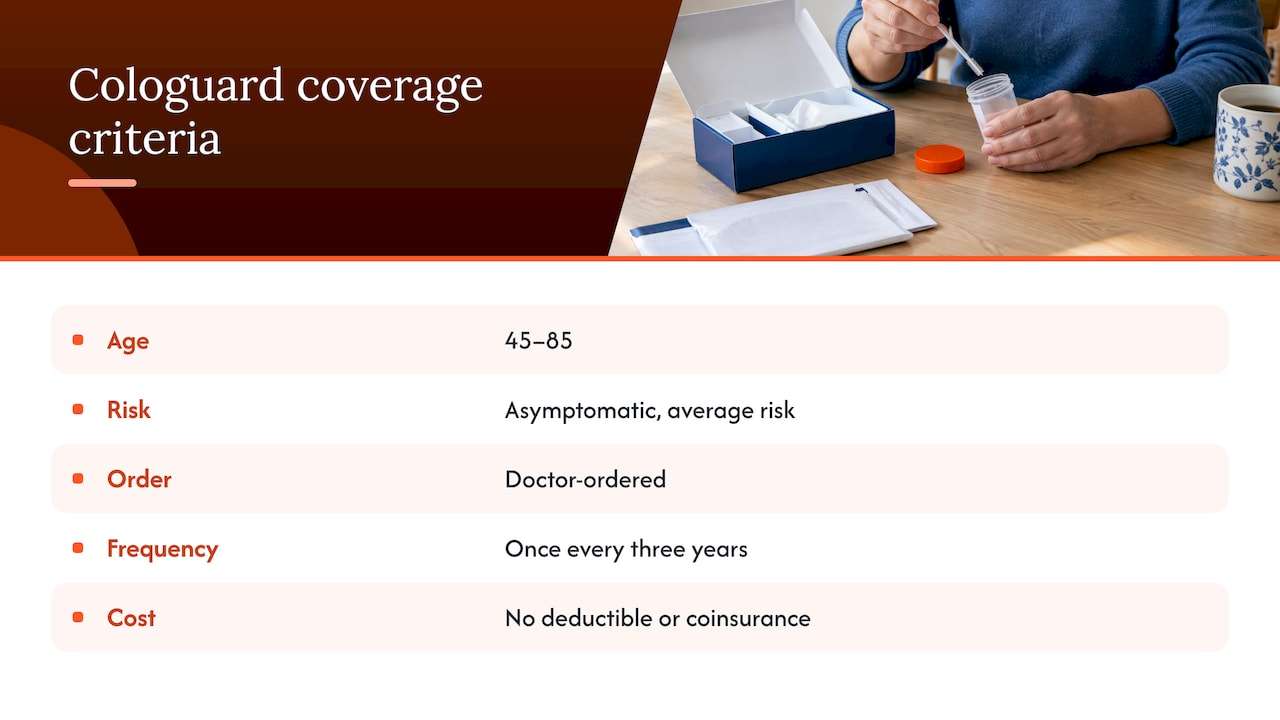
- Original Medicare (Part B) covers Cologuard once every 3 years if you are 45 to 85, have no symptoms and are at average risk for colorectal cancer.
- The test costs you $0 when your doctor or provider accepts assignment.
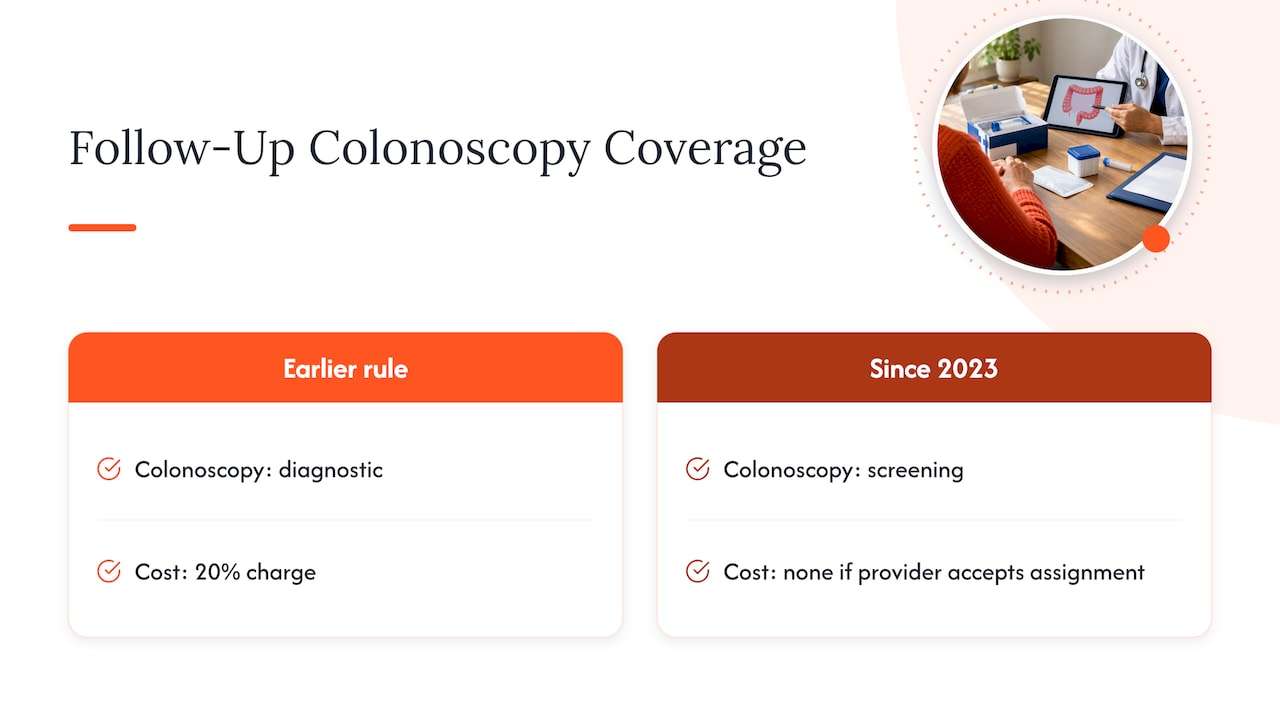
- If the result is positive, the follow-up colonoscopy is covered as a screening test with no cost-sharing, as long as the provider accepts assignment.
- If the doctor removes a polyp during that colonoscopy, you can owe 15% of the Medicare-approved amount.
- Medicare Advantage plans cover the same preventive screening, but network rules can apply, so confirm before you order.
Table of Contents
- What Medicare Part B covers for Cologuard
- Who qualifies: age, symptoms and risk
- How often Medicare pays
- What you pay: $0, with one condition
- Cologuard Plus
- If your Cologuard result is positive
- Original Medicare vs. Medicare Advantage
- How to get your Cologuard test covered, step by step
- Common mistakes that cost people money
- Our view: coverage is only half the question
- Get the right plan around your screenings
- FAQ
- Sources
What Medicare Part B covers for Cologuard
Cologuard is a multi-target stool DNA test. You collect a sample at home, mail it to the lab, and your doctor gets the result. Medicare treats it as a preventive colorectal cancer screening, not a diagnostic test. That distinction matters because preventive screening carries no deductible or coinsurance when the rules are met.
The coverage dates back to a 2014 CMS national coverage decision. CMS found the evidence sufficient to cover Cologuard for asymptomatic, average-risk beneficiaries. It also noted that the three-year interval came from the manufacturer’s suggestion. The current national coverage rule for colorectal cancer screening tests, NCD 210.3, lowered the minimum age from 50 to 45 starting January 1, 2023.
So the short version of the rule: one covered test every three years, ordered by your doctor, for a person who is in the right age range, symptom-free and at average risk.
Who qualifies: age, symptoms and risk
Medicare.gov and NCD 210.3 set three tests. You must meet all of them.
| Requirement | What Medicare looks for |
|---|---|
| Age | 45 to 85 |
| Symptoms | None of colorectal disease, such as lower abdominal pain, blood in the stool, or a positive guaiac fecal occult blood test or FIT |
| Risk | Average risk for colorectal cancer |
Source for the table: Medicare.gov and CMS NCD 210.3.
What “average risk” means
Medicare defines average risk by exclusion. You are not average risk if you have any of the following:
- A personal history of adenomatous polyps or colorectal cancer
- Inflammatory bowel disease, including Crohn’s disease or ulcerative colitis
- A family history of colorectal cancer or adenomatous polyps
- A family history of familial adenomatous polyposis or hereditary nonpolyposis colorectal cancer
If any of these applies to you, talk to your doctor about which screening test is right for your situation. Your doctor decides which test is appropriate for your history, and Medicare’s separate colonoscopy rules cover higher-risk patients.
Symptoms change the category
Cologuard is a screening test for people who feel fine. If you are having blood in your stool or new lower abdominal pain, tell your doctor. That is a medical conversation first, and a billing question second. A test ordered because of symptoms is diagnostic, and Medicare pays for it under different rules.
How often Medicare pays
Medicare covers the test once every three years. Do not schedule it early to “be safe”: a repeat inside the window is likely to be denied, and you could be billed the lab’s full charge. If you are unsure when you last had a stool test, ask your doctor’s office to check your records, or look at your Medicare Summary Notice for the date of the last claim. Our Medicare preventive services guide lists the other screenings with their own frequency limits, so you can plan the year as a whole.
What you pay: $0, with one condition
The condition is assignment. A provider who accepts assignment agrees to take the Medicare-approved amount as full payment. Medicare.gov states that you pay nothing for Cologuard when your provider accepts assignment. It also notes that what you could owe depends on other insurance you have, what the doctor charges, whether the doctor accepts assignment, the type of facility and where you get the service.
Two practical points follow.
- The Part B deductible does not stand in the way. The 2026 annual Part B deductible is $283, up from $257 in 2025, and the standard monthly premium is $202.90. Neither changes the $0 cost of a covered Cologuard test, but you do keep paying your premium.
- Ask before the kit ships. A quick call to the ordering office to confirm that they and the lab accept Medicare assignment takes two minutes and avoids a billing dispute later.
Cologuard Plus
The newer version of the test, Cologuard Plus, is also covered. According to CMS transmittal MM14031, coverage for it (HCPCS code 0464U) started October 3, 2024. The rules mirror the original test: ages 45 to 85, asymptomatic, average risk, once every three years. The same document waives the deductible and coinsurance for it. Claims need a screening diagnosis code, Z12.11 or Z12.12, which your doctor’s office handles.
You do not need to choose between the two versions on coverage grounds. Your doctor orders what is appropriate, and the three-year clock applies either way.
If your Cologuard result is positive
A positive result does not mean you have cancer. It means the test found abnormal DNA or blood in the stool, and a colonoscopy is the way to look directly. This is where many people worry about cost, and where the rules have improved.
Since January 1, 2023, Medicare treats the follow-up colonoscopy after a positive stool-based test as part of the same screening. Medicare.gov says Part B covers it as a screening test with no cost-sharing if the provider accepts assignment. Older articles, including some pages still ranking in search, describe the earlier rule, under which that colonoscopy counted as diagnostic and carried a 20% charge. That is no longer the rule for a complete screening.
The KX modifier
Behind the scenes, the colonoscopy claim has to be labeled correctly. Noridian, a Medicare contractor, explains that the provider applies the KX modifier so the colonoscopy is billed as a screening procedure after a positive non-invasive test. Without it, the claim can be processed as diagnostic or rejected. Your part is simple: when you schedule the colonoscopy, mention that it follows a positive Cologuard result and ask the office to confirm how it will be billed. A clinic that explains how follow-up colonoscopies are billed as part of complete colorectal cancer screening can give you a sense of what to expect from the paperwork side.
The 15% polyp exception
Here is the surprise to know about. If the doctor finds and removes a polyp or other tissue during the colonoscopy, Medicare.gov says you pay 15% of the Medicare-approved amount for the provider’s services. In a hospital outpatient department or ambulatory surgical center you also pay a 15% facility coinsurance. The Part B deductible does not apply.
This is not a billing error. Removing a polyp is a treatment step, and it changes the coinsurance. Because nobody can know in advance whether a polyp will be found, it is worth planning for. We cover the numbers in more detail in our guide to avoiding a 15% surprise on colonoscopy coverage.
Original Medicare vs. Medicare Advantage
If you have a Medicare Advantage plan (Part C), the plan must cover the preventive services Original Medicare covers, including colorectal cancer screening. The difference is how you reach them. Advantage plans typically use networks, so the ordering doctor, the lab and the facility for any follow-up colonoscopy may need to be in network. Your plan’s Evidence of Coverage document and the member services number on your card are the places to confirm.
This is one reason people compare plan types carefully before enrolling. Our guides on Medicare Advantage versus Medigap explain how network rules, premiums and cost-sharing differ. Medicare Supplement plans are designed to help with costs Original Medicare leaves to you, which is the category that matters if a polyp is removed and the 15% applies.
How to get your Cologuard test covered, step by step
- Confirm your eligibility. Check that you are 45 to 85, symptom-free and at average risk. If you are not sure about family history, ask relatives what they know before your appointment.
- Check the three-year window. Find the date of your last stool-based DNA test. Your doctor’s office or Medicare Summary Notice can tell you.
- Get a doctor’s order. Cologuard is ordered by your doctor or other health care provider. You cannot simply buy a Medicare-covered kit on your own.
- Confirm assignment. Ask whether the ordering provider accepts assignment. If you have a Medicare Advantage plan, also confirm that the provider and lab are in network.
- Collect and return the sample. Follow the kit directions and mail it back promptly.
- Plan for the result. A negative result means you wait for your next covered screening. A positive one leads to a follow-up colonoscopy, where you should ask how the claim will be coded and whether a polyp removal could bring the 15% coinsurance.
To understand how Part B fits in more broadly, our Part B guide walks through the premium, deductible and what the program covers.
Common mistakes that cost people money
- Testing too early. Repeating inside the three-year interval leads to a denial.
- Skipping the assignment question. The $0 cost depends on it.
- Ordering with symptoms. If you have symptoms, the test is no longer a screening, and your doctor will choose the right diagnostic path.
- Assuming every article is current. Pages written before 2023 still say 50 is the starting age and that the follow-up colonoscopy is diagnostic. Both have changed.
- Forgetting the network. On Medicare Advantage, an out-of-network lab or facility can create a bill that Original Medicare would not.
Our view: coverage is only half the question
Most people who call us about Cologuard already know the headline: Medicare covers it. What they actually want to know is whether the bill will stay at zero from the test through the colonoscopy.
The answer depends on your plan type, your doctor’s network and whether a polyp is found. That is why we treat preventive screening as part of choosing a plan, not an afterthought. Our agents go through a comprehensive training program, so the guidance you get is personalized and unbiased, at no extra cost to you.
If you are turning 65, or you are on a plan that no longer fits, we start with a free Medicare roadmap that lays out your eligibility and options. Then we review your plan every year, so changes in coverage rules, like the 2023 colonoscopy update, do not catch you off guard.
Zach
Get the right plan around your screenings
Safeguard Benefit Services is a Medicare insurance agency in Charlotte, North Carolina. We help with Medicare Advantage plans, Medicare Supplements, prescription drug plans, and dental, vision and hearing coverage, and we help you avoid enrollment penalties and coverage gaps. If you want to know how your plan treats screenings like Cologuard and follow-up colonoscopies, a personalized consultation and a free Medicare roadmap are a good place to start. See our Medicare plans and services to get started.

Not yet enrolled? Our Medicare eligibility guide for Charlotte explains when you qualify and how to avoid late penalties.
FAQ
Does Medicare cover Cologuard at age 45?
Yes, if you are enrolled in Medicare. CMS lowered the minimum age for the test from 50 to 45 effective January 1, 2023. Most people become eligible for Medicare at 65, but some qualify earlier through disability, and they can use the 45 to 85 range.
How often will Medicare pay for Cologuard?
Once every three years. The test must be ordered by your doctor, and you must be asymptomatic and at average risk for colorectal cancer. A repeat test inside that window is likely to be denied.
Will I owe anything if my Cologuard is positive?
The follow-up colonoscopy is covered as a screening test with no cost-sharing when the provider accepts assignment. If a polyp or other tissue is removed, you pay 15% of the Medicare-approved amount for the provider’s services. In a hospital outpatient setting or surgery center, you also pay a 15% facility coinsurance.
Does Medicare Advantage cover Cologuard?
Medicare Advantage plans must cover the same preventive screenings as Original Medicare. They may require you to use in-network providers, labs and facilities, so check your plan documents or call member services before the test is ordered.
Is Cologuard Plus covered too?
Yes. Medicare began covering Cologuard Plus for dates of service on or after October 3, 2024, with the same age, risk and three-year rules as the original test.
Sources
- Medicare.gov: Multi-target stool DNA tests (screening)
- Medicare.gov: Colonoscopies (screening)
- CMS: NCD Colorectal Cancer Screening Tests (210.3)
- CMS: NCA decision memo on stool DNA testing
- CMS: 2026 Medicare Parts A & B Premiums and Deductibles
- CMS: MM14031 Updates to Colorectal Cancer Screening
- Noridian Medicare: Colorectal Cancer Screening
- Macie Medical: Colorectal cancer screening
Recommended
Request a No Obligation Phone Call








Get Connected