

Your prescription drug coverage is likely creditable if it comes from a current employer, union, TRICARE, the VA, FEHB, or Indian Health Service, meaning it is expected to pay at least as much as standard Part D on average. The single most protective step is simple: keep every Notice of Creditable Coverage you receive and respond to any plan request for proof within the deadline given, since a gap of 63 or more consecutive days without creditable coverage can trigger a lasting penalty.
TL;DR:
- Discount cards, free clinic programs, and online drug discount sites do not qualify, so they cannot protect you from a Part D late enrollment penalty.
- The penalty uses a percentage of the national base beneficiary premium, multiplied by the number of full months you lacked creditable coverage.
- Plans may give you about 30 days to answer a gap notice; dated coverage notices, employer letters, and benefit summaries strengthen your response.
- Extra Help beneficiaries are exempt from the penalty, while current or prior Indian Health Service and Tribal coverage generally qualifies as creditable under 2026 guidance.
Table of Contents
- What Counts as Creditable Prescription Drug Coverage
- Why Creditable Coverage Matters for Your Part D Penalty Risk
- Notice of Creditable Coverage: Who Sends It, When, and What to Keep
- How to Prove You Had Creditable Coverage
- Key Dates and Windows That Affect Your Penalty Risk
- Your Action Checklist to Avoid a Part D Penalty
- How We Help With Creditable Coverage and Part D Enrollment
- A Note on Recordkeeping
- Get Help Documenting Your Coverage and Avoiding Penalties
- FAQ
- Sources
What Counts as Creditable Prescription Drug Coverage
Creditable coverage means a drug plan is expected to pay, on average, at least as much as the standard Medicare Part D benefit. The Centers for Medicare & Medicaid Services uses an actuarial equivalence test to decide this, comparing the overall value of a plan’s drug benefit to Part D’s standard design rather than looking at any single drug or cost.
Most people get creditable coverage through one of these sources:
- Current employer or union group health plans
- TRICARE for military retirees and their families
- Veterans Affairs (VA) prescription drug benefits
- Federal Employees Health Benefits Program (FEHB) plans
- Indian Health Service or Tribal health programs
Not everything qualifies. Discount drug cards, free clinic programs, and online drug discount websites do not meet the creditable coverage standard, even though they can lower out-of-pocket costs. Relying on one of these instead of enrolling in Part D when you need to will not protect you from a penalty.
Why Creditable Coverage Matters for Your Part D Penalty Risk
Losing creditable coverage for 63 or more consecutive days without replacing it can trigger the Part D late enrollment penalty, a cost that generally follows you for as long as you carry Part D coverage. Plans check for gaps using system-level eligibility queries, and when a potential gap shows up, they notify the beneficiary and request a response.
The penalty formula is based on a percentage of the national base beneficiary premium multiplied by the number of full months you went without creditable coverage, according to Medicare’s official Part D penalty publication. Because that base premium changes annually, the dollar amount tied to an existing penalty can shift slightly from year to year even when the number of uncovered months stays fixed.
Two groups get meaningful protection from this penalty. Beneficiaries who qualify for Extra Help, the low-income subsidy program, are exempt from the Part D late enrollment penalty entirely. And under CMS’s CY 2026 Chapter 4 update, current or prior Indian Health Service and Tribal coverage is generally treated as creditable, which gives added clarity and protection to beneficiaries in those programs.
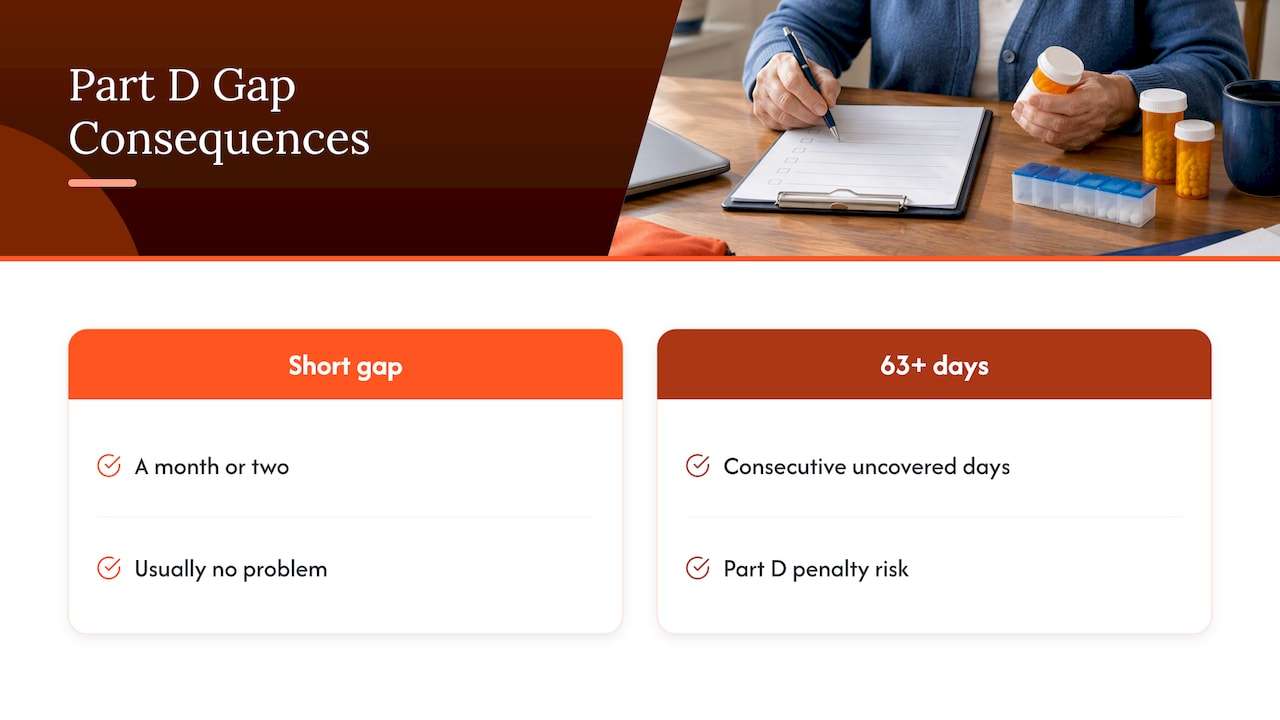
Understanding the 63-day rule matters because it is the trigger point. A short gap, even a month or two, usually will not cause a problem. It is the continuous stretch past 63 days that puts you at risk.
Notice of Creditable Coverage: Who Sends It, When, and What to Keep
Entities that offer prescription drug coverage, including employers, unions, and government programs, must send a written Notice of Creditable Coverage to Medicare-eligible enrollees once a year, generally by October 15, ahead of the Medicare Annual Enrollment Period. Notices also go out at other specific times:
- Before someone’s Medicare Initial Enrollment Period begins.
- Whenever the drug coverage terms change in a way that affects creditable status.
- Whenever a beneficiary requests one directly from the plan sponsor.
- Before an entity’s Medicare Part D application deadline each year.
A proper notice states whether the coverage is creditable, gives the effective date of that determination, and lists plan contact information. Keep a dated copy of every notice you receive. If you ever need to verify that your notice contains the right language or data points, you can compare it against CMS model notice letters, which plan sponsors and employers use as templates for these required communications.
How to Prove You Had Creditable Coverage
When a Part D plan’s system flags a potential gap, it typically sends an attestation notice giving you a window, often around 30 days, to respond and explain your coverage history. The plan may ask for supporting evidence at that point, though formal documentation is not always strictly required to resolve the inquiry.
Here is what strengthens your response:
- Your dated Notice of Creditable Coverage from each relevant period.
- An employer or union benefits letter confirming the plan’s creditable status.
- A summary of plan benefits showing the drug coverage details.
- Any prior correspondence from CMS or a Part D plan about your coverage status.
Pro Tip: Scan and save every Notice of Creditable Coverage the moment you receive it, so you are never searching for a years-old letter under a tight response deadline.
If you miss a deadline and get assessed a penalty you believe is wrong, you can request a reconsideration. Submit your saved notices and any employer documentation with that request. According to CMS Chapter 4 guidance, a timely, well-documented response is usually what resolves these cases in the beneficiary’s favor.
Key Dates and Windows That Affect Your Penalty Risk
A few timelines determine whether you face a penalty and how much time you have to fix a problem.
- Initial Enrollment Period: the seven-month window around your 65th birthday when you can enroll in Part D without needing creditable coverage first.
- The 63-day gap: the continuous stretch without creditable coverage that triggers penalty calculations, counted in full months.
- Annual Enrollment Period and the October 15 notice deadline: the point by which plan sponsors must send that year’s creditable coverage notice.
- Attestation response window: generally around 30 days after a plan flags a potential gap, the time you have to respond with an explanation or documentation.
If you are ever unsure where you stand, contacting Social Security or Medicare directly, or filing a formal reconsideration request, keeps the process moving instead of letting a deadline pass unanswered.
Your Action Checklist to Avoid a Part D Penalty
A few habits cover most of the risk here:
- Ask your current plan directly whether your drug coverage is creditable, and request the written notice if you have not received one.
- Save and date every Notice of Creditable Coverage, along with any employer letter or plan summary you receive.
- Respond immediately to any attestation or gap notice, attaching your saved documents and calling the plan if anything is unclear.
- If you are assessed a penalty you think is wrong, request reconsideration right away and submit your documentation with that request.
Pro Tip: Keep a single folder, physical or digital, labeled “Medicare drug coverage proof” and drop every notice into it the day it arrives.
For a closer look at how the penalty is calculated in practice, our Part D penalty calculator walks through examples based on months without creditable coverage.
How We Help With Creditable Coverage and Part D Enrollment
We help clients locate and interpret Notice of Creditable Coverage letters, walk through attestation forms line by line, and build a simple documentation checklist so nothing gets lost before a deadline. Our agents complete ongoing training so guidance stays current with CMS updates, and we offer annual plan reviews to help clients with their coverage decisions. If you want a closer look at your specific coverage, our prescription drug plan guidance is a good starting point, or reach out directly for a personalized consultation.
A Note on Recordkeeping
The penalty almost always comes down to paperwork, not bad coverage. Keep your notices, answer attestation requests fast, and ask for help the moment a letter confuses you.
— Zach
Get Help Documenting Your Coverage and Avoiding Penalties
We spend our days helping Medicare-eligible clients sort through exactly this kind of documentation, so a missed notice does not turn into a lasting penalty. We offer consultations and walk through your coverage history with you before any enrollment deadline arrives.

- We help you confirm whether your current coverage is creditable before a gap becomes a problem.
- We assist with attestation paperwork and annual plan reviews so nothing slips past a deadline.
- We offer personalized guidance on Part D, Medicare Advantage, and Medigap, built around your specific situation.
Visit our Charlotte, NC prescription drug plans page or start with our main site to set up a consultation.
This article is general information, not a substitute for advice from a qualified financial advisor. Consult a qualified financial professional about your own circumstances before acting on anything here.
FAQ
What is considered creditable coverage for Part D?
Creditable coverage is prescription drug coverage expected to pay, on average, at least as much as the standard Medicare Part D benefit. Common examples include current employer or union plans, TRICARE, VA benefits, FEHB plans, and Indian Health Service or Tribal programs, according to Medicare.gov.
How do I prove creditable coverage for Part D?
The strongest proof is your dated Notice of Creditable Coverage, along with any employer benefits letter or plan summary showing the coverage details. If a plan flags a potential gap, you typically have a limited window, often around 30 days, to attest to your coverage history and submit supporting documents as outlined in CMS Chapter 4 guidance.
What information will I receive in my Medicare Part D notice of creditable coverage?
The notice states whether your drug coverage is considered creditable, the effective date of that determination, and contact information for the plan sponsor. You can compare the wording and required elements against CMS model notice letters if you want to confirm your notice is complete.
Who should receive the Medicare Part D creditable coverage notice?
Any Medicare-eligible individual enrolled in a prescription drug plan through an employer, union, or government program should receive this notice annually, generally by October 15, and at other times such as before their Initial Enrollment Period or upon request. Entities offering the coverage are responsible for sending it, not the beneficiary.
Does losing creditable coverage always lead to a penalty?
Not necessarily. A short gap under 63 consecutive days typically will not trigger a penalty, and beneficiaries who qualify for Extra Help are exempt from the Part D late enrollment penalty regardless of any gap, per Medicare’s penalty publication.
Sources
Recommended
Request a No Obligation Phone Call








Get Connected