
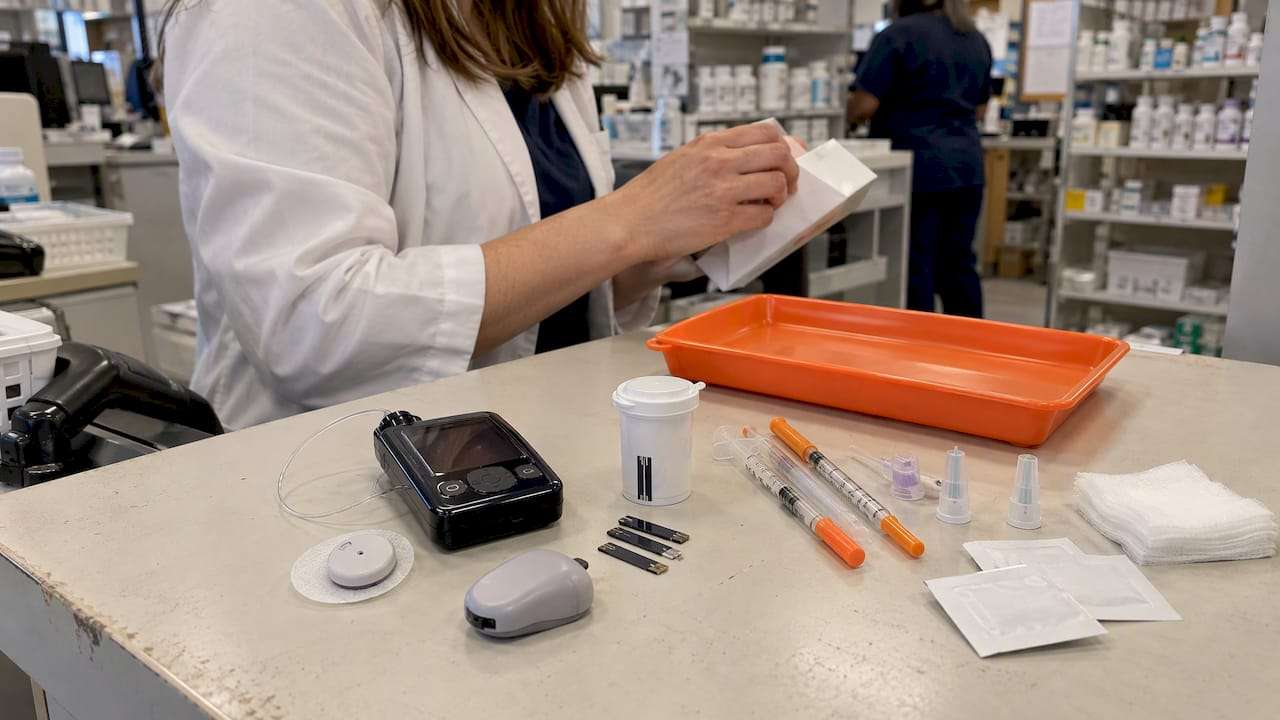
Medicare covers most of what you need to manage diabetes, but it splits the bill between two parts. Part B pays for testing supplies, continuous glucose monitors, insulin pumps and the insulin used in them, and therapeutic shoes. Part D pays for injectable insulin and the supplies you use to inject it. Knowing which part owns which item tells you where to fill a prescription, what you will owe, and why a pharmacy sometimes turns you away.
This guide walks through each category, the costs, the limits, and how to confirm your own coverage.
TL;DR
- Part B covers blood glucose meters, test strips, lancets, continuous glucose monitors (with conditions), insulin pumps and pump insulin, and therapeutic shoes for qualifying foot complications.
- Part D covers injectable insulin, inhaled insulin, disposable patch pump insulin, and syringes, needles, alcohol swabs and gauze.
- Insulin is capped at $35 for a one-month supply, with no deductible, under Part B or Part D.
- For most Part B equipment you pay 20% of the Medicare-approved amount after your deductible. A Medigap plan can cover much of that share.
- Medicare Advantage members must check their own plan for supplier networks, costs and approvals.
Table of Contents
- How Medicare divides diabetes coverage
- What Part B covers
- What Part D covers
- What you pay
- What Medicare does not cover
- A1c tests and other monitoring
- If you have a Medicare Advantage plan
- How to check coverage for one specific item
- Our perspective
- Get help matching your supplies to a plan
- FAQ
- Sources
How Medicare divides diabetes coverage
Original Medicare does not treat diabetes as one benefit. Medicare covers diabetes supplies under Part B and under Part D drug plans, and Part A covers them while you are an inpatient in a hospital. In daily life, that gives you two places to look:
- Part B (medical insurance) treats most diabetes equipment as durable medical equipment (DME). You usually get it from a supplier that accepts Medicare.
- Part D (prescription drug coverage) treats insulin you inject and the items used to inject it as drugs and related supplies. You get them at a pharmacy in your plan’s network.
If you are on a Medicare Advantage plan, the plan must cover what Original Medicare covers, but it sets its own networks, prior authorization rules and cost sharing. We come back to that below.
If you want a refresher on what each part does, our guides to Medicare Part B and what Part D covers go deeper.
What Part B covers
Blood glucose testing supplies
Part B covers self-testing equipment and supplies for all people with diabetes, whether or not they use insulin. That includes:
- Blood glucose monitors
- Test strips
- Lancet devices and lancets
- Glucose control solutions
The American Diabetes Association notes that the quantity of testing supplies covered can vary, even for people who do not use insulin. If you test often, ask your prescriber to document why, so the supplier can bill for the amount you need.
Continuous glucose monitors
Part B covers continuous glucose monitors (CGMs), plus their sensors and transmitters, for people with diabetes who use insulin or have a history of problematic low blood sugar. The device has to be prescribed in line with its FDA indications, and you need a follow-up visit with your prescriber within 6 months. That follow-up is easy to miss, and it can hold up a refill if it slips.
Insulin pumps and the insulin inside them
Part B covers durable insulin pumps and the insulin used in them for people who meet its requirements. Pump supplies are included in that benefit. Your endocrinologist’s office usually handles the paperwork with the pump supplier.
Therapeutic shoes
Therapeutic shoes are covered only if you have a diagnosis of specific foot-related complications of diabetes, not simply a diabetes diagnosis. Medicare does not cover orthopedic shoes in general, so the qualifying condition matters.
Diabetes screenings
If you are at risk but do not have a diagnosis yet, Part B covers up to 2 diabetes screenings a year. High blood pressure and obesity are risk factors, and family history is one of several. You pay nothing if your provider accepts assignment.
What Part D covers
Part D picks up what Part B leaves out. According to Medicare, it covers injectable insulin, inhaled insulin, and insulin used with pumps Part B does not cover, such as disposable patch pumps. It also covers the administration supplies: syringes, needles, alcohol swabs and gauze. CMS lists the same split.
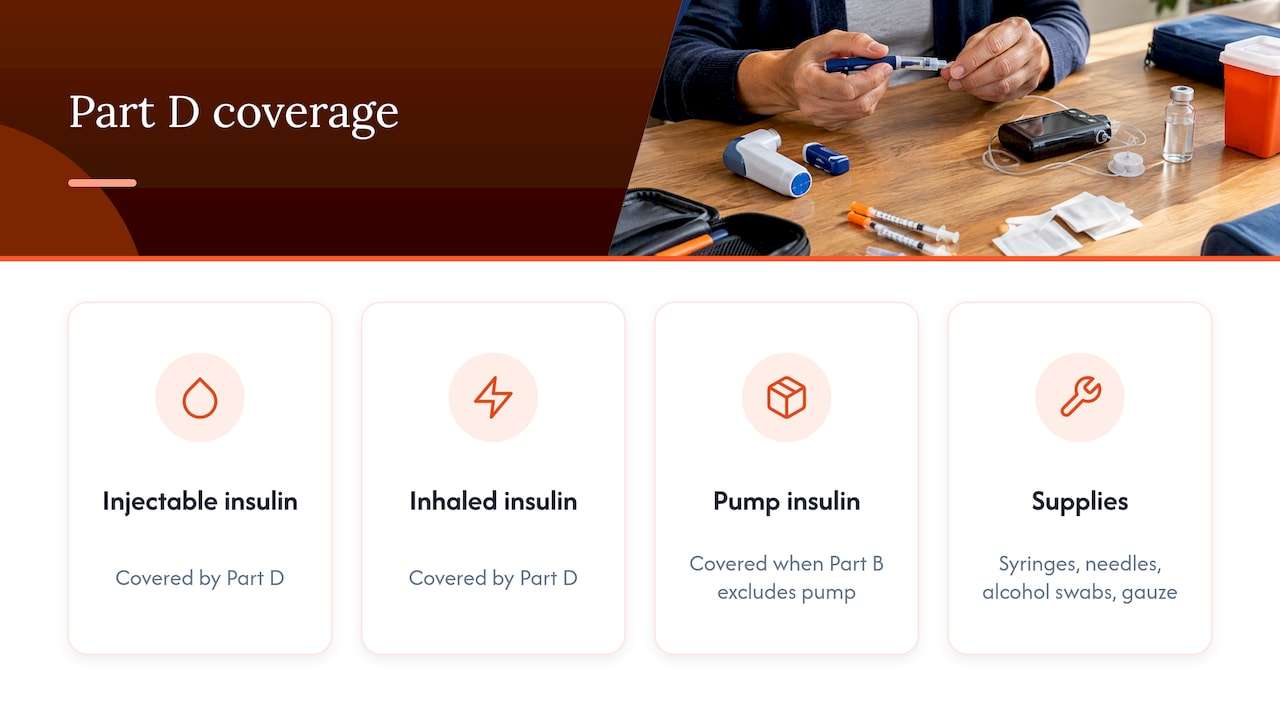
Part D plans each have a formulary, a list of covered drugs sorted into tiers. Two people on different plans can pay different amounts for the same non-insulin diabetes medication, and a plan can require prior authorization or step therapy for a particular brand. That is why the plan you pick in the fall matters. Our Part D explainer covers how formularies and tiers work.
If you have no drug coverage when you first become eligible, penalties can follow. See our page on creditable coverage and the 63-day gap.
Quick reference: which part pays
| Item | Usually covered by | Notes |
|---|---|---|
| Glucose meter, test strips, lancets | Part B | Applies whether or not you use insulin |
| Continuous glucose monitor and sensors | Part B | Insulin use or problematic hypoglycemia; follow-up visit within 6 months |
| Insulin pump and pump insulin | Part B | Must meet requirements |
| Injectable insulin | Part D | Capped at $35 for a one-month supply |
| Syringes, needles, swabs, gauze | Part D | Administration supplies |
| Disposable patch pump insulin | Part D | Not covered by Part B |
| Therapeutic shoes | Part B | Specific foot complications required |
| Diabetes screenings | Part B | Up to 2 a year if at risk |
What you pay
Insulin: the $35 cap
The cost of a one-month supply of any Part B or Part D covered insulin is capped at $35, with no deductible for insulin. That applies to insulin in a covered pump too. It does not cap your test strips, needles or your other diabetes drugs, so those still follow your plan’s cost sharing.
Equipment and supplies under Part B
For most durable medical equipment, you pay 20% of the Medicare-approved amount after meeting your Part B deductible. For a CGM, whose sensors you replace regularly, that 20% is a recurring cost. Ask your supplier what the approved amount is before you commit, and confirm the supplier accepts assignment. Our guide to Medicare costs has the current premium and deductible figures.
Screenings
Screenings cost you nothing when your provider accepts assignment.
Negotiated drug prices
Medicare negotiated prices for certain expensive brand-name drugs, including some diabetes drugs. Prices for the first 10 negotiated Part D drugs took effect January 1, 2026, and prices for the next 15 take effect January 1, 2027. Whether a drug you take is on either list is worth asking your pharmacist.
Where a Medigap plan helps
With Original Medicare, Medigap policies can help pay deductibles, copayments and coinsurance that Medicare leaves to you. For someone buying CGM sensors or pump supplies every month, covering that 20% is the main reason to consider one. Our Medigap overview explains the lettered plans. Medigap does not include drug coverage, so you still need a separate Part D plan.
What Medicare does not cover
Medicare does not cover eye exams for glasses (refraction), orthopedic shoes, or weight loss programs. That surprises people with diabetes, who often need regular eye care. A diabetic eye exam to check for retinopathy is a different service from a refraction for new lenses, so ask which one your visit is billed as. Routine dental, vision and hearing needs fall outside Original Medicare too. Our page on dental, vision and hearing options lays out how people fill those gaps.
Some people with diabetes also look at treatments for related problems, such as nerve or joint pain, and wonder whether Medicare will help. Coverage for newer therapies depends on medical necessity and the specific treatment, as in this breakdown of Medicare coverage for PRP therapy. Ask your doctor and Medicare before you pay for anything out of pocket. Medicare itself advises that you ask your doctor about services Medicare may not cover or may cover less often.
A1c tests and other monitoring
If you are at risk but undiagnosed, an A1c test can be part of the screening benefit. Part B covers two A1c tests a year under the diabetes screening benefit when your doctor considers you at risk. Once you have a diabetes diagnosis, A1c testing is ordered as a medically necessary lab test rather than a screening. Frequency then depends on your doctor’s order and your clinical situation, so ask your provider’s office to confirm how Medicare will bill it. Our page on preventive services and annual screenings covers the rest of the preventive list.
A newer option is the ACCESS model, which starting July 5, 2026 gives Original Medicare beneficiaries a voluntary way to manage chronic diseases like diabetes with technology-supported care. Ask your provider whether they participate.
If you have a Medicare Advantage plan
Medicare Advantage enrollees should contact their plan for exact coverage, eligibility and out-of-pocket costs for diabetes supplies. In practice, check four things before the fall enrollment period:
- Is your CGM or pump supplier in the plan’s network?
- Does the plan require prior authorization for the device or sensors?
- What is your copay or coinsurance for supplies, as opposed to insulin?
- Are your insulin and other diabetes drugs on the plan’s formulary, and at which tier?
Our comparison of Medicare Advantage and Medigap helps you weigh the predictability of a Medigap plan against the network rules of an Advantage plan. If your health needs are broader than diabetes alone, see choosing a plan with complex health needs.
How to check coverage for one specific item
- Original Medicare: search the item at Medicare.gov/coverage or call 1-800-MEDICARE.
- Medicare Advantage: call the number on your member card and ask about the exact product, supplier and any approval needed.
- Part D: look up the drug on your plan’s formulary, and ask the pharmacy whether it bills Part B or Part D for the item.
- Before you order equipment: confirm the supplier accepts Medicare assignment and gets paid directly.
Keep a note of the date, the name of the person you spoke with and what they said. If a claim is denied, that record helps your appeal.
Our perspective
The most common problem we see is not a missing benefit. It is a mismatch between a person’s supplies and the plan they picked. Someone chooses a plan on premium alone, then learns in January that their supplier is out of network or their insulin sits on a high tier. Because the Part B and Part D split is easy to misread, the pharmacy and the equipment supplier may each point at the other.
Our agents go through a comprehensive training program so they can explain these rules plainly, and our guidance does not cost you anything extra. For someone with diabetes, we start with your prescriptions, your supplier and your doctors, then look at plans against that list. We also do an annual plan review, because formularies and networks change from year to year even when your health does not.
— Zach
Get help matching your supplies to a plan
If you live in North Carolina, we can look at your medications, devices and doctors with you and compare Medicare Advantage, Medicare Supplement and Part D prescription drug plans side by side. We also offer a free Medicare roadmap that lays out your options and eligibility. Start at Safeguard Benefit Services and tell us what you use now.
FAQ
Does Medicare cover test strips if I don’t use insulin?
Yes. Part B covers blood glucose monitors, test strips, lancets and control solutions for people with diabetes whether or not they use insulin. The amount covered can vary, so have your prescriber document how often you need to test.
Does Medicare cover continuous glucose monitors?
Part B covers CGMs, sensors and transmitters if you use insulin or have a history of problematic low blood sugar. The device must be prescribed according to its FDA indications, and you need a follow-up visit within 6 months. You typically pay 20% of the approved amount after your deductible.
How much will I pay for insulin?
A one-month supply of a covered insulin is capped at $35 under Part B or Part D, with no deductible. The cap applies to insulin only, not to meters, strips, needles or other diabetes drugs.
Are syringes and needles covered under Part B or Part D?
Part D. Syringes, needles, alcohol swabs and gauze used to inject insulin are Part D supplies. Insulin used in a durable pump is the exception, since that falls under Part B.
Are diabetic shoes covered?
Therapeutic shoes are covered only when you have a qualifying foot-related complication of diabetes. Orthopedic shoes are not covered. Ask your doctor whether your condition qualifies.
Sources
- Medicare Coverage of Diabetes Supplies, Services & Prevention Programs (Medicare.gov)
- MLN7674574: Medicare Coverage of Diabetes Supplies (CMS)
- Insulin coverage (Medicare.gov)
- Diabetes screenings (Medicare.gov)
- What’s covered? (Medicare.gov)
- Medicare (American Diabetes Association)
- Does Medicare Cover A1c Tests for Prediabetes? (Healthline)
Recommended
Request a No Obligation Phone Call








Get Connected