

You enroll in Medicare Part B through Social Security, and the right route depends on one thing: whether you already receive Social Security benefits, still have job-based coverage, or are signing up for the first time. Get the timing wrong and you can face a gap in coverage or a lifetime surcharge. Get it right and Part B starts the month you want it to. This guide walks through each situation, the forms involved and the mistakes that cost people money. If you would rather have a Charlotte specialist confirm your timing before you file, our team at Safeguard Benefit Services builds a free Medicare roadmap around your dates.
TL;DR
- If you already get Social Security or Railroad Retirement benefits at least 4 months before you turn 65, you are enrolled in Part A and Part B automatically and only decide whether to keep Part B.
- Everyone else signs up during a 7-month Initial Enrollment Period: 3 months before, the month of, and 3 months after your 65th birthday.
- Still working for an employer with 20 or more employees? You can usually delay Part B without a penalty and enroll within 8 months after the job or coverage ends.
- Miss your window and you can pay an extra 10% of the premium for each full year you could have enrolled, usually for as long as you have Part B.
- The fastest way to apply is online at Social Security. Form CMS-40B is for people who already have Part A.
Table of Contents
- First, find out whether you are already enrolled
- Who can enroll in Part B
- When to enroll: your Initial Enrollment Period
- Step by step: how to enroll in Part B
- The Part B enrollment form: CMS-40B and CMS-L564
- If you are still working: delay or enroll?
- Choosing when Part B starts
- If you missed your window: the General Enrollment Period
- What the late enrollment penalty costs
- Budgeting for the premium and everything around it
- Our perspective
- Get your Part B timing checked in Charlotte
- FAQ
- Sources
First, find out whether you are already enrolled
Many people never need to “enroll” at all. According to CMS, people who have collected Social Security or Railroad Retirement Board (RRB) benefits for at least 4 months before they become eligible, and who live in the United States outside Puerto Rico, are enrolled automatically in premium-free Part A and in Part B. You can keep or refuse Part B. Puerto Rico residents are enrolled automatically only in Part A and must sign up for Part B themselves.
People who qualify through disability follow a different clock. Medicare.gov’s enrollment publication says you are enrolled automatically in Parts A and B after 24 months of Social Security or RRB disability benefits, with a Welcome to Medicare package arriving about 3 months before your 25th month. People with end-stage renal disease (permanent kidney failure) can enroll at any age through Social Security.
If you are turning 65 and have not started Social Security, nothing happens on its own. You have to act.
Who can enroll in Part B
Part B is the medical side of Original Medicare: doctor visits, outpatient care and preventive services. It carries a monthly premium, and it is voluntary. CMS says Part B is open to people 65 or older, people with disabilities and people with ESRD. If you must pay a premium for Part A, you need to be 65 or older, a U.S. resident, and either a citizen or a lawful permanent resident with 5 continuous years of U.S. residence.
Social Security also lists Cuban and Haitian entrants and Compact of Free Association migrants among those who can sign up. A federal law enacted July 4, 2025 (P.L. 119-21) narrowed Medicare eligibility to specific immigration categories, according to CMS’s July 2026 Medicare overview. If your status is anything other than citizen or permanent resident, confirm your eligibility with Social Security before you plan around Part B.
When to enroll: your Initial Enrollment Period
For most people the window is the Initial Enrollment Period (IEP). Medicare.gov describes it as starting 3 months before the month you turn 65 and ending 3 months after that month. That makes seven months in total.
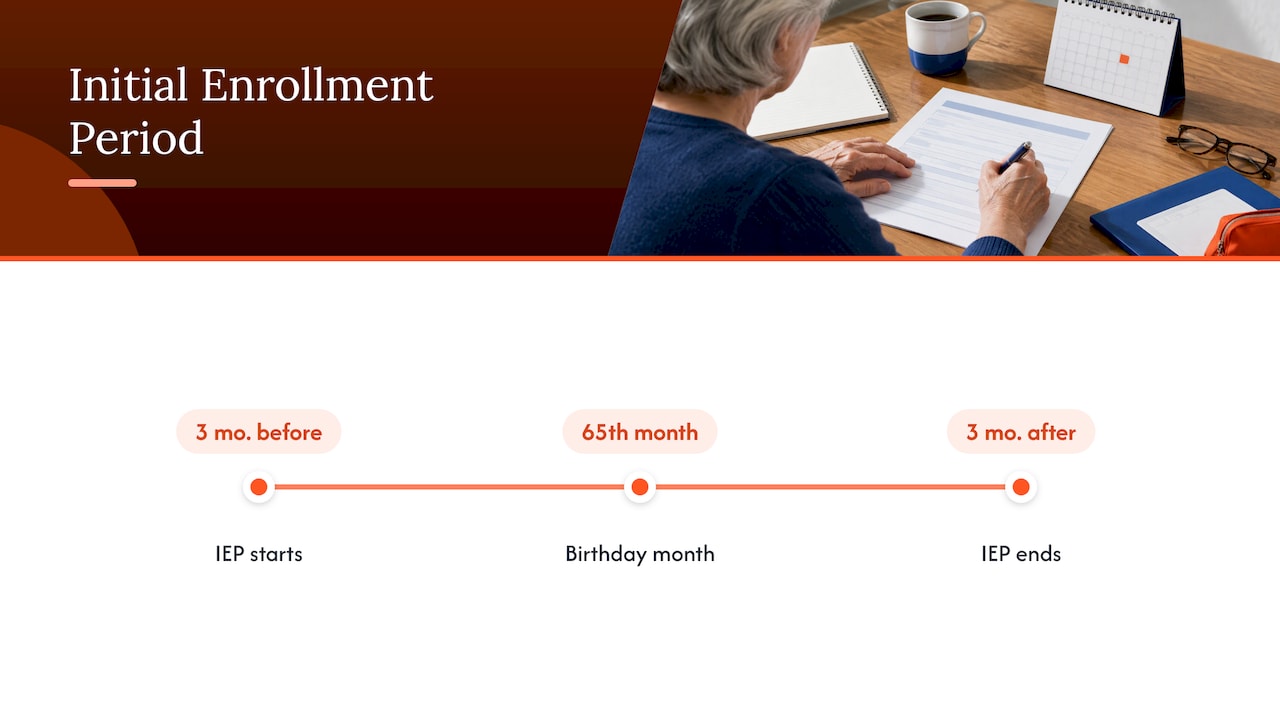
The month you choose inside that window matters, because it controls when coverage begins. Our guide to the Medicare Initial Enrollment Period lays out the month-by-month effect, and our page on locking your Medicare effective date shows how to avoid a gap.
A practical rule: sign up in the three months before your birthday month whenever you want Part B to be in place on day one. Waiting until the later months of the window can push your start date past your birthday, which leaves you without outpatient coverage for a stretch.
Step by step: how to enroll in Part B
The steps differ slightly depending on whether you already have Part A. Here is the sequence for most first-time enrollees.
- Confirm your window. Count back three months from your 65th birthday month. If you are within the IEP, you are in time. This is where people most often slip, and it is the first thing we check in a consultation.
- Decide whether you need Part B now. If you have no job-based coverage, you almost certainly do. You need both Part A and Part B to join a Medicare Advantage Plan and, in most cases, to buy a Medigap policy, according to the Medicare.gov Part B sign-up package. Part B timing and your plan choice are linked, so we look at both together.
- Gather your details. You need your Social Security number, date of birth, and, if you are still working, information about your employer coverage. The Form SSA-1 page lists what Social Security asks for.
- Apply with Social Security. Medicare.gov calls applying online the easiest and fastest route. You can also call 1-800-772-1213 or visit a local Social Security office. If you apply within 3 months of turning 65, the application asks whether you want Part B.
- Choose your start date if the form allows it. People enrolling while covered by a group plan through current employment can pick a start date, covered below.
- Watch for your Medicare card and premium notice. Part B premiums are deducted from your monthly Social Security, RRB or federal retirement benefit, or billed every 3 months if your benefits are too small, per the sign-up package.
- Pair Part B with the rest of your coverage. Part B pays part of your costs. A Medicare Supplement, a Medicare Advantage Plan and a Part D drug plan fill in the rest, and each has its own enrollment timing. We help you line these up so one missed date does not trigger a second penalty.
Social Security processes Part A and Part B applications while CMS runs the Medicare program, as Social Security explains. That is why the application itself goes through them. What we do is get your timing, eligibility and paperwork right before you apply.
The Part B enrollment form: CMS-40B and CMS-L564
The form depends on your situation, and people frequently grab the wrong one.
| Situation | Form | Where it goes |
|---|---|---|
| You already have Part A and want to add Part B | CMS-40B | Local Social Security office, by mail or fax |
| You are still working, or retired or lost job coverage in the last 8 months | CMS-L564 filed together with CMS-40B | Local Social Security office |
| Special situations that qualify for an exceptional enrollment period | CMS-10797 | Local Social Security office |
| You do not have Part A yet | None of these; apply for Medicare with Social Security | Online, by phone or in person |
The CMS-40B form can be used during your Initial Enrollment Period, the General Enrollment Period (January 1 to March 31) or a Special Enrollment Period. It says plainly that if you do not have Part A, you should not complete it and should contact Social Security instead.
Medicare.gov explains that CMS-L564 gives Social Security proof of your employer coverage, and that you submit CMS-40B at the same time. Social Security’s Part B only page adds that if your employer plan ended within the last 8 months, you can often enroll online penalty-free at any time of year.
The most common error is filing CMS-40B without the CMS-L564 when you have employer coverage. Social Security then has no proof you qualify for the Special Enrollment Period, and you risk being treated as a late enrollee. Our guide on keeping Form CMS-L564 ready covers who has to get the employer’s signature and what to ask for.
If you are still working: delay or enroll?
This is where the rules turn on employer size, and where a wrong guess is expensive. According to the Medicare.gov sign-up package:
- Employer with fewer than 20 employees: you may need to sign up for Part B right away.
- Employer with 20 or more employees: you can usually delay Part B and enroll without penalty during a Special Enrollment Period, any time while covered or for up to 8 months after the job or coverage ends.
- Disabled and under 65 on a family member’s plan: the employer must have 100 or more employees for you to delay.
Two details trip people up. First, Medicare.gov says the 8-month clock starts when you or your spouse stop working, even if you choose COBRA or other non-Medicare coverage. COBRA does not extend your window. Second, the same sign-up package says retiree coverage from a former employer, COBRA and VA coverage do not qualify you for the employer Special Enrollment Period when they end. In that case you may have to wait for the next General Enrollment Period and pay a penalty in most cases.
If you want Part B to begin when your job coverage ends, Medicare.gov advises signing up the month before you plan to retire. We cover the full logic in Delay Part B While Working, and we are glad to check your employer’s headcount and plan type against these rules before you decide.
Choosing when Part B starts
For most sign-ups, coverage begins the first day of the month after you enroll. The CMS-40B gives one more option: if you enroll while covered by a group plan based on current employment, or in the first full month after that coverage ends, you can choose to start on the first day of the month you enroll or on the first day of any of the 3 months after, per the form itself. Use that choice to line Part B up with the day your employer plan ends.
If you missed your window: the General Enrollment Period
If you skipped Part B, missed your IEP or never qualified for a Special Enrollment Period, you can sign up from January 1 through March 31 each year. Social Security says this also applies to people who were auto-enrolled and declined Part B, or whose Part B ended for non-payment or voluntary withdrawal. Coverage then starts the first day of the month after you sign up. Applications can be faxed, mailed, dropped off at a local office, or handled by video, phone or in-person appointment through 1-800-772-1213.
Because this window comes once a year, the cost of missing it is real. Anyone reading this in late November has a short wait before it opens again, so it is a good moment to get your paperwork in order.
What the late enrollment penalty costs
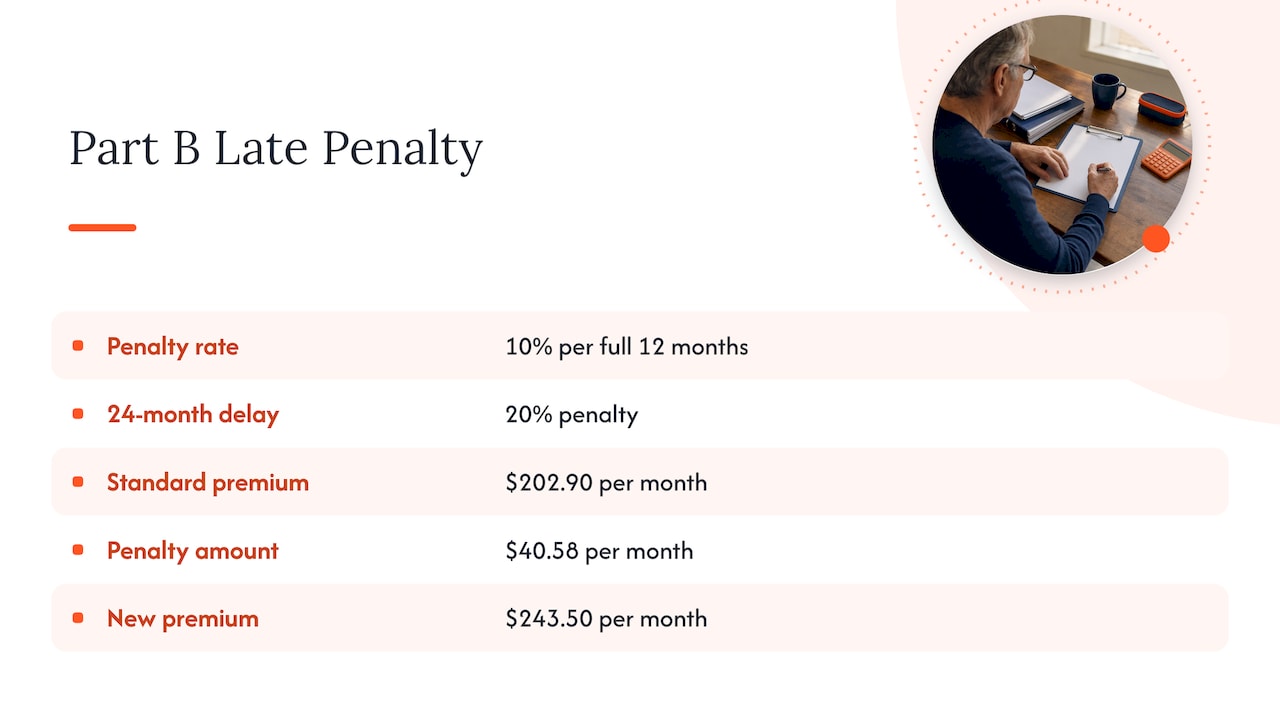
Medicare.gov states that if you miss your enrollment period and do not qualify for a Special Enrollment Period or a Medicare Savings Program, you pay an extra 10% on the Part B premium for each full 12-month year you could have signed up but did not. It is added to your monthly premium and usually charged for as long as you have Part B, according to its late enrollment penalty page.
Here is the worked example Medicare.gov gives for 2026. The standard Part B premium was $202.90 a month. Waiting 24 months means a 20% penalty of $40.58, for a monthly premium of $243.50. Higher earners may also pay an income-related amount. The standard premium is reset each year, so check the new figure in the 2027 Part B premium and deductible guide.
Because the penalty is a percentage you pay every month for life, a gap of even two years compounds across decades. To see your own number, use our Part B penalty calculator, and read how to avoid the Part B penalty for the exceptions.
There is one lesser-known rule. Medicare.gov’s enrollment publication says that enrolling in Part B based on ESRD stops an existing late enrollment penalty. People who delayed Part B and later develop ESRD can call Social Security to have the higher premium removed.
Budgeting for the premium and everything around it
The Part B premium is only one line in a senior’s health budget. Deductions come out of your Social Security check, so your net benefit shrinks by the premium amount. Add the cost of a Medigap or Advantage plan, drug coverage, and out-of-pocket extras such as compression therapy costs in the U.S., and it is worth totaling the full picture before you commit. Our Medicare Advantage vs. Medicare Supplement comparison helps you see which combination fits your budget.
Our perspective
Most of the Part B problems we see start the same way: someone assumed another person had handled the timing. A spouse’s employer plan, a retiree benefit or COBRA feels like Medicare, and it often is not. By the time the gap shows up, the penalty is already running.
We built Safeguard Benefit Services around education first. Our agents go through a comprehensive training program so the guidance you get is unbiased and personalized, and it costs you nothing extra. We start with your birthday, your work status and your employer coverage, then build your free Medicare roadmap from there.
Part B is rarely the only decision. The right Medigap, Medicare Advantage or Part D plan depends on when Part B begins, and we review your plans every year so your coverage keeps pace with your health and your budget. For people in Charlotte and across North Carolina, that is local support you can call when a letter arrives and you are not sure what it means.
Zach
Get your Part B timing checked in Charlotte
If you are within a few months of 65, leaving a job or coming off an employer plan, a short consultation can settle your dates before you file. We help you understand your eligibility, avoid enrollment penalties and coverage delays, and choose among Medicare Advantage Plans, Medicare Supplements, Prescription Drug Plans and dental, vision and hearing coverage.

Start with our Medicare plans and free roadmap, or read the Medicare enrollment guide for the periods that apply to you.
FAQ
Is it better to apply for Part B online or in person?
Online is the fastest route, according to Medicare.gov, and works for first-time sign-ups. If you already have Part A and are using paper forms, mail or fax CMS-40B to your local Social Security office. You can also call 1-800-772-1213 for help.
Do I have to take Part B?
No. Part B is optional and carries a premium. If you are auto-enrolled you can refuse it. Keep in mind that you need Part A and Part B to join a Medicare Advantage Plan and, in most cases, to buy a Medigap policy, and that delaying without a qualifying reason can add a penalty for as long as you have Part B.
What is the biggest enrollment mistake?
Assuming you can delay Part B because you have some other coverage. Whether you can depends on whether the coverage comes from current work, how large the employer is, and whether it is retiree, COBRA or VA coverage. Confirm the details before the end of your Initial Enrollment Period.
When does the General Enrollment Period run?
Every year from January 1 through March 31, per Social Security. Coverage begins the first day of the month after you sign up, and a late enrollment penalty may apply.
Sources
- CMS: Original Medicare (Part A and B) Eligibility and Enrollment
- Medicare.gov: Enrolling in Medicare Part A and Part B
- SSA: Sign up for Medicare
- CMS: Medicare Overview Job Aid, July 2026
- Medicare.gov: When can I sign up for Medicare?
- Medicare.gov: Sign up for Medicare Part B
- SSA: Form SSA-1 information
- Medicare.gov: Ready to sign up for Part A and Part B
- SSA blog: Are you 65 or older and need Medicare Part B?
- Medicare.gov: Enrollment forms
- CMS: Form CMS-40B
- SSA: Sign up for Part B only
- Medicare.gov: Avoid late enrollment penalties
Recommended
Request a No Obligation Phone Call








Get Connected