

Guaranteed issue life insurance is a whole life policy that accepts you no matter your health. There is no medical exam and there are no health questions. The trade-off is a small death benefit, a high price for what you get, and a waiting period of usually two to three years before the full benefit applies for a natural death. It works best as a last resort for final expenses, when health problems have kept you out of every other kind of coverage.
This guide explains how these policies work, what they cost, what your family receives if you die early in the policy, and how to tell whether you should try a cheaper option first.
TL;DR
- Guaranteed issue (also called guaranteed acceptance) means you can’t be turned down. There is no exam and no health questions.
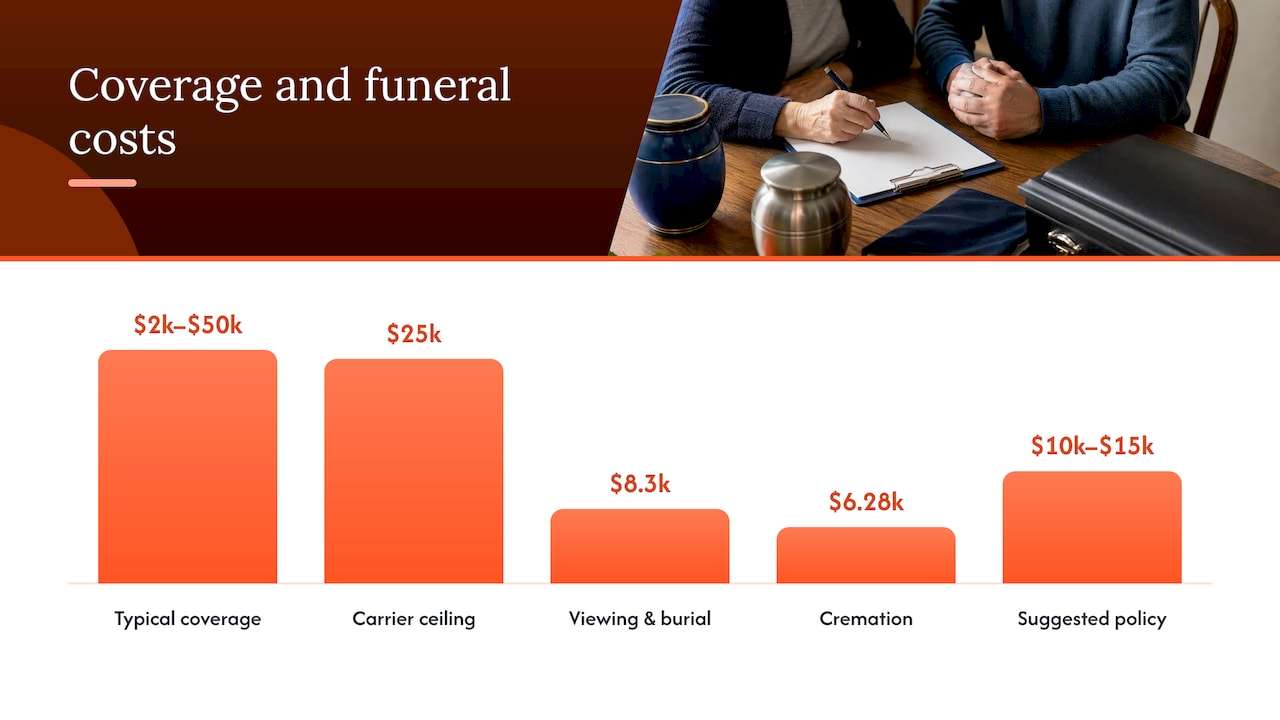
- Individual policies usually cover only about $2,000 to $50,000, and many carriers cap them at $25,000.
- Most have a two- to three-year waiting period. Death from natural causes inside it usually returns only the premiums paid plus interest, while accidental death is often covered in full.
- Try simplified issue coverage first. It asks a few health questions, skips the exam, and usually costs less for more coverage.
- Sorting this out alongside your Medicare choices? We can help you with both in one conversation.
Table of Contents
- What guaranteed issue life insurance is
- Who can qualify
- How much coverage you can get
- What it costs
- The waiting period and graded death benefit
- Pros and cons at a glance
- Try simplified issue first
- Where it fits with Medicare
- Our perspective
- Get help comparing your options
- How to apply: a short checklist
- FAQ
- Sources
What guaranteed issue life insurance is
A guaranteed issue policy is permanent life insurance sold without underwriting. The insurer doesn’t look at your medical history, your prescriptions or your doctor’s notes. If you are in the eligible age range and can pay the premium, you get the policy.
The product goes by several names: guaranteed acceptance life insurance, guaranteed whole life, and the “no exam life insurance for seniors” you see advertised on TV. They all describe the same basic idea. The insurer takes on every applicant, so it prices and structures the policy to protect itself from the sickest ones.
Two features follow from that design:
- A small face amount. The insurer limits how much it can lose on any one person.
- A delayed full benefit. The insurer holds back the full payout for natural deaths in the early years, so people who are already seriously ill can’t buy a policy and collect right away.
One note on terminology. Employers sometimes offer “guaranteed issue” group life as a workplace benefit. That is a different thing. Group guaranteed issue coverage can run much higher, sometimes one to two times your salary, but it is tied to your job and generally doesn’t follow you into retirement as a personal financial plan. This article is about individual policies for seniors.
Who can qualify
The eligible age window is the main requirement. Most guaranteed acceptance policies target ages 50 to 85, and some insurers accept applicants as young as 45. Outside the window, you won’t be offered this product.
Beyond age, you generally need to:
- live in a state where the carrier sells the product (availability and limits can differ by state);
- be able to sign the application yourself, since some insurers won’t issue a policy when a power of attorney or guardianship is in place for the insured;
- name a beneficiary and pay premiums on schedule.
The products fit best in a few situations:
- You have a serious condition such as cancer, kidney disease or cognitive impairment, and other insurers have declined you. Guidance from ValuePenguin and others points to exactly this group as the main audience.
- You are in your 60s or 70s, have no coverage, and want to leave something specific for a funeral.
- You were turned down for simplified issue coverage and need a backstop.
If you’re healthy, this probably isn’t your product. More on that below.
How much coverage you can get
Individual guaranteed issue policies are small by design. Face amounts typically sit between $2,000 and $50,000, and many carriers stop at $25,000. Some also add up all the guaranteed policies you hold with them, so buying a second one from the same company doesn’t raise your ceiling.
That is why the “$100,000 guaranteed life insurance” search tends to disappoint. A policy of that size usually requires some form of underwriting, and a policy with no underwriting rarely goes that high at an individual level.
It helps to anchor the number to a real expense. Funeral costs are the most common reason people buy this coverage. The National Funeral Directors Association has reported a median of about $8,300 for a funeral with viewing and burial and about $6,280 with cremation, before extras such as a vault. A $10,000 to $15,000 policy covers a typical service with room for flowers, travel and a few small bills. It won’t replace income or pay off a mortgage.
What it costs
Expect a high price for a low payout. Insurers can’t screen out risk, so they build it into every premium. MoneyGeek explains that the cost reflects the risk of accepting every applicant.
Without health questions, only a few things move your quote. According to ValuePenguin, quotes depend on your age, your location and your sex. Here is how that plays out in practice:
| Factor | Effect on your premium |
|---|---|
| Age at purchase | Older applicants pay more per $1,000 of coverage |
| Sex | Rates are usually higher for men |
| State | Rates and available face amounts vary by location |
| Face amount | Higher coverage means a higher monthly premium, though not always in a straight line |
| Health | No effect, which is the point of the product |
Because rates are set by age, each year you wait makes the same coverage cost more. A premium on a whole life policy stays level once the policy is issued, so buying earlier locks in a lower rate.
We don’t publish premiums for carriers, because they change by age, state and company. A free quote from an agent who can look at several carriers shows your actual numbers.
The waiting period and graded death benefit
This is the part of the contract to read twice. Most guaranteed issue policies have a two- to three-year waiting period or graded death benefit. If the insured dies from natural causes in that window, the beneficiary usually gets back the premiums paid plus interest, not the full face amount. The Wall Street Journal reports that interest on returned premiums often falls between 5% and 10%.
Here is a worked example with made-up round numbers, not a quote. Say you buy a $10,000 policy and pay $90 a month. If you die of illness in month 14, your beneficiary would receive roughly $1,260 in premiums plus the stated interest. If you die in month 40, after the waiting period, they receive $10,000.
Two details soften this:
- Accidental death. Many policies pay the full benefit for an accidental death during the graded period. Check your contract for the exact definition of accident.
- Policies with no waiting period. Some insurers offer them, but these generally have lower coverage maximums, often $5,000 or less, and stricter age requirements.
If you are in poor health today, think carefully about whether you can reasonably expect to outlast the waiting period. If the answer is unclear, a smaller no-wait policy or a funeral savings plan may serve your family better.
Pros and cons at a glance
What works in your favor
- Acceptance is certain, which gives peace of mind to people with severe health conditions.
- No exam, no health questions, and fast approval.
- It is permanent coverage with a level premium, and it builds some cash value you can receive on surrender. How much depends on the policy.
- It can fund final expenses so your family doesn’t have to.
What works against you
- The premium is high compared to the death benefit.
- Natural deaths in the first two to three years pay out far less than face value.
- Cash value is limited.
- Coverage amounts are too low to protect income or debts.
Forbes Advisor, MoneyGeek and Kiplinger all describe it as a last-resort product for people who can’t get anything else, and not a main financial planning tool. We agree with that assessment.
Try simplified issue first
If you have a manageable health history, simplified issue life insurance deserves a look before you commit to guaranteed issue. It asks a handful of yes-or-no health questions and skips the exam. ValuePenguin and Business Insider both advise trying it first because it usually offers better pricing and higher coverage limits.
A rough order to work through:
- Fully underwritten term or whole life. Cheapest per dollar of coverage if you’re healthy. Our guide on term versus whole life for U.S. budgets covers when each makes sense.
- Simplified issue. Fewer questions, no exam, often a modest wait or none.
- Guaranteed issue. Everyone gets in, at the highest cost per dollar and with the waiting period.
You can apply to a simplified policy and, if you’re declined, move to guaranteed issue without losing anything. Just don’t cancel an existing policy before the new one is in force.
Where it fits with Medicare
A lot of our clients first ask about guaranteed issue life insurance around the time they turn 65 or retire. Medicare and life insurance solve different problems. Medicare pays medical bills, while life insurance pays your family after you die. Medicare doesn’t help with funeral costs.
If health conditions are the reason you’re looking at guaranteed issue, you may also be wondering how they affect your health coverage. Medigap and Medicare Advantage have their own rules, which we explain in our articles on preexisting conditions and Medigap and on choosing a Medicare plan with pre-existing conditions.
If a serious diagnosis is what worries you, a different kind of policy may help with the bills that come before the end of life. Hospital indemnity insurance pays cash for hospital stays, and our comparison of cancer insurance and critical illness insurance shows how those two differ.
Our perspective
We sit across the table from people nearing 65 every week, and the same pattern comes up. Someone sees a TV ad promising that nobody is turned down, and they call us ready to buy the first policy offered. Our job is to slow that down by one step.
First, we ask what the money is for. If the answer is a funeral and a few bills, a small policy may be exactly right. If it is replacing income or leaving an inheritance, guaranteed issue is the wrong tool.
Second, we check whether the person has actually been declined. Many haven’t. A person with well-controlled blood pressure or diabetes can often qualify for simplified issue and pay less for more coverage. Guaranteed issue should come after that check, not before.

Third, we explain the waiting period in plain terms, before they sign. We’d rather lose a sale than have a family find out about a graded benefit at the worst possible time.
We train our agents to give this kind of unbiased guidance, and our help doesn’t cost you extra. We earn a commission from the carrier if you enroll, so we tell you that up front and make sure the plan fits you first.
— Zach
Get help comparing your options
We’re a Charlotte, North Carolina Medicare agency that also helps clients with life insurance, cancer insurance and hospital indemnity plans. If you’re weighing final expense coverage alongside your Medicare decisions, we can review both and show you what’s realistic for your age and health.

Start on our home page to request a free Medicare roadmap and a no-pressure consultation.
How to apply: a short checklist
- Decide the purpose and amount, such as funeral costs or small debts.
- Confirm you’re in the carrier’s age range and state.
- Ask whether you could qualify for simplified issue first.
- Get the waiting period length and what the beneficiary receives if you die inside it, in writing.
- Ask about the accidental death provision.
- Check the monthly premium against your budget, since a lapsed policy pays nothing.
- Name a beneficiary and tell them where the policy is kept.
- Review the free-look period in your state so you can cancel if the terms differ from what you expected.
FAQ
Is guaranteed issue the same as guaranteed acceptance life insurance?
Yes. Both terms describe a whole life policy that accepts every applicant in the eligible age range without an exam or health questions. Companies use the names interchangeably, so compare the actual terms, such as face amount, waiting period and age limits.
Can I get guaranteed life insurance for $100,000?
Usually not as an individual policy. Most carriers cap guaranteed issue at about $25,000, and the general range is $2,000 to $50,000. Higher amounts generally require underwriting, or come from an employer’s group plan.
What happens if I die during the waiting period?
If death is from natural causes, your beneficiary typically receives the premiums you paid plus interest. Accidental death is often covered for the full amount right away. The contract spells out the details.
Who should avoid guaranteed issue life insurance?
Anyone who could qualify for simplified issue or fully underwritten coverage. Those policies generally cost less and pay more. Guaranteed issue makes more sense once you’ve been declined or have a serious condition that makes other options unlikely.
Does Kiplinger’s view change the advice?
Not really. Kiplinger notes these policies exist to ease funeral and burial costs for families of people who can’t get other coverage. Used for that narrow purpose, with the waiting period understood, they do the job.
Sources
- Guaranteed Issue Life Insurance: Pros and Cons, Forbes Advisor
- Guaranteed-Issue Life Insurance, The Wall Street Journal
- Best Guaranteed Acceptance Life Insurance Companies (2026), MoneyGeek
- Best Guaranteed Acceptance Life Insurance Companies, ValuePenguin
- What About Those Guaranteed Life Insurance Ads?, Kiplinger
- Funeral costs and consumer rights, MassMutual
Recommended
Request a No Obligation Phone Call








Get Connected