

Observation status means Medicare treats you as an outpatient, even if you sleep in a hospital bed. Inpatient status means a doctor formally admitted you. The label decides which part of Medicare pays (Part B or Part A), what you owe, and whether Medicare will cover a skilled nursing facility (SNF) stay afterward. The care can look identical from the bed, but the bill and the follow-up coverage can be very different.
TL;DR
- Observation is outpatient care. It falls under Part B, so you generally pay 20% of the Medicare-approved amount after the Part B deductible, plus any separate charges for services.
- Inpatient is Part A. In 2026 you owe a $1,736 deductible per benefit period, then $0 a day for days 1 to 60.
- The three-day rule counts inpatient midnights only. Observation time does not count toward the three days Medicare requires before it covers SNF care.
- Ask your status every day. Get the answer in writing, and if the hospital changes you from inpatient to observation, you have a right to a fast appeal.
- Your plan matters. Original Medicare and Medicare Advantage handle these situations differently, so check how your coverage works before you need it.
Table of Contents
- What observation and inpatient mean
- How the hospital decides: the Two-Midnight Rule
- What you pay under each status in 2026
- The three-day rule: where observation hurts most
- How to find out your status while you are in the hospital
- Appealing a status change
- Our perspective: plan before the hospital does it for you
- Ways to cover the gaps
- Talk to a Charlotte Medicare agent
- FAQ
- Sources
What observation and inpatient mean
A hospital admits you as an inpatient when a doctor writes a formal order to admit you. Until then, you are an outpatient, whether you are in the emergency department, a recovery area or a regular room.
Observation services are short-term outpatient care. Hospitals use them to treat you, to monitor you, or to decide whether you need to be admitted or can safely go home. CMS explains that observation can include an overnight stay and is still outpatient care.
That is why people are surprised. You may stay two or three nights, eat hospital meals and see the same nurses, and still be an outpatient the whole time. Medicare says your status affects what you pay for hospital services such as X-rays, drugs and lab tests, and it can affect coverage after you leave.
How the hospital decides: the Two-Midnight Rule
The main benchmark is the Two-Midnight Rule. Inpatient admission is generally considered appropriate under Part A when the physician expects you to need medically necessary hospital care that crosses at least two midnights, according to the CMS fact sheet.
Three points make this rule less rigid than it sounds:
- It is a benchmark, not a guarantee. The final decision rests with the admitting physician’s judgment.
- A shorter stay can still be inpatient. Doctors can admit case by case when they expect less than two midnights, though CMS says these short stays get closer review. CMS’s patient status review FAQ describes a short stay as one lasting fewer than two midnights after inpatient admission.
- Observation is often the “wait and see” step. If doctors cannot yet tell how sick you are, they may place you in observation first and admit you later if you do not improve.
You do not choose your status. The Medicare Rights Center calls the distinction illogical and punitive in part because patients get the same care either way while the financial results differ so much.
What you pay under each status in 2026
The cost gap is not always as simple as “observation is more expensive.” A short observation stay can cost less than the Part A deductible. A long one with many separate charges can cost more. What changes is the structure of the bill.
| Inpatient (Part A) | Observation (Part B outpatient) | |
|---|---|---|
| Who pays | Medicare Part A | Medicare Part B |
| Main cost | $1,736 deductible per benefit period in 2026 | Part B deductible, then 20% coinsurance |
| Days 1 to 60 | $0 coinsurance after the deductible | Billed service by service |
| Days 61 to 90 | $434 per day | Not applicable |
| Lifetime reserve days (91 to 150) | $868 per day | Not applicable |
| Counts toward SNF three-day rule | Yes | No |
The inpatient figures come from Medicare’s inpatient hospital care page and the CMS 2026 premiums and deductibles fact sheet. The 20% outpatient coinsurance is described on Medicare’s outpatient hospital services page.
Two details are worth knowing:
- Outpatient billing is itemized. Each test, procedure and doctor service is billed on its own, and 20% applies to each Medicare-approved amount. How much you owe depends on what was done. Even a single outpatient service can have its own cost rules, as this look at Medicare colonoscopy coverage shows for one common procedure.
- Self-administered drugs can be a surprise. Medicare Part B generally does not cover many routine pills you take yourself while in observation, so the hospital may bill them separately. Ask the hospital’s billing office what applies to you, and check with your Part D plan about reimbursement.
For a wider view of premiums, deductibles and where state help may apply, see our 2026 Original Medicare out-of-pocket estimate and our Part B premium guide.
The three-day rule: where observation hurts most
The biggest financial risk is not the hospital bill. It is the rehab bill afterward.
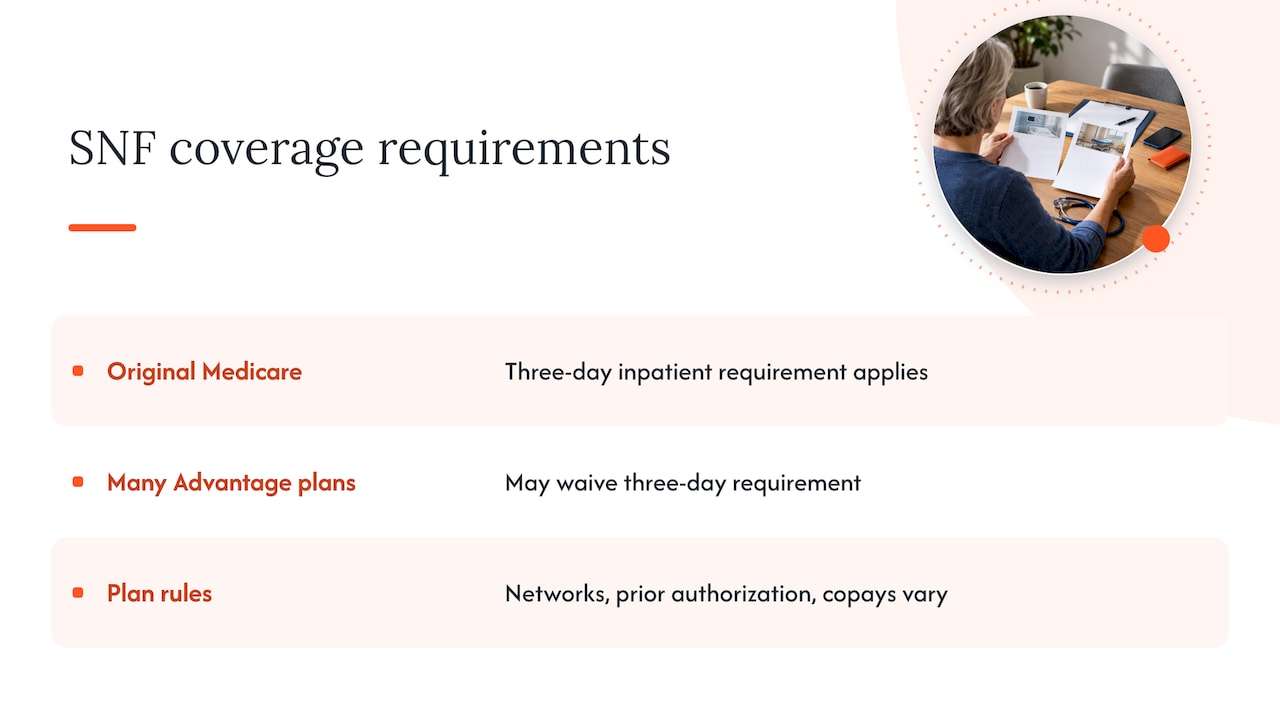
Original Medicare Part A covers skilled nursing facility care after a hospital stay only if you were formally admitted as an inpatient for three consecutive days first. Medicare’s status page is clear that time in observation does not count toward those three days.
Here is a worked example, using only the rules above:
- Monday: you arrive at the emergency department with a fall and a hip injury.
- Monday night to Wednesday: you are in a hospital bed under observation.
- Wednesday: the doctor writes an inpatient order. You are discharged Friday.
You were in the hospital for four or five days, yet you have only two inpatient midnights. Medicare Part A would not cover the SNF rehab that your therapists recommend. The Medicare Rights Center’s observation status factsheet explains how the rule works and how often it catches people off guard.
If you do qualify, SNF coverage still has limits. Our guide to Medicare SNF coverage and the daily cost after day 20 walks through what to expect and how to appeal a denial.
Do Medicare Advantage plans handle this differently?
Often, yes. Advocates note that many Medicare Advantage plans may waive the three-day inpatient requirement, unlike Original Medicare. But every plan sets its own rules, networks, prior authorization and copays, so read the Evidence of Coverage before assuming anything. Our comparison of Medicare Advantage vs. Medigap plans explains the trade-offs.
How to find out your status while you are in the hospital
You can protect yourself with a few direct questions. Ask them of the nurse, the case manager or the attending doctor, and ask a family member or friend to do it for you if you cannot.
- “Am I an inpatient or an outpatient under observation?” Ask this on day one and again every day.
- “Has a doctor written an inpatient admission order?” If not, you are an outpatient.
- “Do you expect me to need hospital care past a second midnight?” This ties directly to the benchmark above.
- “Will I need skilled nursing or rehab after discharge?” If so, say so early, because it makes the three-day rule urgent.
If you are in observation for more than 24 hours, the hospital must give you a written notice. The Medicare Outpatient Observation Notice (MOON) tells you that you are an outpatient and what that means for you. CMS says it must be delivered no later than 36 hours after observation services begin. Keep your copy.
Appealing a status change
Sometimes a hospital admits you as an inpatient and then changes you to observation while you are still there. That change is the situation Medicare’s appeal rights cover.
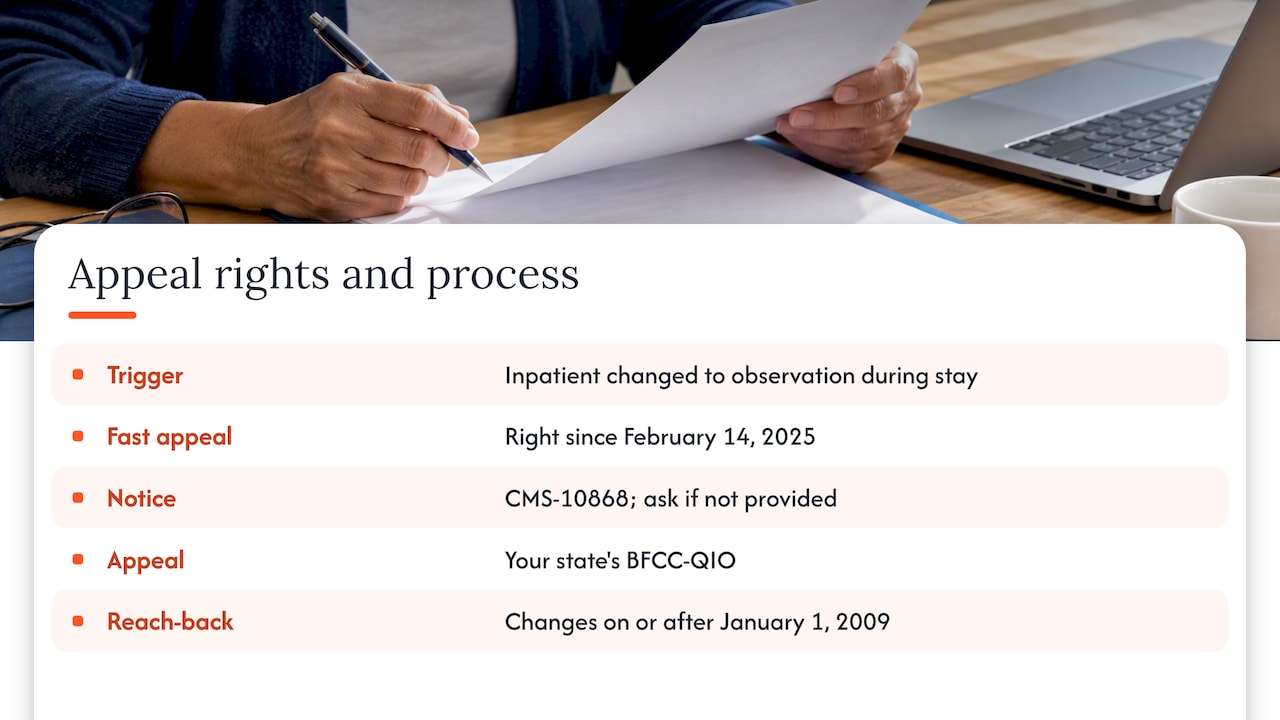
Since February 14, 2025, you have the right to ask for a fast appeal if your status was changed from inpatient to outpatient getting observation services during your stay. The hospital should give you a Medicare change-of-status notice (form CMS-10868). If you are leaving without one, ask for it, because it is your paperwork for any appeal.
The appeal goes to your state’s Beneficiary and Family Centered Care Quality Improvement Organization (BFCC-QIO). A successful appeal can lead to Part A coverage of the hospital stay and a qualifying SNF stay that followed. Medicare’s page also says appeals can reach back to status changes on or after January 1, 2009, which matters if a past stay left you with an unexpected rehab bill.
There is also a separate court-ordered appeal route for people who meet certain criteria. The Medicare Rights Center’s summary of the final rule is a good plain-language overview.
Note what this does not cover: if you were never admitted as an inpatient and were only ever in observation, these particular appeal rights do not apply in the same way. In that case, speak with the hospital’s patient advocate or case manager, and call 1-800-MEDICARE with the details of your stay. Both are free.
Our perspective: plan before the hospital does it for you
We sit across the table from people nearing 65 in Charlotte every week. Almost nobody asks us about observation status until after it has happened to them or to a parent. By then the rehab bill is on the kitchen table.
Our view is simple. You cannot control your hospital’s label, so the smart move is to control the coverage that sits behind it. That means three things:
- Know what your plan does with the three-day rule. Original Medicare enforces it. Some Medicare Advantage plans waive it. If you are choosing between them, ask the question directly and get the answer in the plan documents.
- Know how much you could owe in a bad week. Original Medicare has no out-of-pocket cap. A Medicare Supplement (Medigap) plan can cover some of the deductibles and coinsurance, depending on the plan letter. Advantage plans have an annual out-of-pocket maximum, but with network and authorization rules.
- Review every year. Plans, networks and costs change. An annual check keeps you from finding out about a gap in the emergency room.
Our agents go through a training program built around education, so the guidance you get is about fit, not a sales script, and our help comes at no extra cost to you. We would rather you understand observation status in October than learn about it in an ambulance.
— Zach
Ways to cover the gaps
A few types of coverage can soften the impact of a hospital stay, observation or inpatient. They work differently, so match them to your situation:
- Medicare Supplement (Medigap): pays some of what Original Medicare leaves, such as Part A and Part B cost sharing, depending on the plan. See our Medicare Supplement plans explained guide.
- Medicare Advantage (Part C): bundles Part A and Part B, with plan-specific rules for hospital stays and SNF care. See Medicare Advantage plans explained.
- Hospital indemnity insurance: pays you a fixed cash benefit when you are hospitalized, which you can put toward deductibles, coinsurance or everyday bills. Benefits depend on the policy, and we explain how it works on our hospital indemnity insurance page.
Talk to a Charlotte Medicare agent
If you live in Charlotte or elsewhere in North Carolina and want to know how your current coverage would handle an observation stay, we can walk through it with you. We offer personalized consultations and a free Medicare roadmap that lays out your options and eligibility, and we help with Medicare Advantage, Medicare Supplement, Part D, dental, vision and hearing, and hospital indemnity plans. Start at Safeguard Benefit Services.
FAQ
Is observation status inpatient or outpatient?
Observation is outpatient status, even if you stay overnight in a hospital bed. Medicare Part B pays for it, not Part A. Only a formal inpatient admission order moves you to Part A.
Does observation time count toward the three-day rule?
No. Medicare counts only inpatient days toward the three consecutive days required before it covers skilled nursing facility care under Original Medicare. If you spent two days in observation and then were admitted, the clock starts at admission. Some Medicare Advantage plans waive the requirement, so check yours.
Can I appeal observation status?
Yes, in some cases. If a hospital admits you as an inpatient and then changes you to observation during the stay, you can request a fast appeal through your state’s BFCC-QIO. If you were never admitted, talk to the hospital’s patient advocate and call 1-800-MEDICARE about your options.
Can a stay under two midnights be inpatient?
Yes. The Two-Midnight Rule is a benchmark, not a ban. A physician can admit you as an inpatient when they judge it medically necessary, though CMS reviews short stays more closely.
What should I do before I leave the hospital?
Ask which status you had on each day, and ask for your Medicare Outpatient Observation Notice or change-of-status notice if you were due one. Keep copies. If you will need rehab, ask the case manager how it will be covered before you are discharged.
Sources
- Medicare.gov: Inpatient or outpatient hospital status affects your costs
- Medicare.gov: Inpatient hospital care coverage
- Medicare.gov: Outpatient hospital services coverage
- Medicare.gov: Appeal when a hospital changes your status
- Medicare.gov: Appealing a change in status during a hospital stay
- CMS: Two-Midnight Rule fact sheet
- CMS: Hospital patient status review FAQ
- CMS: Medicare Outpatient Observation Notice (MOON)
- CMS: 2026 Medicare Parts A and B premiums and deductibles
- Medicare Rights Center: The three-day stay problem
- Medicare Rights Center: Observation status factsheet
- Medicare Rights Center: Final rule codifies observation stay appeal rights
- Precision Digestive: U.S. colonoscopy coverage
Recommended
Request a No Obligation Phone Call








Get Connected