

Is Medicare Part D ending in North Carolina? The short answer is no—Medicare Part D is not ending in North Carolina. If you’ve heard rumors, recent 2026 changes and plan exits may be the cause of confusion. Below we explain what changed this year, how many Part D options North Carolinians still have, and the steps to protect your prescription drug coverage.
Is Medicare Part D really ending in North Carolina in 2026?
No. Medicare Part D remains a federally administered benefit that helps pay for prescription drugs, whether you get it through a stand-alone Part D plan (PDP) or a Medicare Advantage plan that includes drug coverage (MA-PD). Part D was created by federal law and continues nationwide, including in North Carolina.
What’s new is not an end to the program, but ongoing updates to costs and plan availability for 2026. These changes are part of routine annual adjustments and recent federal reforms to improve affordability.
What changed in 2026 that’s causing confusion about Medicare Part D?
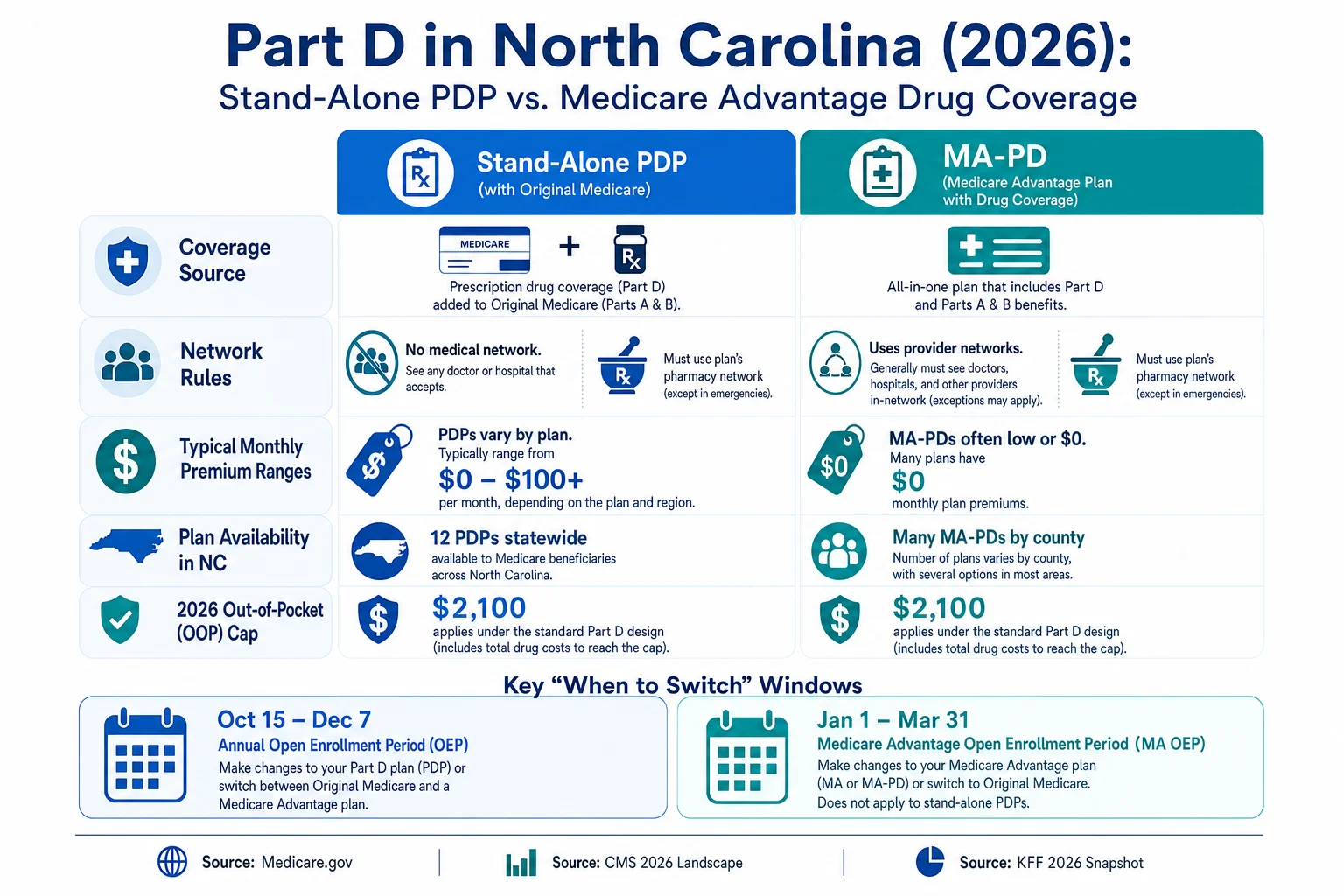
For 2026, the standard Part D design features an annual out-of-pocket cap of $2,100 for most beneficiaries, following the 2025 hard cap of $2,000. This helps limit total drug costs across the year.
At the same time, fewer stand-alone drug plans are on the market nationally than in prior years, and plan bids and premiums adjusted under 2025–2026 reforms. The 2026 Part D “base beneficiary premium” is $38.99 (used for certain calculations, like the late-enrollment penalty), though your actual plan premium may be higher or lower.
Also contributing to the chatter: more Medicare beneficiaries now get drug coverage through a Medicare Advantage plan rather than a stand-alone PDP, which can make it seem like PDP choices are shrinking—even though MA-PD choices remain robust.

How many Medicare Part D plans are available in North Carolina for 2026?
North Carolina Medicare beneficiaries have 12 stand-alone prescription drug plans (PDPs) in 2026. That is fewer than in some past years, but it still provides a range of choices across premiums and formularies.
Independent analyses tracking North Carolina confirm the same count and note that monthly premiums for 2026 PDPs start as low as $3.60, depending on the plan and your county. Actual costs vary with your medications, pharmacies, and any Extra Help eligibility.
Why are people hearing “plans are leaving” if Part D isn’t ending?
Each year, some insurers consolidate or discontinue specific Part D plans. When a PDP exits, enrollees receive notices and can pick a new plan. This does not mean Medicare Part D is ending—only that particular plan’s contract is. The benefit continues, and you can enroll in another PDP or an MA-PD.
Separately, North Carolina has seen Medicare Advantage network changes at certain hospitals in 2026. Those headlines involve MA provider networks—not the existence of Part D. Still, they can create understandable confusion during the same season when PDPs also change.
Does a Medicare Advantage plan cover prescriptions instead of a Part D plan?
Often, yes. Most Medicare Advantage options are MA-PDs (Medicare Advantage plans with prescription drug coverage), combining your Part A, Part B, and drug coverage into one Medicare plan. You can also pair Original Medicare (Part A and Medicare Part B) with a stand-alone Part D plan instead.
The best fit depends on your doctors, medications, and costs. Medicare Advantage involves plan networks for medical providers and may have different pharmacy arrangements than a stand-alone PDP. Review formularies and preferred pharmacies before you enroll or switch.
What do the 2026 changes mean for my prescription drug costs?
Thanks to the $2,100 out-of-pocket cap in 2026, most beneficiaries will have a limit on what they pay for covered Part D prescription drugs across the year. You’ll still see monthly cost-sharing at the pharmacy, but the total you pay for covered drugs won’t exceed that cap under the standard benefit.
Some plan premiums rose for 2026 as sponsors adjusted to the new cost-sharing rules. Your own premium depends on the Part D plan</strong) you choose, plus any income-related adjustment (Part D-IRMAA) if your income is above federal thresholds. The national base premium used to calculate certain amounts is $38.99 in 2026.
If your budget is tight, check whether you qualify for Extra Help (the Part D Low-Income Subsidy). In 2026, Extra Help can lower or eliminate premiums and reduce copays for covered prescriptions—many people in North Carolina qualify and don’t realize it.
How many North Carolinians still use stand-alone Part D vs. Medicare Advantage for drug coverage?
Nationally in 2026, there are about 56 million Medicare Part D enrollees, and a majority get their drug coverage through Medicare Advantage plans. This shift explains why PDP counts can decline even though overall prescription drug coverage remains widespread.
What enrollment periods do I need to know so I don’t lose prescription drug coverage?
Most people make or review their plan choice during the annual Open Enrollment Period (October 15–December 7). Changes take effect January 1. This is when you can switch PDPs, move between MA-PD and PDP + Original Medicare, or change Medicare Advantage plans.
If you’re already in a Medicare Advantage plan, there’s also the Medicare Advantage Open Enrollment Period (January 1–March 31)—you can switch to another Medicare Advantage plan or return to Original Medicare and join a Part D plan.
New to Medicare? Your Initial Enrollment Period is a 7-month window around your 65th birthday (or disability eligibility). If you miss it and don’t have other creditable drug coverage, a late-enrollment penalty may apply when you later enroll in Part D.
How do I compare 2026 prescription drug plans in North Carolina the right way?
Start by listing your medications, dosages, and preferred pharmacies. Then, use the Medicare Plan Finder to compare 2026 formularies, premiums, deductibles, and pharmacy networks across the 12 PDP options—and any local Medicare Advantage plans you’re considering. Check whether your drugs are on each plan’s formulary and the tier they’re placed in.
- Confirm the 12 PDP choices and any benchmark (no-premium with Extra Help) options for your county.
- Review premiums and deductibles—in NC, 2026 PDP premiums start at $3.60, but your best-value plan depends on your medications and pharmacy.
- Check preferred pharmacies—your copays can differ between preferred, standard, and out-of-network pharmacies.
What if my current plan is leaving or changing for 2026?
If your prescription drug plan is ending or changing significantly, you’ll receive a notice with your options. You can pick another Part D plan during the fall Open Enrollment Period; coverage in your new plan generally starts January 1. Your old plan coverage ends when your new drug plan coverage begins.
If you qualify for Extra Help or certain Special Enrollment Periods, you may be able to switch at other times. North Carolinians can also call the North Carolina Department of Insurance (NCDOI) SHIIP helpline (1-855-408-1212) for unbiased counseling.

What’s the bottom line for North Carolina Medicare beneficiaries in 2026?
Medicare Part D is not ending in North Carolina. You still have multiple 2026 options—12 stand-alone PDPs statewide, plus many Medicare Advantage plans with drug coverage—to help manage your prescription drug costs. The new $2,100 cap and Extra Help can further protect your spending if you enroll in the right plan.
Because formularies and networks vary, the best plan is the one that fits your exact medication list. Review your options during the fall Open Enrollment Period, and use the Medicare Plan Finder, NCDOI SHIIP, or a licensed local agent to compare plans side by side.
Need local help comparing 2026 Medicare Part D and Medicare Advantage options?
As a licensed independent insurance agency based in Charlotte, NC, Safeguard Benefit Services helps Medicare beneficiaries and caregivers across North Carolina understand Medicare Part A, Medicare Part B, Medicare Advantage, and Part D prescription drug coverage. We’ll map your medications to the 2026 PDPs and Medicare Advantage plans available in your county, explain HMO vs. PPO networks, and make sure you know your enrollment period windows.
If you’re worried about whether your drugs are covered, premiums are increasing, or how to use the $2,100 cap, we’ll walk you through a personalized comparison and help you enroll when you’re ready—no pressure. Contact us at / to schedule a no-cost consultation.

Sources referenced in this article
- Medicare.gov: What’s Medicare Drug Coverage (Part D)?; Costs and Extra Help; Key Medicare enrollment dates; Joining a plan.
- Centers for Medicare & Medicaid Services (CMS): Part D program overview; 2026 landscape state fact sheet (North Carolina PDP count).
- KFF (Kaiser Family Foundation): 2026 Part D snapshot (out-of-pocket cap; premium/base premium; plan availability); 2026 Part D enrollment analysis.
- healthinsurance.org: Medicare in North Carolina (2026 PDP count and starting premiums).
- NCDOI/SHIIP: North Carolina Medicare Part D consumer guidance and helpline; 2026 PDP resources.
- Local news context: MA network changes in 2026 that may have fueled confusion (not an end to Part D).
This article is for informational purposes only and does not constitute financial advice. Consult a qualified professional for your specific situation.
Sources
- medicare.gov — Part D
- kff.org — A Current Snapshot Of The Medicare Part D Prescription Drug Benefit
- kff.org — Analyzing Changes In Medicare Part D Enrollment For 2026
- cms.gov — 2026 Ma Part D Landscape State State Fact Sheet
- healthinsurance.org — North Carolina
- cms.gov — Prescription Drug Coverage
- witn.com — Plan Holders React Carolinaeast Dropping Medicare Advantage Coverage
- medicare.gov — Costs
- medicare.gov — Drug Costs
- medicare.gov — 12192 Remember Key Medicare Dates
- medicare.gov — 11219 Understanding Medicare Advantage Medicare Drug Plan Enrollment Periods
- cms.gov — Original Part A B
- ncdoi.gov — Medicare Prescription Drug Plan Part D
- ncdoi.gov — Get Help Paying Your Medicare Costs
- safeguardbenefitservices.com — About Us






Get Connected