

Confused about what Medicare Part D in 2026 means for your prescriptions? You’re not alone. Medicare Part D in 2026 introduces updated costs, clearer pharmacy rules, and tools that make it easier to estimate your annual prescription drug costs. This expert Q&A explains the essentials in plain language so you can choose a part d plan with confidence.
What is Medicare Part D in 2026, in plain English?
Medicare Part D is the part of Medicare that helps pay for prescription drugs, offered by private insurers that follow federal rules. In 2026, most beneficiaries pay their plan’s premium, possibly a deductible, and cost sharing at the pharmacy until they reach a new annual out-of-pocket cap for covered drugs. After you hit the cap, your plan covers the rest of your covered prescriptions for the year at $0.
What are the key 2026 numbers for deductible, coinsurance, and the out-of-pocket cap?
For 2026, the standard Part D deductible is $615. After meeting any deductible your plan uses, you generally pay 25% coinsurance for covered drugs during the initial coverage stage. Your total out-of-pocket costs for covered Part D prescriptions are capped at $2,100 in 2026; once you reach that amount, you pay $0 for the rest of the calendar year.
For context, the annual cap was $2,000 in 2025 and increased to $2,100 for 2026 under the Inflation Reduction Act’s indexing rules. CMS confirms the 2026 threshold and the elimination of beneficiary cost sharing above it. This redesign helps limit surprise pharmacy bills for high-cost medications.
How do formularies and drug tiers work in a 2026 Medicare Part D plan?
A plan’s drug list—called a formulary—shows which prescription drugs are covered and at what cost tier. Lower tiers (often generics) typically have lower copays, while higher tiers (often brands or specialty drugs) cost more. Plans must cover a wide range of medications and include “protected classes” (like cancer and HIV/AIDS drugs), but each plan can decide which specific drugs to list and what utilization rules (prior authorization, step therapy, quantity limits) to apply.
If your medication isn’t listed—or it moves to a higher tier—you can ask your plan for an exception. Your prescriber will need to support why the non-formulary or higher-tier drug is medically necessary for you.

Are ACIP‑recommended adult vaccines really $0 under Part D in 2026?
Yes. As of 2026, Medicare Part D plans must cover all adult vaccines recommended by the Advisory Committee on Immunization Practices (ACIP) at $0—no deductible or copay—when the vaccine is covered under Part D (for example, shingles and RSV). Vaccines covered under Part B (like flu and pneumococcal) remain $0 under Part B rules.
What’s the Medicare Prescription Payment Plan, and does it lower what I owe?
The Medicare Prescription Payment Plan is a payment option that spreads your out‑of‑pocket Part D drug costs across the year in monthly bills from your plan, instead of paying large amounts all at once at the pharmacy. It helps with cash flow but doesn’t reduce your total out-of-pocket costs or your premium. Anyone with Part D or a Medicare Advantage plan with drug coverage can opt in.
In 2026 examples from Medicare, the program references the $2,100 out-of-pocket maximum for covered drugs. If predictably high fills are due early in the year (for example, an expensive specialty medication in January), this program can smooth your monthly expenses—you still reach the cap, just without a single large payment at the counter.
How do preferred pharmacies and mail-order options affect my out-of-pocket costs?
Part D plans contract with pharmacy networks. Within those, many plans designate preferred in‑network pharmacies that offer lower copays or coinsurance than “standard” in‑network pharmacies. Using preferred locations can meaningfully reduce your prescription drug costs.
Some plans also offer mail‑order options with up to a 90‑day supply for maintenance medications, which can be convenient and sometimes cheaper. Always compare costs at your local preferred pharmacy versus mail-order before deciding.
What’s the late enrollment penalty for Part D in 2026—and how is it calculated?
If you go 63+ days without “creditable” prescription drug coverage after you’re first eligible and later enroll in Part D, you’ll owe a late enrollment penalty added to your premium. The penalty equals 1% of the national base beneficiary premium for each full month you went without coverage; for 2026 the base premium is $38.99. The penalty is generally permanent while you have Part D.
How can I estimate my 2026 annual prescription costs the right way?
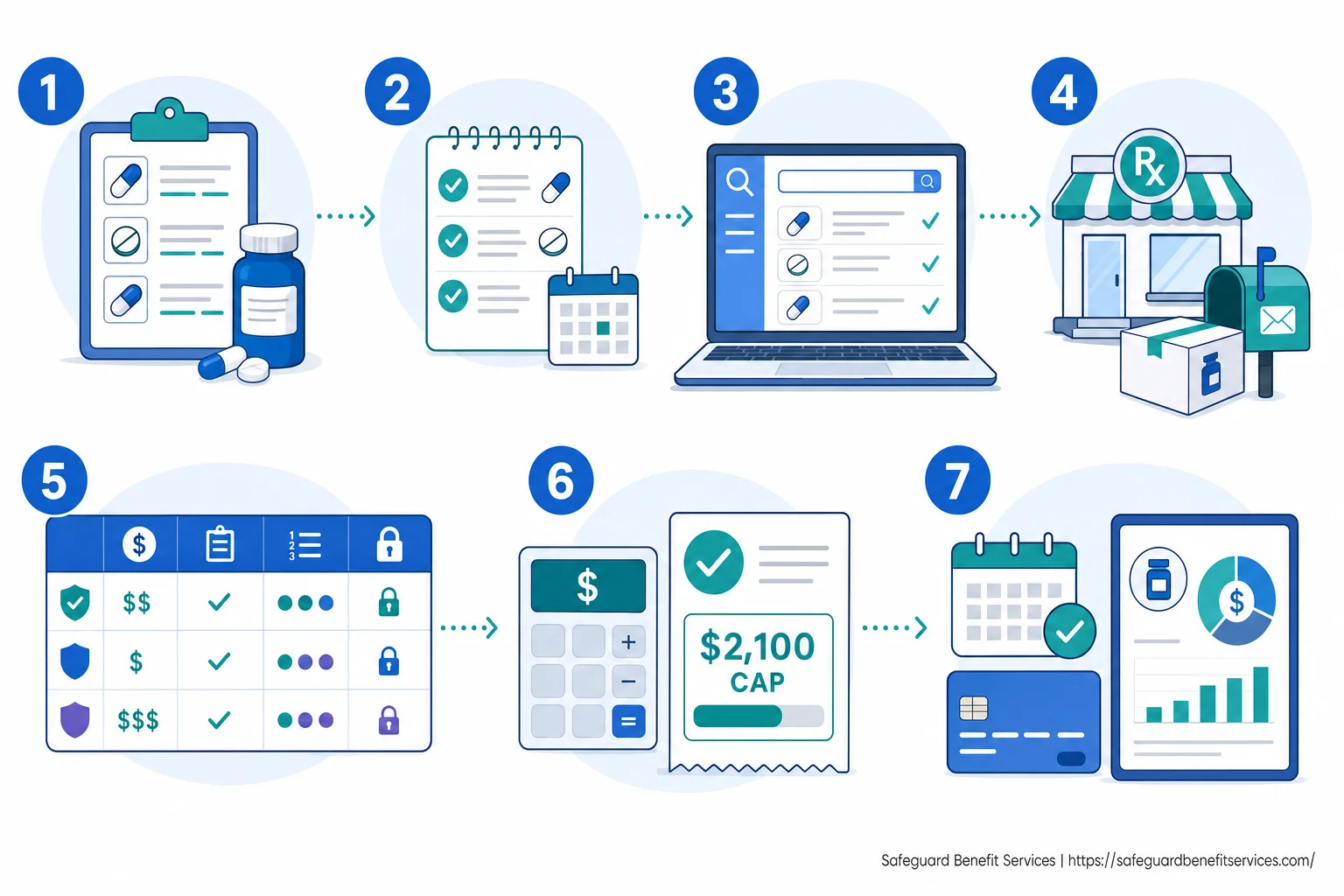
Use Medicare’s official Plan Finder to compare plans in your ZIP code. You can enter your exact medications, doses, and preferred pharmacies to see each plan’s estimated monthly and yearly drug costs (including premiums). This is the most reliable way to project your 2026 spending.
Practical steps we use with our clients in Charlotte and across North Carolina:
- List each medication with its exact name, dose, and frequency (include future medications your doctor already planned).
- On Medicare’s Plan Finder, enter your drug list and choose your preferred pharmacies (local and mail‑order) for apples-to-apples pricing.
- Review each plan’s deductible, tiers, and any prior authorization or step therapy that could affect fills.
- Confirm whether your pharmacies are “preferred” to capture lower copays.
- Add your plan’s premium to the estimated drug costs to see total annual spending.
- If your early‑year costs look high, consider the Medicare Prescription Payment Plan to spread payments monthly.
Important: Estimates assume you fill exactly as entered; switching to non‑preferred pharmacies, changing doses, or adding a new brand medication can increase your out‑of‑pocket costs. Re‑check your estimate if anything changes mid‑year.
Does it matter if my prescription drug coverage is a stand‑alone Part D plan or part of a Medicare Advantage HMO/PPO?
You can get prescription drug coverage either through a separate prescription drug plan (PDP) with Original Medicare or in a Medicare Advantage plan that includes Part D (MA‑PD). If you’re in a Medicare Advantage HMO/PPO, you generally must use the plan’s network for medical care, and your Part D pharmacy network is set by that MA‑PD plan. If you enroll in a stand‑alone drug plan while in an HMO/PPO MA‑PD, you’ll be disenrolled from the MA‑PD and returned to Original Medicare.
What changed from 2025 to 2026 that I should know about?
Two big items: the annual out‑of‑pocket cap rose from $2,000 (2025) to $2,100 (2026), and the standard deductible increased to $615. The 25% coinsurance in the initial coverage stage and the $0 cost sharing above the out‑of‑pocket threshold continue in 2026, further protecting beneficiaries from very high prescription drug costs.
How do Extra Help and other savings programs affect my Part D costs in 2026?
Extra Help (the Low-Income Subsidy) can lower your premium, deductible, and copays—often to very small amounts. In 2026, people with Extra Help pay $0 for covered drugs after they reach the $2,100 out‑of‑pocket threshold (and many pay only minimal amounts before then). If you think you might qualify, applying can dramatically reduce your prescription drug costs.
What if I don’t take prescriptions now—should I skip Part D in 2026?
Think carefully. If you go without creditable prescription coverage and later enroll, you’ll likely owe a late enrollment penalty added to your premium—calculated using the $38.99 national base beneficiary premium for 2026 and the number of uncovered months. Many beneficiaries choose an inexpensive drug plan now to avoid a lifetime penalty and to be protected if a new medication is prescribed mid‑year.
Any North Carolina‑specific tips for formularies and pharmacy networks?
Yes. In Charlotte and surrounding communities (Mecklenburg, Gaston, Union, Cabarrus, Iredell), formularies and preferred pharmacy arrangements vary by county and ZIP code. Regional grocers, independent pharmacies, and national chains may have different cost‑sharing status across plans. Always run your drug list with your exact pharmacies in Medicare’s Plan Finder before enrolling, and ask us to compare local HMO vs. PPO Medicare Advantage networks if you’re considering a switch.
When can I change my Medicare Part D plan for 2026 or beyond?
You can change plans during Open Enrollment (October 15–December 7); changes take effect January 1 of the following year. Special Enrollment Periods may apply if you move, lose other coverage, qualify for Extra Help/Medicaid, or if your plan’s contract changes. If you’re already in a Medicare Advantage plan with drug coverage, the Medicare Advantage Open Enrollment Period (January 1–March 31) may offer additional options.
Quick answers to other common 2026 questions
- Do insulin and vaccines still have special protections? Yes—adult ACIP vaccines are $0 under Part D, and special insulin cost‑sharing rules continue in 2026 under IRA updates.
- Is the $2,100 cap automatic? Yes. Your plan tracks your out‑of‑pocket costs; once you reach $2,100 on covered Part D drugs in 2026, your copays drop to $0 for the rest of the year.
- Does the Prescription Payment Plan lower my costs? No. It spreads payments out; it doesn’t change your deductible, coinsurance, premium, or the $2,100 cap.

Need help comparing 2026 plans, formularies, and pharmacies in North Carolina?
Safeguard Benefit Services is an independent North Carolina agency with local Medicare expertise. We’ll enter your exact prescriptions, check formularies and preferred pharmacies in Charlotte and nearby counties, and compare Part D and Medicare Advantage plan options—so you can see your estimated yearly drug costs before you enroll. Get personal, no‑pressure guidance at safeguardbenefitservices.com.
Sources
- Centers for Medicare & Medicaid Services (CMS) — 2026 Rate Announcement; updated standard benefit parameters, including $615 deductible and $2,100 OOP threshold.
- Medicare.gov — How much Medicare drug coverage costs and 2026 coverage stages; Plan Finder tools; pharmacy network definitions; late enrollment penalty formula with $38.99 base premium.
- CMS/Medicare — Final CY 2026 Part D Redesign and related fact sheets confirming $2,100 OOP cap and $0 cost sharing above threshold.
- Medicare.gov — Medicare Prescription Payment Plan explanation and examples.
- Medicare.gov/CDC — $0 out‑of‑pocket ACIP‑recommended adult vaccines under Part D.
Professional guidance you can trust
We help North Carolina beneficiaries and caregivers understand medicare part d details, compare HMO vs. PPO options, and plan for prescription drug costs with confidence. Talk with a licensed, independent agent who will put your needs first at safeguardbenefitservices.com.
This article is for informational purposes only and does not constitute financial advice. Consult a qualified professional for your specific situation.
Sources
- medicare.gov — Basics
- cms.gov — 2026 Announcement
- cms.gov — Medicare Advantage Medicare Prescription Drug Programs Remain Stable Cms Implements Improvements
- medicare.gov — How Drug Plans Work
- medicare.gov — 10110 Your Guide To Medicare Preventive Services
- medicare.gov — Prescription Payment Plan
- medicare.gov — Examples
- medicare.gov — Pharmacies
- medicare.gov — Costs
- medicare.gov — Helpful Tools
- medicare.gov — Plan Compare
- medicare.gov — Drug Costs
- medicare.gov — Open Enrollment
- cms.gov — Final Cy 2026 Part D Redesign Program Instructions







Get Connected