

Most Medicare Advantage plans charge a flat copay for an emergency room visit, and the amount depends on your plan. Published 2026 examples sit around $130 per visit. Many plans waive the copay if you are admitted to the hospital, and emergency care is covered even when the hospital is outside your network. Your exact number is in your plan’s Summary of Benefits and Evidence of Coverage.
Below, we explain how the copay works, why it differs from plan to plan, what else can show up on the bill and what to check before you pick or keep a plan.
TL;DR
- A Medicare Advantage ER copay is set by your plan, not by Medicare. One 2026 plan example lists $130 per visit.
- Many plans waive the ER copay if you are admitted within 24 hours, though the exact rule is in your Evidence of Coverage.
- True emergencies are covered at in-network cost sharing even at an out-of-network hospital.
- Ambulance rides, follow-up care and other benefits can carry their own costs.
- Plan costs can change every January 1, so review your Annual Notice of Change each fall.
Table of Contents
- How much is a Medicare Advantage ER copay?
- What the copay usually covers
- When the ER copay is waived
- Emergency care outside your network
- How this differs from Original Medicare
- Why your neighbor’s copay may be different from yours
- Where to find your exact ER cost
- A worked example
- Our perspective
- Get help comparing plans in Charlotte
- FAQ
- Sources
How much is a Medicare Advantage ER copay?
There is no single national figure. Each Medicare Advantage plan sets its own premiums, deductibles and service cost sharing, so the ER copay is one number among many that differ between plans. Medicare explains that these amounts can differ from Original Medicare and that what you pay can only change once a year, on January 1.
Here are published 2026 examples, so you can see the range of how plans write it:
| Plan example (2026) | ER copay | If admitted |
|---|---|---|
| AARP Medicare Advantage from UHC TX-001P (HMO-POS) | $130 per visit | Check plan documents |
| Infirmary Health Advantage (HMO) | $130 per visit | Waived if admitted to the same hospital within 24 hours for the same condition |
| A UHC Medicare Advantage example plan | $130 per visit | You pay the inpatient hospital copay instead of the ER copay if admitted within 24 hours |
These are examples, not a promise about your plan. Some plans charge less and some charge more, and the search results for this topic show everything from double-digit to triple-digit copays. Treat any number you read online as a reason to open your own plan documents.
What the copay usually covers
For most plans, the ER copay is meant to be all-inclusive for the services billed on the emergency room claim. UnitedHealthcare’s Medicare Advantage copay guidelines describe the ER copay that way, while also listing separate cost-share categories for other benefits such as durable medical equipment. Other carriers word it differently, so confirm in your own Evidence of Coverage.
That is why the ER copay alone does not tell you the whole cost of a bad night. A few other pieces can sit outside it:
- Ambulance transport. Plans list ambulance as its own benefit with its own cost sharing.
- Follow-up care. Once the emergency is over, follow-up visits are covered, but if the follow-up provider is out of network, higher out-of-network cost sharing may apply.
- Equipment and prescriptions. Crutches, a boot or take-home prescriptions fall under other parts of your coverage.
When the ER copay is waived
If the emergency visit turns into a hospital stay, many plans drop the ER copay. UnitedHealthcare’s guidelines say the ER copay is waived when the visit results in an admission within 24 hours, with plan-specific details in the member’s Evidence of Coverage.
The fine print matters here. In one 2026 plan example, the ER copay is waived only if you are admitted to the same hospital within 24 hours for the same condition. In another, you stop paying the ER copay but pay the inpatient hospital copay instead. So “waived” can mean you owe nothing for the ER portion and something else for the stay.
Ask yourself two questions when you read a plan:
- How long is the window after the ER visit for the admission to count?
- What do I pay for the inpatient stay once the ER copay drops away?
Emergency care outside your network
You do not need to hunt for an in-network ER when something serious is happening. Cost sharing for medically necessary emergency services is the same for network and out-of-network providers under UnitedHealthcare’s Medicare Advantage guidelines. A sample Humana Evidence of Coverage goes further: you don’t need a referral from your primary care doctor for emergency care, and you can get covered emergency care anywhere in the United States or its territories.
Network rules bite elsewhere. Medicare advises that your plan may not cover services, or may charge more, if you go outside the network for non-emergency or non-urgent care. That is the difference worth remembering: the rules are forgiving in a true emergency and stricter for everything else.
Emergency room versus urgent care
Plans define an emergency using a “prudent layperson” standard: a situation where a person with average health knowledge would expect that not getting immediate care could seriously harm them. An “urgently needed service” is immediate care that is not an emergency, often when you are temporarily outside the plan’s service area or it is not reasonable to reach network care in time.
The copays often differ too. Urgent care typically costs less than the ER on a plan’s benefit chart, so if your problem is a sprained ankle or a stubborn infection and not chest pain or stroke symptoms, your plan’s urgent care benefit may be the cheaper fit. If you think it could be life-threatening, call 911 or go to the nearest ER. The cost question comes second.
Emergencies while traveling
In the UHC plan example above, the emergency care copay is $0 when the care happens outside the United States. That is a feature of that plan, not a rule. Original Medicare generally does not cover care abroad, and plans that do offer a foreign emergency benefit set their own limits. If you travel, find that line in your Summary of Benefits before you go.
How this differs from Original Medicare
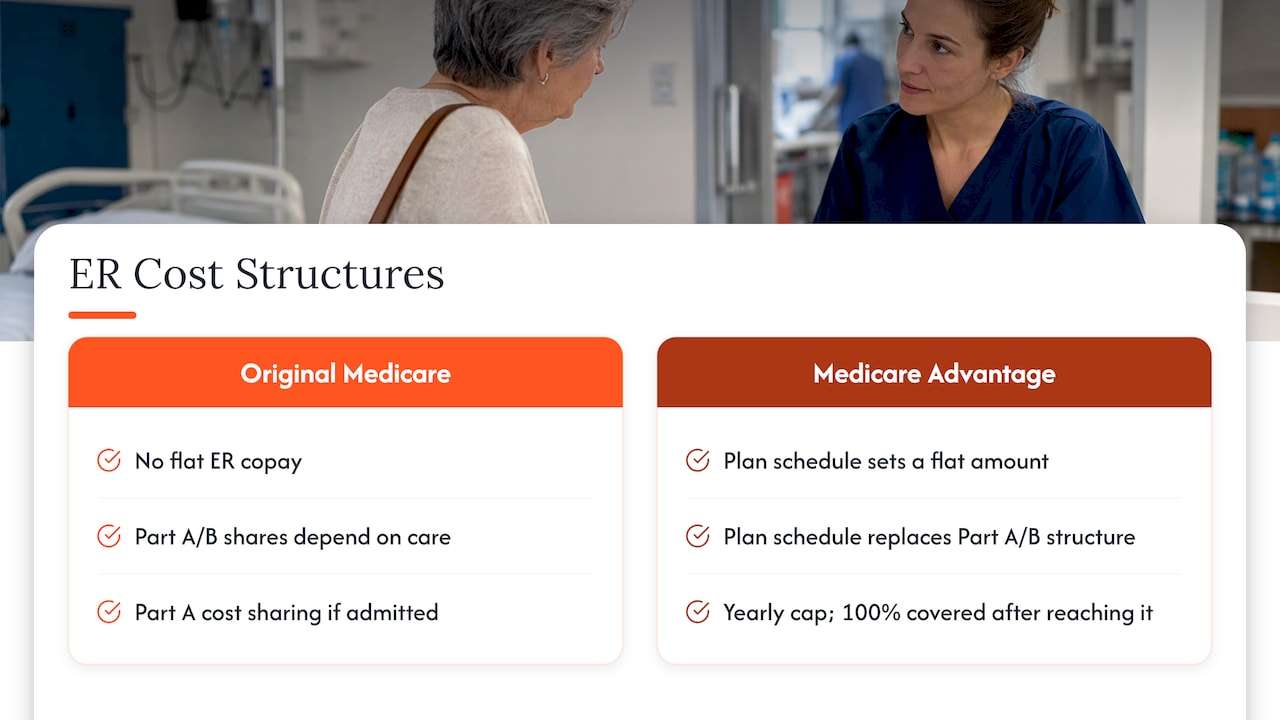
Original Medicare has no flat ER copay in the way most Advantage plans do. You pay a share of costs under Part A or Part B depending on what happens: the hospital outpatient copayment structure and Part B coinsurance for the doctor’s services if you are treated and released, and Part A cost sharing if you are admitted. That is why many people with Original Medicare pair it with a Medicare Supplement plan.
A Medicare Advantage plan swaps that structure for its own schedule. You see a predictable flat number on the benefit chart, and there is a yearly cap on your spending. Medicare Advantage plans have an annual out-of-pocket limit that varies by plan. Once you hit it, the plan pays 100% of covered health services for the rest of the calendar year. If a hard ceiling on a bad year matters to you, see our breakdown of 2026 Medicare Advantage out-of-pocket maximums. For the bigger side-by-side, our guide Medicare Advantage vs. Original Medicare walks through the trade-offs.
Why your neighbor’s copay may be different from yours
Three things drive the gap.
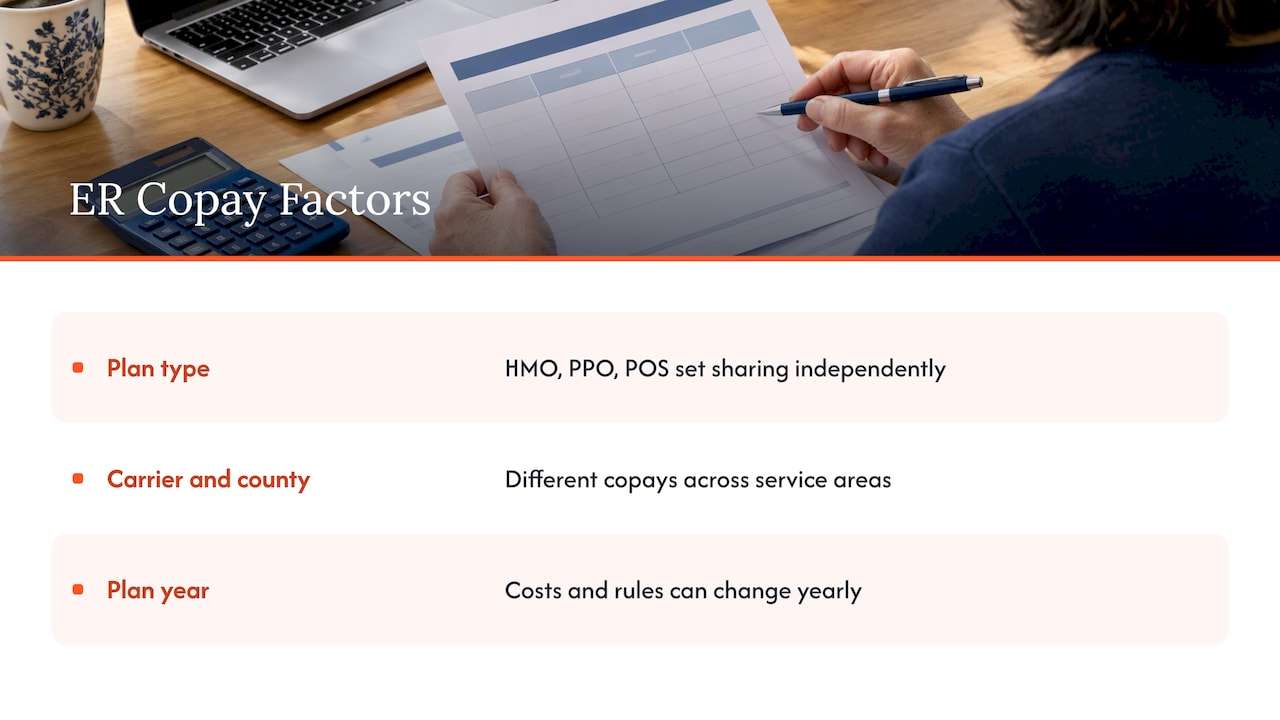
Plan type. HMO, PPO and POS plans all set cost sharing independently. Our overview of HMO plans covers how network rules shape what you pay.
Carrier and county. The same carrier can offer different plans with different copays in different service areas. A plan sold in Charlotte can have a different ER copay than one sold in Texas.
Plan year. Costs and rules can change each year. Plans must notify members through the Annual Notice of Change, typically mailed before September 30, with changes effective in January.
KFF notes that not all Medicare Advantage plans have the same cost-sharing requirements, and suggests comparing through Medicare’s plan comparison tool or by calling 1-800-MEDICARE. Your State Health Insurance Assistance Program (SHIP) can also provide local personalized counseling.
Where to find your exact ER cost
You can find the number in about five minutes:
- Open your Annual Notice of Change, or your Summary of Benefits if you are shopping.
- Find the “Emergency care” line, usually under outpatient or hospital benefits.
- Note the copay, whether it is waived on admission and the time window.
- Look for a separate line for ambulance services and for urgently needed services.
- Check for a worldwide or foreign emergency benefit if you travel.
- Find the plan’s out-of-pocket maximum, since it caps your total covered spending.
Medicare also advises that you contact your plan for more information about cost sharing and what it covers.
It is open enrollment season right now, and the window to change plans for next year is short. Our checklist 5 checks before December 7 covers what to review. If you want more background on how your costs fit together, see understanding Medicare costs and our guide to Medicare Advantage costs.
A worked example
Say your plan lists a $130 ER copay, waived on admission within 24 hours.
- Treated and sent home. You pay the $130 ER copay. You may also owe separately for an ambulance ride if you took one, and for any follow-up visits.
- Admitted from the ER. The $130 is waived. You pay what the plan lists for an inpatient stay instead, which is a separate schedule in the same benefits document.
- Third ER visit in a year. You pay the copay each time until your total covered spending reaches the plan’s out-of-pocket maximum. After that, the plan pays 100% of covered services for the rest of the calendar year.
Those figures are illustrations built on the plan examples above. Your plan’s terms are what count.
Our perspective
Most people who call us about an ER copay are not really asking about the ER. They are asking whether their plan will hold up on its worst day. The copay is only one line. We look at the ER copay, the inpatient copay, the ambulance benefit, the out-of-pocket maximum and whether your doctors and hospital are in the network, all together.
We train our agents to explain the tradeoffs plainly, so you can pick coverage with your eyes open. Our guidance comes at no extra cost to you, and we stay with you after you enroll. That means a yearly plan review, because a plan that suited you last year can look different on January 1.
If you are nearing 65, or your Annual Notice of Change just arrived, bring it to us. We will read it with you, line by line, and show you what an emergency would actually cost under each option, including pairing Medicare Advantage with extras like hospital indemnity coverage.
Zach
Get help comparing plans in Charlotte
Safeguard Benefit Services is a Medicare insurance agency in Charlotte, North Carolina. We help you compare Medicare Advantage plans, Medicare Supplements, prescription drug plans and extras such as dental, vision, hearing and hospital indemnity coverage. We also offer a free Medicare roadmap that lays out your options and eligibility.

If you want a second set of eyes on your ER copay and out-of-pocket maximum, talk with our team about Medicare Advantage plans. If you want a cash benefit that can help with a hospital stay on top of your plan, read about hospital indemnity insurance.
FAQ
Does Medicare Advantage cover the emergency room?
Yes. Medicare Advantage plans cover emergency care, and a sample plan document says you can get it anywhere in the United States or its territories, even if the provider is not in your network. You still pay the ER copay your plan lists. Check your Evidence of Coverage for the amount.
Is the ER copay waived if I am admitted?
Often, but not always in the same way. Some plans waive the ER copay if you are admitted within 24 hours. Others replace it with the inpatient hospital copay. Look for the waiver and its time window in your Summary of Benefits.
Is the copay the same at an out-of-network hospital?
For a true emergency, UnitedHealthcare’s guidelines say cost sharing is the same for network and out-of-network providers. Follow-up care after the emergency is different, since out-of-network follow-up can cost more. Confirm with your plan.
Can my ER copay change during the year?
No. Medicare says that what you pay in a plan can only change once a year, on January 1. Your Annual Notice of Change tells you what is changing before then. Review it each fall.
Who can help me compare ER costs across plans?
You can use Medicare’s plan comparison tool, call 1-800-MEDICARE or contact your state SHIP. A licensed agent such as ours in Charlotte can also walk through the numbers with you, and our help costs you nothing extra.
Sources
- AARP Medicare Advantage from UHC TX-001P (HMO-POS), 2026 plan details
- UnitedHealthcare Medicare Advantage copay guidelines
- Infirmary Health Advantage (HMO) 2026 summary of copays
- UHC Medicare Advantage example plan, 2026 benefits
- Humana Evidence of Coverage example, 2026
- Medicare.gov: Understanding health plan costs
- Medicare.gov: Medicare costs
- Medicare.gov: Understanding Medicare Advantage Plans
- Medicare.gov: Learning What Medicare Covers and Your Costs
- KFF: Are covered benefits and cost-sharing requirements the same under Medicare Advantage plans?
Recommended
Request a No Obligation Phone Call








Get Connected