

Original Medicare tends to fit people who want to see any doctor who accepts Medicare, travel often, or manage a complex specialist schedule. Medicare Advantage tends to fit people who want bundled dental, vision, and drug coverage plus a yearly spending cap, and who don’t mind a defined network. Before deciding, pull your current doctor list and prescription list. Everything else follows from those two documents.
TL;DR:
- Verify which of your current doctors are contracted with the Medicare plans you consider, as networks update quarterly and directories often lag.
- Consider your out-of-pocket costs carefully by comparing recent healthcare spending against each plan’s copay and coinsurance structures, especially if you anticipate significant medical needs.
- Check the specific coverage details for prescription drugs, dental, vision, and hearing benefits, as Advantage extras are often capped, and out-of-network costs can be high.
- Understand that Medigap offers a guaranteed-issue window during initial enrollment, which is essential for protection against high costs if health needs increase later.
- Be aware that Medicare Advantage plans change their networks, formularies, and costs annually, so re-evaluate your choice each open enrollment to avoid surprises.
Table of Contents
- Advantage vs Original Medicare: Doctor and Hospital Choice
- What Does Original Medicare vs. Medicare Advantage Actually Cost?
- Coverage and Extra Benefits: Part D, Dental, Vision, and Hearing
- Out-of-Pocket Limits and Medigap: The Trade-Off Nobody Explains Well
- When Can You Enroll or Switch Plans?
- How to Choose Between Original Medicare and Medicare Advantage
- Why This Decision Deserves More Attention Than It Gets
- Get a Personalized Medicare Comparison in Charlotte
- Where to Verify Plan Details Before You Enroll
- Sources
Advantage vs Original Medicare: Doctor and Hospital Choice
The single biggest fork in the road is provider access, and it’s usually the one people underestimate until they’re mid treatment and discover their specialist is out of network.
Under Original Medicare, you can walk into any hospital or clinic that accepts Medicare, anywhere in the country, and in most cases you don’t need a referral to see a specialist. Medicare as one of the defining differences between the two paths. Medicare Advantage flips that arrangement. Most plans run on an HMO or PPO network, and stepping outside it can mean paying full price or getting nothing covered at all.
Here’s what changes depending on the plan type:
- HMOs generally require a primary care referral before you see a specialist and cover almost nothing out of network except emergencies.
- PPOs allow out-of-network care but charge noticeably higher coinsurance for it.
- Many plans also require prior authorization for procedures like MRIs, certain surgeries, or hospital stays, which can sometimes delay care.
Before enrolling in anything, call your current doctors’ offices directly and ask which Advantage plans they’re contracted with this year. Plan directories go stale fast.
Pro Tip: Don’t just check the network list online. Networks get updated quarterly, but the published directory sometimes lags. A phone call to the front desk takes five minutes and settles it.
What Does Original Medicare vs. Medicare Advantage Actually Cost?
Sticker price and real cost are two different numbers, and Medicare Advantage plans are notorious for winning on the first while losing on the second for people with heavy medical needs.
Original Medicare’s Part B premium is set annually and applies regardless of which plan you eventually choose, since Part A and Part B form the baseline for both paths. Medicare Advantage plans replace that structure with their own copays and coinsurance, and many carry a $0 monthly premium because the plan is reimbursed directly by Medicare for your care.
That $0 premium is the number that gets advertised everywhere, and it’s also the number that tells you the least about what you’ll actually spend.
A workable way to estimate your real annual cost:
- List your visits and procedures from the past 12 months (primary care, specialists, imaging, ER trips).
- List every prescription and its dosage.
- Price that list against a candidate Advantage plan’s copay schedule and against Original Medicare plus a Part D plan (and Medigap, if you’re considering it).
- Add a buffer for anything unplanned. One hospital stay changes the math completely.
A useful mental model: think of Original Medicare plus Medigap as a higher fixed monthly cost with almost no surprises, and Medicare Advantage as a lower fixed cost with variable, sometimes large, costs depending on what happens to your health that year.
Coverage and Extra Benefits: Part D, Dental, Vision, and Hearing
If you go with Original Medicare, drug coverage doesn’t come with it. You have to buy a standalone Part D plan separately, and Original Medicare offers essentially no routine dental, vision, or hearing coverage on its own.
Medicare Advantage plans usually bundle things differently. Most include Part D built in, and many add extras like routine dental cleanings, eyewear allowances, hearing aid credits, and sometimes gym memberships or over-the-counter allowances. That bundling is genuinely appealing, but it comes with strings.
Watch for these trade-offs before you assume the extras are a clean win:
- Dental and vision allowances on Advantage plans are often capped annually (sometimes a few hundred dollars), and going out-of-network for dental work can erase the savings fast.
- Drug formularies differ plan to plan; a medication covered cheaply on one Advantage plan might sit in an expensive tier on another.
- OTC and fitness perks sound generous but rarely move the needle if you’re comparing plans based on major medical costs.
Check the specific dental, vision, and hearing coverage tied to any plan you’re considering, not the marketing summary. And if you’re leaning toward Original Medicare, price out a standalone dental or vision plan now, not after a crown breaks.
Out-of-Pocket Limits and Medigap: The Trade-Off Nobody Explains Well
Medicare Advantage plans are legally required to have an annual out-of-pocket maximum for covered Part A and Part B services. Original Medicare has no such cap built in.
That’s the gap Medigap exists to fill, and it’s also where timing becomes a real financial risk rather than a technicality.
- Medigap has the strongest guaranteed-issue protections during your Initial Enrollment Period, when insurers generally can’t deny you or charge more for health conditions.
- Miss that window, and in most states insurers can medically underwrite you, meaning a health condition can get you denied or priced out entirely.
- Switching from Medicare Advantage back to Original Medicare later can leave you trying to buy Medigap outside that protected window, with no guarantee you’ll qualify.
Pro Tip: If there’s any chance you’ll want Original Medicare plus Medigap down the road, buying Medigap when you’re first eligible is almost always the safer bet, even if you don’t think you need it yet. Health status can change fast, and the insurer’s underwriting decision won’t wait for convenience.
People with predictable, frequent medical needs, ongoing specialist relationships, or a family history that suggests they’ll need serious care tend to do better with Original Medicare plus Medigap despite the higher combined premium. It’s insurance against the worst-case scenario, not just a payment plan for routine care. For a side-by-side breakdown, see how Medicare Advantage compares with Medigap directly.
When Can You Enroll or Switch Plans?
Timing mistakes are some of the costliest, and most avoidable, errors people make with Medicare.
- Initial Enrollment Period: a seven-month window around your 65th birthday (three months before, your birthday month, three months after) to enroll without penalty.
- Annual Enrollment Period (October 15 to December 7): the main window each year to switch between Original Medicare and Medicare Advantage, change Advantage plans, or adjust Part D coverage.
- Medicare Advantage Open Enrollment (January 1 to March 31): a second, narrower window limited to people already on Advantage who want to switch plans or move back to Original Medicare.
- Special Enrollment Periods: triggered by specific events like moving out of a plan’s service area or losing employer coverage.
Every fall, your plan sends an Annual Notice of Change, and ignoring it is a common, expensive mistake. Networks shrink, formularies shuffle drugs into pricier tiers, and cost-sharing resets, all without you doing anything. Read it every single year, even if you loved your plan last year.
Switching into Medicare Advantage is simple. Switching back out later is where the Medigap underwriting risk from the previous section can bite, so treat that decision as harder to reverse than it looks on paper.
How to Choose Between Original Medicare and Medicare Advantage
Run through this before your next enrollment window closes:
- List every doctor and specialist you see regularly, then confirm which ones accept Original Medicare and which Advantage networks include them.
- Pull your prescription list and check formulary tiers on any Advantage plan or standalone Part D plan you’re comparing.
- Estimate your total annual cost using last year’s actual medical spending as your baseline, not a guess.
- Check your state’s Medigap rules, since guaranteed-issue protections and switching risk vary by state.
- Set a calendar reminder for October to review your ANOC before Annual Enrollment closes on December 7.
When you talk to a plan rep or advisor, ask directly: Is my specialist in-network? What services need prior authorization? What’s the exact out-of-pocket maximum? What tier is my most expensive drug? Can I keep my current pharmacy? What happens if I need care while traveling?
Pro Tip: If your answers to “how often do I see specialists” and “do I travel for months at a time” are both high, weight your decision toward Original Medicare plus Medigap, even at a higher monthly cost. If both are low, an Advantage plan’s bundled extras often deliver more value for less money.
Why This Decision Deserves More Attention Than It Gets
Most people treat this choice like a one-time fork in the road. It isn’t. Medicare Advantage plans reset their networks, formularies, and cost-sharing every single year, which means the plan that fit your life perfectly at 65 might not fit at 68. Original Medicare doesn’t have that problem, but it trades stability for a lack of any spending ceiling unless you’ve locked in Medigap while you still qualified medically.
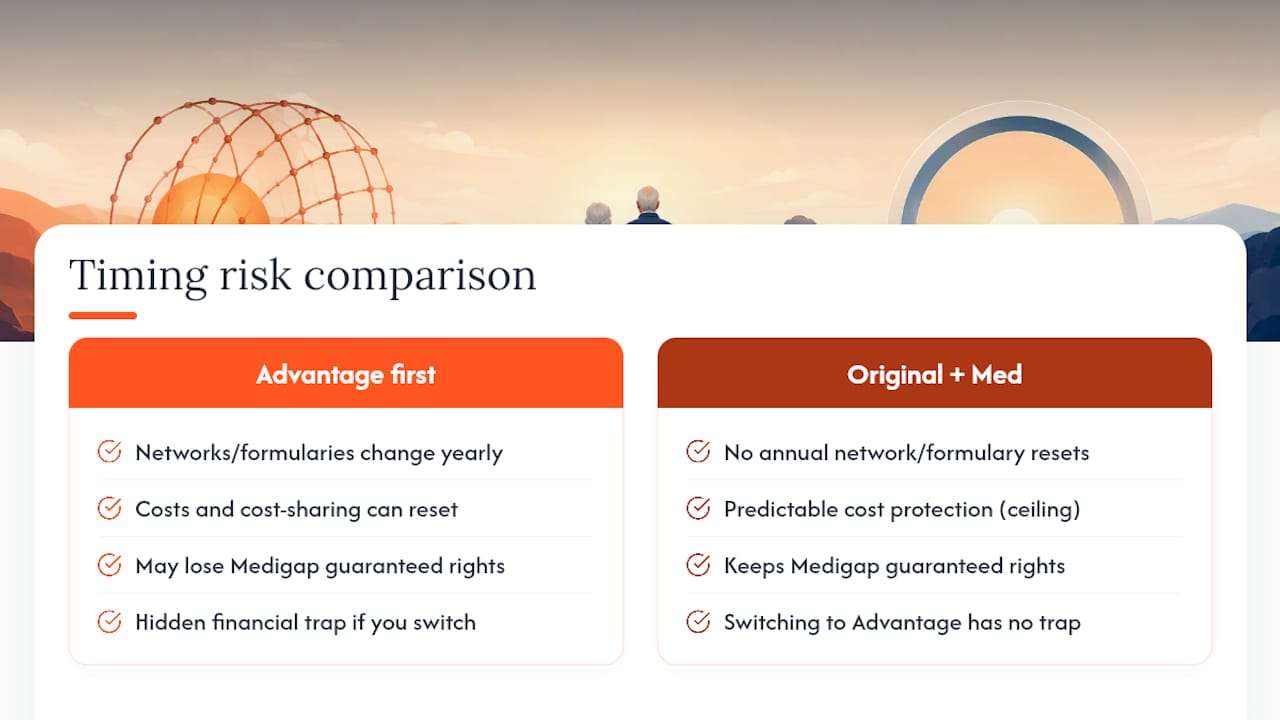
The part that gets glossed over in most comparisons is the asymmetry of risk. Choosing Medicare Advantage first and deciding to move to Original Medicare later is a financial decision with a hidden trapdoor: your Medigap guaranteed-issue rights may already be gone by the time you want them. Choosing Original Medicare with Medigap first and later deciding you want Advantage’s extra benefits carries no such trap. That asymmetry alone should weigh heavier in the decision than most people give it credit for.
Safeguard Benefit Services trains its advisory team specifically on this timing risk, because it’s the detail that causes the most regret years after enrollment. A free Medicare roadmap walks through your specific provider list, prescriptions, and state Medigap rules to translate the checklist above into an actual recommendation. That said, this article is educational. It’s not enrollment paperwork, and no plan decision should be finalized without reviewing the specific plan documents for your zip code and situation.
— Zach
Get a Personalized Medicare Comparison in Charlotte
Reading about provider networks and out-of-pocket caps only gets you so far. What actually settles the Medicare Advantage vs. Original Medicare question is running your specific doctors, prescriptions, and budget against real plan numbers, not averages. Safeguard Benefit Services does exactly that for people in Charlotte and across North Carolina, at no cost to you, because we’re paid by the carriers, not by you.

Bring your current medication list, your top three doctors, and a rough sense of how often you expect to need care this year. In one consultation, we’ll compare your options side by side, flag any Medigap timing risk specific to your situation, and show you exactly what you’d pay under each path. If Medicare Advantage looks right for you, our Medicare Advantage plan guide breaks down how Part C actually works before you commit. Call or book a free consultation this week, before the next enrollment deadline sneaks up on you.
Where to Verify Plan Details Before You Enroll
Always confirm specifics directly through Medicare.gov’s plan finder and CMS data, along with policy explainers from KFF and AARP. Before enrolling in any plan, read its current-year ANOC and formulary yourself, not just a summary.
This article is general information, not a substitute for advice from a qualified doctor. Consult a qualified healthcare professional about your own circumstances before acting on anything here.
Sources
- Medicare
- Original Medicare vs. Medicare Advantage | AARP
- What is a Medicare Advantage plan? How does it differ from traditional Medicare? | KFF








Get Connected