

If you are comparing Medicare Advantage HMO vs PPO Charlotte plans, the biggest question is usually not just price. It is whether your doctors, hospitals, prescriptions, referral rules, and travel habits fit the plan’s network before you enroll.
How does Medicare Advantage HMO vs PPO Charlotte coverage work?
Medicare Advantage plans, also called Medicare Part C, are private insurance plans approved by Medicare. According to Medicare.gov, these plans must cover medically necessary services that Original Medicare covers, but they can use provider networks, prior authorization rules, copays, and different out-of-pocket structures.
In Charlotte, the Medicare Advantage HMO vs PPO Charlotte decision often comes down to access to major health systems such as Atrium Health and Novant Health. A plan may look attractive on premium, dental benefits, or over-the-counter allowances, but those extras matter less if your preferred cardiologist, primary care doctor, or hospital is not in network.
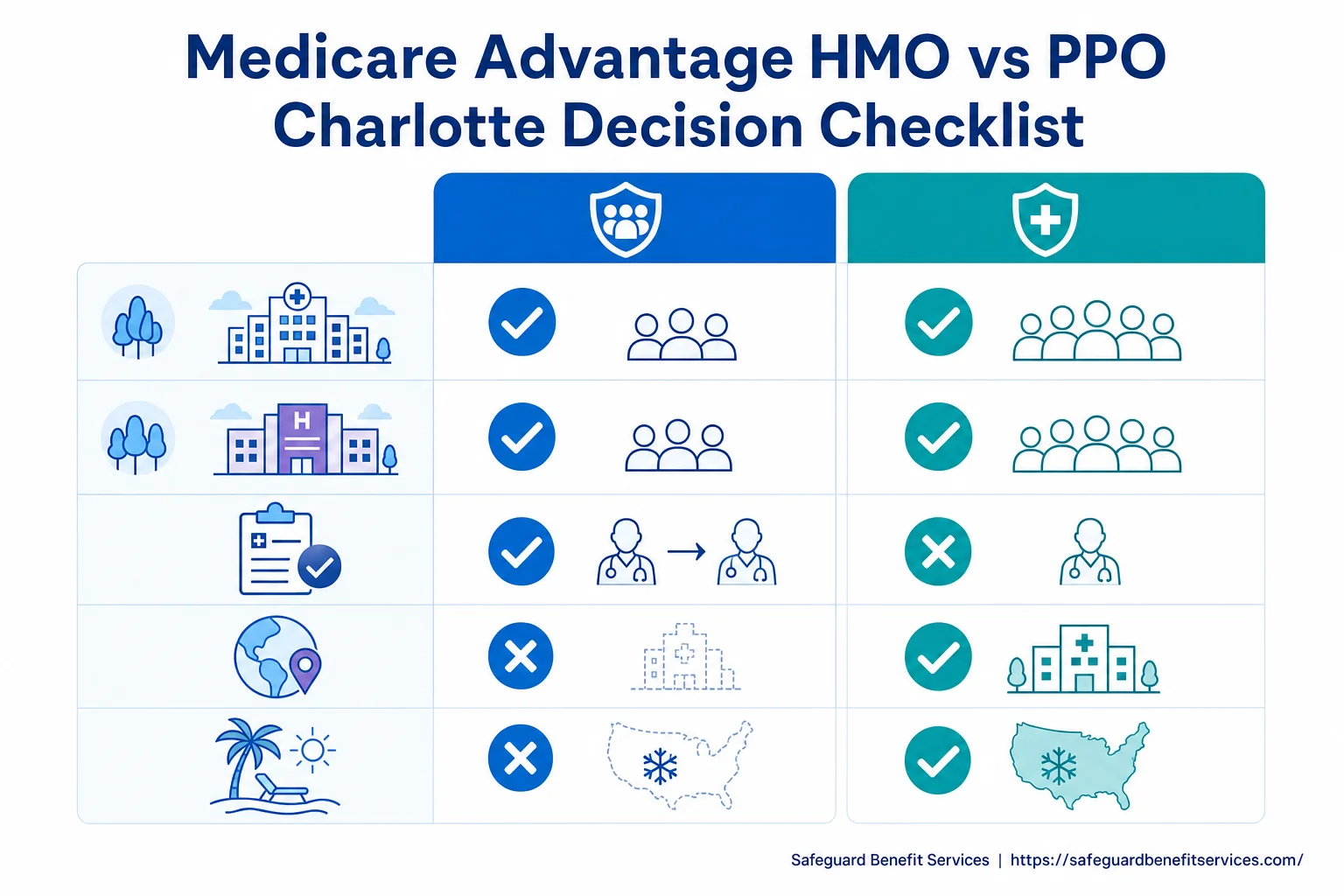
An HMO, or Health Maintenance Organization, generally requires you to use in-network providers except for emergencies, urgent care, and certain covered situations such as out-of-area dialysis. A PPO, or Preferred Provider Organization, usually gives you more flexibility to see out-of-network providers, but you may pay more when you do.
For many Charlotte retirees, the practical question is simple: “Can I keep seeing my doctors without surprise costs?” That answer can vary by insurance carrier, county, plan year, provider group, and even individual doctor contract.

Which is better for Atrium Health and Novant Health access in Charlotte?
The best Medicare Advantage HMO vs PPO Charlotte choice depends on which health system and individual providers you rely on. Atrium Health and Novant Health both have extensive footprints in the Charlotte region, but network participation is plan-specific and can change from year to year.
Do not assume that “Atrium is in network” or “Novant is in network” means every affiliated physician, clinic, hospital, lab, imaging center, or specialist is included. Medicare.gov advises beneficiaries to check plan provider directories, but experienced agents also know that directories should be verified directly with the provider office when possible.
When comparing HMO and PPO options, check access at three levels:
- Hospital access: Confirm whether the hospitals you prefer, such as major Atrium Health or Novant Health facilities in the Charlotte area, are listed as in network.
- Doctor access: Verify your primary care physician, specialists, and medical groups by name and location.
- Service access: Ask about labs, imaging centers, rehabilitation providers, durable medical equipment suppliers, and outpatient surgery centers.
An HMO may work well if your doctors are all in one participating network and you are comfortable staying inside that system. A PPO may be more useful if you split care between multiple provider groups, want more specialist flexibility, or are concerned about future provider changes.
What are the biggest cost differences in Medicare Advantage HMO vs PPO Charlotte plans?
Costs are not limited to the monthly premium. The Centers for Medicare & Medicaid Services explains that Medicare Advantage plans can charge different copays, coinsurance, deductibles, and maximum out-of-pocket limits, and those amounts vary by plan.
HMO plans often have lower premiums and predictable in-network copays. PPO plans may have higher premiums or higher out-of-pocket costs, but they can offer access to out-of-network care at a higher cost-sharing level.
When comparing Medicare Advantage HMO vs PPO Charlotte options, review these cost categories carefully:
- Monthly premium: Some plans have $0 premiums, but you still must pay your Medicare Part B premium unless you qualify for assistance.
- Primary care and specialist copays: Compare what you pay for routine visits and specialty visits.
- Inpatient hospital costs: Look at daily copays, per-stay charges, and total potential exposure.
- Out-of-network costs: PPO plans may cover out-of-network care, but the member cost can be significantly higher.
- Maximum out-of-pocket limit: Medicare Advantage plans have annual limits for covered Part A and Part B services, but in-network and out-of-network limits may differ.
According to KFF’s 2024 Medicare Advantage enrollment analysis, more than half of eligible Medicare beneficiaries are enrolled in Medicare Advantage plans. That popularity does not mean every plan fits every person; it means careful comparison is more important because plan designs vary widely.
How do referral rules affect Charlotte specialists?
Referral rules can be one of the most important differences between an HMO and a PPO. In many HMO plans, your primary care provider coordinates care and may need to issue referrals before you see certain specialists.
PPO plans typically do not require referrals for covered specialist visits, although prior authorization may still apply for certain procedures, imaging, medications, or facility-based services. Medicare.gov notes that Medicare Advantage plans may use prior authorization for some services, so “no referral” does not always mean “no approval process.”
In a real-world Charlotte scenario, this matters if you see several specialists across cardiology, oncology, orthopedics, endocrinology, or neurology. If those specialists are in network and referral rules are easy to manage, an HMO may be efficient. If you prefer more direct specialist access, a PPO may feel less restrictive.
Before enrolling, ask these questions:
- Does the plan require a primary care physician selection?
- Are referrals required for specialists I already see?
- Does the specialist need to be in the same medical group or network?
- Which services require prior authorization?
- What happens if I see a specialist without a required referral?
What out-of-network exposure should Charlotte residents watch for?
Out-of-network exposure is where the Medicare Advantage HMO vs PPO Charlotte comparison can become expensive. With most HMOs, non-emergency out-of-network care is generally not covered unless the plan authorizes it or a special exception applies.
With Medicare Advantage PPOs, out-of-network care is usually covered, but you can typically face higher copays or coinsurance. PPOs must use a single deductible that applies to both in-network and out-of-network Part A and Part B services, and they must have a higher combined in-network and out-of-network maximum out-of-pocket limit alongside an in-network maximum, not a separate out-of-network-only maximum. Some providers may also choose not to accept the plan’s payment terms, so it is important to confirm before receiving non-emergency care.
This is especially important for Charlotte residents who receive care in nearby areas such as Matthews, Huntersville, Concord, Gastonia, Rock Hill, or Lake Norman communities. A short drive does not guarantee that a provider is in network.
Out-of-network exposure can appear in less obvious places:
- Hospital-based physicians: An in-network hospital does not always mean every anesthesiologist, radiologist, or consulting physician is in the plan network.
- Imaging and labs: A doctor may order tests at a facility that is not preferred by your plan.
- Post-acute care: Skilled nursing facilities, home health agencies, and rehabilitation providers have their own network status.
- Specialty medications: Part B drugs administered in a clinic may involve authorization and network rules.
Federal protections such as the No Surprises Act, enforced by the Centers for Medicare & Medicaid Services and other federal agencies, help protect consumers from certain surprise bills in emergency and some facility-based situations. However, those protections do not replace the need to understand your Medicare Advantage network before planned care.
Is an HMO or PPO better for snowbirds and frequent travelers?
For snowbirds, the Medicare Advantage HMO vs PPO Charlotte decision deserves extra attention. Many North Carolina retirees spend part of the year in Florida, South Carolina, the mountains, or with family in another state.
Medicare.gov explains that Medicare Advantage plans must cover emergency and urgent care, even when you are outside the plan’s service area. That protection is important, but it is not the same as routine out-of-state care for follow-up visits, chronic condition management, physical therapy, or non-urgent specialist appointments.
An HMO may be a good fit if you travel occasionally and mainly need emergency protection while away. A PPO may be better if you spend months outside Charlotte and want more flexibility to receive routine or specialist care outside the local network.
Snowbirds should ask very specific questions before choosing a plan:
- Will routine care be covered while I am outside North Carolina?
- Does the PPO have a national network or only local out-of-network benefits?
- Can I refill prescriptions at national pharmacies while traveling?
- Are telehealth visits available with my Charlotte providers?
- What happens if I need follow-up care after an emergency while out of state?
Travel patterns should be matched to health conditions. Someone who only takes a few generic prescriptions may have different needs than someone receiving cancer care, cardiac monitoring, infusion therapy, or frequent specialist follow-ups.

How should prescription drug coverage influence the HMO vs PPO choice?
Many Medicare Advantage plans include Part D prescription drug coverage, often called MAPD plans. According to Medicare.gov, plan formularies, pharmacy networks, tiers, prior authorization, quantity limits, and step therapy rules can all affect what you pay for medications.
Do not choose a Medicare Advantage HMO vs PPO Charlotte plan based on medical network alone if you take ongoing prescriptions. A plan with strong Atrium or Novant access may still be a poor fit if your medications are expensive, excluded, or placed on higher tiers.
Review each prescription using the exact drug name, dosage, frequency, and preferred pharmacy. Also compare whether your pharmacy is standard, preferred, or out of network under the plan.
For snowbirds, pharmacy access matters even more. A plan that works well at a Charlotte pharmacy may not price the same at a seasonal pharmacy in Florida or another state.
When does an HMO make more sense than a PPO in Charlotte?
An HMO may be the stronger choice when you want lower costs and your care is already concentrated within the plan’s local network. If your primary care doctor, specialists, hospital, labs, and pharmacy all align, the HMO structure may be straightforward.

A Charlotte HMO can be a good fit if:
- You are comfortable using in-network doctors and facilities.
- Your preferred Atrium Health or Novant Health providers are confirmed in network.
- You do not need routine care outside the service area.
- You prefer coordinated care through a primary care physician.
- You are comfortable following referral and authorization rules.
The tradeoff is flexibility. If a provider leaves the network or you want care outside the plan’s contracted system, your options may be limited except for emergencies, urgent care, or plan-approved exceptions.
When does a PPO make more sense than an HMO in Charlotte?
A PPO may be the stronger choice when flexibility is worth the potential extra cost. This can be especially true if you see specialists in different provider groups or want more room to access out-of-network care.
A Charlotte PPO can be a good fit if:
- You want more flexibility to see providers outside the plan’s main network.
- You split care between Atrium Health, Novant Health, or other regional providers.
- You spend part of the year outside North Carolina.
- You want specialist access without typical HMO referral requirements.
- You are willing to compare higher out-of-network costs before receiving care.
The tradeoff is cost predictability. PPO flexibility is valuable only if you understand the out-of-network rules, provider acceptance, and annual maximum out-of-pocket structure.
How can you verify Atrium Health, Novant Health, and doctor access before enrolling?
The safest way to compare Medicare Advantage HMO vs PPO Charlotte plans is to verify access in multiple ways. Provider directories are useful starting points, but they can lag behind contract updates or list providers at locations where they do not actually accept a specific plan.
Use this verification process before submitting an application:
- Check the plan’s official provider directory: Search by doctor name, clinic location, specialty, and hospital affiliation.
- Call the provider office: Ask whether the doctor accepts the exact plan name, not just the insurance company brand.
- Confirm hospital privileges: Ask where your doctor admits patients or performs procedures.
- Review referral rules: Ask whether your current doctors can refer you to the specialists you use.
- Document the conversation: Write down the date, person you spoke with, and what was confirmed.
In practice, licensed insurance agents often review provider networks, prescription lists, pharmacy pricing, and travel needs together. That is important because a plan that wins on one factor may lose on another.
What should caregivers compare when helping a parent choose?
Caregivers often focus on premium first, but the most important issues are usually access, coordination, and predictability. If your parent has multiple specialists, recent hospitalizations, or chronic conditions, network disruption can create stress quickly.
When helping a parent compare HMO and PPO plans, gather current information before reviewing options. Include doctor names, facility names, prescription details, pharmacy preferences, upcoming procedures, and seasonal travel plans.
The North Carolina Department of Insurance and its Seniors’ Health Insurance Information Program provide Medicare education resources for residents. Independent local guidance can also help families interpret plan details without relying only on advertisements or mailers.
What is the bottom line on Medicare Advantage HMO vs PPO Charlotte plans?
The right Medicare Advantage HMO vs PPO Charlotte plan is the one that fits your doctors, hospitals, medications, budget, and lifestyle. HMOs may offer lower-cost coordinated care when your providers are in network, while PPOs may offer more flexibility for out-of-network care, specialists, and snowbird travel.
For Charlotte residents, the decision should include a careful review of Atrium Health and Novant Health access, not just the insurance company logo. Confirm the exact plan, provider, location, hospital, prescription coverage, referral rules, and travel needs before enrolling.
If you are unsure how to compare Medicare Advantage HMO vs PPO Charlotte options, Safeguard Benefit Services can help you review local plan networks, check provider access, compare prescription coverage, and understand the cost tradeoffs in plain language. Visit Safeguard Benefit Services at / to connect with licensed insurance professionals who can guide you through your Medicare Advantage choices with a consultative, North Carolina-focused approach.
This article is for informational purposes only and does not constitute financial advice. Consult a qualified professional for your specific situation.








Get Connected