

If you are comparing Plan G vs Plan N North Carolina 2026 options, the decision often comes down to one tradeoff: higher monthly premium with fewer surprises, or lower monthly premium with more cost-sharing. Both plans are standardized Medicare Supplement, or Medigap, policies, but they handle office visit copays, excess charges, and out-of-pocket predictability differently.
What should North Carolina retirees know about Plan G vs Plan N North Carolina 2026 choices?
Medigap Plan G and Plan N are designed to work with Original Medicare Parts A and B, not replace it. Medicare.gov explains that Medigap policies help pay some remaining out-of-pocket costs after Medicare pays its approved share, such as coinsurance, copayments, and deductibles.
In North Carolina, Medigap benefits are standardized by plan letter, meaning a Plan G from one carrier must provide the same core medical benefits as a Plan G from another carrier. The same is true for Plan N. The difference is usually the premium, underwriting approach, household discounts, rate history, and customer service.
This standardization is why a bottom-line comparison matters. A Charlotte retiree seeing specialists at Atrium Health or Novant Health may care more about predictable outpatient costs, while a retiree in a smaller North Carolina town may focus on provider access and whether local physicians accept Medicare assignment.
According to the Centers for Medicare & Medicaid Services publication Choosing a Medigap Policy, Medigap plans sold to people newly eligible for Medicare after January 1, 2020, cannot cover the Medicare Part B deductible. That rule applies to both Plan G and Plan N, so you should plan to pay the annual Part B deductible yourself in 2026.
How are Medigap Plan G and Plan N benefits standardized in North Carolina?
Plan G and Plan N both cover many of the same major Medicare gaps. These include Part A hospital coinsurance, additional hospital days after Medicare benefits are used, Part B coinsurance after the Part B deductible, blood, hospice coinsurance, skilled nursing facility coinsurance, and the Part A deductible.
Both plans also include a limited foreign travel emergency benefit, subject to plan rules. Medicare.gov notes that Medigap foreign travel emergency coverage generally pays 80% of certain emergency care costs outside the United States after a deductible, up to plan limits.
The key differences are not about whether the plans are “real” Medicare Supplement coverage. They are about how much risk you keep in exchange for a lower premium.
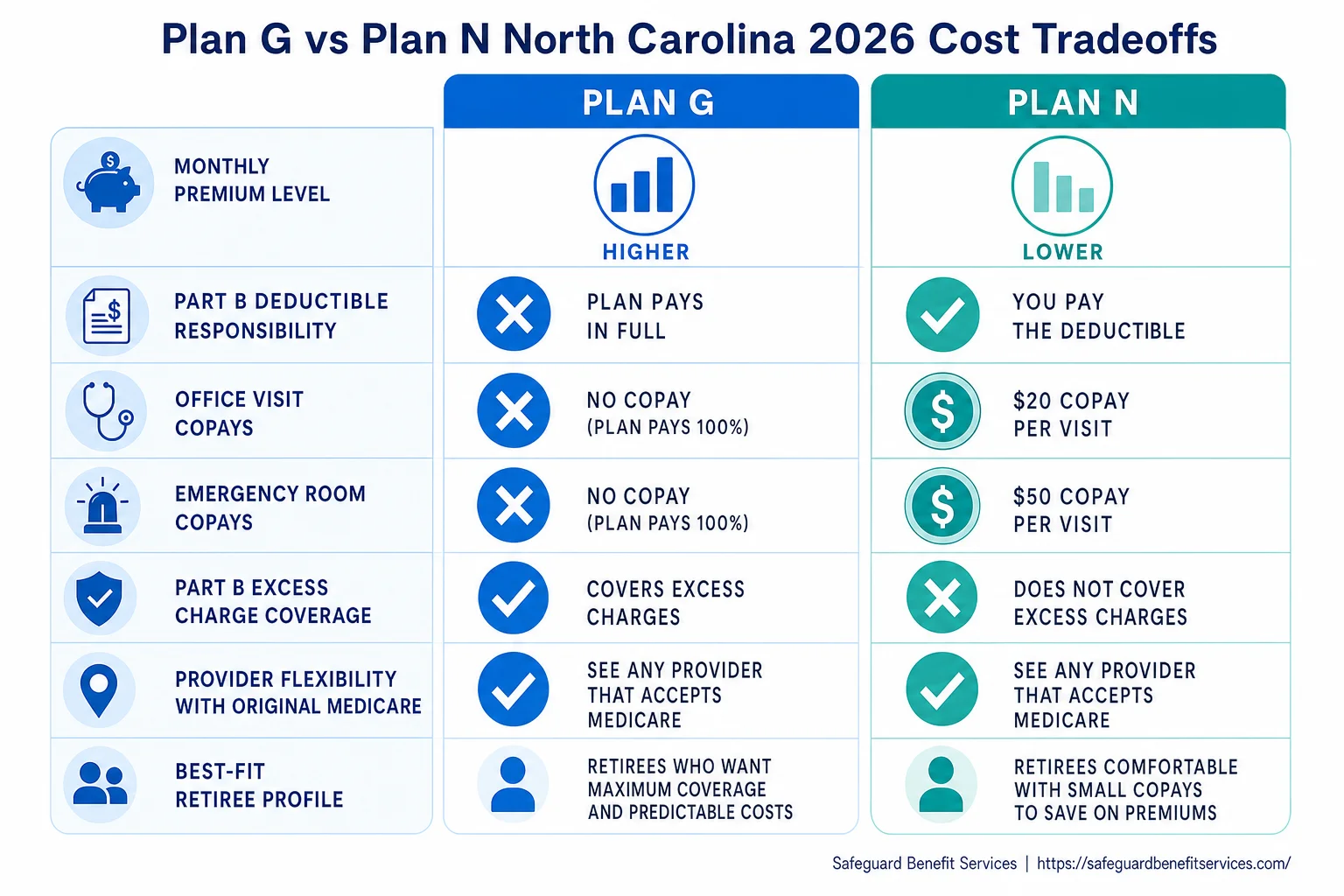
- Plan G: Covers Medicare Part B excess charges and generally leaves you responsible for the Part B deductible only.
- Plan N: Does not cover Part B excess charges and may require copays for certain office and emergency room visits.
- Both plans: Require you to stay enrolled in Original Medicare Parts A and B and pay your Part B premium.
How do Plan N office visit copays work compared with Plan G?
One of the biggest practical differences in the Plan G vs Plan N North Carolina 2026 decision is how often you expect to use outpatient care. Plan G generally pays the Part B coinsurance after you meet the annual Part B deductible, with no Plan G office visit copay.
Plan N can require a copay of up to $20 for certain office visits and up to $50 for emergency room visits that do not result in inpatient admission. These copay rules are described in Medicare.gov’s Medigap plan comparison materials and are part of the standardized Plan N design.
For a healthy retiree who sees a primary care doctor once or twice a year, Plan N’s lower premium may outweigh occasional copays. For someone managing diabetes, heart disease, arthritis, or multiple specialist visits, those copays may become more noticeable over a full year.
A practical way agents compare the two plans is to estimate annual premium savings under Plan N, then subtract expected office and emergency copays. If the premium savings remain meaningful after realistic usage, Plan N may be worth considering.
What are Medicare Part B excess charges, and why do they matter in North Carolina?
Medicare Part B excess charges can occur when a provider accepts Medicare patients but does not accept Medicare assignment. Medicare.gov explains that providers who do not accept assignment may charge up to 15% above the Medicare-approved amount for certain Part B services, unless state law limits that practice.
Plan G covers Part B excess charges. Plan N does not. This is one of the most important differences for retirees who want more predictable bills when seeing specialists, outpatient surgeons, or other Part B providers.
Many Medicare providers do accept assignment, but you should not assume every provider does. Before choosing Plan N, it is wise to ask your doctors’ billing offices whether they accept Medicare assignment, not merely whether they “take Medicare.”
In North Carolina, this question can matter for retirees who split time between cities, use out-of-area specialists, or travel frequently. You can also use Medicare.gov’s Care Compare tool and confirm directly with the provider’s office because directory information can change.

Does Plan G or Plan N offer better provider flexibility in North Carolina?
Both Plan G and Plan N preserve the broad provider flexibility of Original Medicare. Most Medigap policies do not use provider networks for covered Medicare services; however, Medicare SELECT Medigap policies, available in some states, require you to use network hospitals—and sometimes doctors—to receive full benefits, according to Medicare.gov’s Choosing a Medigap Policy. By contrast, Medicare Advantage HMO or PPO plans use provider networks. If a provider accepts Medicare, your non-SELECT Medigap policy can generally coordinate with Medicare according to the plan’s standardized benefits.
This can be especially valuable in North Carolina, where retirees may receive care across multiple systems or counties. A person living in Charlotte may see one specialist locally, visit a Duke Health or UNC Health provider for another condition, and receive urgent care while visiting family at the coast or in the mountains.
The provider flexibility is similar, but the billing exposure is not identical. With Plan G, the policy covers Part B excess charges; with Plan N, you should be more careful about confirming Medicare assignment.
This distinction is why Plan G often appeals to people who dislike bill uncertainty. Plan N may appeal to those who are comfortable asking provider billing questions and accepting limited copays in exchange for a lower premium.
How should you compare Plan G vs Plan N North Carolina 2026 premiums?
Premiums for Medigap Plan G and Plan N vary by insurance company, age, ZIP code, tobacco status, household discount eligibility, and rating method. The North Carolina Department of Insurance regulates Medicare Supplement policies sold in the state, but it does not make every carrier charge the same premium.

Plan N usually has a lower monthly premium than Plan G because it shifts some costs back to the member. However, the lowest premium is not always the best long-term value. Rate increase history, carrier financial strength, and underwriting practices also matter.
When insurance professionals compare Medigap quotes, they typically look beyond the first-month price. They review whether the carrier uses attained-age, issue-age, or other approved rating practices; whether household discounts are available; and how the company’s rate increases have behaved over time.
A helpful 2026 comparison should include:
- Your current age and Medicare Part B effective date.
- Your county or ZIP code in North Carolina.
- Your expected number of primary care and specialist visits.
- Whether your doctors accept Medicare assignment.
- Your prescription drug needs, because Medigap does not include Part D drug coverage.
- Your comfort level with copays and possible excess charges.
Who is usually a better fit for Medigap Plan G in North Carolina?
Plan G may be a better fit if you want the most predictable out-of-pocket structure available to many new Medicare beneficiaries. After you pay the annual Medicare Part B deductible, Plan G generally covers the remaining Medicare-approved Part B coinsurance and excess charges.
This can be useful for retirees who see specialists often, want fewer billing variables, or travel frequently. It may also be attractive to caregivers helping a parent choose coverage because the plan is easier to explain and track.
Plan G may be worth considering if you:
- Prefer fewer copays and less ongoing math.
- Use specialists or outpatient services regularly.
- Want coverage for Medicare Part B excess charges.
- Are willing to pay a higher premium for greater predictability.
- Want broad Original Medicare provider access without Medicare Advantage network rules.
For example, a retiree in Mecklenburg County who sees a cardiologist, dermatologist, and orthopedic specialist throughout the year may value Plan G’s predictability. The monthly premium may be higher, but fewer surprise Part B cost-sharing issues can make budgeting easier.
Who is usually a better fit for Medigap Plan N in North Carolina?
Plan N may be a better fit if you want strong standardized Medigap benefits but are willing to handle some cost-sharing. The tradeoff is straightforward: lower premium potential in exchange for office visit copays, emergency room copays in some cases, and no coverage for Part B excess charges.
This plan can work well for retirees who are healthy, see doctors infrequently, and use providers who accept Medicare assignment. It may also appeal to people who want Medigap provider flexibility but do not want to pay Plan G-level premiums.
Plan N may be worth considering if you:
- Want to reduce monthly premium costs.
- Do not mind paying occasional office visit copays.
- Are comfortable confirming Medicare assignment with providers.
- Rarely use emergency room care.
- Prefer Original Medicare plus Medigap over Medicare Advantage networks.
A practical example is a newly retired North Carolina resident with one annual wellness visit, one or two routine follow-ups, and doctors who accept assignment. In that case, Plan N’s premium savings may be more important than avoiding every possible copay.

How do enrollment timing and underwriting affect your 2026 choice?
Your best time to buy a Medigap policy is usually your Medigap Open Enrollment Period. Medicare.gov states that this six-month period begins when you are both age 65 or older and enrolled in Medicare Part B.
During this window, you generally have stronger federal protections because insurers cannot deny you a Medigap policy or charge more based on health history. After that period, you may have to answer health questions unless you qualify for a guaranteed issue right or another state-specific protection.
North Carolina residents should also check current rules with the North Carolina Department of Insurance or a licensed agent. State protections can change, and some situations may allow certain Medigap changes without full medical underwriting.
This timing matters because choosing Plan N only because it is cheaper today may not be easy to reverse later. If you later want to move from Plan N to Plan G, the insurer may be allowed to review your health history unless a protection applies.
What costs are not solved by either Plan G or Plan N?
Neither Plan G nor Plan N includes outpatient prescription drug coverage. If you choose Original Medicare with Medigap, you should also evaluate a standalone Medicare Part D plan. CMS and Medicare.gov emphasize that late enrollment in Part D can lead to a penalty if you go without creditable drug coverage.
Medigap also does not typically cover routine dental, vision, hearing aids, long-term custodial care, or private-duty nursing. Some retirees buy separate dental, vision, or hearing coverage, while others compare Medicare Advantage plans if those extra benefits are a priority.
That is why the Plan G vs Plan N North Carolina 2026 decision should not happen in isolation. Your Medigap plan, Part D plan, doctors, prescriptions, travel habits, and budget all need to work together.
What is the simplest way to decide between Plan G and Plan N?
Start with your risk preference. If you want the cleaner, more predictable option and can afford the premium, Plan G is often the easier choice. If you want to lower your monthly premium and are comfortable with copays and assignment questions, Plan N deserves a serious look.
Then compare real 2026 quotes from multiple carriers rather than relying on a generic national average. In North Carolina, two people the same age can see different pricing depending on ZIP code, tobacco status, discounts, and carrier rate filings.
A simple decision rule is this: choose Plan N only if the annual premium savings are large enough to justify the expected copays and the possibility of excess charges. Choose Plan G if predictability, specialist use, or avoiding excess-charge exposure is worth the higher monthly premium.
Safeguard Benefit Services helps North Carolina Medicare beneficiaries compare Plan G vs Plan N North Carolina 2026 options with a local, consultative approach. As an independent insurance agency serving Medicare-eligible clients in North Carolina, Safeguard Benefit Services can review standardized benefits, carrier rates, Part D needs, and provider considerations so you can choose coverage with confidence. Visit Safeguard Benefit Services at / to request personalized Medicare Supplement guidance.
This article is for informational purposes only and does not constitute financial advice. Consult a qualified professional for your specific situation.








Get Connected