

Medicare Advantage plans run on private provider networks, and that structure is the whole trade-off in one sentence: you often get lower premiums and extra perks like dental or vision coverage, but you give up some freedom to see any doctor you want. Go outside the network without checking first, and you risk paying full price or getting nothing covered at all. Networks also shift during the year, so verifying your doctors and hospitals before you enroll, and again during open enrollment, protects you from a bill you never saw coming.
TL;DR:
- Medicare Advantage networks often exclude about half of the physicians available to traditional Medicare beneficiaries in the same area, limiting access to preferred providers.
- Plan types vary in network restrictions, with HMOs requiring referrals and no out-of-network coverage, while PPOs offer flexibility at higher costs and out-of-network coinsurance.
- Out-of-network care can lead to significant balance billing and higher coinsurance, with coverage and costs varying by plan type and network status.
- Networks are not fixed, and provider drops mid-year are becoming more common, making regular verification and understanding of special enrollment options essential.
- Confirming providers and pharmacies in-network requires checking directories, calling providers directly, and understanding separate drug and healthcare networks before enrollment.
Table of Contents
- Types of Medicare Advantage Networks and How They Limit Access
- In-Network Vs. Out-of-Network: What It Actually Costs You
- How Networks Change and What Protects You
- How to Confirm a Doctor, Hospital, or Pharmacy Is In-Network
- Choosing a Medicare Advantage Plan Without Getting a Surprise Bill
- Why Provider Continuity Deserves More Attention Than Premiums
- Get a Free Medicare Roadmap Before You Enroll
- Where to Verify Networks and Rules Yourself
- Sources
Types of Medicare Advantage Networks and How They Limit Access
Not all Medicare Advantage plans restrict access the same way, and the label on the plan tells you almost everything about how much freedom you’ll have.
- HMO (Health Maintenance Organization): Requires a primary care doctor and referrals to see specialists. Care outside the network is generally not covered except emergencies.
- PPO (Preferred Provider Organization): Lets you see out-of-network providers without a referral, but you pay more for the privilege. No referrals needed for specialists.
- PFFS (Private Fee-for-Service): The plan sets payment terms, and any provider who agrees to those terms and the plan’s terms can treat you, network or not.
- SNP (Special Needs Plan): Built for people with specific chronic conditions, dual Medicare/Medicaid eligibility, or institutional care needs; networks often include specialists tied to that condition.
- MSA (Medical Savings Account): Pairs a high-deductible plan with a savings account; many MSAs allow any provider who accepts Medicare, though this format is uncommon.
If you have one steady primary care doctor and rarely need specialists, an HMO’s lower cost usually makes sense. If you’re managing several conditions and see multiple specialists across different systems, a PPO’s flexibility is worth the higher premium. Compare the HMO versus PPO trade-offs before you assume either one fits your situation.
In-Network Vs. Out-of-Network: What It Actually Costs You
The dollar gap between in-network and out-of-network care is the part most new enrollees underestimate. An in-network specialist visit might cost a modest copay. The same visit out-of-network, if your plan even covers it, could mean significantly higher coinsurance on the full billed charge, plus the provider can bill you for anything above what the plan pays. That’s called balance billing, and it can turn a routine visit into a four-figure bill.
- HMO plans: Typically zero coverage outside the network except emergencies or urgent care.
- PPO plans: Often cover out-of-network care, but at noticeably higher coinsurance and a separate, higher out-of-pocket maximum.
- PFFS plans: Coverage depends on whether the provider accepts the plan’s payment terms, network or not.
Every Medicare Advantage plan caps your annual out-of-pocket spending on in-network Part A and B services, a federally mandated protection Original Medicare doesn’t offer on its own. That cap resets each year and typically runs several thousand dollars, with a separate, higher combined limit for plans that cover out-of-network care. One detail that trips people up: Medigap policies do not work with Medicare Advantage, so if you’re leaning on a supplement to cover out-of-network gaps, it won’t apply here. Prior authorization adds another layer. Many Advantage plans require approval before covering certain procedures, imaging, or specialist referrals, and a denied authorization means you’re paying out of pocket even for in-network care.
How Networks Change and What Protects You
Provider networks are not fixed for the year, and that’s the part CMS regulation tries to manage without fully solving. Under 42 C.F.R. § 422.116, CMS requires Medicare Advantage organizations to meet network adequacy standards based on time and distance to providers and minimum specialty counts. Insurers can apply for exceptions when local provider supply falls short, and some plans get temporary credit toward those standards for offering telehealth instead of in-person access.
Despite those rules, network disruptions are becoming more common. Separations between Advantage plans and health systems, often triggered by payment disputes, rose roughly 66% over three recent years, and enforcement against plans that fall short of adequacy standards happens rarely. If your provider drops out mid-year:
- Ask your plan whether a special enrollment period applies, since CMS sometimes grants one when a network change cuts off medically necessary care.
- Call 1-800-MEDICARE for guidance if your plan won’t resolve the issue directly.
- File a formal appeal with your plan if a claim gets denied because a provider you believed was in-network turns out not to be.
How to Confirm a Doctor, Hospital, or Pharmacy Is In-Network
Skipping this step is how people end up with the balance-billing surprise described earlier. Do it in three steps.
- Check the plan’s provider directory and Medicare Plan Finder. The Medicare lets you enter up to five “must-have” providers and see which plans include all of them.
- Call the provider’s office directly and ask if they accept that specific plan, by name, not just “Medicare.” Also ask if they’re accepting new patients, since being in-network doesn’t guarantee an open panel.
- Check the Part D formulary and pharmacy network separately. Drug coverage and provider coverage run on different networks, and missing this step is a common enrollment mistake.
Pro Tip: Directories lag behind real contract changes more often than people expect. When you call a provider’s office, write down the staff member’s name and the date you called. If a billing dispute comes up later, that record makes the appeal process faster.
Choosing a Medicare Advantage Plan Without Getting a Surprise Bill
Start with your own medical reality, not the plan’s marketing brochure. Build a short list of the providers and hospitals you can’t afford to lose, then work backward from there.
- List your must-have providers: primary care doctor, key specialists, preferred hospital, and any specific pharmacy.
- Check the out-of-pocket maximum and whether out-of-network spending counts toward it or has a separate, higher cap.
- Review the plan’s history of prior authorization requirements for your specific conditions, not just in general.
- Confirm the plan includes Part D drug coverage and that your regular pharmacy is in its network.
Before you sign anything, ask the agent or plan representative these five questions:
- Is my specific doctor confirmed in-network right now, not just listed in an old directory?
- If that provider leaves mid-year, what are my options and how fast can I switch?
- Does this plan require referrals to see specialists?
- What are the prior-authorization rules for my specific health conditions?
- What’s the in-network out-of-pocket maximum, and does out-of-network spending count toward it?
If your honest answer is that you need broad provider choice or you already see out-of-network specialists regularly, that’s a real signal to look at Original Medicare paired with a Medigap policy instead. Readers managing several chronic conditions should also look at how network access affects specialist care before locking into any plan type.
Why Provider Continuity Deserves More Attention Than Premiums

Most people shopping for Medicare Advantage compare premiums and extra benefits first, and network access almost as an afterthought. That’s backward. KFF’s research found Advantage enrollees have access to roughly 48% of the physicians available to someone on traditional Medicare in the same area. That’s not a fringe statistic. It means the plan with the lowest premium in your area might exclude half the specialists you’d actually want to see.
At Safeguard Benefit Services, we walk clients through their specific provider list before we ever talk premiums, checking each doctor and hospital against a plan’s current network rather than relying on a directory that might be months out of date. Our agents complete ongoing training specifically so they understand how Charlotte-area hospital systems and provider groups contract with different Advantage carriers, because network makeup varies block by block, not just state by state. We’ve walked clients through situations where a plan looked perfect on paper until a phone call revealed their cardiologist wasn’t actually contracted for the coming year, and switching plans during the right enrollment window avoided a disruption entirely.
— Zach
Get a Free Medicare Roadmap Before You Enroll
Network research shouldn’t fall entirely on you, especially when a wrong guess can mean losing a doctor you’ve trusted for years. Safeguard Benefit Services builds a free, personalized Medicare roadmap for Charlotte-area clients that checks your specific providers against plan networks before you commit to anything.

We’re not tied to a single insurance carrier, so our recommendations are based on what actually fits your provider list and budget, not a sales quota. If you want to see whether your current doctors, hospital, and pharmacy line up with a specific Medicare Advantage plan, schedule a free consultation with our Charlotte team. We’ll walk through your provider list, check plan options for your area, and give you a straight answer, including whether you’d be better off with Original Medicare and a supplement instead.
Where to Verify Networks and Rules Yourself
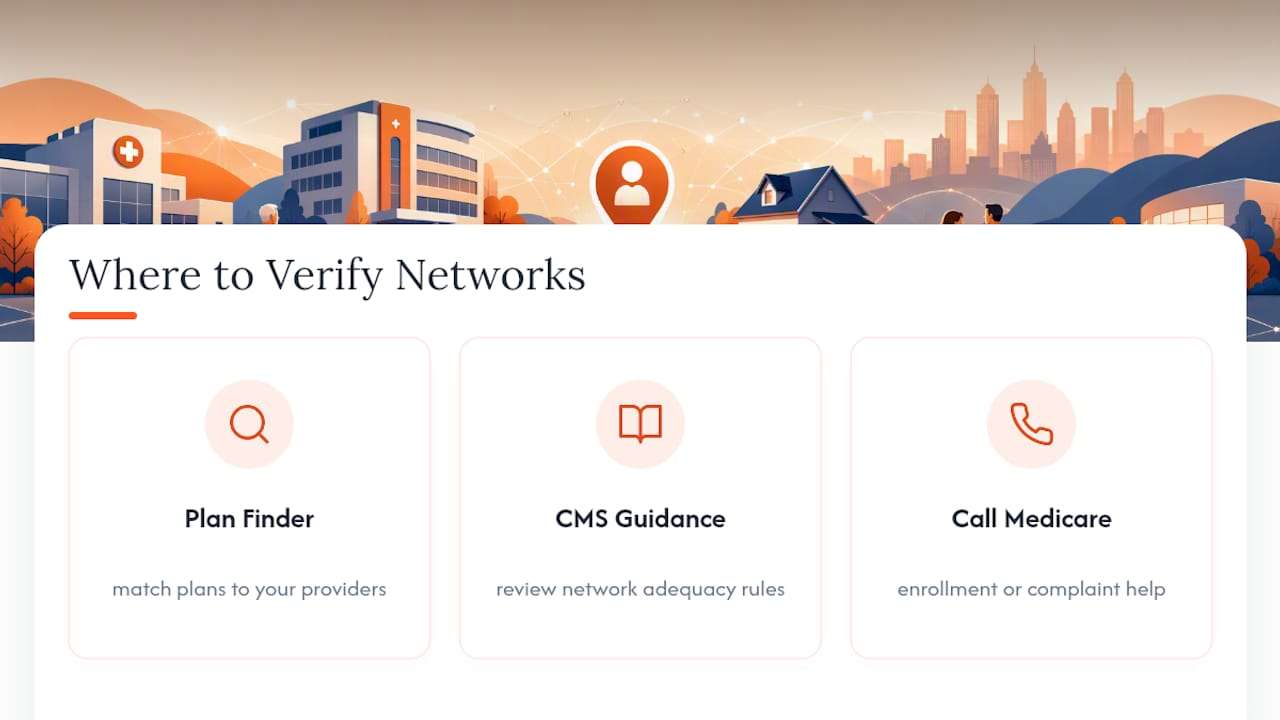
For direct lookups, use Medicare Plan Finder to match plans against your specific providers. Review CMS network adequacy guidance for the underlying rules, and call 1-800-MEDICARE for enrollment or complaint help.








Get Connected