

If you’re 65 or older and still working, the employer’s group health plan usually pays first when your employer has 20 or more employees. Fewer than 20, and Medicare typically pays first. Confirm which scenario applies with your benefits administrator before you make any enrollment decision, and keep documentation ready. If you’re unsure, the Benefits Coordination & Recovery Center (BCRC) and your local State Health Insurance Assistance Program (SHIP) can help sort it out.
TL;DR:
- Employer size significantly affects whether Medicare or the employer plan pays first, with 20 or more employees making the employer’s plan primary.
- The 8-month window to delay Medicare Part B starts after employment or coverage ends, requiring written proof to avoid penalties.
- Coverage must be creditable to prevent lifelong Part D late enrollment penalties, making annual documentation essential.
- COBRA is not considered active employer coverage for Medicare, so delaying Part B while on COBRA can lead to late enrollment penalties.
- Confirming payer order and coverage details in writing before major life events helps prevent costly claim denials and coverage gaps.
Table of Contents
- Understanding Medicare and Employer Insurance: Who Pays First
- When Can You Delay Part B Without a Penalty?
- Is Your Drug Coverage Creditable, and What Happens If It Isn’t?
- COBRA vs. Medicare: What Changes When You Sign Up
- How Claims Actually Get Paid When Two Plans Are Involved
- Your HR Conversation: Exact Questions and Documents to Bring
- How Safeguard Benefit Services Helps You Get the Order Right
- What Happens When Your Spouse’s Employer Insurance Is the One in Play
- Coordination Rules Differ for Disability Retirees Under 65
- Medicare Advantage and Working Past 65: What Actually Happens
- What the Conventional Advice Gets Wrong
- Get Your Free Medicare Roadmap From Safeguard Benefit Services
- Sources
Understanding Medicare and Employer Insurance: Who Pays First
The rule sounds simple, but the details trip up a lot of people who assume Medicare automatically takes a back seat once they turn 65. It doesn’t. Combining Medicare with employer insurance depends almost entirely on one number: how many people work for your employer.
When your employer has 20 or more employees, the group health plan is the primary payer and Medicare pays secondary, covering costs the employer plan doesn’t. When the employer has fewer than 20 employees, Medicare becomes primary and the employer plan pays second, if it pays at all. This is the core mechanic behind Medicare benefits and employer coverage, and it doesn’t change based on how good your employer plan is or how long you’ve worked there.
A few situations complicate this:
- Multi-employer plans (union trusts, associations covering several small employers) often follow the largest employer’s size, so a small company in a multi-employer plan might still have Medicare pay secondary.
- Government employers sometimes have separate coordination rules depending on the agency and plan type.
- Spousal coverage through a working spouse’s employer follows the spouse’s employer size, not yours.
- Some employer plans quietly reduce benefits for Medicare-eligible employees unless the plan document clearly designates itself as primary.
Pro Tip: Don’t rely on a verbal answer from a coworker in HR. Ask for written confirmation of your plan’s size classification and payer order. It’s the only thing that will protect you if a claim gets denied later.
When Can You Delay Part B Without a Penalty?
You generally have two windows to enroll in Medicare: your Initial Enrollment Period (the seven months around your 65th birthday) and, if you’re actively working with employer group coverage, an 8-month Special Enrollment Period (SEP) that starts the month after employment or group coverage ends, whichever comes first.
Here’s how the timeline actually plays out:
- You turn 65 while still working and covered by a qualifying employer plan. You can delay Part B with no penalty.
- You retire on, say, June 15. Your SEP clock starts July 1.
- You have 8 months from that point, until roughly the end of February the following year, to enroll in Part B without a late enrollment penalty.
- Miss that window, and you’re stuck waiting for the general enrollment period, likely facing a permanent premium surcharge.
Before that last day of work, request written proof of your employer coverage dates and a letter confirming it was a qualifying group health plan. Medicare will ask for this when you file for the SEP, and HR departments are not always fast about producing it after the fact. For a deeper walk-through of trigger events, see this Medicare enrollment guide covering initial and special enrollment scenarios.
Is Your Drug Coverage Creditable, and What Happens If It Isn’t?
Creditable prescription drug coverage means your employer’s plan pays, on average, at least as much as Medicare’s standard Part D plan. Employers offering drug benefits must send an annual notice telling you whether your coverage meets that bar, and CMS requires this disclosure regardless of company size.
The stakes are real. Anyone who goes 63 days or longer without creditable drug coverage after their initial eligibility window faces a Part D late enrollment penalty that lasts for as long as they carry Part D, added to the premium every single month.
To protect yourself:
- Request the creditable coverage notice from HR every year, even if you already have a copy from a prior year.
- Keep it in a file. You do not send it to Medicare, but you may need it later to prove continuous coverage.
- If your employer’s coverage is not creditable, don’t wait past the 63-day mark to enroll in Part D.
If you want to see what a gap actually costs, Safeguardbenefitservices built a Part D penalty calculator that runs the math based on how long you went uncovered.
COBRA vs. Medicare: What Changes When You Sign Up
This is where a lot of people get burned. COBRA is not treated as active employer coverage for Medicare purposes, which means electing COBRA does not open or extend your Special Enrollment Period. If you leave a job and pick up COBRA instead of enrolling in Part B during your initial eligibility, you can end up with a Part B late enrollment penalty you didn’t see coming.
There’s a flip side too: enrolling in Medicare can end your COBRA coverage or your dependents’ COBRA coverage, depending on the plan. COBRA typically runs 18 months, with some situations extending to 36 months, but Medicare enrollment during that period can complicate things fast.
- If you’re Medicare-eligible and offered COBRA, enroll in Part B when you’re first eligible, not later.
- Ask HR in writing how enrolling in Medicare will affect your specific COBRA or retiree plan.
- Retiree health plans generally work like small-employer coverage: Medicare pays first, and the retiree plan fills gaps.
How Claims Actually Get Paid When Two Plans Are Involved
Coordination of benefits sounds bureaucratic until a claim gets stuck between two payers and nobody covers it. Here’s the mechanic: if the primary insurer doesn’t pay a claim within a reasonable window, usually 120 days, the provider can bill Medicare directly. Medicare may issue a conditional payment, then try to recover that money later if it turns out the employer plan should have paid.
To keep this from turning into a paperwork mess:
- Notify every provider’s office that you have both Medicare and employer coverage, and give them both card numbers at every visit.
- Confirm with your plan administrator, in writing, which plan is primary.
- Follow up on any claim that sits unpaid past 60 days rather than waiting for a denial letter.
Pro Tip: If a bill lands in your mailbox that Medicare shouldn’t have paid, call the BCRC before you pay anything. Fighting a recovery request after the fact is far harder than catching it early. Your local SHIP counselor can also walk through denied or delayed claims at no cost.
Your HR Conversation: Exact Questions and Documents to Bring
Walking into a benefits conversation without a script wastes everyone’s time. Bring these three questions, worded exactly like this:
- “Is this plan considered an employer group health plan under Medicare’s coordination rules?”
- “Is this plan primary or secondary to Medicare for someone my age at this company?”
- “Is our prescription drug coverage creditable under Medicare Part D standards?”
Then request these documents before you leave:
- The plan’s Notice of Creditable Coverage (or non-creditable notice) for the current year
- A summary plan description showing employer size or group classification
- Written confirmation, email is fine, of primary/secondary payer status
Timeline-wise, do this at least two months before any planned retirement date or Medicare enrollment deadline. That gives you room to file for a Special Enrollment Period, avoid a Part D gap, and correct any mismatch before it becomes a denied claim. For step-by-step enrollment mechanics once you’ve got your answers, this Medicare enrollment walkthrough covers the filing process.
How Safeguard Benefit Services Helps You Get the Order Right
Sorting out payer order, SEP timing, and creditable coverage status is exactly the kind of paperwork Safeguardbenefitservices handles daily for clients in Charlotte and across North Carolina. A free Medicare roadmap consultation walks through your specific employer plan, verifies whether your drug coverage is creditable, and documents your SEP eligibility so nothing gets lost if you need to prove it later.
Services that directly address coordination issues:
- Verifying whether your employer plan is primary or secondary based on group size
- Reviewing creditable coverage notices to confirm you’re penalty-protected
- Documenting SEP trigger dates for your enrollment file
- Comparing Medicare Advantage and Medigap options once payer order is confirmed
Use a licensed agent when you need help choosing a plan or want someone to double check your specific situation. Use SHIP when you want free, unbiased counseling with no product recommendation attached. Both have their place, and for Charlotte-area readers, local Medicare and employer insurance guidance covers scenarios specific to the area.
What Happens When Your Spouse’s Employer Insurance Is the One in Play
Payer order isn’t just about your own job. If your spouse is still working and you’re covered under their employer plan, the coordination rules follow your spouse’s employer size, not yours or your retirement status. A 66-year-old whose spouse works for a 40-person company is in a primary-employer-plan situation, even though the retiree themselves hasn’t worked in years.
This matters for the Special Enrollment Period too. Your SEP to delay Part B without penalty is tied to your spouse’s active employment and group coverage, not your own work history. If your spouse retires or the employer drops group coverage, your SEP clock starts then, on their timeline, not yours.
The tricky part is documentation. Insurers and Medicare will want proof tied to your spouse’s employment dates and plan enrollment, not just a marriage certificate. Get the same written confirmation from your spouse’s HR department that you’d get from your own: group size, primary/secondary status, and creditable drug coverage status if you’re on their prescription plan.
One more wrinkle: if your spouse’s employer has fewer than 20 employees, Medicare pays primary for you even while your spouse is actively working there. That surprises a lot of couples who assumed employer coverage automatically wins. It doesn’t, once the headcount drops below the threshold.
Coordination Rules Differ for Disability Retirees Under 65
Medicare eligibility isn’t only about turning 65. People who qualify through disability, typically after 24 months of Social Security Disability Insurance benefits, face a different set of coordination rules while they’re also covered by an employer plan, often through a spouse’s job or their own part-time work.
For disability-based Medicare beneficiaries under 65, the employer-size threshold shifts. Instead of the 20-employee rule that applies to age-based eligibility, the relevant threshold for large group health plan coordination is generally 100 employees. If the employer has 100 or more employees, the group plan pays first. Below that, Medicare typically pays first, similar in spirit to the age-65 rule but calculated against a different headcount.
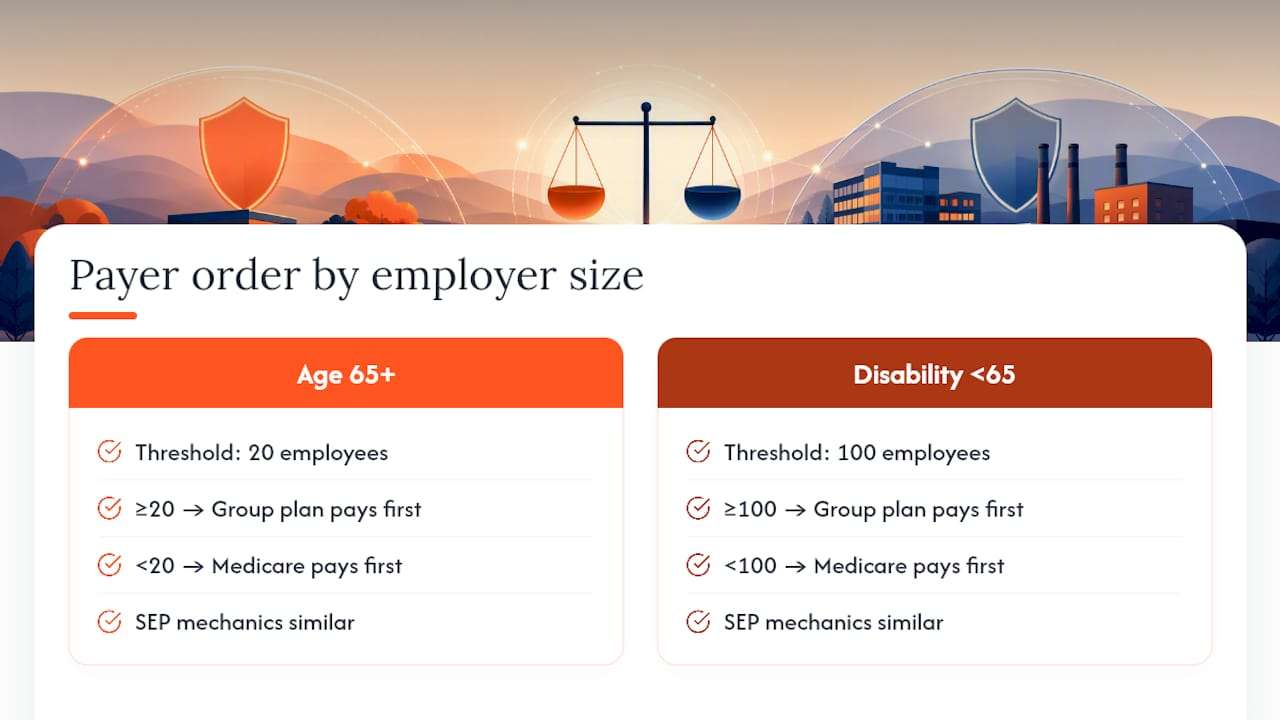
This distinction catches people off guard constantly, especially those who read general Medicare coordination material written for the 65-and-up crowd without noticing it doesn’t apply to their disability-based eligibility. If you’re under 65 and on Medicare through disability, don’t assume the 20-employee rule from earlier in this piece applies to you. Ask your HR department specifically about the 100-employee large group health plan threshold when you’re confirming payer order.
The Special Enrollment Period mechanics work similarly to the age-65 version, tied to active employment and group coverage, but eligibility windows and some COBRA interactions can play out differently depending on how you first qualified for Medicare. If your situation involves disability-based eligibility, a conversation with SHIP or a licensed agent familiar with these rules is worth the twenty minutes it takes.
Medicare Advantage and Working Past 65: What Actually Happens
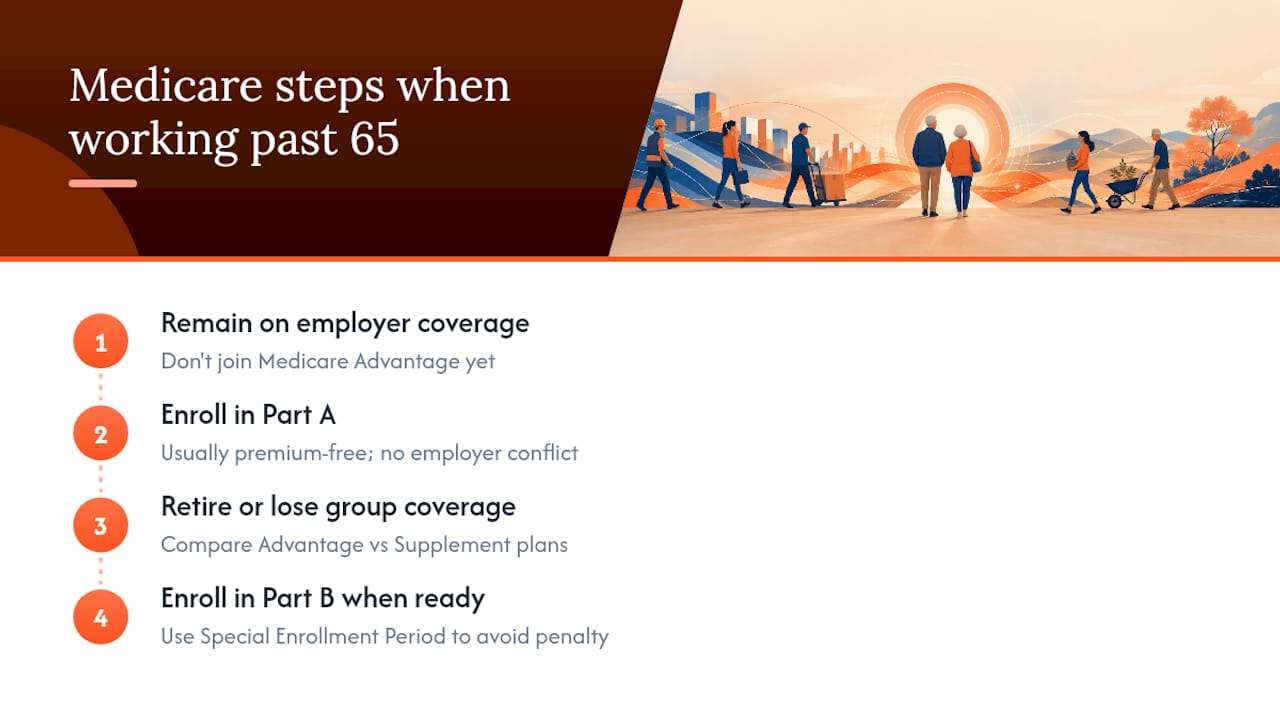
If you’re still working past 65 and have employer coverage, you generally do not need to enroll in a Medicare Advantage plan right away, and in most cases, you shouldn’t. Medicare Advantage plans (Part C) replace Original Medicare as your primary coverage, and they’re designed to work as your main plan, not as a secondary payer alongside an employer plan.
Enrolling in Medicare Advantage while you still have solid employer group coverage can create overlapping, sometimes conflicting, coverage rather than added protection. Most people in this situation are better served by enrolling in Part A (which is usually premium-free and doesn’t conflict with employer coverage) and delaying Part B and any Medicare Advantage decision until they actually leave the workforce or lose group coverage.
Once you do retire, that’s the moment to compare Medicare Advantage against Medicare Supplement plans and decide which structure fits your health needs and budget. Enrolling in Part B at that point also opens your window to choose a Medicare Advantage plan without penalty, since you’ll be using your Special Enrollment Period rather than missing your original window entirely.
One caveat worth flagging: if your employer offers a Medicare Advantage-style retiree plan as part of your benefits package once you turn 65, read the fine print carefully. These employer-sponsored Advantage plans coordinate differently than a plan you’d buy on the open market, and the primary/secondary payer rules can shift depending on how the employer structured it.
What the Conventional Advice Gets Wrong
Most guides on this topic treat the 20-employee rule like it’s the whole story, then move on. It’s not. The rule tells you who pays first in theory. It says nothing about whether your specific plan documents actually reflect that, whether your HR department has the paperwork ready when you need it, or whether your spouse’s coverage quietly overrides your own assumptions.
The bigger failure in most advice I’ve seen is treating this as a one-time decision made at 65. It’s not. It’s a running set of checkpoints: when you or your spouse changes jobs, when a company crosses the 20 or 100-employee line, when a creditable coverage notice doesn’t show up one year. Each of those moments has its own clock, and missing one can mean a lifetime penalty over what amounts to a paperwork gap.
If there’s one thing to prioritize, it’s this: get everything in writing, every year, not just once. HR turnover happens. Plan documents change. The letter you got two years ago proving creditable coverage doesn’t help you if this year’s plan changed and nobody told you.
— Zach
Get Your Free Medicare Roadmap From Safeguard Benefit Services
Safeguardbenefitservices exists for exactly the moment you’re in right now: staring at a payer-order question, a creditable coverage notice, or an SEP deadline and needing a straight answer instead of a guessing game. Unlike a generic call center, our agents walk through your specific employer plan, your spouse’s coverage if it applies, and your timeline, then hand you a written roadmap you can act on.

The free consultation covers whether your employer plan is primary or secondary, whether your drug coverage is creditable, and which enrollment window actually applies to your situation, whether that’s age-based or disability-based eligibility. It’s the kind of review that catches a missed SEP deadline before it turns into a permanent penalty.
If you’re in Charlotte or anywhere in North Carolina and want a licensed agent to sort through your specific coverage before you make a move, start with Safeguard Benefit Services and request your free Medicare roadmap today.
This article is general information, not a substitute for advice from a qualified doctor. Consult a qualified healthcare professional about your own circumstances before acting on anything here.
Sources
- Creditable coverage and late enrollment penalty | CMS
- How Medicare works with other insurance | Medicare








Get Connected