

Most people turning 65 assume they can hold off on a Medicare drug plan until they actually need one. That assumption costs them money, sometimes permanently. The Medicare Part D penalty is not a one-time fine you pay and move on from. It is a permanent monthly surcharge added to your drug plan premium for as long as you have Medicare coverage. Every month you wait past your enrollment window, the penalty grows. By the time many people in Charlotte and across North Carolina finally call an agent, they have already locked themselves into a penalty that will follow them for the rest of their lives. Here is exactly how the penalty works and what you can do to prevent it.
Table of Contents
- What Is the Medicare Part D Penalty?
- How the Penalty Is Calculated
- Creditable Coverage: The One Thing That Saves You
- Enrollment Windows You Must Know
- Penalty Comparison: Waiting vs. Enrolling Early
- How to Appeal or Waive a Part D Penalty
- Frequently Asked Questions
- References
What Is the Medicare Part D Penalty?
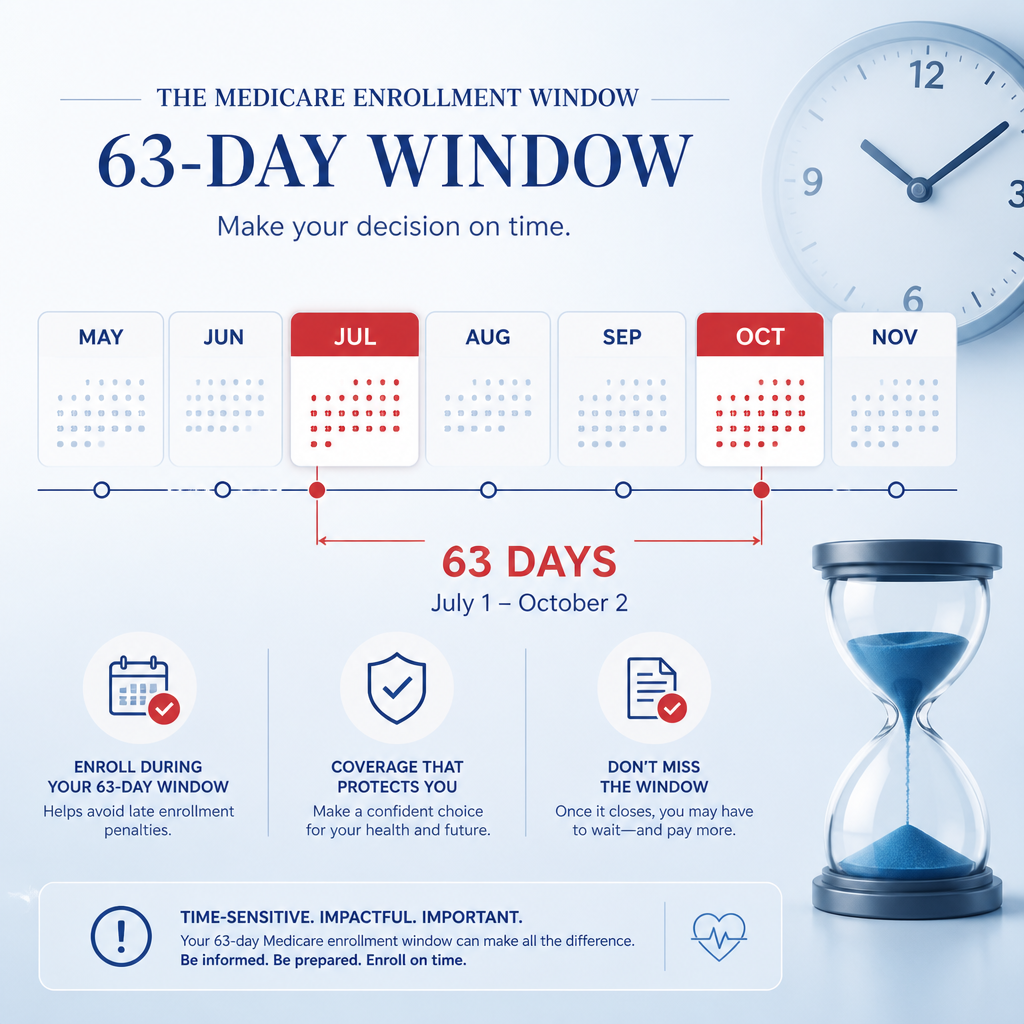
The Part D late enrollment penalty is a permanent surcharge added to your monthly Medicare drug plan premium if you go 63 or more consecutive days without creditable prescription drug coverage after first becoming eligible for Medicare Part D. The keyword is “consecutive.” A single 63-day gap is enough to trigger it.
Unlike some mistakes in life, this one does not expire. The penalty stays on your bill for as long as you are enrolled in any Medicare drug plan. Switching plans does not reset or remove it. The penalty travels with you from plan to plan and recalculates every year, which means the dollar amount you owe can actually increase over time even without any new violations on your record.
This is not a bureaucratic technicality that rarely affects real people. It catches a surprising number of individuals who delayed enrollment because they felt healthy, because they thought their retiree coverage was good enough, or simply because no one explained the 63-day rule to them clearly.

How the Penalty Is Calculated
The formula is straightforward. The penalty equals 1% of the national base beneficiary premium for each full month you were eligible for Part D but went without creditable coverage. That percentage is then multiplied by the national base beneficiary premium for that year, rounded to the nearest $0.10, and added to your monthly Part D premium.
For 2026, the national base beneficiary premium is $38.99. So a single month of uncovered eligibility costs you roughly $0.39 per month, forever. That sounds small, but it compounds quickly.
A Real-World Example
Here is how the numbers play out on a real case. A person becomes eligible for Medicare in May 2022 and does not enroll in any drug plan or maintain other creditable coverage. They finally enroll during the Annual Enrollment Period, with coverage starting January 1, 2026. That is 43 months of uncovered time. Their penalty is 43% of $38.99, which comes out to approximately $16.76, rounded to $16.80 per month. That $16.80 is added to their drug plan premium every single month, and will be recalculated upward if the base premium rises in future years.
The Penalty Recalculates Every Year
This is the detail that surprises people most. The percentage of your penalty is locked in once Medicare determines your months of uncovered eligibility. But the dollar amount fluctuates because it is always applied against the current year’s national base beneficiary premium. When that premium rises, your penalty amount rises too, even though you did nothing new to deserve it. Over a decade of retirement, the cumulative cost of even a modest penalty adds up to hundreds or thousands of dollars.
Pro tip: Request a low-premium Part D plan now, even if you currently take no prescription drugs. A plan that costs around $10 to $15 per month locks in your enrollment and permanently eliminates your exposure to the late enrollment penalty. That is almost always cheaper than the penalty itself.
Creditable Coverage: The One Thing That Saves You
The penalty only applies to months where you had neither a Medicare Part D plan nor other creditable prescription drug coverage. Creditable coverage means drug coverage that is at least as good as Medicare’s standard Part D benefit. If you have qualifying coverage, those months count as “covered” and are excluded from your penalty calculation.
What Counts as Creditable Coverage
Common sources of creditable drug coverage include employer or union prescription drug plans, coverage through the Department of Veterans Affairs (VA), TRICARE (for military personnel, retirees, and their dependents), the Federal Employees Health Benefits (FEHB) program, and the Indian Health Service.
Not every employer drug plan automatically qualifies. Your plan sponsor is required by law to notify you in writing before October 15 each year whether your coverage is creditable. Do not assume it is. Keep every creditable coverage notice you receive. These notices are the proof Medicare needs if your record is ever questioned, and without them, an appeal becomes much harder to win.
What Does NOT Count
Coverage that typically does not qualify as creditable for Part D purposes includes most individual health insurance plans that are not specifically designed to meet Medicare’s drug coverage standards, discount cards, and certain limited benefit plans. If you are relying on a plan that might be borderline, call the plan administrator and ask directly whether it is certified as creditable for Medicare Part D purposes. Get that answer in writing.
A common mistake made by people approaching 65 in the Charlotte area and across North Carolina is assuming that a working spouse’s employer plan automatically covers them adequately and indefinitely. It often does, but the plan must be verified as creditable, and you must enroll in Part D within 63 days of losing that coverage when it ends.

Enrollment Windows You Must Know
Avoiding the Medicare drug plan penalty Charlotte residents worry about starts with understanding exactly when you are allowed to enroll without consequences. There are three main enrollment periods that matter here.
Initial Enrollment Period
Your Initial Enrollment Period (IEP) is the seven-month window centered on your 65th birthday: three months before the month you turn 65, the birthday month itself, and three months after. This is your cleanest opportunity to enroll in Part D without any penalty risk. Miss this window without having creditable coverage in place, and the clock starts ticking toward a penalty.
Special Enrollment Period
If you are covered by a creditable employer or union plan while working (or through a working spouse), you can delay Part D without penalty. When that coverage ends, you have a Special Enrollment Period (SEP) of 63 days to enroll in a Part D plan without triggering a penalty. The 63-day countdown begins the day your creditable coverage ends, not the day you receive notice of termination.
This is where people get tripped up. Retirement does not always align cleanly with the calendar. If your employer coverage ends mid-month and you are not prepared with a Part D plan, those days start counting immediately.
Annual Enrollment Period
The Annual Enrollment Period runs from October 15 to December 7 each year. This is the standard window to join, switch, or drop a Part D plan, with coverage beginning January 1 of the following year. If you are already past your IEP and do not have a special enrollment situation, this is when you can finally enroll, but you will owe a penalty for every full month of uncovered eligibility in the interim.
Missing your Medicare Part D enrollment window is not a paperwork problem. It is a financial problem that compounds monthly, recalculates annually, and stays with you for the rest of your coverage. The 63-day grace period is not a generous buffer. It is a hard deadline.
Penalty Comparison: Waiting vs. Enrolling Early
The table below illustrates the real cost difference between enrolling on time, waiting one year, and waiting two years. These calculations use the 2026 national base beneficiary premium of $38.99.
| Scenario | Months Without Coverage | Monthly Penalty Added (Based on 2026 Premium) |
|---|---|---|
| Enrolled on time during IEP | 0 months | $0.00 |
| Delayed enrollment by 12 months | 12 months | ~$4.68/month (permanent) |
| Delayed enrollment by 24 months | 24 months | ~$9.36/month (permanent) |
| Delayed enrollment by 43 months | 43 months | ~$16.80/month (permanent) |
The dollar amounts look modest on their own. But remember, this is a lifetime charge. A $9.36 monthly penalty paid over 20 years of retirement equals over $2,200 in total extra costs, not counting the upward recalculations that occur when the base premium rises.
Pro tip: If you are turning 65 and currently do not take any prescription drugs, enroll in the lowest-cost Part D plan available in your area. Pay a few dollars a month now to lock in zero-penalty enrollment. Do not wait until you have a health event that suddenly makes drug coverage urgent, because at that point you will be paying both the drugs and the penalty.
How to Appeal or Waive a Part D Penalty
If you have already been assessed a Part D late enrollment penalty, you are not necessarily stuck with it. There are specific circumstances under which the penalty can be waived, reduced, or appealed, but the window to act is narrow and the documentation requirements are strict.
Qualifying for Extra Help
If your income and resources fall within federal limits, you may qualify for the Extra Help program (also called the Low-Income Subsidy, or LIS). When you qualify for Extra Help, your Part D late enrollment penalty is completely waived and removed from your monthly bill automatically. For 2025, the Extra Help income limit was $23,475 for individuals and $31,725 for married couples. These thresholds adjust each year, so it is worth checking current eligibility even if you were told you did not qualify previously.
Filing a Formal Reconsideration
If you believe Medicare made an error, such as failing to credit months where you had legitimate creditable coverage, or if you were given incorrect enrollment information by a federal employee, you can file a reconsideration request. You typically have 60 days from the date of the penalty determination to file. Send documentation of your creditable coverage, such as the annual creditable coverage notice from your employer, alongside your appeal. Without documentation, appeals rarely succeed.
The Independent Review Process
If your initial reconsideration is denied, you can escalate. An Independent Review Entity (IRE), which is an outside organization not affiliated with your plan, can conduct a second review. The IRE operates on the same 60-day window from the Level 1 denial. If the dispute involves a sufficient dollar amount, further escalation to an Administrative Law Judge is also possible. Most penalties are resolved at Level 1 or Level 2, but having a knowledgeable advisor in your corner at the start makes the documentation process significantly less daunting.
The agents at Safeguard Benefit Services in Charlotte regularly help clients untangle Part D penalty situations, gather creditable coverage documentation, and understand which appeals pathway fits their circumstances. A free consultation can clarify in minutes whether you have grounds for an appeal that you might not have known existed. You can learn more about their Medicare Part D guidance and review coverage options from the 30-plus carriers they work with.
Frequently Asked Questions
What triggers the Medicare Part D late enrollment penalty?
The penalty is triggered when you go 63 or more consecutive days without creditable prescription drug coverage after first becoming eligible for Medicare Part D. This typically begins at age 65, though people who receive Medicare due to disability may become eligible earlier. Every full month of uncovered eligibility adds 1% to your permanent penalty percentage.
Does the Part D penalty ever go away on its own?
No. The penalty is permanent for as long as you have Medicare drug coverage. Switching to a different Part D plan does not eliminate or reduce it. The only ways to remove a penalty are qualifying for the Extra Help program or successfully winning a formal reconsideration appeal with documented proof of creditable coverage or an administrative error.
My employer drug plan ended. How long do I have before the penalty kicks in?
You have exactly 63 days from the date your employer or union creditable coverage ends to enroll in a Medicare Part D plan through a Special Enrollment Period. If you enroll within that window, no penalty applies. If you miss it by even a single day past the 63-day mark, Medicare counts that entire gap, starting from when you first became Part D-eligible, not just the recent gap.
Can I avoid the penalty if I do not take any prescription drugs right now?
Not being on medications does not exempt you from the penalty. Medicare does not grant a health-status exception. The penalty is based on enrollment behavior, not drug use. The standard guidance is to enroll in a low-premium Part D plan during your Initial Enrollment Period regardless of your current health status. The cost of a minimal plan is almost always less than the permanent penalty that results from skipping enrollment.
What documentation do I need to prove creditable coverage if I appeal?
The most useful document is the annual creditable coverage notice your employer, union, VA, or other plan sponsor is required to send you before October 15 each year. This notice explicitly states whether your coverage meets Medicare’s standard. Keep these letters every year. If you no longer have them, contact your former employer’s HR department or benefits administrator and request written confirmation of your coverage dates and creditable status. Submit copies, not originals, with any appeal you file.
Is the Part D penalty the same every year?
The penalty percentage is fixed once determined, based on your months without coverage. However, the actual dollar amount you pay can change each year because it is recalculated annually against the current national base beneficiary premium. If that premium increases, so does the dollar amount of your penalty, even though you did nothing new to trigger it. This means a penalty assessed today could cost more per month in five or ten years than it does now.
If you have already been hit with a Part D penalty or you are approaching 65 and unsure whether your current drug coverage qualifies as creditable, share your situation in the comments below. The more specific you are about your circumstances, the more useful the conversation becomes for others who are in the same position.
References
- Medicare.gov: Official explanation of the Part D late enrollment penalty and how it is calculated
- National Council on Aging: Guide to understanding and avoiding the Medicare Part D penalty
- MedicareFAQ: How creditable coverage works and what happens if you miss the enrollment window
- MedicareFAQ: Pathways to having the Part D late enrollment penalty waived or reduced
- U.S. News and World Report: Overview of the Medicare Part D penalty, creditable coverage, and how to appeal








Get Connected